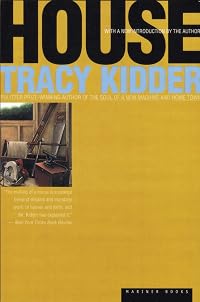
House
by Tracy Kidder
On This Page
Description
The Pulitzer Prize–winning author brings "clarity, intelligence and grace" to the tale of building a home in this New York Times Bestseller (TheNew York Times Book Review).It's 1983 and Jonathan and Judith Souweine are ready to build their forever home on a four-acre lot just outside of Amherst, Massachusetts. A lawyer and a psychologist, neither has much experience with the process. In this New York Times bestseller, Tracy Kidder leads readers through the grand adventure of building the show more American dream.
In his portrayal, constructing a staircase or applying a coat of paint becomes a riveting tale of conflicting wills, the strength and strain of relationships, and pride in craftsmanship. With drama, sensitivity, and insight, the Pulitzer Prize-winning author of The Soul of the New Machine takes us from blueprints to moving day. In the process, he sheds new light on objects usually taken for granted and creates a vivid cast of characters you will not soon forget.
"Tracy Kidder has done it again. . . . What might seem like ordinary work takes on an extraordinary, unpredictable life of its own. The subject is fascinating, the book a remarkable piece of craftsmanship in itself." —Chicago Tribune Book World
"Kidder makes us feel with a splendid intensity the complex web of relationships and emotions that inevitably comes into play in the act of bringing a work of architecture to fruition." —The New York Times Book Review
. show less
Tags
Recommendations

















Member Reviews
As someone who has built [is still building] a house and who is married to a carpenter, I found the book a little too flashback-triggering to be fully enjoyable. I actually started having heart palpitations during one of the homeowner/builder fights over the contract. BUT, that aside, this is truly brilliant in a classic creative nonfiction way. Kidder takes a subject that seems completely mundane and imbues is with history, drama, and human intrigue.
Tracy Kidder is a master of nonfiction writing. I’ve read most of what he has written including what I consider to be his masterpiece, “Soul of a New Machine.” “House” is as entertaining and insightful as any of Kidder’s books. It gave me a new appreciation for those who work with their hands. Over the years I’ve had many people in my houses doing various types of repairs and constructions. I’ve always respected their skill, but I don’t think I knew much about their spirit until I read “House.” I once told a plumber, “You know, Earl, what you do is amazing. What I do (teaching high school English) is nothing.” He looked at me with a quizzical look. I said, “If I don’t show up, they’ll find another person show more with an English degree to do what I do. If you don’t show up, people can’t flush their toilet. Now, you tell me who is more important?” He grinned and went on fixing the drain he was working on.
I have the same kind of respect for Tracy Kidder. Lots of people can write. Many of them can write well. Tracy Kidder writes the way the building crew in “House” worked: with spirit, precision, and soul. show less
I have the same kind of respect for Tracy Kidder. Lots of people can write. Many of them can write well. Tracy Kidder writes the way the building crew in “House” worked: with spirit, precision, and soul. show less
I think this book is wonderful. It gives an insight and expresses an appreciation for those in the building trade -- many of whom are extremely bright, talented. and quite often underappreciated.
The characters in this book are so lifelike; the conversations so real. I can feel the tension in the air between Jim (the builder and lead carpenter), Bill (the architect), and Jonathan and Judith Souweine (the owners). The workers are great, too. Their comments are snide and funny. I often hear stories from my husband in his concrete business of how an architect’s plans are not always practical or realistic when construction actually takes place. I love seeing how this situation plays out in the book.
SPOILER--> I really felt for the show more builders when their profit was disappointingly small in the end. Kidder not only captured the nuances of interpersonal relations between those involved in all aspects of the house’s construction, but also the very essence of each character’s personality. show less
The characters in this book are so lifelike; the conversations so real. I can feel the tension in the air between Jim (the builder and lead carpenter), Bill (the architect), and Jonathan and Judith Souweine (the owners). The workers are great, too. Their comments are snide and funny. I often hear stories from my husband in his concrete business of how an architect’s plans are not always practical or realistic when construction actually takes place. I love seeing how this situation plays out in the book.
SPOILER--> I really felt for the show more builders when their profit was disappointingly small in the end. Kidder not only captured the nuances of interpersonal relations between those involved in all aspects of the house’s construction, but also the very essence of each character’s personality. show less
In this one, Kidder, a standout author in the field of creative nonfiction, tells the story of a house's of construction from design to completion. His steady, articulate narrative voice is, as usual, a pleasure to read. Kidder also works hard to understand the perspectives of everyone involved with the homebuiding process and takes the time to explain the finer points of home construction to readers who've never swung a hammer before. He even takes the time to provide a historical account how the craft and the role of the builder have evolved over time and to trace the origins of some of the trade's superstitions. "House" is also notable because it treats the social and economic divides between the various protagonists – builders, show more architects, and clients – in an intelligent and prescient way. The builders working on the house come from diverse backgrounds, but they aspire to be craftsmen very much in the old tradition. The clients they're building for are members of an emerging set of wealthy, highly-educated professionals that are new to western Massachusetts. While their personalities and their economic interests often clash, the emotional heart of this book lies in the carpenters' struggle to balance the demands of fine construction against the economic pressures they feel. "House" is, at base, a story of art versus commerce, one of the oldest ones there is, and Kidder, as usual, tells it well. This book's subject matter, and, to some extent, the personalities involved, aren't as immediately captivating as his better-known "Mountains Beyond Mountains," but this one's still very much worth reading. Construction's usually talked about as a trade, but this book might convince some readers that it should be regarded it as a craft, or perhaps even an art. show less
“The art of civilization is the act of drawing lines.” – Oliver Wendell Holmes
In [House], we follow the process of building a typical architect-designed American home from initial design phases to construction. Now, as an architect, this book drove me crazy. The clients give a friend who is an architect his first commission. The contractor starts working without a contract. The architect does most of the design after the start of construction and then gets upset about changes that happen. The clients force the contractor to reduce the total contract price by $660 (psst…if you do this to a contractor at the start of a job, they aren’t going to be very willing to take care of little things that come up during the course of show more construction). So, I spent a good bit of my reading time variously cursing under my breath and throwing the book across the room. I had to put it down for several weeks during which work was very stressful for me, and this was only exacerbating it. However, if you are not in the industry I would actually recommend it highly – especially if you are planning on doing any construction/working with an architect. While I didn’t enjoy reading [House], I do think it is a very good book.
The book was originally published in 1985, which makes for some interesting foreshadowing of our current housing predicament. For instance, when speaking about borrowing the money for the construction, the wife comments “It’s us against the world, you know.” I think this kind of attitude is part of what got us here. The idea that as an American you are owed a new home by right and any builder/bank/city zoning ordinance that stands in your way is somehow infringing on this right somehow replaced the idea of a new home as a luxury.
Another interesting sort of side issue for me is the New Englandness of the parties involved. It’s amazing to me how attitudes and personalities vary over regions which is something I never really noticed as much until I moved. show less
In [House], we follow the process of building a typical architect-designed American home from initial design phases to construction. Now, as an architect, this book drove me crazy. The clients give a friend who is an architect his first commission. The contractor starts working without a contract. The architect does most of the design after the start of construction and then gets upset about changes that happen. The clients force the contractor to reduce the total contract price by $660 (psst…if you do this to a contractor at the start of a job, they aren’t going to be very willing to take care of little things that come up during the course of show more construction). So, I spent a good bit of my reading time variously cursing under my breath and throwing the book across the room. I had to put it down for several weeks during which work was very stressful for me, and this was only exacerbating it. However, if you are not in the industry I would actually recommend it highly – especially if you are planning on doing any construction/working with an architect. While I didn’t enjoy reading [House], I do think it is a very good book.
The book was originally published in 1985, which makes for some interesting foreshadowing of our current housing predicament. For instance, when speaking about borrowing the money for the construction, the wife comments “It’s us against the world, you know.” I think this kind of attitude is part of what got us here. The idea that as an American you are owed a new home by right and any builder/bank/city zoning ordinance that stands in your way is somehow infringing on this right somehow replaced the idea of a new home as a luxury.
Another interesting sort of side issue for me is the New Englandness of the parties involved. It’s amazing to me how attitudes and personalities vary over regions which is something I never really noticed as much until I moved. show less
Probably the best book that will ever be written about the building of a house. Not "building" a house as in a how-to-do-it guide, but "the building" of a house as a process of personalities, philosophies, histories, trends, class status, power, and economics. Mostly, personalities. As a contractor I read it with a sense of recognition and as a writer I read it with admiration and awe. Jim, the contractor in this project, seemed like a clone of my own personality - the drive for quality, the disdain for haggling, the over-sensitivity to the slightest insults of class warfare that seem to come with the job. I recognized all the carpenters in the crew - Vietnam vets, college grads, the likable kid clawing his way out of poverty, the show more equally likable one rejecting his father's bourgeois life, the dyslexic, the screwup, the perfectionist, the speedster - mix and match - and became very fond of them. But Tracy Kidder brought so much more than just the carpenters' points of view. He followed the thoughts and actions of Bill Rawn, the architect, who I came to admire. And Kidder described equally the drama of the house-building from the clients' point of view. I never warmed to Jonathan Souweine, the attorney husband, as he used his advantages and self-justifications to beat down the price, completely oblivious of the demoralizing effect it had on the workers. Meanwhile I liked Judith, Jonathan's wife. The fact that I reacted so strongly to each of the characters in this project shows how well Tracy Kidder described them. I'm not an objective reviewer here; I'm somebody who has lived through most of the scenes that he portrays. House, the book, is about the birth of one particular house, a birth filled with drama, conflict, history and hard work. show less
This is a really wonderfully told story. The writing is simple and straightforward, but really evocative of place and emotion. I will say, though, I’ve read this book several times, and every time it succeeds in pissing me off. I get so frustrated with the builders, and the clients, and even with the architect. That’s what I get for reading books that hit so close to home! But I can’t deny that this is a really good book.
http://archthinking.blogspot.com/2009/05/review-house.html
http://archthinking.blogspot.com/2009/05/review-house.html
Members
- Recently Added By
Author Information

14+ Works 14,899 Members
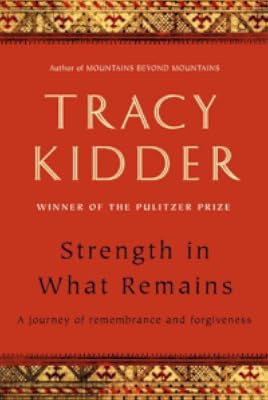
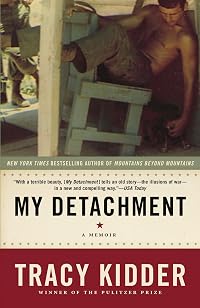
Tracy Kidder was educated at the University of Iowa and Harvard University. He served in the US Army in Vietnam. Kidder has garnered numerous literary awards including the Pulitzer Prize in General Non-Fiction and the National Book Award for General Nonfiction both in 1982. He has also been honored with the Robert F. Kennedy Book Award, 1990 and show more the Christopher Award, 1990. His publications include numerous nonfiction articles and short fiction for The Atlantic and other periodicals. Non-Fiction books include The Road to Yuba City, Doubleday, 1974; The Soul of a New Machine, Atlantic Monthly-Little Brown, 1981 for which he won a Pulitzer and a National Book Award; House, Houghton Mifflin, 1985; Old Friends, Houghton Mifflin, 1993; Home Town, Random House, 1999; Mountains Beyond Mountains, Random House, 2003; My Detachment, Random House, 2005; Strength in What Remains, Random House, 2009. (Bowker Author Biography) show less
Awards and Honors
Series
Belongs to Publisher Series
Avon (70176)
Common Knowledge
- Original publication date
- 1985
- Dedication
- For
FRANCES TOLAND KIDDER - First words
- Jim Locke sets gently on the undisturbed earth a mahogany box, opens it, and takes out his transit, which looks like a spyglass.
[Epilogue] The Boston Society of Architects annually confers award for buildings that have been designed by local firms and erected outside the city and its suburbs. - Last words
- (Click to show. Warning: May contain spoilers.)"This is my best pose right here," he explains. "When I'm swingin' my hammer."
(Click to show. Warning: May contain spoilers.)[Epilogue] All were contract jobs, and Jim wasn't nervous about any of them.
Classifications
- Genres
- Nonfiction, General Nonfiction, Biography & Memoir, Art & Design
- DDC/MDS
- 690.837 — Applied science & technology Buildings Construction of buildings Residential and related buildings Specific kinds of conventional housing Separate houses, detached; cottages
- LCC
- TH4811 .K48 — Technology Building construction Building construction Buildings: Construction with reference to use
- BISAC
Statistics
- Members
- 1,207
- Popularity
- 20,607
- Reviews
- 20
- Rating
- (3.86)
- Languages
- English
- Media
- Paper, Audiobook, Ebook
- ISBNs
- 12
- UPCs
- 1
- ASINs
- 13