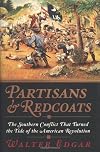
Partisans and Redcoats: The Southern Conflict That Turned the Tide of the American Revolution
by Walter B. Edgar
On This Page
Description
Recounts South Carolina's role during the Revolutionary War, describing the British occupation of Charleston, the brutal massacre of innocent civilians throughout the Carolina backcountry, and the desperate struggle of patriots against overwhelming forces.Tags
Recommendations






Member Reviews
This brief history nevertheless manages to add significant insights to the American Revolution and the war which accompanied it. Most histories of the Revolutionary War focus on the northern colonies, as this is where Washington and his army spent much of the war. Yet, conflict was also unfolding in the southern colonies, conflict that could be characterized as both disorganized and brutal. I was struck by many of the stories recounted in this book - of a disabled man who could not fight and so instead became an American spy, of women who passed messages to men who were eluding British soldiers, and others. In addition, this book was also a local history, grounded in a particular place and the people who considered that place home, show more making for fascinating connections between the local and national aspects of history. Overall, a readable account of a significant part of the American Revolution which deserves more attention. show less
The American Revolution in back country South Carolina in a word: ugly. The British essentially had the war won after the capture of Charleston on May 12, 1780. There were no Continental troops left in the colony; all were POWs. All the civilian males and militia had been paroled and returned to their homes; every organized town had surrendered and had a British garrison. Then General Henry Clinton unilaterally abrogated the surrender agreement. All parolees now had 17 days to sign a loyalty oath – with the understanding that they would now take up arms against the King’s enemies, i.e., their neighbors – or be considered “King’s Enemies” themselves. This was enforced brutally, with a massacre at the Waxhaws by Banastre show more Tarleton’s British Legion and raiding parties burning the houses of prominent citizens James Simpson, William Hill, and Thomas Sumpter. In a short time, South Carolina was in revolt again.
Author Walter Edgar makes it a constant theme that most of the fighting and almost all the atrocity was inflicted by Americans on each other. Tarleton’s Legion was mostly Pennsylvanians, and Christian Huck, one of the most ardent farm burners, was a Philadelphia lawyer. Damnyankees. This leads to one of the major flaws in an otherwise excellent book; Edgar doesn’t use consistent terms to describe the sides. He’s justifiably reluctant to make it a war between “Americans” and “British”, so it becomes a war between “British” (meaning Royal Army regulars) and “Tories” (meaning Americans supporting the British) and “Whigs” (meaning Americans fighting the British and Tories) except sometimes there are “partisans” (always meaning Americans fighting the British) and “loyalists” (unfortunately, sometimes meaning Americans loyal to the Crown and sometimes Americans loyal to the Revolution). Well, they were confused back then, too.
Most of the British allies were large planters from the coast – they had the most to lose, after all. Neither they nor the British thought very much of the backcountry people they were fighting – they “Live in Logg Cabins like Hogs – and their Living and Behavior as rude or more so than the Savages”. Unfortunately, those are exactly the kind of people you don’t want standing behind a tree with a deer rifle, about to behave rudely or more so toward you. There was also, interestingly enough, a good deal of religious prejudice; the coastal people were Church of England while the backcountry was Presbyterian with a scattering of Baptists. Even before the Revolution, there had been trouble – more “rude behavior” - when Anglican ministers showed up in the woods and tried to take over churches. Several of the partisan leaders were Presbyterian ministers.
Contempt for your enemies is usually not a good idea, as the aforementioned Captain Huck learned when he took two bullets in the head during one of his farm-burning expeditions (Edgar notes that many of the Tories with Huck fled into the woods and were later found dead). “Huck’s Defeat” lead to a long series of battles – Edgar lists 27 – culminating in Cowpens in January 1781 (Cowpens involved Continental regulars under Nathaniel Greene in addition to partisans). Cornwallis left the state to pursue Greene after Cowpens; Charleston remained British controlled but they had no presence outside the city.
Although Cowpens was the last battle, Edgar (and Sir Henry Clinton) holds King’s Mountain was the decisive one. This was entirely a partisan affair on the American side, with a mix of British regulars and American Tories under Colonel Patrick Ferguson (inventor of the Ferguson rifle) on the other. Ferguson’s skill as a rifleman didn’t do him much good – he was hit 11 times. King’s Mountain was another brutal battle, with American partisans cheerfully calling out to their besieged Tory neighbors, getting their attention, and then shooting them.
When the movie The Patriot came out, there were howls of outrage from across the Atlantic over the portrayed brutal behavior of the British. To a certain extent, the outrage was justified; Colonel William Tavington in the film is based on Banastre Tarleton in reality, and Tarleton really did lead a band of brutal butchers. Unfortunately, as Edgar’s book makes clear, they were home-grown American butchers. (I note there was also outrage – I heard people gasp in the theater where I saw the film – on this side of the Atlantic when the Benjamin Martin character (presumable supposed to be Sumpter or Francis Marion or one of the other partisan fighters) not only lets his children handle guns, he lets them shoot them at people. The retroactive application of political correctness is both funny and sad.
Yet another recommended book, as long as you keep track of who’s who. A nice chronology, references, and capsule biographies of the participants at the end. Yet another bunch of places I’d like to visit. show less
Author Walter Edgar makes it a constant theme that most of the fighting and almost all the atrocity was inflicted by Americans on each other. Tarleton’s Legion was mostly Pennsylvanians, and Christian Huck, one of the most ardent farm burners, was a Philadelphia lawyer. Damnyankees. This leads to one of the major flaws in an otherwise excellent book; Edgar doesn’t use consistent terms to describe the sides. He’s justifiably reluctant to make it a war between “Americans” and “British”, so it becomes a war between “British” (meaning Royal Army regulars) and “Tories” (meaning Americans supporting the British) and “Whigs” (meaning Americans fighting the British and Tories) except sometimes there are “partisans” (always meaning Americans fighting the British) and “loyalists” (unfortunately, sometimes meaning Americans loyal to the Crown and sometimes Americans loyal to the Revolution). Well, they were confused back then, too.
Most of the British allies were large planters from the coast – they had the most to lose, after all. Neither they nor the British thought very much of the backcountry people they were fighting – they “Live in Logg Cabins like Hogs – and their Living and Behavior as rude or more so than the Savages”. Unfortunately, those are exactly the kind of people you don’t want standing behind a tree with a deer rifle, about to behave rudely or more so toward you. There was also, interestingly enough, a good deal of religious prejudice; the coastal people were Church of England while the backcountry was Presbyterian with a scattering of Baptists. Even before the Revolution, there had been trouble – more “rude behavior” - when Anglican ministers showed up in the woods and tried to take over churches. Several of the partisan leaders were Presbyterian ministers.
Contempt for your enemies is usually not a good idea, as the aforementioned Captain Huck learned when he took two bullets in the head during one of his farm-burning expeditions (Edgar notes that many of the Tories with Huck fled into the woods and were later found dead). “Huck’s Defeat” lead to a long series of battles – Edgar lists 27 – culminating in Cowpens in January 1781 (Cowpens involved Continental regulars under Nathaniel Greene in addition to partisans). Cornwallis left the state to pursue Greene after Cowpens; Charleston remained British controlled but they had no presence outside the city.
Although Cowpens was the last battle, Edgar (and Sir Henry Clinton) holds King’s Mountain was the decisive one. This was entirely a partisan affair on the American side, with a mix of British regulars and American Tories under Colonel Patrick Ferguson (inventor of the Ferguson rifle) on the other. Ferguson’s skill as a rifleman didn’t do him much good – he was hit 11 times. King’s Mountain was another brutal battle, with American partisans cheerfully calling out to their besieged Tory neighbors, getting their attention, and then shooting them.
When the movie The Patriot came out, there were howls of outrage from across the Atlantic over the portrayed brutal behavior of the British. To a certain extent, the outrage was justified; Colonel William Tavington in the film is based on Banastre Tarleton in reality, and Tarleton really did lead a band of brutal butchers. Unfortunately, as Edgar’s book makes clear, they were home-grown American butchers. (I note there was also outrage – I heard people gasp in the theater where I saw the film – on this side of the Atlantic when the Benjamin Martin character (presumable supposed to be Sumpter or Francis Marion or one of the other partisan fighters) not only lets his children handle guns, he lets them shoot them at people. The retroactive application of political correctness is both funny and sad.
Yet another recommended book, as long as you keep track of who’s who. A nice chronology, references, and capsule biographies of the participants at the end. Yet another bunch of places I’d like to visit. show less
A very comprehensive history of the American Revolution in South Carolina. Aside from Mel Gibson's "The Patriot" movie a few years back, which I assumed was overly brutalized as was his habit in his tales, had no idea of the chaos and carnage of the war in the Carolinas. And Gibson's movie apparently wasn't that far off. Yikes!
The book did get a bit ponderous and repetitive towards the end, but it's description of British political blunders and tolerance for brutality towards the population contributes a great deal to understanding why the American Revolution was a success.
The book did get a bit ponderous and repetitive towards the end, but it's description of British political blunders and tolerance for brutality towards the population contributes a great deal to understanding why the American Revolution was a success.
Edgar's little book examines the nature of partisan warfare in South Carolina during the War of Independence. There is some great contextual work, examining the struggle to control the backcountry prior to war, and how that divided the frontiersmen between Tories and Whigs.
Edgar advances the thesis that the seeds were planted in South Carolina that blossomed into kind of warfare in the southern campaign of 1780-82 that won our independence. I'm not prepared to dispute that. However, he lays the blame for British defeat strictly on the the brutality of the British occupiers which led to the politicization of neutrals into the Whig camp. It was a nasty, brutal conflict rife with houseburnings and summary executions on both sides. The show more flaw in this book is Edgar's diminished objectivity. Nevertheless, it is a great read, and I learned a great deal. show less
Edgar advances the thesis that the seeds were planted in South Carolina that blossomed into kind of warfare in the southern campaign of 1780-82 that won our independence. I'm not prepared to dispute that. However, he lays the blame for British defeat strictly on the the brutality of the British occupiers which led to the politicization of neutrals into the Whig camp. It was a nasty, brutal conflict rife with houseburnings and summary executions on both sides. The show more flaw in this book is Edgar's diminished objectivity. Nevertheless, it is a great read, and I learned a great deal. show less
Partisans & Redcoats examines the civil unrest in the South Carolina back country during the Revolutionary War and the decade preceding it. The partisans of the title are the back country residents who opposed the British occupation of the state and formed themselves into militias or small raiding parties. The battles and skirmishes described in the book pitted partisans against British regulars and/or local Tory militia groups. The Continental Army had only a minor role in the events described in the book. The author suggests that the seemingly minor raids and skirmishes in the South Carolina back country between July and October of 1780, culminating in the Battle of King's Mountain, were actually the "beginning of the end" for the show more British side. Better editing would have eliminated the many repetitive passages and might have strengthened the author's thesis. The repetition is probably a good indication that this should have been a long journal article rather than a short book. show less
Ratings
Members
- Recently Added By
Author Information
17+ Works 559 Members
Walter Edgar is the Neutter Professor of Southern Studies Emeritus and Distinguished Professor Emeritus of History at the University of South Carolina.
Common Knowledge
- Important places
- South Carolina, USA (Upcountry)
- Important events
- American Revolution (1775 | 1783)
- Blurbers
- Thomas, Emory M.; Buchanan, John; Power, J. Tracy; Hallahan, William
Classifications
Statistics
- Members
- 228
- Popularity
- 142,127
- Reviews
- 5
- Rating
- (3.64)
- Languages
- English
- Media
- Paper
- ISBNs
- 3
- UPCs
- 1
- ASINs
- 2