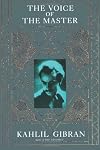
The Voice of the Master
by Kahlil Gibran
On This Page
Description
Kahlil Gibran (1883-1931) was a Lebanese poet, philosopher, artist, and writer. The millions of people familiar with his work consider him the genius of his age.Tags
Recommendations
























Member Reviews
Similar in vein to his 'The Prophet', and similar also to that of Paulo Coehlo. Its kind of pseudo-philsophical, quasi-pseudo-new-age love fest, kinda Buddha stuff, that is both interesting, and when looked at too long isn't nearly as deep as it pretends to be. Has a good message and at least its interesting. Finished this today at work on my break.
Similar in vein to his 'The Prophet', and similar also to that of Paulo Coehlo. Its kind of pseudo-philsophical, quasi-pseudo-new-age love fest, kinda Buddha stuff, that is both interesting, and when looked at too long isn't nearly as deep as it pretends to be. Has a good message and at least its interesting. Finished this today at work on my break.
Suite de "Prophet"
> Babelio : https://www.babelio.com/livres/Gibran-La-voix-de-leternelle-sagesse/964614
> LA VOIX DE L'ÉTERNELLE SAGESSE, de Khalil Gibran (l'auteur du « Prophète »). — Il est sans doute inutile de présenter Khalil Gibran qui, avec son ouvrage : Le Prophète (269 000 exemplaires en version française !) connaît une vaste renommée dans presque tous les pays du monde. Et La Voix de l'Eternelle Sagesse que nous présentons maintenant est certes la digne continuation du célèbre Prophète.
Ce qui, chez Gibran, nous émeut dès l'abord, c'est la beauté de son langage en lequel richesse poétique et profondeur de pensée se fondent admirablement. Il opère comme un charme, emportant le coeur et l'esprit du lecteur dans la show more contemplation de sa propre destinée. En effet, Gibran, avec la vive sensibilité qui est la sienne, explore sans relâche les problèmes essentiels formant la trame de l'existence de l'homme. En des accents , tantôt tristes, tantôt gais, il nous dévoile le jeu perpétuel de la vie.
Gibran, c'est le messager de l'espoir et de la joie sereine. Quand bien même il nous laisse entrevoir les sombres abîmes de la souffrance humaine, il sait tout autant designer du doigt le ciel infini du bonheur qui est enclos dans les profondeurs de notre coeur.
—L'Originel, (7), Janvier 1979
> La voix de l'éternelle sagesse, de Khalil Gibran. — Dans un texte pur et prenant, Gibran se fait le messager de l'espoir et de la joie sereine. Avec sensibilité, il explore les problèmes essentiels formant la trame de I existence de l'homme.
—La presse, 4 décembre 1979 show less
> LA VOIX DE L'ÉTERNELLE SAGESSE, de Khalil Gibran (l'auteur du « Prophète »). — Il est sans doute inutile de présenter Khalil Gibran qui, avec son ouvrage : Le Prophète (269 000 exemplaires en version française !) connaît une vaste renommée dans presque tous les pays du monde. Et La Voix de l'Eternelle Sagesse que nous présentons maintenant est certes la digne continuation du célèbre Prophète.
Ce qui, chez Gibran, nous émeut dès l'abord, c'est la beauté de son langage en lequel richesse poétique et profondeur de pensée se fondent admirablement. Il opère comme un charme, emportant le coeur et l'esprit du lecteur dans la show more contemplation de sa propre destinée. En effet, Gibran, avec la vive sensibilité qui est la sienne, explore sans relâche les problèmes essentiels formant la trame de l'existence de l'homme. En des accents , tantôt tristes, tantôt gais, il nous dévoile le jeu perpétuel de la vie.
Gibran, c'est le messager de l'espoir et de la joie sereine. Quand bien même il nous laisse entrevoir les sombres abîmes de la souffrance humaine, il sait tout autant designer du doigt le ciel infini du bonheur qui est enclos dans les profondeurs de notre coeur.
—L'Originel, (7), Janvier 1979
> La voix de l'éternelle sagesse, de Khalil Gibran. — Dans un texte pur et prenant, Gibran se fait le messager de l'espoir et de la joie sereine. Avec sensibilité, il explore les problèmes essentiels formant la trame de I existence de l'homme.
—La presse, 4 décembre 1979 show less
Oct 6, 2020 (Edited)French
CX16
Nov 25, 2019Portuguese (Brazil)
Librería 1. Estante 6.
Jul 15, 2019Spanish
Ratings
Members
- Recently Added By
Lists

1970s
657 works; 23 members
Author Information

750+ Works 29,540 Members
Khalil Gibran, also known as Kahlil Gibran, was born on January 6, 1883 in Northern Lebanon. As a result of his family's poverty, he received no formal education as a small child but had regular visits from the local priest who taught him about the Bible as well as the Syrian and Arabic languages. After his father was imprisoned for embezzlement show more and his family's property was confiscated by the authorities, his mother decided to emigrate to the United States in 1895. They settled in Boston's South End. He attended public school and art school, where he was introduced to the artist, photographer, and publisher Fred Holland Day. A publisher used some of Gibran's drawings for book covers in 1898. His family forced him to return to Lebanon to complete his education and learn the Arabic language. He enrolled in Madrasat-al-Hikmah, a Maronite-founded school, which offered a nationalistic curriculum partial to church writings, history and liturgy. He learned Arabic, French, and exceled in poetry. He returned to the United States in 1902. In 1904, he hosted his first art exhibit, which featured his allegorical and symbolic charcoal drawings. During this exhibition, he met Mary Elizabeth Haskell, who would go on to fund Gibran's artistic development for nearly his entire life. Not only was he an artist, but he also wrote poetry and other works including The Madman, The Prophet, and Sand and Foam. He died of cirrhosis of the liver and tuberculosis on April 10, 1931. (Bowker Author Biography) show less
Some Editions
Series
Belongs to Publisher Series
Work Relationships
Is contained in
Common Knowledge
- Original title
- The Voice of the Master
- Original publication date
- 1963 (collection) (collection)
Classifications
- Genres
- Fiction and Literature, Poetry
- DDC/MDS
- 892.78 — Literature & rhetoric Literatures of other languages Afro-Asiatic literatures Arabic (Egypt, Lebanon, Palestine, Saudi Arabia, Sudan) Arabic miscellany
- LCC
- PJ7826 .I2 .V6 — Language and Literature Oriental languages and literatures Oriental philology and literature Arabic Arabic literature Individual authors or works
- BISAC
Statistics
- Members
- 434
- Popularity
- 71,199
- Reviews
- 6
- Rating
- (3.56)
- Languages
- 11 — Dutch, English, Finnish, French, Indonesian, Italian, Korean, Norwegian (Bokmål), Portuguese, Croatian, Spanish
- Media
- Paper, Ebook
- ISBNs
- 37
- ASINs
- 27