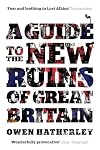
A Guide to the New Ruins of Great Britain
by Owen Hatherley
On This Page
Description
Back in 1997, New Labour came to power amid much talk of regenerating the inner cities left to rot under successive Conservative governments. Over the next decade, British cities became the laboratories of the new enterprise economy: glowing monuments to finance, property speculation, and the service industry--until the crash. In A Guide to the New Ruins of Great Britain, Owen Hatherley sets out to explore the wreckage--the buildings that epitomized an age of greed and aspiration. From show more Greenwich to Glasgow, Milton Keynes to Manchester, Hatherley maps the derelict Britain of the 2010s: from riverside apartment complexes, art galleries and amorphous interactive "centers," to shopping malls, call centers and factories turned into expensive lofts. In doing so, he provides a mordant commentary on the urban environment in which we live, work and consume. Scathing, forensic, bleakly humorous, A Guide to the New Ruins of Great Britain is a coruscating autopsy of a get-rich-quick, aspirational politics, a brilliant, architectural "state we're in." show lessTags
Recommendations
















Member Reviews
From library
The author delivers an excellent, detailed, sometimes vituperative and highly readable critique of the "Urban Renaissance" architecture that came after the postmodern "vernacular" mish-mash of the 1990s. This is characterised by lofty and noble aims that are not often carried through - and not just because of the credit crunch. Our cities are full of mixed-use behemoths and home-grown attempts to ape great architecture, leading to a PFI hospital-style mess. Hatherley celebrates the great modernist and brutalist successes like Park Hill in Sheffield and notes what is happening now in an approachable, human and often funny way.
The author delivers an excellent, detailed, sometimes vituperative and highly readable critique of the "Urban Renaissance" architecture that came after the postmodern "vernacular" mish-mash of the 1990s. This is characterised by lofty and noble aims that are not often carried through - and not just because of the credit crunch. Our cities are full of mixed-use behemoths and home-grown attempts to ape great architecture, leading to a PFI hospital-style mess. Hatherley celebrates the great modernist and brutalist successes like Park Hill in Sheffield and notes what is happening now in an approachable, human and often funny way.
"Property development is the new punk rock."
Britain and America, long separated by a common language, can now see what happens when they both speak concrete. I don't know eff all about British buildings. And though I seem to like architecture, Amazon claims it's my #1 subject, I still only dance about it. Yet this Baedecker's for the 21st century was one of my favourite reads this year.
Going by the reviews and blurbs, I thought this book would be all about what's wrong. It isn't. Hatherly is an excellent writer who does a damn good job of describing places I've never seen in such a way that I understand what he's talking about, and he never hesitates to point out what's right in these cities (Southampton, Milton Keynes, Nottingham, show more Sheffield, Manchester, Tyneside, Glasgow, Cambridge, The West Riding, Cardiff, Greenwich, Liverpool) when he sees it.
This is very much a book about urban space as well as architecture. A lot of this kind of space is international. I navigate these spaces here. Why are some skyways awful to walk over and others a great deal of fun? He gets into it, and he never forgets the people. If you've ever played Sim-City, or just lived somewhere dreadful, you know that people don't use a space the same way as the little figures in the maquettes. And God help you when the space starts using you.
This is also a melancholy book about boom and bust; how a downtown's unfinished buildings speak both kinds of English, as do those manufacturing spaces that have become shopping space when they're not empty space; and that everyone wants to build housing for the rich but no one else.
I am sitting here leafing through the book feeling sorry it's over.
The small black and white matte photos on every page were fitting and informative. If I take a trip to Sheffield, I will know who to blame. show less
Britain and America, long separated by a common language, can now see what happens when they both speak concrete. I don't know eff all about British buildings. And though I seem to like architecture, Amazon claims it's my #1 subject, I still only dance about it. Yet this Baedecker's for the 21st century was one of my favourite reads this year.
Going by the reviews and blurbs, I thought this book would be all about what's wrong. It isn't. Hatherly is an excellent writer who does a damn good job of describing places I've never seen in such a way that I understand what he's talking about, and he never hesitates to point out what's right in these cities (Southampton, Milton Keynes, Nottingham, show more Sheffield, Manchester, Tyneside, Glasgow, Cambridge, The West Riding, Cardiff, Greenwich, Liverpool) when he sees it.
This is very much a book about urban space as well as architecture. A lot of this kind of space is international. I navigate these spaces here. Why are some skyways awful to walk over and others a great deal of fun? He gets into it, and he never forgets the people. If you've ever played Sim-City, or just lived somewhere dreadful, you know that people don't use a space the same way as the little figures in the maquettes. And God help you when the space starts using you.
This is also a melancholy book about boom and bust; how a downtown's unfinished buildings speak both kinds of English, as do those manufacturing spaces that have become shopping space when they're not empty space; and that everyone wants to build housing for the rich but no one else.
I am sitting here leafing through the book feeling sorry it's over.
The small black and white matte photos on every page were fitting and informative. If I take a trip to Sheffield, I will know who to blame. show less
As usual with Owen Hatherley a deliberately provocative but never less than interesting take on development and regeneration in the major cities of the UK from the latter half of the 20th century onwards. Mr Hatherley has opinions and he is not shy of sharing them. A fan of classical modernism and its offshoot brutalism he has no time for the frippery of what he calls the pseudomodernism of odd shaped buildings with random finishes and cuddly names. The only quarrel I have with him is that though his criticisms regularly hit the spot he doesn't take the time to lay out clearly his own underlying principles. They might be easy enough to distill but it would be nice to have them laid out for us.
A study of the architecture inspired by the Labour government of 1997 - 2010, with its aspirational belief in the market instead of the collective and its reliance for major public building projects on the Private Finance Initiative, where the private sector builds and leases back to the public sector, thus keeping the costs off the balance sheet but increasing the overall cost to the taxpayer whilst allowing private companies the option of making millions or just walking away. On first glance, the author is scathing about the architectural style of the era; as this is a holding review only, I don't yet know if that's an honest opinion of the architecture, or if it's coloured by his political opinion of the Blair/Brown era. It also show more looks at cities in overview, so the political viewpoint is probably the more prevalent. There is much architecture of this period that I like, but on the other hand it does tend to lapse into cliché and self-parody all too easily. Illustrations are awful - for an £18 hardback, I expect photographs reproduced better than black & white low-resolution inserts into text that would disgrace a £7 paperback. show less
Acerbic, and often spot-on. When he isn't spot on though, he fervor makes him sound blinkered and dogmatic (which he would probably cheerfully admit, he is)
Sometimes the descriptions it gives aren't detailed enough without photos to give you a good feel for the buildings talked about, which is a bit frustrating. Like these buildings have so much more of an impact with actual decent photos and then you could let the photos do the talking for some of it
Also way too much use of "neoliberalism" in the introduction and I don't understand half the architecture shit so it's like only half interesting to me but hopefully I'll pick it up more as I go along. Sometimes he's really good at conjuring up an atmosphere and sometimes the architecture stuff I half understand and it makes sense to me and I agree.
Almost feels like a tour of britain where he shits on all buildings except suddenly they'll be show more one he likes because it's brutalist or whatever and then it's good even though there's no clear distinction of how it effects social environment etc
Also they go on about how good the Nottingham Contemporary is but it's a few shipping containers as a building. Didn't realise it was so easy to be an architect, apparently if I slap a few ugly shipping containers down I'm being "daringly minimalist"
Gonna pause it for now, it has that sort of tone that's all culture and very little politics but in a patronising tone that almost talks down about architecture that's really hard to explain and I probably sound dumb. I dunno I just don't like it much. Not enough about social environment and this sense that everything that matters is aesthetics of a kind. Also at one point there's a reference to "lumpen" as an almost insult which rubbed me the wrong way. Maybe I'll like it more some other time show less
Also way too much use of "neoliberalism" in the introduction and I don't understand half the architecture shit so it's like only half interesting to me but hopefully I'll pick it up more as I go along. Sometimes he's really good at conjuring up an atmosphere and sometimes the architecture stuff I half understand and it makes sense to me and I agree.
Almost feels like a tour of britain where he shits on all buildings except suddenly they'll be show more one he likes because it's brutalist or whatever and then it's good even though there's no clear distinction of how it effects social environment etc
Also they go on about how good the Nottingham Contemporary is but it's a few shipping containers as a building. Didn't realise it was so easy to be an architect, apparently if I slap a few ugly shipping containers down I'm being "daringly minimalist"
Gonna pause it for now, it has that sort of tone that's all culture and very little politics but in a patronising tone that almost talks down about architecture that's really hard to explain and I probably sound dumb. I dunno I just don't like it much. Not enough about social environment and this sense that everything that matters is aesthetics of a kind. Also at one point there's a reference to "lumpen" as an almost insult which rubbed me the wrong way. Maybe I'll like it more some other time show less
Location : NWS
Members
- Recently Added By
Published Reviews
This abrasive ramble probes the repeated failure of architects and planners, particularly in the "dispiriting exurbia of Blairite Britain", to enhance the lives of those who live and work in their constructions.
added by geocroc
...this is a personal, crusading book – not an encyclopedia or a thinktank paper. Like one of the postwar megastructures Hatherley cherishes, it may be a bit jerry-built in places, but it is bold and original, and it may change how you see British cities.
added by geocroc
This is a book of finespun rage, and at times its message is so miserable that it feels like having your skin scraped away. Its ending is desolate as a Cormac McCarthy novel. Yet its subjects are mere buildings. Who would have thought they could cause so much pain?
added by geocroc
Author Information

23+ Works 952 Members
Awards and Honors
Awards
Common Knowledge
- Canonical title
- A Guide to the New Ruins of Great Britain
- Original publication date
- 2010
- Important places
- Southampton, England, UK; Milton Keynes, Buckinghamshire, England, UK; Nottingham, Nottinghamshire, England, UK; Sheffield, South Yorkshire, England, UK; Manchester, England, UK; Newcastle upon Tyne, England, UK (show all 16); Gateshead, Tyne and Wear, England, UK; Glasgow, Scotland, UK; Cambridge, Cambridgeshire, England, UK; West Yorkshire, England, UK; Leeds, England, UK; Bradford, Yorkshire, England, UK; Wakefield, West Yorkshire, England, UK; Cardiff, Wales, UK; Greenwich, London, England, UK; Liverpool, England, UK
- Epigraph
- "Trumpets around the wall of the Barbican. Trumpets turning into penny whistles and then, reflected in the new shining glass, suddenly and surprisingly accompanied by a respectful and celebratory choir." Raymond Willams
- First words
- In 2009, the dying Labour government came up with one of the more amusing of its politcal gambits.
- Last words
- (Click to show. Warning: May contain spoilers.)An old idea or urbanism is utterly ruined, here at Stanley Dock, and you can smell its decomposition. Yet it feels so much less ruinous than the desolate city of property and tourism just a couple of miles away.
- Original language
- English
Classifications
Statistics
- Members
- 132
- Popularity
- 246,729
- Reviews
- 7
- Rating
- (3.82)
- Languages
- English
- Media
- Paper, Ebook
- ISBNs
- 4
- ASINs
- 2