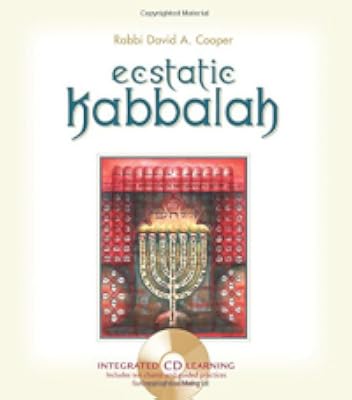
Ecstatic Kabbalah
by David A. Cooper
On This Page
Description
Kabbalah--the secret is out From Madonna's controversial conversion to the Dalai Lama's acknowledgment and support, this mystical tradition is gaining unprecedented recognition. But how do we put this powerful and esoteric worldview into practice? With The Ecstatic Kabbalah, Rabbi David Cooper--author of God Is a Verb (100,000 copies sold, Riverhead, 1958), and a renowned leader of the Jewish meditation movement provides practical exercises on the path toward "mending the soul," the show more fundamental Jewish experience that brings union with the Divine. With meditation techniques for both beginning and advanced practitioners, The Ecstatic Kabbalah guides listeners into awareness of the "presence of light" with experiential practices for touching the four worlds of mystical Judaism: Physical--breath work and mind-body harmonization "Emotional" tone the divine names as an expression of devotion. Mental--learn the histories of these techniques. Spiritual--stabilize your connection with divine presence show lessTags
Recommendations











Member Reviews
Last week, I finished reading and working with Rabbi David A. Cooper's Ecstatic Kabbalah. Cooper is a rabbi of some note, having also written such works as Three Gates to Meditation Practice and God is a Verb. If I remember correctly, he may also be profiled in Stalking Elijah.
Ecstatic Kabbalah is a guide for meditative practice. It's a short (less than 100 page) book with an audio CD one plays at certain points in the text. It's useful in that it assumes no prior knowledge. It's a bit frustrating, however, for that very reason -- it doesn't even use Hebrew letters, and doesn't really explain how the meditative practices sit within the context of Kabbalistic teaching, which makes it harder to integrate it into what one might already show more know of Kabbalism. At times it's also hard to know how useful the book would be to someone with no knowledge of Judaism. For example, the book has a page-sized aleph in the middle of a section on meditation on letters, but has no caption to tell the reader he is in fact looking at an aleph. That particular section leaves one wondering why it was even included, since how to meditate on the letters is not even addressed; Cooper just takes a few valuable pages of what is already a very short book to say people used to do it.
It's also hard to tell what here is received, and what here is Cooper drawing on modern creative visualization. Only one set of exercises is given a source, Isaac Abulafia's breath exercises. I know it's my own drawback, but I lose patience with creative visualization. When someone tells me to imagine I'm walking through a field, it does not relax me -- it makes me anxious and then angry. I'm very interested in learning about received Kabbalism; I'm not interested at all in creative visualization or even mash-ups which have proven useful for 60s survivors.
Also, its chapters are very uneven. Each chapter should be read in a sitting, but some are less than ten pages and have only a three-minute audio clip, while others are longer -- and, indeed, one chapter is more than ten pages and has two audio clips, each of more than ten minutes. This is like trying to take a class which sometimes lasts ten minutes and other times runs for more than an hour; it's very hard to prepare oneself for.
Like most meditation, it's very hard to tell whether this just relaxes one (like any other creative visualization) or really opens one to the Godhead. Perhaps if I used the Abulafia breath exercises daily, as the book suggests, my feelings would be different. I feel like I need some kind of escape, or feel some longing for something out of this world, and this wasn't what I was looking for. show less
Ecstatic Kabbalah is a guide for meditative practice. It's a short (less than 100 page) book with an audio CD one plays at certain points in the text. It's useful in that it assumes no prior knowledge. It's a bit frustrating, however, for that very reason -- it doesn't even use Hebrew letters, and doesn't really explain how the meditative practices sit within the context of Kabbalistic teaching, which makes it harder to integrate it into what one might already show more know of Kabbalism. At times it's also hard to know how useful the book would be to someone with no knowledge of Judaism. For example, the book has a page-sized aleph in the middle of a section on meditation on letters, but has no caption to tell the reader he is in fact looking at an aleph. That particular section leaves one wondering why it was even included, since how to meditate on the letters is not even addressed; Cooper just takes a few valuable pages of what is already a very short book to say people used to do it.
It's also hard to tell what here is received, and what here is Cooper drawing on modern creative visualization. Only one set of exercises is given a source, Isaac Abulafia's breath exercises. I know it's my own drawback, but I lose patience with creative visualization. When someone tells me to imagine I'm walking through a field, it does not relax me -- it makes me anxious and then angry. I'm very interested in learning about received Kabbalism; I'm not interested at all in creative visualization or even mash-ups which have proven useful for 60s survivors.
Also, its chapters are very uneven. Each chapter should be read in a sitting, but some are less than ten pages and have only a three-minute audio clip, while others are longer -- and, indeed, one chapter is more than ten pages and has two audio clips, each of more than ten minutes. This is like trying to take a class which sometimes lasts ten minutes and other times runs for more than an hour; it's very hard to prepare oneself for.
Like most meditation, it's very hard to tell whether this just relaxes one (like any other creative visualization) or really opens one to the Godhead. Perhaps if I used the Abulafia breath exercises daily, as the book suggests, my feelings would be different. I feel like I need some kind of escape, or feel some longing for something out of this world, and this wasn't what I was looking for. show less
I admit I still didn't read, “God is a verb.” It is on my shelf. I hope I will get to it and not just because this is Rabbi David A. Cooper's most famous work, but also because it promises new concepts in the study of spirituality and Kabbalah. Meanwhile I dipped my toe into the rabbi's work by reading and listening to his Ecstatic Kabbalah. As I already confessed one thin, might as well confess another one. The book, but particularly the CD was intended to be used for meditation. Reading the book from beginning to end and listening to the CD in a similar way has no chance to bring the expected results.
The ten sessions on the CD (totaling 80 minutes) range from 15 to three minutes. Yes, in this decreasing order as the first session show more is the longest, the second one is the shortest and the rest is in between. (There are prompts in the book, telling you when to close the book and turn on the CD to meditate along with.) They are all spoken words by Cooper, there is no music. “Spoken word” is not best expression to describe them, as he sings, hums, resonates, vibrates, sooths and guides you along the sessions. It is as if you'd have your personal meditation guru in your living room. Along with the echo. This was not a compliment: I found his voice harmonic but the recording sounds like it was done in a too large empty chamber, making it harder to feel intimate with the voice.
The book is short but beautifully designed. Following the five page introduction comes the 8 main chapters on 83 pages. The volumes is rounded up with an eight page appendix (on sounds, breathing techniques and practices) and a single page about the author. I found the historical perspective on the development of ecstatic Kabbalah in the introduction providing a useful framework for the rest of the book. In the first chapter Cooper defined, compared and contrasted of enlightenment and ecstasy. Next he takes on Kabbalah itself: “ a collection of methods and teachings that are used in an attempt to understand the nature of the universe.” It was refreshing to discover that this understanding very much coincides with mine. Chapter four is devoted to one of my favorite kabbalists, the de facto founder of ecstatic Kabbalah: Abraham Abulafia. (We consider him the “de facto” founder as the works of others of his and previous eras who might have developed similar techniques were lost.) Chapter four we learn (and start using) Abulafia's practices. In chapter five comes a favorite topic of many kabbalists and non-kabbalists: the names of God (and how they can be utilized through chanting). Presence” the topic of the next chapter may be familiar for those who are familiar with the Buddhist mindfulness concept. But here we go through a six phased approach to gain a deeper sense of our own presence. Next we depersonalize ourselves by trying to see through God's eyes. In the final chapter the thirteen attributes of God play the central focal point for the spiritual exercises.
I am still more interested in academic/scholarly Kabbalah than practical or meditational. But for those who are looking for a practice that can help them this seems a wonderful resource. Cannot speak from first hand (or is it first breath) experience though. But even for academic perspective this is a useful book of resources on the topic. show less
The ten sessions on the CD (totaling 80 minutes) range from 15 to three minutes. Yes, in this decreasing order as the first session show more is the longest, the second one is the shortest and the rest is in between. (There are prompts in the book, telling you when to close the book and turn on the CD to meditate along with.) They are all spoken words by Cooper, there is no music. “Spoken word” is not best expression to describe them, as he sings, hums, resonates, vibrates, sooths and guides you along the sessions. It is as if you'd have your personal meditation guru in your living room. Along with the echo. This was not a compliment: I found his voice harmonic but the recording sounds like it was done in a too large empty chamber, making it harder to feel intimate with the voice.
The book is short but beautifully designed. Following the five page introduction comes the 8 main chapters on 83 pages. The volumes is rounded up with an eight page appendix (on sounds, breathing techniques and practices) and a single page about the author. I found the historical perspective on the development of ecstatic Kabbalah in the introduction providing a useful framework for the rest of the book. In the first chapter Cooper defined, compared and contrasted of enlightenment and ecstasy. Next he takes on Kabbalah itself: “ a collection of methods and teachings that are used in an attempt to understand the nature of the universe.” It was refreshing to discover that this understanding very much coincides with mine. Chapter four is devoted to one of my favorite kabbalists, the de facto founder of ecstatic Kabbalah: Abraham Abulafia. (We consider him the “de facto” founder as the works of others of his and previous eras who might have developed similar techniques were lost.) Chapter four we learn (and start using) Abulafia's practices. In chapter five comes a favorite topic of many kabbalists and non-kabbalists: the names of God (and how they can be utilized through chanting). Presence” the topic of the next chapter may be familiar for those who are familiar with the Buddhist mindfulness concept. But here we go through a six phased approach to gain a deeper sense of our own presence. Next we depersonalize ourselves by trying to see through God's eyes. In the final chapter the thirteen attributes of God play the central focal point for the spiritual exercises.
I am still more interested in academic/scholarly Kabbalah than practical or meditational. But for those who are looking for a practice that can help them this seems a wonderful resource. Cannot speak from first hand (or is it first breath) experience though. But even for academic perspective this is a useful book of resources on the topic. show less
Abraham Abulafia-whose 'theory of ecstatic knowledge' inspired the Jewish world of the thirteenth century-once set out on a pilgrimage to the mystical River Sambatyon. In Jewish mythology, this great body of water was the magical boundary that stranded the ten lost tribes of Israel outside the Holy Land. It became the metaphor for Abulafia's life journey, and his spiritual teachings: to explore the barriers that must be encountered if we wish to break through the limits of ordinary consciousness.
With Ecstatic Kabbalah, Rabbi David A. Cooper brings you some of the most influential teachings from the vast expanse of Kabbalistic thought. While many of these teachings have been lost, Abulafia's techniques have survived to become a show more cornerstone of this spiritual tradition. Join Rabbi Cooper to learn a wealth of these practical tools including: how to access your me'orer penimi, the 'inner mover' who guides you through vieils of confusion; Hebrew prayer-chants to awaken creativity; the 'Abulafia practice of 'doublets'' to merge body and mind, and other keys for experiencing the ecstatic life of the Kabbalistic mystics.
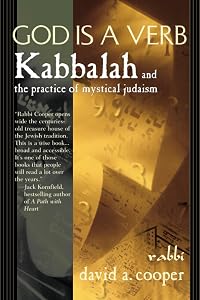
Rabbi David A. Cooper is an author, lecturer, teacher, meditation guide, and an active student of the world's great spiritual traditions. He has been called 'one of today's leading teachers of Jewish meditation.' Rabbi Coper is the author of many books, including A Heart of Stillness: A Complete Guide to Learning The art of Meditation; Silence, Simplicity, and Solitude, The Handbook of Jewish Meditation Practice, and Three Gates to Meditation Practice. His bestselling God is a Verb; Kabbalah and the Practice of Mystical Judaism has been translated into several languages, and has sold over 1000,000 copies. He is also he author of the audio learning series The Mystical Kabbalah and The Holy Chariot. Rabbi Cooper has been interviewed nationwide on NPR, television, and various newspapers. For more information, please visit his website: www.rabbidavidcooper.com
'Wisdom surrounds us, penetrates us, lives within us. The 'secrets' are so obvious, so close, so simple-they only await our discovery.'-Rabbi David A. Cooper
The secrets of Kabbalah are not something we learn form outside of ourselves, but rather they are to be discovered within our own minds. But how? If ancient spiritual teachings were that easy to access, wouldn't we have discovered them by now? According to Rabbi David A. Cooper, the secrets to unlocking the knowledge and power within us is to engage in daily mystical practices. With this new integrated learning program, Kabbalistic insights reveal themselves as Rabbi Cooper guides you through the techniques that invoke their wisdom.
'Rather than longing to become enlightened, you can take simple actions that themselves are enlightened,' Rabbi Cooper teaches. With him, you will discover how Yah breathing meditation quiets your mind and instills peace. The experience of the Divine at every moment-and in any situation-with the Kabbalistic principle of Shiviti. Sherma chant to inspire introspection and personal growth, and much more. Prepare to receive the secrets Kabbalists have held sacred for centuries, and to infuse their strength and power into your own life with Ecstatic Kabbalah.
Ten authentic Kabaistic practices on audio include:
Ahavat olam-a melodic chant tor receiving the Divine's immeasurable love. The 'magic mirror exercise' to see the world through God's eyes. Chants from the great mystic Abulafia for invoking clarity and creativity. The Pure Soul mantra to open your heart, and other timeless exerecises, techniques, and guided meditations to enhance our spiritual practice.
Contents
Acknowledgments
Introduction
Chapter 1 Enlightenment
Chapter 2 Kabbalah
Chapter 3 Abraham Abulafia
Chapter 4 Abulafia's practices
Chapter 5 Names of God
Chapter 6 The sense of presence
Chapter 7 Seeing through God's eyes
Chapter 8 The thirteen attributes
Appendix
About the author show less
With Ecstatic Kabbalah, Rabbi David A. Cooper brings you some of the most influential teachings from the vast expanse of Kabbalistic thought. While many of these teachings have been lost, Abulafia's techniques have survived to become a show more cornerstone of this spiritual tradition. Join Rabbi Cooper to learn a wealth of these practical tools including: how to access your me'orer penimi, the 'inner mover' who guides you through vieils of confusion; Hebrew prayer-chants to awaken creativity; the 'Abulafia practice of 'doublets'' to merge body and mind, and other keys for experiencing the ecstatic life of the Kabbalistic mystics.
Rabbi David A. Cooper is an author, lecturer, teacher, meditation guide, and an active student of the world's great spiritual traditions. He has been called 'one of today's leading teachers of Jewish meditation.' Rabbi Coper is the author of many books, including A Heart of Stillness: A Complete Guide to Learning The art of Meditation; Silence, Simplicity, and Solitude, The Handbook of Jewish Meditation Practice, and Three Gates to Meditation Practice. His bestselling God is a Verb; Kabbalah and the Practice of Mystical Judaism has been translated into several languages, and has sold over 1000,000 copies. He is also he author of the audio learning series The Mystical Kabbalah and The Holy Chariot. Rabbi Cooper has been interviewed nationwide on NPR, television, and various newspapers. For more information, please visit his website: www.rabbidavidcooper.com
'Wisdom surrounds us, penetrates us, lives within us. The 'secrets' are so obvious, so close, so simple-they only await our discovery.'-Rabbi David A. Cooper
The secrets of Kabbalah are not something we learn form outside of ourselves, but rather they are to be discovered within our own minds. But how? If ancient spiritual teachings were that easy to access, wouldn't we have discovered them by now? According to Rabbi David A. Cooper, the secrets to unlocking the knowledge and power within us is to engage in daily mystical practices. With this new integrated learning program, Kabbalistic insights reveal themselves as Rabbi Cooper guides you through the techniques that invoke their wisdom.
'Rather than longing to become enlightened, you can take simple actions that themselves are enlightened,' Rabbi Cooper teaches. With him, you will discover how Yah breathing meditation quiets your mind and instills peace. The experience of the Divine at every moment-and in any situation-with the Kabbalistic principle of Shiviti. Sherma chant to inspire introspection and personal growth, and much more. Prepare to receive the secrets Kabbalists have held sacred for centuries, and to infuse their strength and power into your own life with Ecstatic Kabbalah.
Ten authentic Kabaistic practices on audio include:
Ahavat olam-a melodic chant tor receiving the Divine's immeasurable love. The 'magic mirror exercise' to see the world through God's eyes. Chants from the great mystic Abulafia for invoking clarity and creativity. The Pure Soul mantra to open your heart, and other timeless exerecises, techniques, and guided meditations to enhance our spiritual practice.
Contents
Acknowledgments
Introduction
Chapter 1 Enlightenment
Chapter 2 Kabbalah
Chapter 3 Abraham Abulafia
Chapter 4 Abulafia's practices
Chapter 5 Names of God
Chapter 6 The sense of presence
Chapter 7 Seeing through God's eyes
Chapter 8 The thirteen attributes
Appendix
About the author show less
Members
- Recently Added By
Author Information

17 Works 1,158 Members
Classifications
- Genres
- Religion & Spirituality, Nonfiction, History
- DDC/MDS
- 296.712 — Religion Other religions Judaism Jewish life and customs Experience and Psychology of Judaism Kabbalah and Mysticism
- LCC
- BM526 .C66 — Philosophy, Psychology and Religion Judaism Judaism Sources of Jewish religion. Rabbinical literature Cabala
- BISAC
Statistics
- Members
- 57
- Popularity
- 540,347
- Reviews
- 3
- Rating
- (3.00)
- Languages
- English
- Media
- Paper, Ebook
- ISBNs
- 4
- UPCs
- 1
- ASINs
- 3