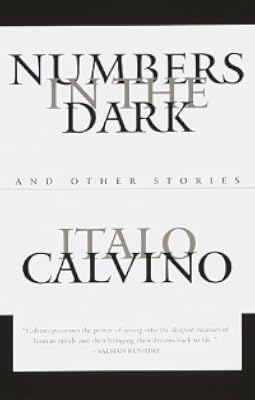
Numbers in the Dark: And Other Stories
by Italo Calvino
On This Page
Description
For the first time in paperback--a volume of thirty-seven diabolically inventive stories, fables, and "impossible interviews" from one of the great fantasists of the 20th century, displaying the full breadth of his vision and wit. Written between 1943 and 1984 and masterfully translated by Tim Parks, the fictions in Numbers in the Dark display all of Calvino's dazzling gifts: whimsy and horror, exuberance of style, and a cheerful grasp of the absurdities of the human condition.Tags
Recommendations



Member Reviews
This collects a number of different Italo Calvino short stories, ranging across his entire career. I think they're all stories that haven't been previously published in English. At least, they were all new to me, and I've read a fair few Calvinos at this point. The book opens with a number of goofy 2-3-page stories on various absurd topics (the town where everything was forbidden, or the country where everyone is a thief). These are fun, if flimsy. A lot of later authors have done stuff that reminds me of this (such as Jonathon Keats in The Book of the Unknown, or Michael Ajvaz in The Golden Age, though there are probably better examples), but Calvino was first, and let's be honest, he's probably the best.
The later stuff is longer, and show more it's all your typical Calvinoesque meanderings, but it's usually good, and when it's not, there's another one along in ten pages or so. I was a big fan of "The Lost Regiment," where an entire regiment goes missing in a very confusing town, or "A General in the Library," where a library is occupied by the military to find subversive material, only they turn out to like reading a whole lot. Come to think of it, there's a lot of stories here that satirize military thickheadedness, which makes sense for someone who resisted the Italian government during World War II. There are also interviews with a Neanderthal, Montezuma, and Henry Ford, which is a weird selection, but entertaining enough.
I have a fondness for his stories that are just ordinary (or seemingly ordinary) people overthinking very small moments. Mostly because I assert that that's what all of us do, or at least it's what I do, which is close enough.
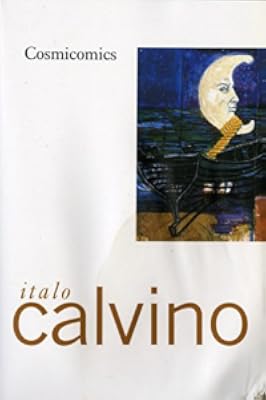
Also good: "The Workshop Hen," about a crackdown on a hen in a workshop and the sadness and bureaucracy that ensues; "Beheading the Heads," about a gruesome tradition in a foreign country; "The Burning of the Abominable House," which reads like Calvino's take on the Clue film; and "Implosion" and "Nothing and Not Much," a couple Qfwfq stories (the same guy/entity/thing who starred in Cosmicomics and t zero).
The best story was "World Memory," about a computer that records all things, and the implications that has for a jealous husband. It actually feels very Stanislaw Lemesque, but then, I always assert that Calvinoesque is Lemesque. show less
The later stuff is longer, and show more it's all your typical Calvinoesque meanderings, but it's usually good, and when it's not, there's another one along in ten pages or so. I was a big fan of "The Lost Regiment," where an entire regiment goes missing in a very confusing town, or "A General in the Library," where a library is occupied by the military to find subversive material, only they turn out to like reading a whole lot. Come to think of it, there's a lot of stories here that satirize military thickheadedness, which makes sense for someone who resisted the Italian government during World War II. There are also interviews with a Neanderthal, Montezuma, and Henry Ford, which is a weird selection, but entertaining enough.
I have a fondness for his stories that are just ordinary (or seemingly ordinary) people overthinking very small moments. Mostly because I assert that that's what all of us do, or at least it's what I do, which is close enough.
Also good: "The Workshop Hen," about a crackdown on a hen in a workshop and the sadness and bureaucracy that ensues; "Beheading the Heads," about a gruesome tradition in a foreign country; "The Burning of the Abominable House," which reads like Calvino's take on the Clue film; and "Implosion" and "Nothing and Not Much," a couple Qfwfq stories (the same guy/entity/thing who starred in Cosmicomics and t zero).
The best story was "World Memory," about a computer that records all things, and the implications that has for a jealous husband. It actually feels very Stanislaw Lemesque, but then, I always assert that Calvinoesque is Lemesque. show less
Calvino makes me feel happy and a bit dim. Part way through a Calvino story I get this aha moment where I realize he is writing a story that is impossible to get right and then I am amazed when he gets it right.
Stories that take place between the placing of a call and before you say hello. Stories that transform the invisible cities into women. Worlds where the leaders can be leaders, but they are executed on a schedule. Stories where all of the action (murder, arson, seduction, etc.) takes place in a programmer's head while he codes for an insurance agency...
Stories that take place between the placing of a call and before you say hello. Stories that transform the invisible cities into women. Worlds where the leaders can be leaders, but they are executed on a schedule. Stories where all of the action (murder, arson, seduction, etc.) takes place in a programmer's head while he codes for an insurance agency...
A varied and interesting collection of stories, from little parables, to 'interviews', to mysteries. These have been written over some forty years, and show how varied Calvino can be.
Some of the earlier stories are almost boring, but many of the middle and later ones are excellent, among his best work, with Invisible Cities and Cosmicomics. Read it for those.
Some of the earlier stories are almost boring, but many of the middle and later ones are excellent, among his best work, with Invisible Cities and Cosmicomics. Read it for those.
product of a brilliant mind: this engaging collection of stories shows calvino's versatility.playfully absurd fables, mind-bending exercises in combinatorics, "interviews" with somewhat deranged historical figures, glaciation interrupting a romantic encounter, an encylopedia of all human knowledge... these ideas and more are all expressed with humor, economy and wonderful style.
This is a collection of short stories, some of which have been in newspapers or magazines, and others which hadn't been previously published. Some of them were exciting, deep, engaging, and enjoyable to read. The majority of them had at least two of these qualities, but there were a few that I think I must have missed the point on, as I was just hoping that they would end. Others were over too soon, and could have benefited with a few more pages, as I had become involved in them. If it wasn't for the few duds I would have given this book a 4 and a half.
I would recommend this book to those who like short stories, as Calvino seems to write these best. With some of his longer books being just a collection of shorter pieces at heart, like show more Invisible Cities and If On A Winters Night. show less
I would recommend this book to those who like short stories, as Calvino seems to write these best. With some of his longer books being just a collection of shorter pieces at heart, like show more Invisible Cities and If On A Winters Night. show less
I specially liked the parable like stories in the beginning, and while all of them are good writing, I think `The Flash' was just amazing, in it's brevity.
Se reconocen en estas a veces brevísimas obras maestras toda la demoledora ironía con la que Calvino «interviene» en los hechos cotidianos más nimios, pero que parecen insuperables, todo el humor con que describe los absurdos del Poder, toda la exuberante fantasía que en él suscitan una situación, un lugar, un objeto, una lectura cualesquiera, o el modo de ser de una persona o de una comunidad. Desde la lucha titánica que libra uno de sus personajes contra el hielo a la hora de servirse unos cubitos, hasta esa revolución que se desencadena precisamente cuando el poder establecido hace concesiones para evitarla, pasando por las paradojas a las que se enfrenta Casanova y las entrevistas imaginarias con el hombre de Neanderthal, show more Moctezuma o Henry Ford, los lectores nos sentimos como hechizados por la inagotable imaginación de Calvino. Desde «El hombre que llamaba a Teresa» (1943) hasta «La implosión» (1984), estos cuentos abarcan cuarenta años de su producción literaria. show less
Jul 21, 2022Spanish
Members
- Recently Added By
Lists

Favourite Books
1,820 works; 308 members

Italian Literature
558 works; 40 members
Author Information

403+ Works 70,457 Members
Italo Calvino 1923-1984 Novelist and short story writer Italo Calvino was born in Cuba on October 15, 1923, and grew up in Italy, graduating from the University of Turin in 1947. He is remembered for his distinctive style of fables. Much of his first work was political, including Il Sentiero dei Nidi di Ragno (The Path of the Nest Spiders, 1947), show more considered one of the main novels of neorealism. In the 1950s, Calvino began to explore fantasy and myth as extensions of realism. Il Visconte Dimezzato (The Cloven Knight, 1952), concerns a knight split in two in combat who continues to live on as two separates, one good and one bad, deprived of the link which made them a moral whole. In Il Barone Rampante (Baron in the Trees, 1957), a boy takes to the trees to avoid eating snail soup and lives an entire, fulfilled life without ever coming back down. Calvino was awarded an honorary degree from Mount Holyoke College in 1984 and died in 1985, following a cerebral hemorrhage. At the time of his death, he was the most translated contemporary Italian writer and a contender for the Nobel Prize for Literature. (Bowker Author Biography) show less
Some Editions
Series
Belongs to Publisher Series
Keltainen kirjasto (436)
Work Relationships
Contains
Common Knowledge
- Canonical title*
- Kenraali kirjastossa
- Original title
- Prima che tu dica 'Pronto'
- Original publication date
- 1993
- Original language*
- italia
*Some information comes from Common Knowledge in other languages. Click "Edit" for more information.
Classifications
- Genres
- Fiction and Literature, General Fiction
- DDC/MDS
- 853.914 — Literature & rhetoric Italian, Romanian & related literatures Italian fiction 1900- 20th Century 1945-1999
- LCC
- PQ4809 .A45 .P713 — Language and Literature French, Italian, Spanish and Portuguese literatures Italian literature Individual authors, 1900-1960
- BISAC
Statistics
- Members
- 1,246
- Popularity
- 19,830
- Reviews
- 10
- Rating
- (3.89)
- Languages
- 8 — English, Finnish, French, German, Greek, Italian, Spanish, Portuguese (Portugal)
- Media
- Paper, Audiobook, Ebook
- ISBNs
- 34
- ASINs
- 10