Rocks in His Head (Avenues)
by Carol Otis Hurst
On This Page
Description
A young man has a lifelong love of rock collecting that eventually leads him to work at a science museum.Tags
Recommendations












Member Recommendations
Member Reviews
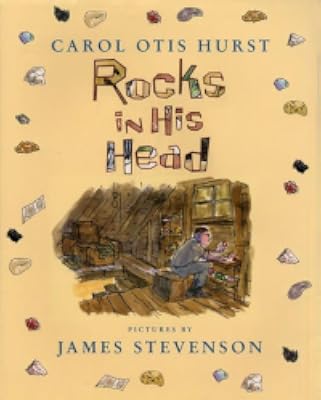
Children's author Carol Otis Hurst turns to the life story of her own father in this delightful picture-book biography, chronicling his life-long love of rocks, and how this obsession eventually led to his dream job, despite the nay-saying of all those who claimed that there "wasn't any money" in it. A collector since childhood, Hurst's father always had time to work on his rocks - polishing them, building display shelves for them, trading them for new specimens - even while running a filling station, or, during the Great Depression, looking for work. When the curator of mineralogy noticed him haunting the rock room at the local science museum, she struck up a conversation, and, learning of his passion and knowledge, offered him a job. show more It was only a position as a night janitor, but soon, despite his lack of a college degree, better things were to follow...
An inspirational reminder that, sometimes, with both luck and dedication, one's private passions can be transformed into a career, Rocks In His Head was an absolute joy to read. The historical setting - the booming car business of the 1920s, the hardships and mass unemployment of the 1930s - are worked seamlessly into the narrative, which focuses on Hurst's easy-going father, and his utter absorption in his area of interest. The artwork by James Stevenson, done in watercolor and black pen, is immensely expressive, and accentuates the humor of the story. My only complaint is that there is no informative afterword to give further details, as there so often is with books like this. We learn from the author's dust-jacket blurb that her father eventually did earn a college degree - after obtaining a job as curator - but facts like these might have been better presented in a brief "what happened next" addendum. Leaving that aside, this is just a wonderful book, and a moving tribute from an author daughter to her rock-hound father. show less
An inspirational reminder that, sometimes, with both luck and dedication, one's private passions can be transformed into a career, Rocks In His Head was an absolute joy to read. The historical setting - the booming car business of the 1920s, the hardships and mass unemployment of the 1930s - are worked seamlessly into the narrative, which focuses on Hurst's easy-going father, and his utter absorption in his area of interest. The artwork by James Stevenson, done in watercolor and black pen, is immensely expressive, and accentuates the humor of the story. My only complaint is that there is no informative afterword to give further details, as there so often is with books like this. We learn from the author's dust-jacket blurb that her father eventually did earn a college degree - after obtaining a job as curator - but facts like these might have been better presented in a brief "what happened next" addendum. Leaving that aside, this is just a wonderful book, and a moving tribute from an author daughter to her rock-hound father. show less
This is...I can't decide. Technically, I think it is a biography because it is about the author's father, but when I was reading it, there was no indication of his name or that he was even a real person. I had to read the summary to figure out it was the author's actual father in the story. So I think I would classify this as historical fiction and a good example of historical fiction. It focuses on someone who is not a public figure, but talks about how the events happening in those years (invention of the Model T, The Depression, etc.) effected the father and his family.
The theme of this story is definitely "do what you love." Throughout the story you see people laughing at or ignoring the father's love and knowledge for rocks. But show more he kept looking for them and thinking about them and was able to get a job in a museum working with rocks. Sometimes people asked about rocks and he could tell them stories, but a lot of times people just thought he was strange. So the author, I think, highlights the importance of standing by what you love to do and pursuing it, no matter what other people think.
Age Appropriateness: Primary, Intermediate
Media: Watercolor and ink show less
The theme of this story is definitely "do what you love." Throughout the story you see people laughing at or ignoring the father's love and knowledge for rocks. But show more he kept looking for them and thinking about them and was able to get a job in a museum working with rocks. Sometimes people asked about rocks and he could tell them stories, but a lot of times people just thought he was strange. So the author, I think, highlights the importance of standing by what you love to do and pursuing it, no matter what other people think.
Age Appropriateness: Primary, Intermediate
Media: Watercolor and ink show less
I did not like this book for a few reasons. Primarily, the content of this book was not up to par. The plot was boring and there was not much of a story line to follow. The story first introduces his father and his adoration for rocks. The author then goes on to tell the story of his father’s business in rock collecting, and its lack of success. In the end, his father gets a job at a science museum, even though he is under-qualified. From that, the reader can pull out the main message, being to always persevere, no matter how many attempts it takes to get to where you want to be. In my opinion, there could have been more substance to the plot and more of a climax and resolution. I also think some of the references in the story were show more too advanced. For instance, the book references the crash of the stock market, without going into any explanation of what that means. I do not think children in grades k-3 know much about the economy and what that has to do with job security. Additionally the phrase “rocks in his head” is used a lot and the book does not do a good job of revealing what that idiom means, in relation to the story. This book does not push readers to broaden their horizons and see things from a different view point, neither does this book evoke much thought. The language itself was pleasing, as there was a lot of good dialogue, and the language was descriptive. For example there was great imagery in this paragraph, “One day my father picked up the chess set and carefully packed it in a big box. He took down each mineral, wrapped it in newspaper, and carefully placed it in a wooden box.” I enjoyed reading that segment because I could vividly picture what was being described in the text, and children could do the same. The illustrations were also well done, and each picture gave a clear message that correlated with the supporting text. show less
This is a true story of the author's father, whose passion for rocks (even when other people teased him gently about it) eventually led him to become director of a museum and, in her own words, "probably the happiest man I ever knew".
I love this one beyond belief. It's very sweet and nostalgic. Don't let it pass you by.
I will say that it's probably better suited for the older end of the 4-8 range. It's a bit wordy, and some of the details about their lives - much of the book takes place during the Depression - are going to go right over the heads of the younger ones.
I love this one beyond belief. It's very sweet and nostalgic. Don't let it pass you by.
I will say that it's probably better suited for the older end of the 4-8 range. It's a bit wordy, and some of the details about their lives - much of the book takes place during the Depression - are going to go right over the heads of the younger ones.
A dad is so in love with rocks, and collecting rocks, that he finds himself a job as a janitor at a museum. The woman who hired him is so impressed with his willingness to learn about rocks that she asks the museum to send him to college. I found this book very refreshing because it embraces the power of knowledge.
Not everyone is meant to own a gas station, but sometimes those with rocks in their head just do. From a young age, Mr. Otis loved rocks. Every where he went he was in search of the best rocks. He built shelves for them in his home and his gas station to proudly display his treasures. After the Great Depression, Mr. Otis had to sell his gas station and look for work. He spent some of his time admiring the rocks at the science museum. While there, a curator of the museum inquired about his fancy for the rocks on display. He explained to her that he has always had rocks in his head. She offered him a position as a janitor in the museum and he was delighted to be able to spend more time with the rocks at the museum. After a while, despite show more his lack of a college degree, the curator offered him a job as her assistant. Sometimes it doesn't hurt to have what you love occupy your head. Even if it's rocks! show less
I really enjoyed this book and the illustrations that went along with it. This story would be great to use in a science lesson about rocks and minerals because many of the illustrations were the rocks that her dad collected and they were labeled. This book would also be good to introduce science vocabulary to students, such as minerals, mineralogist, and the specific names of rocks and minerals. You could also use part of this story in a history lesson about the Great Depression and the effects it had on the economy and the way people lived.
Members
- Recently Added By
Published Reviews
ThingScore 88
Deborah Stevenson (The Bulletin of the Center for Children's Books, December 2001 (Vol. 55, No. 4))
Hurst writes gently and affectionately of her father’s unusual career. Owner of a pre-Depression gas station, he really preferred to collect rocks and talk to his customers about them. When the Depression took its toll and he lost his station, he turned an avocation of museum-going (to see the show more mineralogy exhibits) into a janitor’s job at the museum; his mineralogical expertise finally triumphed over the museum board’s requirements, and he was appointed curator of mineralogy. There’s a retrospective and adult slant here that will distance this from some young readers, but this is a quiet and personal evocation of one man’s self-acquired education and enduring passion (“Take a look at this one,” he’s always saying as he pulls another specimen out of his pocket). Stevenson’s scratchy, flyaway lines have a front-porch informality suited to their unpretentious subject; the colors are sometimes a bit overly subdued, but they’ve got a low-key and pleasing period flavor. “Do what you love” is a rather abstract message, but this concrete demonstration of the philosophy and its rewards may open some youthful eyes. (Reviewed from galleys) Review Code: R -- Recommended. (c) Copyright 2001, The Board of Trustees of the University of Illinois. 2001, Greenwillow, 32p, $15.95 and $15.89. Grades 3-5. show less
Hurst writes gently and affectionately of her father’s unusual career. Owner of a pre-Depression gas station, he really preferred to collect rocks and talk to his customers about them. When the Depression took its toll and he lost his station, he turned an avocation of museum-going (to see the show more mineralogy exhibits) into a janitor’s job at the museum; his mineralogical expertise finally triumphed over the museum board’s requirements, and he was appointed curator of mineralogy. There’s a retrospective and adult slant here that will distance this from some young readers, but this is a quiet and personal evocation of one man’s self-acquired education and enduring passion (“Take a look at this one,” he’s always saying as he pulls another specimen out of his pocket). Stevenson’s scratchy, flyaway lines have a front-porch informality suited to their unpretentious subject; the colors are sometimes a bit overly subdued, but they’ve got a low-key and pleasing period flavor. “Do what you love” is a rather abstract message, but this concrete demonstration of the philosophy and its rewards may open some youthful eyes. (Reviewed from galleys) Review Code: R -- Recommended. (c) Copyright 2001, The Board of Trustees of the University of Illinois. 2001, Greenwillow, 32p, $15.95 and $15.89. Grades 3-5. show less
added by kthomp25
Karen Leggett (Children's Literature)
Anyone with rocks in his head must be crazy, right? Look a bit more closely, though, and there may be something very special about those rocks--and the person with rocks in his head. The father in this story has collected rocks since he was a young boy. When he grew up he wanted to do something with rocks, even though he was told "there's no money in show more rocks." He ended up opening a gas station, pumping gas, changing tires and fixing Model Ts...still collecting rocks and always ready to pull the newest find out of pocket. When the depression forced him to close his filling station and rain kept him from looking for another job, he went to the science museum "looking for rocks that are better than mine." He was hired as a janitor but he spent so much time scrubbing the rocks in the mineral cases that the director put him in charge of the rocks, even though the board of directors usually didn't hire people without college degrees. "I told them I need somebody with rocks in his head and rocks in his pockets. Are you it?" asked the director. "Maybe I am," said the father. This gentle story of persistence and curiosity is illustrated in softly colored, cartoon-style sketches. 2001, Greenwillow Books, $15.95 and $15.89. Ages 5 up. show less
Anyone with rocks in his head must be crazy, right? Look a bit more closely, though, and there may be something very special about those rocks--and the person with rocks in his head. The father in this story has collected rocks since he was a young boy. When he grew up he wanted to do something with rocks, even though he was told "there's no money in show more rocks." He ended up opening a gas station, pumping gas, changing tires and fixing Model Ts...still collecting rocks and always ready to pull the newest find out of pocket. When the depression forced him to close his filling station and rain kept him from looking for another job, he went to the science museum "looking for rocks that are better than mine." He was hired as a janitor but he spent so much time scrubbing the rocks in the mineral cases that the director put him in charge of the rocks, even though the board of directors usually didn't hire people without college degrees. "I told them I need somebody with rocks in his head and rocks in his pockets. Are you it?" asked the director. "Maybe I am," said the father. This gentle story of persistence and curiosity is illustrated in softly colored, cartoon-style sketches. 2001, Greenwillow Books, $15.95 and $15.89. Ages 5 up. show less
added by kthomp25
Lists

Museums -- children's/young adult fiction
65 works; 2 members
Author Information
20 Works 644 Members
All Editions
Awards and Honors
Awards
Distinctions
Classifications
Statistics
- Members
- 360
- Popularity
- 87,322
- Reviews
- 20
- Rating
- (4.13)
- Languages
- English
- Media
- Paper
- ISBNs
- 4
- ASINs
- 1