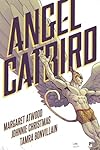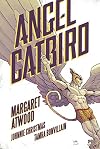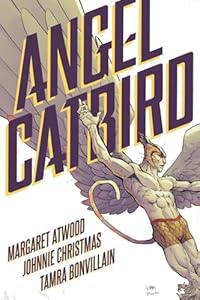
Angel Catbird Volume 1
by Margaret Atwood, Tamra Bonvillain (Illustrator), Johnnie Christmas (Illustrator)
Angel Catbird (1)
On This Page
Description
"On a dark night, young genetic engineer Strig Feleedus is accidentally mutated by his own experiment when his DNA is merged with that of a cat and an owl"--Tags
Recommendations



Member Reviews
Warning: You have to be in a very specific mood for this. If you are here for a sophisticated, complex, artistic graphic novels, you will roll your eyes and go "OMG, this is so dumb."
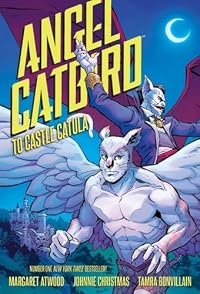
This comic is very campy, very corny, and very old school. It is at the same breakneck, hasty pace of yesteryear in which an origin story is a couple pages or a couple panels rather than its own series. The characters are very flat, often outright announce how they feel (the dialogue is equally direct and no-nonsense), and have exaggerated mannerisms. The villain is exceptionally cartoonish and over-the-top. And there are so many cat puns. Including 'Count Catula.'
If you go in seeing this as a punny homage, its enjoyable. I found myself smiling a lot show more through this volume, even if I never felt much in the way of fear, suspense, etc. The art is fantastic and there is a lot of care put into the character designs.
To put it simply, its more silly than smart. And that's okay.
I appreciated the additional information about cat ownership scattered in the margins throughout. Its accurate, its helpful, its interesting, it lends more context to the story, and hopefully, it helps readers be better cat owners.
Also, just FYI - multiple domestic cats die realistically "on screen." Its not terribly graphic but it made the first half an exceptionally hard read - this is the one thing that bothers me most in books, and I want you to be duly warned. I wish I knew going in. show less
This comic is very campy, very corny, and very old school. It is at the same breakneck, hasty pace of yesteryear in which an origin story is a couple pages or a couple panels rather than its own series. The characters are very flat, often outright announce how they feel (the dialogue is equally direct and no-nonsense), and have exaggerated mannerisms. The villain is exceptionally cartoonish and over-the-top. And there are so many cat puns. Including 'Count Catula.'
If you go in seeing this as a punny homage, its enjoyable. I found myself smiling a lot show more through this volume, even if I never felt much in the way of fear, suspense, etc. The art is fantastic and there is a lot of care put into the character designs.
To put it simply, its more silly than smart. And that's okay.
I appreciated the additional information about cat ownership scattered in the margins throughout. Its accurate, its helpful, its interesting, it lends more context to the story, and hopefully, it helps readers be better cat owners.
Also, just FYI - multiple domestic cats die realistically "on screen." Its not terribly graphic but it made the first half an exceptionally hard read - this is the one thing that bothers me most in books, and I want you to be duly warned. I wish I knew going in. show less
This book was not what I expected at all. I was expecting some super-literary graphic novel, but what I got was a cheesy throwback to pulp comics, with lots of winking and costumes and goofy names. Don't get me wrong, I did like it, but it took more than a couple of moments to adjust my expectations so that I could appreciate this book for what it is.
What it is is bonkers. But in a mostly good way. Campy and punny, filled with half-cats (who can transform to human to cat and back), one Count (half-bat), and of course, Angel Catbird himself (half cat-owl). In human form, they share attributes with their animal selves -- contemplating eating baby birds, craving fish, and thinking about going into heat.
Not sure how far I'll follow this show more comic, but it certainly was interesting! show less
What it is is bonkers. But in a mostly good way. Campy and punny, filled with half-cats (who can transform to human to cat and back), one Count (half-bat), and of course, Angel Catbird himself (half cat-owl). In human form, they share attributes with their animal selves -- contemplating eating baby birds, craving fish, and thinking about going into heat.
Not sure how far I'll follow this show more comic, but it certainly was interesting! show less
Okay, here's the thing.
If you pick up this comic expecting it to have the emotional gravitas and depth of most of Margaret Atwood's work, you're going to be disappointed. I completely understand all the low reviews.
But that's not the point of this story. This story is *fun*. It's silly and it doesn't make much sense. The main character falls in love with a woman he's literally spoken like 6 words to. It's absolutely ridiculous, and I love it.
If you pick up this comic expecting it to have the emotional gravitas and depth of most of Margaret Atwood's work, you're going to be disappointed. I completely understand all the low reviews.
But that's not the point of this story. This story is *fun*. It's silly and it doesn't make much sense. The main character falls in love with a woman he's literally spoken like 6 words to. It's absolutely ridiculous, and I love it.
I wanted this to be amazing. I thought the title/main character name was just plain stupid, but with Margaret Atwood at the helm of the story it would be recover. It didn't. But that doesn't mean it wasn't a crazy fun read...just probably not in the way it was intended. Yes, it was so utterly absurd that I was thoroughly amused through the entire thing despite the fact that the story is flimsy at best and the characters are beyond ridiculous.
Underneath my amusement of just how awful the whole thing is, however, is the tiniest whiff of discomfort. Haven't comic audiences been begging the industry to cool it with the blatant over-sexualization of characters, especially female characters? Yet here we have (from the celebrated author of show more The Handmaid's Tale, no less) characters whose only value to each other is how hot they look with tails. There is no heroism going on, just defense from a stereotypical bad guy, and zero attempt to even get ahead of the impending tragedy. Ultimately, it's as if Atwood decided to see just how many tired of comic book cliches she could cram into one story because that's all there is here--cliche. There is not a shred of plot, character, or even setting that is not derivative. And I have never seen such super-nerdy scientists be so painfully oblivious of how technology works.
In the end, I enjoyed the comic in a very Mystery Science Theater 3000 kind of way, which is why I decided to be generous with a second star. I'm glad Atwood was able to fulfill a little dream of hers, but I'm also very glad I got this at the library and didn't fork over my hard-earned cash for it. show less
Underneath my amusement of just how awful the whole thing is, however, is the tiniest whiff of discomfort. Haven't comic audiences been begging the industry to cool it with the blatant over-sexualization of characters, especially female characters? Yet here we have (from the celebrated author of show more The Handmaid's Tale, no less) characters whose only value to each other is how hot they look with tails. There is no heroism going on, just defense from a stereotypical bad guy, and zero attempt to even get ahead of the impending tragedy. Ultimately, it's as if Atwood decided to see just how many tired of comic book cliches she could cram into one story because that's all there is here--cliche. There is not a shred of plot, character, or even setting that is not derivative. And I have never seen such super-nerdy scientists be so painfully oblivious of how technology works.
In the end, I enjoyed the comic in a very Mystery Science Theater 3000 kind of way, which is why I decided to be generous with a second star. I'm glad Atwood was able to fulfill a little dream of hers, but I'm also very glad I got this at the library and didn't fork over my hard-earned cash for it. show less
I loves me some Margaret Atwood. This graphic novel - not so much.
There's some cute/corny to it. But I don't think that was the tone they were going for.
Something just didn't congeal between the concept and the execution and ultimately it falls short.
For me, the cause behind the graphic novel was more compelling than the cause in the graphic novel.
House cats who live three times longer than outdoor cats. And they don't eat songbirds. That's what I'll remember long after the rest has faded.
...maybe take your cat out in your yard on a leash if you feel guilty about keeping them indoors (which you shouldn't, cats are fine with it. Even if the make that hungry chittering when they look out the window at delicious birds, don't be show more fooled). We have two cats, they are cats with thumbs, so they are inherently superior to us humans, and they know it. They tricked/convinced/cajoled us into getting them harnesses to walk around the back yard in. All that is to say, get a cat, name it Strig or Cate Leone and give it a long happy life -instead of reading this graphic novel. show less
There's some cute/corny to it. But I don't think that was the tone they were going for.
Something just didn't congeal between the concept and the execution and ultimately it falls short.
For me, the cause behind the graphic novel was more compelling than the cause in the graphic novel.
House cats who live three times longer than outdoor cats. And they don't eat songbirds. That's what I'll remember long after the rest has faded.
...maybe take your cat out in your yard on a leash if you feel guilty about keeping them indoors (which you shouldn't, cats are fine with it. Even if the make that hungry chittering when they look out the window at delicious birds, don't be show more fooled). We have two cats, they are cats with thumbs, so they are inherently superior to us humans, and they know it. They tricked/convinced/cajoled us into getting them harnesses to walk around the back yard in. All that is to say, get a cat, name it Strig or Cate Leone and give it a long happy life -instead of reading this graphic novel. show less
I can only assume the creators wanted this to be so bad it was good, sort of like the campy Batman TV show of the sixties. A homage to comic books and strips of the 1930-50s that panders to cat lovers, this book is laughingly stupid at times, groan inducing at others and just plain ludicrous overall.
When a young scientist, who has been working on gene splicing, is the victim of a car accident along with his beloved cat and an owl, he develops super powers related to both animals. He can see in the dark and he can fly. Soon he meets others much like him, half-cat or in one case, part cat, bat, and vampire. But he soon finds himself in a battle against a half-rat man with hoards of rats to do his bidding.
Angel Catbird is author Margaret Atwood’s foray into graphic novels. It combines an homage to the mid-twentieth century super heroes with a goal to convince cat owners to keep their pets from roaming freely, thus protecting both cats and birds. This first in the series gives the origin story, introduces us to the characters and show more sets up the story for future issues. As such, it ends on a cliffhanger. It is beautifully illustrated by Johnnie Christmas.
I am a huge fan of both Margaret Atwood and graphic novels. Unfortunately, I suspect my inner fan girl raised my expectations unrealistically high leaving me feeling somewhat disappointed. Not to say I didn’t enjoy the story, it’s fun with lots of interesting cat facts interspersed, but it just didn’t grab me. I was left wondering if I would have been as disappointed if it had it been written by anyone else or, on the other hand, I suppose, would I have even read it had it been by any other writer. I do, however, respect and wholeheartedly support her purpose for writing this novel. As a result, my recommendation would have to be read it and judge for yourself.
Thanks to Edelweiss and Dark Horse for the opportunity to read this graphic novel in exchange for an honest review show less
Angel Catbird is author Margaret Atwood’s foray into graphic novels. It combines an homage to the mid-twentieth century super heroes with a goal to convince cat owners to keep their pets from roaming freely, thus protecting both cats and birds. This first in the series gives the origin story, introduces us to the characters and show more sets up the story for future issues. As such, it ends on a cliffhanger. It is beautifully illustrated by Johnnie Christmas.
I am a huge fan of both Margaret Atwood and graphic novels. Unfortunately, I suspect my inner fan girl raised my expectations unrealistically high leaving me feeling somewhat disappointed. Not to say I didn’t enjoy the story, it’s fun with lots of interesting cat facts interspersed, but it just didn’t grab me. I was left wondering if I would have been as disappointed if it had it been written by anyone else or, on the other hand, I suppose, would I have even read it had it been by any other writer. I do, however, respect and wholeheartedly support her purpose for writing this novel. As a result, my recommendation would have to be read it and judge for yourself.
Thanks to Edelweiss and Dark Horse for the opportunity to read this graphic novel in exchange for an honest review show less
Members
- Recently Added By
Lists

2017 Hugo Eligible Graphic Stories
16 works; 2 members

Books Read in 2017
4,249 works; 130 members
Author Information

282+ Works 198,333 Members
Margaret Atwood was born on November 18, 1939 in Ottawa, Canada. She received a B.A. from Victoria College, University of Toronto in 1961 and an M.A. from Radcliff College in 1962. Her first book of verse, Double Persephone, was published in 1961 and was awarded the E. J. Pratt Medal. She has published numerous books of poetry, novels, story show more collections, critical work, juvenile work, and radio and teleplays. Her works include The Journals of Susanna Moodie, Power Politics, Cat's Eye, The Robber Bride, Morning in the Buried House, the MaddAdam trilogy, and The Heart Goes Last. She has won numerous awards including the Prince of Asturias Award for Literature, the Booker Prize in 2000 for The Blind Assassin, the Giller Prize and the Premio Mondello for Alias Grace, and the Governor General's Award in 1966 for The Circle Game and in 1986 for The Handmaid's Tale, which also won the very first Arthur C. Clarke Award in 1987. She won the PEN Pinter prize in 2016 for her political activism. She was awarded the 2016 PEN Pinter Prize for the outstanding literary merit of her body of work. (Bowker Author Biography) show less

Some Editions
Awards and Honors
Awards
Series

Work Relationships
Is contained in
Has the adaptation
Common Knowledge
- Canonical title
- Angel Catbird Volume 1
- Original publication date
- 2016-09-06
- People/Characters
- Strig Feleedus; Cate Leone
- Original language
- English
Classifications
- Genre
- Graphic Novels & Comics
- DDC/MDS
- 741.5 — Arts & recreation Drawing & decorative arts Drawing and drawings Comic books, graphic novels, fotonovelas, cartoons, caricatures, comic strips
- LCC
- PZ7.7 .A896 .A — Language and Literature Fiction and juvenile belles lettres Fiction and juvenile belles lettres Juvenile belles lettres
- BISAC
Statistics
- Members
- 397
- Popularity
- 78,054
- Reviews
- 29
- Rating
- (2.87)
- Languages
- English, Spanish
- Media
- Paper, Audiobook, Ebook
- ISBNs
- 12
- ASINs
- 1