
Fábio Moon
Author of Daytripper
About the Author
Disambiguation Notice:
Gabriel Ba and Fabio Moon are twin brothers and writing partners - but not a single person. So please don't combine them.
Image credit: Photo by Luigi Novi.
Series
Works by Fábio Moon
Daytripper #09 — Author — 2 copies
5 — Author — 2 copies
Casanova #1 — Illustrator — 2 copies
Atelier — Author — 2 copies
Daytripper #06 2 copies
Daytripper Deluxe Edition 1 copy
Cortina 1 copy
10 Pãezinhos: Um Dia, Uma Noite — Author — 1 copy
Casanova: Gula #1 — Illustrator — 1 copy
Casanova: Gula #3 — Illustrator — 1 copy
Casanova: Gula #4 — Illustrator — 1 copy
Associated Works
Tagged
Common Knowledge
- Birthdate
- 1976-06-05
- Gender
- male
- Relationships
- Bá, Gabriel (brother)
- Nationality
- Brazil
- Birthplace
- São Paulo, Brazil
- Places of residence
- São Paulo, Brazil
- Disambiguation notice
- Gabriel Ba and Fabio Moon are twin brothers and writing partners - but not a single person. So please don't combine them.
- Associated Place (for map)
- Brazil
Members
Reviews

On days when my anxiety rears its head and its occasional nudges turn into a fully charged assault, I think—if I died crossing this road this second with a bag of groceries in my hand, guilt in my heart of somehow not being polite enough to the veggie vendor, and placating thoughts of next-time-apologies in a corner of my head—what would my obituary say? I proceed to letter it by myself and five minutes after that, for that's how long it takes to develop a thought-out obituary, I move on show more with my life. Daytripper is just that, but art. How best to talk about life if not through deaths that could have been the end, but weren't? And sometimes we die to prove that we lived. show less
Grasps a little too frequently at a Grand Meaning of Life, but otherwise, a lovely meditation on life that hypnotized me with all of the details of its settings. I felt like a friendly tourist in someone else's memories, a la Eternal Sunshine of the Spotless Mind, with every page serving as a good place to sit down and have a picnic. Small inconsistencies of anatomy are hand-waved away in lieu of all the accomplished art on display; the art's shortcomings would only matter if this was a book show more of talking heads and not a series of worlds opening before the reader.
My reading experience was aided by reading in an app that didn't tell me how close the ending was, meaning whenever characters talking about not knowing when their stories would finish, I felt amused and tense at the same time about when the book would end. show less
My reading experience was aided by reading in an app that didn't tell me how close the ending was, meaning whenever characters talking about not knowing when their stories would finish, I felt amused and tense at the same time about when the book would end. show less
Brás de Oliva Domingos has many lives and many deaths. Told in a series of well-paced, flowing vignettes, Daytripper by Fábio Moon and Gabriel Bá chronicles all these lives and deaths to show how precious life is. It's a story with strong existential hues, asking the eternal question about what's really important in life. What are the moments that matter? The answer is obvious of course, but it takes not just a lifetime but many lifetimes for Brás to get to the right answer. Each replay show more or turn of the wheel of Brás's life is another chance for him to mull over and figure out those questions.
There is no linear time here and the narrative jumps around so that we see Brás at different ages throughout. In chapter one, Brás is turning thirty-two-years-old; and then in the next chapter, he is twenty-one. At his oldest, he is seventy-six; the youngest we see him at is eleven or so. Each life focuses on some life-turning event—a budding romance; a failed relationship; the birth of a child; a life-changing trip with a friend—and is also filled with quiet moments, the moments we usually don't remember. Each chapter ends in a finite way, though the authors disrupt the pattern tellingly in the last chapter.
If only we had that kind of do-over in real life? Or maybe it's the karmic wheel at work here because the progression seems to move Brás from confusion toward a better understanding of his own life.
I think this graphic novel would have worked better for me if it weren't so mawkishly sentimental and focused so obsessively on this one, single character. Each inevitable death that comes feels more and more diminished and the repetition becomes tiresome, decreasing rather than increasing the tragedy and melancholy for me. As an astute reviewer put it: "Death is the ultimate consequence. There are no higher stakes than those of an existential conflict. The linear suspense this generates can be deployed as a narrative engine forward (Will the hero survive? Does the hero deserve to live?) or in flashback. (Why did the hero die? What significance did the hero's death have?) However, invoking a single-beat rhythm of chapter-ending caesurae through a sequence of unrelated, arbitrary endings, removes conflict and unpredictability. … With no turning of the screw, no stakes or consequences, why care?"
Still, Daytripper is a lofty idea conceptually and an even better story executed in visual form. The dreamy watercolor panels are beautifully drawn and filled in. I found myself thinking, yes, life as a watercolor painting is pitch-perfect here, the way memories and events seem to soak, deepen, bleed, and fade. show less
There is no linear time here and the narrative jumps around so that we see Brás at different ages throughout. In chapter one, Brás is turning thirty-two-years-old; and then in the next chapter, he is twenty-one. At his oldest, he is seventy-six; the youngest we see him at is eleven or so. Each life focuses on some life-turning event—a budding romance; a failed relationship; the birth of a child; a life-changing trip with a friend—and is also filled with quiet moments, the moments we usually don't remember. Each chapter ends in a finite way, though the authors disrupt the pattern tellingly in the last chapter.
If only we had that kind of do-over in real life? Or maybe it's the karmic wheel at work here because the progression seems to move Brás from confusion toward a better understanding of his own life.
I think this graphic novel would have worked better for me if it weren't so mawkishly sentimental and focused so obsessively on this one, single character. Each inevitable death that comes feels more and more diminished and the repetition becomes tiresome, decreasing rather than increasing the tragedy and melancholy for me. As an astute reviewer put it: "Death is the ultimate consequence. There are no higher stakes than those of an existential conflict. The linear suspense this generates can be deployed as a narrative engine forward (Will the hero survive? Does the hero deserve to live?) or in flashback. (Why did the hero die? What significance did the hero's death have?) However, invoking a single-beat rhythm of chapter-ending caesurae through a sequence of unrelated, arbitrary endings, removes conflict and unpredictability. … With no turning of the screw, no stakes or consequences, why care?"
Still, Daytripper is a lofty idea conceptually and an even better story executed in visual form. The dreamy watercolor panels are beautifully drawn and filled in. I found myself thinking, yes, life as a watercolor painting is pitch-perfect here, the way memories and events seem to soak, deepen, bleed, and fade. show less
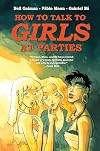
Absolutely love this graphic novel adaptation of Neil Gaiman’s short story! Moon & Ba were definitely the perfect choice of illustrators, since their artistic style is anchored in reality but with serious overtones of whimsy that capture the careful balance between reality and strange happenings in this story. Gaiman’s text presents the adventure of two young boys going to a house party as being relatively straightforward - they go, they talk to girls, and the girls are weird. Obviously show more the story can be interpreted literally, in that the party really is full of alien tourists in the form of beautiful girls, but speaking from the perspective of a girl we are absolutely as strange as the story portrays without actually being creatures from another planet. I’ve had far stranger conversations with boys - whether that strangeness comes from a fundamental difference in how boys and girls communicate or whether I just have weird topics of conversation is a whole other matter. The art style seems to very much support this theory that our hapless narrator just doesn’t quite get girls, so he sees their conversations as being otherworldly and above his comprehension, as all of the girls look very human (even for all their beauty). And yet, the final scene, where the boys exit the party post-haste due to some kind of disagreement with Stella, brings us back to the idea that maybe these girls are not just girls - having the fires of a thousand suns in their eyes (etc) is a typical description of extreme anger, but I get the distinct impression that Stella could be much more than what she seems. Better run for your lives, boys! show less
Lists
Awards


You May Also Like


Associated Authors
Statistics
- Works
- 50
- Also by
- 19
- Members
- 2,926
- Popularity
- #8,754
- Rating
- 3.8
- Reviews
- 140
- ISBNs
- 77
- Languages
- 11
- Favorited
- 2