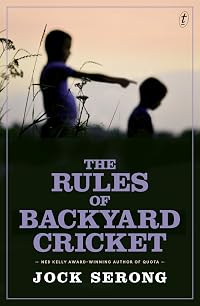
The Rules of Backyard Cricket
by Jock Serong
On This Page
Description
It starts in a suburban backyard with Darren Keefe and his older brother, sons of a fierce and gutsy single mother. The endless glow of summer, the bottomless fury of contest. All the love and hatred in two small bodies poured into the rules of a made-up game. Darren has two big talents: cricket and trouble. No surprise that he becomes an Australian sporting star of the bad-boy variety:one of those men who's always got away with things and just keeps getting. Until the day we meet him, show more middle aged, in the boot of a car. Gagged, cable-tied, a bullet in his knee. Everything pointing towards a shallow grave. The Rules of Backyard Cricket is a novel of suspense in the tradition of Peter Temple's Truth. With glorious writing harnessed to a gripping narrative, it observes celebrity, masculinity--humanity--with clear-eyed lyricism and exhilarating narrative drive. show lessTags
Recommendations
























Member Reviews
Jock Serong's second novel (his first, Quota, earned him the Ned Kelly Award for First Fiction in 2015) is filled with spare yet luminous prose recalling endless dry summer days punctuated with the sounds of willow smacking the leather. It is also a fine portrait of a small family struggling with more than their fair share of grief and loss.
Darren Keefe has been beaten and shot. He lies in a car boot, hands cable-tied and mouth covered in gaffer, contemplating his (probable) imminent violent end and what has brought him to this point. He tells of his fierce rivalry with and terrible love for older brother Wally, played out in their makeshift cricket pitch in a working class backyard in Melbourne's west during the 70s and 80s.
The Keefe show more brothers are raised by their single mother, who is unbowed by her husband's desertion and determined that her boys will be professional sportsmen. While Wally becomes the kind of cricketer whose public persona is always measured and perfect, Darren can never seem to side with the better angels of his nature. His ne'er-do-well, larrikin, clown prince behaviour is an amalgam of the kinds of things Australian sporting fans have unfortunately come to know all too well in the last three decades. Despite his poor choices, Darren feels things deeply and when he loves it is with the intensity of a badly-behaved supernova.
The Keefe brothers' love-hate relationship, and the toll it takes on those around them, is beautifully set down here and is a must-read for lovers of cricket and literature alike. show less
Darren Keefe has been beaten and shot. He lies in a car boot, hands cable-tied and mouth covered in gaffer, contemplating his (probable) imminent violent end and what has brought him to this point. He tells of his fierce rivalry with and terrible love for older brother Wally, played out in their makeshift cricket pitch in a working class backyard in Melbourne's west during the 70s and 80s.
The Keefe show more brothers are raised by their single mother, who is unbowed by her husband's desertion and determined that her boys will be professional sportsmen. While Wally becomes the kind of cricketer whose public persona is always measured and perfect, Darren can never seem to side with the better angels of his nature. His ne'er-do-well, larrikin, clown prince behaviour is an amalgam of the kinds of things Australian sporting fans have unfortunately come to know all too well in the last three decades. Despite his poor choices, Darren feels things deeply and when he loves it is with the intensity of a badly-behaved supernova.
The Keefe brothers' love-hate relationship, and the toll it takes on those around them, is beautifully set down here and is a must-read for lovers of cricket and literature alike. show less
When Jock Serong's debut novel QUOTA was released it was the first crime fiction book I could recall using over-permit limit Abalone catches as a central theme. The incorporation of crime and cricket therefore shouldn't have come as that much of a surprise in his second novel, THE RULES OF BACKYARD CRICKET. If both of these books are anything to go by, this is an author with a keen eye for an unusual but extremely workable scenario.
The depiction of cricket, from the Keefe brother's backyard contests, through to their District, State and ultimately Australian representation is brilliant. The careful use of tactics everywhere, the effects of micro-waving tennis balls for the backyard form, everything about the all consuming nature of the show more game and it's subtleties is gloriously depicted. The way that this sport provides a way forward for the two sons of a fierce single mother, her involvement, her constant presence behind them, and the dawning realisation that Darren comes to, of the sacrifices that their mother must have made, are perfect.
Which does not sit well with the opening of this novel - starting as it does with a trussed up Darren in the boot of a car, at night, being driven somewhere to pay a hefty price for something. As the novel starts to switch backwards and forwards through the boy's childhood, and Darren's current predicament, a picture starts to emerge of two different and yet similar brothers. Darren's always been a bit of a loose canon. A fierce player, erratic and undisciplined, he had potential and yet, ending up in the boot of a car has some sort of inevitability about it. The older brother, Wally, is a quieter, more reflective boy and man. A less flashy cricketer, he's still good enough to follow the same trajectory. Wally's the brother who makes it to Australian Captain. He's got the big house, the travelling lifestyle, the testimonial dinner on retirement. Darren was the one always in trouble for breaking team rules, the one with nothing much to fall back on when injury takes away his big chance at cricketing fame and fortune.
There's a lot about the tensions between the brothers that come from them simply being brothers, and then there's that which comes from the intricacies of the cricket world. The difference between being a respected Test Player, and a bit of a one-trick showman in the shorter forms for example. Then there's the question marks over the game itself rearing their ugly heads as the two men are stepping away from the game.
All the way along there's Darren's voice - looking back at their childhood and the lives that they lived, and at his present - in that boot with its inevitable sense of doom, approached with determination and a calm level-headedness that's somehow apt. Darren might have been a mercurial customer in his youth, but he's no fool, and he's not prepared to lie in that boot and take what's coming to him without an argument.
Really, everything in THE RULES OF BACKYARD CRICKET is brilliant. As the novel progresses, slowly and steadily, like a tactical battle against a good opposition test team, Darren works his way through his options, playing the timeframe, working the percentages. He's also calmly analysing what got him into this situation, and, as in any good cricket game, sometimes you can see the moves being played out, and sometimes they come straight out of the back of the bowler's hand.
For a cricket obsessed reader, fond of the assertion that test cricket is a metaphor for life, THE RULES OF BACKYARD CRICKET made me wonder about that just for a moment. Darren, Wally and their mum used the game as a way out of a difficult background, something that gave them a chance of a better future. What they got was more like a rain-affected draw, in the final game of a tied five day test series. For this reader though, THE RULES OF BACKYARD CRICKET was nearly as good as 5 nil whitewash, home series defeat of the old enemy.
https://www.austcrimefiction.org/review/review-rules-backyard-cricket-jock-seron... show less
The depiction of cricket, from the Keefe brother's backyard contests, through to their District, State and ultimately Australian representation is brilliant. The careful use of tactics everywhere, the effects of micro-waving tennis balls for the backyard form, everything about the all consuming nature of the show more game and it's subtleties is gloriously depicted. The way that this sport provides a way forward for the two sons of a fierce single mother, her involvement, her constant presence behind them, and the dawning realisation that Darren comes to, of the sacrifices that their mother must have made, are perfect.
Which does not sit well with the opening of this novel - starting as it does with a trussed up Darren in the boot of a car, at night, being driven somewhere to pay a hefty price for something. As the novel starts to switch backwards and forwards through the boy's childhood, and Darren's current predicament, a picture starts to emerge of two different and yet similar brothers. Darren's always been a bit of a loose canon. A fierce player, erratic and undisciplined, he had potential and yet, ending up in the boot of a car has some sort of inevitability about it. The older brother, Wally, is a quieter, more reflective boy and man. A less flashy cricketer, he's still good enough to follow the same trajectory. Wally's the brother who makes it to Australian Captain. He's got the big house, the travelling lifestyle, the testimonial dinner on retirement. Darren was the one always in trouble for breaking team rules, the one with nothing much to fall back on when injury takes away his big chance at cricketing fame and fortune.
There's a lot about the tensions between the brothers that come from them simply being brothers, and then there's that which comes from the intricacies of the cricket world. The difference between being a respected Test Player, and a bit of a one-trick showman in the shorter forms for example. Then there's the question marks over the game itself rearing their ugly heads as the two men are stepping away from the game.
All the way along there's Darren's voice - looking back at their childhood and the lives that they lived, and at his present - in that boot with its inevitable sense of doom, approached with determination and a calm level-headedness that's somehow apt. Darren might have been a mercurial customer in his youth, but he's no fool, and he's not prepared to lie in that boot and take what's coming to him without an argument.
Really, everything in THE RULES OF BACKYARD CRICKET is brilliant. As the novel progresses, slowly and steadily, like a tactical battle against a good opposition test team, Darren works his way through his options, playing the timeframe, working the percentages. He's also calmly analysing what got him into this situation, and, as in any good cricket game, sometimes you can see the moves being played out, and sometimes they come straight out of the back of the bowler's hand.
For a cricket obsessed reader, fond of the assertion that test cricket is a metaphor for life, THE RULES OF BACKYARD CRICKET made me wonder about that just for a moment. Darren, Wally and their mum used the game as a way out of a difficult background, something that gave them a chance of a better future. What they got was more like a rain-affected draw, in the final game of a tied five day test series. For this reader though, THE RULES OF BACKYARD CRICKET was nearly as good as 5 nil whitewash, home series defeat of the old enemy.
https://www.austcrimefiction.org/review/review-rules-backyard-cricket-jock-seron... show less
I loved this book.
We start with Darren, Daz, Keefe tied up in a car boot, knee cap shot, lying on a shovel with a bag of quicklime for company, contemplating his predicament and how on earth it should happen that he end up here.
Darren starts his journey to the boot from memories of playing cricket in the back yard against his big brother Wally. Its 1976 and Darren is in grade two and Wally in grade four, 19 months older. Serong perfectly captures the adhoc rules of any backyard cricket game.
"And in the current memory, the stump is an arm’s length behind me as I stare down my brother. The bat in my hands is an SP, as used in Tests by England captain Tony Greig. He’s tall, implacable, patient. All the things I’m not. The dog at show more our feet is Sam, a grossly obese staffy. The lawn’s kept down by an ancient handmower that’s always been there. Razor sharp blades made to look innocuous by rust. It didn’t come from anywhere and it’ll never go anywhere.
Those deep shades of autumn are last year now, when we were smaller. Here in high summer, where my memories crowd more, sunlight is a scatter of bleaches and reflections. At backward point there’s a banksia. At extra cover, a holly bush where Sam likes to shit. At mid-off, a bare patch where nothing, not even grass, grows. It’s lightning fast if you send a drive through there. Off drive I mean. I assume you’re keeping up. I’m a lefty.
Mid-on’s the vegie patch, never grows anything but tomatoes this time of year, stinging nettles along the back. Dirty bare feet in there come out red-welted. Midwicket is the shortest boundary, formed by the Apostouloses’ fence. Directly behind those palings, separated by a spindly pittosporum, is their kitchen. If you really middle a pull shot—wrap the handle around your ribs and smack that ball sweet off the end of the blade—it makes the finest sound hitting the timbers out there. I can only imagine how it sounds at the Apostas’ kitchen sink.
Fine leg is into the corner, towards the crappy asbestos outhouse that contains the second dunny and the laundry. Something about the plumbing in there; there’s a smell even when no one’s been.
Keeper and slips are automatic: the big sheet of trellis that Mum put up to grow climbing roses. Snick it onto the trellis on the full and you’re gone. Hit the dog and it makes a hollow thud.
Sam’s a random element in all this, wandering around sniffing the air. Occasionally he lies on his back and does that thing fat dogs do when they wriggle around just scratching the bejesus out of their backs. You can’t shoo him away. You have to get on with it no matter where Sam is located, and you can’t hit him. Hit him and you’re gone. If Sam decides he wants to stop and eat a bee off a clover flower right in the middle of the pitch, you play around him. In future years, under greater pressures, I sometimes wonder if Wally and I learned to stare through distraction because we had to play around a fat dog."
Cricket is meant to be played with two teams of 11 players, but to be honest is flexible enough to accommodate any number with the minimum being two, batsman and bowler. Backyard cricket between siblings is fierce, uncompromising and not for the faint hearted. Many a hotly disputed decision is decided by physical combat.
"Voices would be raised, equipment thrown. Unless Mum intervened, it would end in a red-faced tangle with fingers in eyes and gappy milk teeth sunk into soft flesh: an itchy, grunting wrestle that never produced a clear winner."
In the playing of cricket ;ironically a game for 'gentlemen' where the saying "that's not cricket' would mean having something that is unjust or just plain wrong done to someone or something, we learn all we need of the character of Darren and Wally. The boys used to wait outside the local tennis courts, waiting for an errant lob to clear the fence and they'd be off on their Malvern Stars with a new ball for their next game.
"And right there you have an essential distinction between the Keefe brothers. I would do these things for the sheer joy of it. Busting free, sending my blood roaring in the knowledge I’d flouted the rules and disappointed expectations. The problem for me is that the more times you do it and the more you get caught, the lower the expectations become. Correspondingly, the lesser the thrill."
We alternate between Darren's attempts to extricate himself from the boot and the continuing story of the two brothers and their rise through the grades to higher and higher levels of cricket. Serong covers all the highs and lows of the professional sportsman, contrasting the dour buttoned up Wally with the flamboyant, larrikin that Darren became.Serong uses the contrasts between Darren and Wally to illustrate the rise of the celebrity sportsman as a product to be sold, torn between the purity of the game and the ugliness of the corporatisation of sport and the pressure to entertain.
Darren keeps chasing the next high, sporting or drug induced it doesn't seem to matter to him, Wally winds himself tighter and tighter, paring away all spontaneity in order to fulfill his idea of how a top sportsman should behave.
For both men there are consequences.
I did not see this ending the way it did. Serong does a brilliant job keeping the suspense of Darren's predicament going while we inexorably follow his story to the surprising denouement.
For those of who have no idea what cricket is or what any of the aussie lingo means, you'll have to find a friendly interpreter from a cricket playing nation to assist. It will be well worth the discussion. show less
We start with Darren, Daz, Keefe tied up in a car boot, knee cap shot, lying on a shovel with a bag of quicklime for company, contemplating his predicament and how on earth it should happen that he end up here.
Darren starts his journey to the boot from memories of playing cricket in the back yard against his big brother Wally. Its 1976 and Darren is in grade two and Wally in grade four, 19 months older. Serong perfectly captures the adhoc rules of any backyard cricket game.
"And in the current memory, the stump is an arm’s length behind me as I stare down my brother. The bat in my hands is an SP, as used in Tests by England captain Tony Greig. He’s tall, implacable, patient. All the things I’m not. The dog at show more our feet is Sam, a grossly obese staffy. The lawn’s kept down by an ancient handmower that’s always been there. Razor sharp blades made to look innocuous by rust. It didn’t come from anywhere and it’ll never go anywhere.
Those deep shades of autumn are last year now, when we were smaller. Here in high summer, where my memories crowd more, sunlight is a scatter of bleaches and reflections. At backward point there’s a banksia. At extra cover, a holly bush where Sam likes to shit. At mid-off, a bare patch where nothing, not even grass, grows. It’s lightning fast if you send a drive through there. Off drive I mean. I assume you’re keeping up. I’m a lefty.
Mid-on’s the vegie patch, never grows anything but tomatoes this time of year, stinging nettles along the back. Dirty bare feet in there come out red-welted. Midwicket is the shortest boundary, formed by the Apostouloses’ fence. Directly behind those palings, separated by a spindly pittosporum, is their kitchen. If you really middle a pull shot—wrap the handle around your ribs and smack that ball sweet off the end of the blade—it makes the finest sound hitting the timbers out there. I can only imagine how it sounds at the Apostas’ kitchen sink.
Fine leg is into the corner, towards the crappy asbestos outhouse that contains the second dunny and the laundry. Something about the plumbing in there; there’s a smell even when no one’s been.
Keeper and slips are automatic: the big sheet of trellis that Mum put up to grow climbing roses. Snick it onto the trellis on the full and you’re gone. Hit the dog and it makes a hollow thud.
Sam’s a random element in all this, wandering around sniffing the air. Occasionally he lies on his back and does that thing fat dogs do when they wriggle around just scratching the bejesus out of their backs. You can’t shoo him away. You have to get on with it no matter where Sam is located, and you can’t hit him. Hit him and you’re gone. If Sam decides he wants to stop and eat a bee off a clover flower right in the middle of the pitch, you play around him. In future years, under greater pressures, I sometimes wonder if Wally and I learned to stare through distraction because we had to play around a fat dog."
Cricket is meant to be played with two teams of 11 players, but to be honest is flexible enough to accommodate any number with the minimum being two, batsman and bowler. Backyard cricket between siblings is fierce, uncompromising and not for the faint hearted. Many a hotly disputed decision is decided by physical combat.
"Voices would be raised, equipment thrown. Unless Mum intervened, it would end in a red-faced tangle with fingers in eyes and gappy milk teeth sunk into soft flesh: an itchy, grunting wrestle that never produced a clear winner."
In the playing of cricket ;ironically a game for 'gentlemen' where the saying "that's not cricket' would mean having something that is unjust or just plain wrong done to someone or something, we learn all we need of the character of Darren and Wally. The boys used to wait outside the local tennis courts, waiting for an errant lob to clear the fence and they'd be off on their Malvern Stars with a new ball for their next game.
"And right there you have an essential distinction between the Keefe brothers. I would do these things for the sheer joy of it. Busting free, sending my blood roaring in the knowledge I’d flouted the rules and disappointed expectations. The problem for me is that the more times you do it and the more you get caught, the lower the expectations become. Correspondingly, the lesser the thrill."
We alternate between Darren's attempts to extricate himself from the boot and the continuing story of the two brothers and their rise through the grades to higher and higher levels of cricket. Serong covers all the highs and lows of the professional sportsman, contrasting the dour buttoned up Wally with the flamboyant, larrikin that Darren became.Serong uses the contrasts between Darren and Wally to illustrate the rise of the celebrity sportsman as a product to be sold, torn between the purity of the game and the ugliness of the corporatisation of sport and the pressure to entertain.
Darren keeps chasing the next high, sporting or drug induced it doesn't seem to matter to him, Wally winds himself tighter and tighter, paring away all spontaneity in order to fulfill his idea of how a top sportsman should behave.
For both men there are consequences.
I did not see this ending the way it did. Serong does a brilliant job keeping the suspense of Darren's predicament going while we inexorably follow his story to the surprising denouement.
For those of who have no idea what cricket is or what any of the aussie lingo means, you'll have to find a friendly interpreter from a cricket playing nation to assist. It will be well worth the discussion. show less
When THE RULES OF BACKYARD CRICKET opens Darren Keefe is trussed up in the boot of a moving vehicle. He believes he is being taken somewhere to be killed and doesn’t seem terribly surprised by the fact. For him the only real mystery is whether or not he’ll be forced to dig his own grave before death. A difficult proposition given his left hand hasn’t worked properly since the broken thumb of years before. And he’s been shot in one knee.
For a long time this is really all we learn about Darren’s present-day life. Over the rest of the book there are brief return visits to the boot, where Darren is making half-hearted attempts to free his cable-tied limbs. But before we can find out why Darren is in this predicament we have to show more learn what led up to it. Darren’s story begins on the backyard pitch where he and his older brother Wally fight for supremacy
From the day – lost now in the Kodachrome blur – when we take up backyard cricket, we are an independent republic of rage and obsession. Our rules, our records, our very own physics. Eye-to-eye and hand-to-hand combat. By the time we emerge into the world beyond the paling fences, it surprises us to learn that anyone considers this a team sport.
You might not have grown up in a cricket-mad household. The names Lillee, Thomo and the rest may mean nothing to you. And it’s possible that you don’t know mid-on from fine leg (the vegie patch and the asbestos outhouse respectively in the Keefe backyard, the small rose garden and the rumpus room wall in the backyard of my own youth). You may never have known the anguish of watching a whole Test only to have it end in a rain-soaked draw on the final day. But even if all this is true you couldn’t fail to miss the authenticity in the depiction of Darren and Wally’s lives. It’s not just that the pages of the book have absorbed Australian cricketing lore in a physical way. It’s that the obsession the boys display for it is entirely believable. The most natural thing in the world. Their single mother works dead-end barmaid jobs to keep her sons in cricket gear. The game – and their skill at it – is the best chance they have of not re-living her own hard life and Pamela Keefe is almost as determined as her boys.
But, like many brothers that have come before them, the Keefes are not equal in all things. Wally is disciplined, focused, responsible, emotionally impenetrable. Qualities which are almost as important as his talent in securing him the ultimate prize – the Australian captaincy. Darren is none of these things. To call him a risk taker would be misleading; implying as it does that he weighs up the potential consequences of his actions. Darren doesn’t put nearly enough thought into things for that. On the field his innate ability and the fact that his boyhood tussles with Wally were tougher than almost anything anyone else can dish out take him a long way. But a combination of hubris and lack of forethought bring on the game-changing injury to his hand. He never reaches the heights he imagined for himself as a kid. Though high enough that his fall from grace, when he becomes “…a man who retains a public profile, but with all the good parts eaten away”, is deeply painful to watch.
That was the first surprise for me here. As someone who normally wavers between disgust and boredom at the adoration and sycophancy heaped upon sports stars – even those who continuously engage in juvenile, debauched and often illegal activities – I was not predisposed to feeling much other than scorn for Darren Keefe. And some of that is there. He really does have no one but himself to blame for his circumstances. But Serong’s portrait is so nuanced…so honest…that I will, somewhat grudgingly, admit to feeling much more. At times my heart ached. Because I saw that to be angry at Darren for his inability to behave sensibly would be akin to scoffing at a paralysed person for not walking up a flight of stairs. Like there is free will involved in either case.
The resolution to the story was the second surprise. In the way that being struck from behind with a brick might be. The noir label is thrown around with far too much abandon for my liking but as I closed the back cover of this book I thought it might just be the most perfect example of the genre I’ve read. In forever. For me noir is at its finest when the inevitable quality to the ending is only visible in hindsight and I am left physically aching for a different outcome while knowing such a thing would be both impossible and imperfect. The very definition of bittersweet.
I would recommend this book to everyone. Except I am a bit worried about how those who still think of cricket as the gentleman’s game might fare with it. There’s nothing genteel about any of the cricket in this book. Not the war waged in the Keefe’s backyard and not the big, sometimes corrupt business they are involved with as adults. But everyone who isn’t afraid of losing their wide-eyed innocence about the sport should read this book. It is beautifully written, brutally honest and gets the balance of aching sadness and dark humour just right. An outstanding read. show less
For a long time this is really all we learn about Darren’s present-day life. Over the rest of the book there are brief return visits to the boot, where Darren is making half-hearted attempts to free his cable-tied limbs. But before we can find out why Darren is in this predicament we have to show more learn what led up to it. Darren’s story begins on the backyard pitch where he and his older brother Wally fight for supremacy
From the day – lost now in the Kodachrome blur – when we take up backyard cricket, we are an independent republic of rage and obsession. Our rules, our records, our very own physics. Eye-to-eye and hand-to-hand combat. By the time we emerge into the world beyond the paling fences, it surprises us to learn that anyone considers this a team sport.
You might not have grown up in a cricket-mad household. The names Lillee, Thomo and the rest may mean nothing to you. And it’s possible that you don’t know mid-on from fine leg (the vegie patch and the asbestos outhouse respectively in the Keefe backyard, the small rose garden and the rumpus room wall in the backyard of my own youth). You may never have known the anguish of watching a whole Test only to have it end in a rain-soaked draw on the final day. But even if all this is true you couldn’t fail to miss the authenticity in the depiction of Darren and Wally’s lives. It’s not just that the pages of the book have absorbed Australian cricketing lore in a physical way. It’s that the obsession the boys display for it is entirely believable. The most natural thing in the world. Their single mother works dead-end barmaid jobs to keep her sons in cricket gear. The game – and their skill at it – is the best chance they have of not re-living her own hard life and Pamela Keefe is almost as determined as her boys.
But, like many brothers that have come before them, the Keefes are not equal in all things. Wally is disciplined, focused, responsible, emotionally impenetrable. Qualities which are almost as important as his talent in securing him the ultimate prize – the Australian captaincy. Darren is none of these things. To call him a risk taker would be misleading; implying as it does that he weighs up the potential consequences of his actions. Darren doesn’t put nearly enough thought into things for that. On the field his innate ability and the fact that his boyhood tussles with Wally were tougher than almost anything anyone else can dish out take him a long way. But a combination of hubris and lack of forethought bring on the game-changing injury to his hand. He never reaches the heights he imagined for himself as a kid. Though high enough that his fall from grace, when he becomes “…a man who retains a public profile, but with all the good parts eaten away”, is deeply painful to watch.
That was the first surprise for me here. As someone who normally wavers between disgust and boredom at the adoration and sycophancy heaped upon sports stars – even those who continuously engage in juvenile, debauched and often illegal activities – I was not predisposed to feeling much other than scorn for Darren Keefe. And some of that is there. He really does have no one but himself to blame for his circumstances. But Serong’s portrait is so nuanced…so honest…that I will, somewhat grudgingly, admit to feeling much more. At times my heart ached. Because I saw that to be angry at Darren for his inability to behave sensibly would be akin to scoffing at a paralysed person for not walking up a flight of stairs. Like there is free will involved in either case.
The resolution to the story was the second surprise. In the way that being struck from behind with a brick might be. The noir label is thrown around with far too much abandon for my liking but as I closed the back cover of this book I thought it might just be the most perfect example of the genre I’ve read. In forever. For me noir is at its finest when the inevitable quality to the ending is only visible in hindsight and I am left physically aching for a different outcome while knowing such a thing would be both impossible and imperfect. The very definition of bittersweet.
I would recommend this book to everyone. Except I am a bit worried about how those who still think of cricket as the gentleman’s game might fare with it. There’s nothing genteel about any of the cricket in this book. Not the war waged in the Keefe’s backyard and not the big, sometimes corrupt business they are involved with as adults. But everyone who isn’t afraid of losing their wide-eyed innocence about the sport should read this book. It is beautifully written, brutally honest and gets the balance of aching sadness and dark humour just right. An outstanding read. show less
The Rules of Backyard Cricket – Brutal and Brilliant Literary Crime
Jock Serong is the award winning writer of The Rules of Backyard Cricket, which is one of the most brutal and brilliant literary crime novels of the year. Serong clearly is one the boldest new voices in Australian literary circles and The Rules of Backyard Cricket should endear him to a wider audience here in England.
Darren & Wally Keefe are talented cricketers who grew up playing out in the backyard, using anything they could for bat and ball. Whether it was using the fence as the boundary, the lazy pet dog as a fielder and the tree stump as the wicket, this was their world. Where there was a fierce sibling rivalry, even though Darren did look up to his elder brother show more Wally. Brought up by their single mother who works all the hours God sends to provide for all their needs, and especially for their cricket.
From the outset it is clear, that even though the Keefe boys are talented, Darren and Wally are clearly very different people. Darren had two massive talents, cricket and trouble, both came to him easily, whereas Wally was more studious of the game, always calm under pressure and would not cause trouble, ever.
Darren is the sort of character that has always seem to have got away with whatever trouble he caused, until the time we meet him, when he is middle aged, in the boot of a car, gagged, cable tied and with a bullet in his knee. He knows he is heading for the end, as he begins to reflect on his life and that of his brother.
This literary crime is written in a fine tradition of suspense novels, with brilliant and clear prose which brings to life the gripping narrative. Throughout the novel we observe everything from sibling rivalry, winner takes all, masculinity, the trappings of celebrity and humanity. How even as we approach our last breath we are looking for those few extra moments.
An enjoyable and intriguing read that really draws the reader in, Jock Serong really is a new talent we should all be taking note of. show less
Jock Serong is the award winning writer of The Rules of Backyard Cricket, which is one of the most brutal and brilliant literary crime novels of the year. Serong clearly is one the boldest new voices in Australian literary circles and The Rules of Backyard Cricket should endear him to a wider audience here in England.
Darren & Wally Keefe are talented cricketers who grew up playing out in the backyard, using anything they could for bat and ball. Whether it was using the fence as the boundary, the lazy pet dog as a fielder and the tree stump as the wicket, this was their world. Where there was a fierce sibling rivalry, even though Darren did look up to his elder brother show more Wally. Brought up by their single mother who works all the hours God sends to provide for all their needs, and especially for their cricket.
From the outset it is clear, that even though the Keefe boys are talented, Darren and Wally are clearly very different people. Darren had two massive talents, cricket and trouble, both came to him easily, whereas Wally was more studious of the game, always calm under pressure and would not cause trouble, ever.
Darren is the sort of character that has always seem to have got away with whatever trouble he caused, until the time we meet him, when he is middle aged, in the boot of a car, gagged, cable tied and with a bullet in his knee. He knows he is heading for the end, as he begins to reflect on his life and that of his brother.
This literary crime is written in a fine tradition of suspense novels, with brilliant and clear prose which brings to life the gripping narrative. Throughout the novel we observe everything from sibling rivalry, winner takes all, masculinity, the trappings of celebrity and humanity. How even as we approach our last breath we are looking for those few extra moments.
An enjoyable and intriguing read that really draws the reader in, Jock Serong really is a new talent we should all be taking note of. show less
This is a very cleverly written book, and will particularly be enjoyed by Australian readers who like to read crime fiction and follow the fortunes of the Australian cricket team.
The main voice is Darren Keefe, middle aged, trussed up in the boot of a car, seemingly on his way to his execution. He's an ex-cricket player, the younger of two famous brothers, the elder of whom reached the pinnacle, the captain of the Australian XI. Darren always considered himself the better player but it was Wally who reached the heights. While Wally was calm and serene and reliable, Darren lived the high life, sometimes dropped from the team for disciplinary reasons, but recalled because he was so incredible on the field.
I kept thinking of cricketing show more brothers, the Chappells, the Waughs, and others, and cricketing bad boys, whose larrikinism has held us captive. So many incidents in the book tweaked half-remembered things in my brain, and the author has obviously been a keen observer of the sport. Like so many Australian cricketers the Keefe brothers pay a terrible price for their fame, and there is a dramatic twist in the tail when a final mystery is solved.
An excellent read. show less
The main voice is Darren Keefe, middle aged, trussed up in the boot of a car, seemingly on his way to his execution. He's an ex-cricket player, the younger of two famous brothers, the elder of whom reached the pinnacle, the captain of the Australian XI. Darren always considered himself the better player but it was Wally who reached the heights. While Wally was calm and serene and reliable, Darren lived the high life, sometimes dropped from the team for disciplinary reasons, but recalled because he was so incredible on the field.
I kept thinking of cricketing show more brothers, the Chappells, the Waughs, and others, and cricketing bad boys, whose larrikinism has held us captive. So many incidents in the book tweaked half-remembered things in my brain, and the author has obviously been a keen observer of the sport. Like so many Australian cricketers the Keefe brothers pay a terrible price for their fame, and there is a dramatic twist in the tail when a final mystery is solved.
An excellent read. show less
The Rules of Backyard Cricket is the story of two cricketing prodigies from the wrong side of the tracks. Darren, the narrator, is a gifted tearaway with scant regard for the rules, whereas his older brother Wally is a gimlet-eyed disciplinarian dedicated to his career.
The novel starts with Darren bound and gagged in the boot of a car, heading up the Geelong Road to Melbourne. In each chapter, he reveals a little more of his and Wally's backstory, and how things led up to his current predicament.
This book is best thought of as a "ripping yarn" style of novel rather than a whodunit, as there are few surprises. On that level it's very good, with a pacy plot told in a very engaging style.
Fans of cricket are going to have fun spotting show more character traits and incidents that Serong borrows; people acquainted with Melbourne's true crime stories are also going to recognise a few allusions. I think this is overdone though, to the point where I really wouldn't recommend this book to people not au fait with, or interested in, cricket.
Whoever designed the cover of this book should be fired; it pretty much gives away the ending show less
The novel starts with Darren bound and gagged in the boot of a car, heading up the Geelong Road to Melbourne. In each chapter, he reveals a little more of his and Wally's backstory, and how things led up to his current predicament.
This book is best thought of as a "ripping yarn" style of novel rather than a whodunit, as there are few surprises. On that level it's very good, with a pacy plot told in a very engaging style.
Fans of cricket are going to have fun spotting show more character traits and incidents that Serong borrows; people acquainted with Melbourne's true crime stories are also going to recognise a few allusions. I think this is overdone though, to the point where I really wouldn't recommend this book to people not au fait with, or interested in, cricket.
Members
- Recently Added By
Author Information

9+ Works 374 Members
Jock Serong is the author of Quota, which won the Ned Kelly 2015 award in the category of Best First Novel. (Bowker Author Biography)
Awards and Honors
Awards
Common Knowledge
- Important places
- Melbourne, Victoria, Australia
Classifications
Statistics
- Members
- 116
- Popularity
- 280,518
- Reviews
- 11
- Rating
- (4.26)
- Languages
- English, German
- Media
- Paper, Audiobook, Ebook
- ISBNs
- 12
- ASINs
- 3