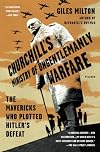
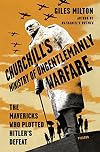
Churchill's Ministry of Ungentlemanly Warfare: The Mavericks Who Plotted Hitler's Defeat
by Giles Milton
On This Page
Description
"Six gentlemen, one goal: the destruction of Hitler's war machine. In the spring of 1939, a top-secret organization was founded in London: its purpose was to plot the destruction of Hitler's war machine through spectacular acts of sabotage. The guerrilla campaign that followed was every bit as extraordinary as the six men who directed it. One of them, Cecil Clarke, was a maverick engineer who had spent the 1930s inventing futuristic caravans. Now, his talents were put to more devious use: he show more built the dirty bomb used to assassinate Hitler's favorite, Reinhard Heydrich. Another, William Fairbairn, was a portly pensioner with an unusual passion: he was the world's leading expert in silent killing, hired to train the guerrillas being parachuted behind enemy lines. Led by dapper Scotsman Colin Gubbins, these men--along with three others--formed a secret inner circle that, aided by a group of formidable ladies, single-handedly changed the course Second World War: a cohort hand-picked by Winston Churchill, whom he called his Ministry of Ungentlemanly Warfare. Churchill's Ministry of Ungentlemanly Warfare is a gripping and vivid narrative of adventure and derring-do that is also, perhaps, the last great untold story of the Second World War"-- show lessTags
Recommendations






Member Recommendations

nessreader There's a lot about SOE in Knightley's book, though he is less enthusiastic about the organisation and sceptical about its usefulness - interesting as a contrasting point of view. (Knightley generally seems to despise spies, in his entire book of 20th century spycraft)
Member Reviews
The ungentlemanly warfare in Giles Milton’s history consists of “murder, sabotage, and subversion” carried out by “undercover men, spies, and saboteurs” during WWII. That species of warfare took its inspiration from Sinn Fein and T.E. Lawrence (of Arabia), and the un-gentlemen so engaged, “if caught, would be neither acknowledged nor defended by their government.” Start playing that Lalo Schifrin theme music and recite: “The Secretary will disavow any knowledge of your actions.”
Those involved were a different breed. Men willing to do the worst things to serve a cause can be men who like doing the worst things. The ministry absolutely had ungentlemanly men among its better sorts to carry out the ungentlemanly plans, show more plans which seem to have excited opposition rather than support from regular officers and ministers. Winston Churchill backed the enterprise, however, so traditionalists just had to accept it.
Before jumping into the murder and sabotage and subversion, the author begins with the technical development efforts supporting these activities. New weaponry was needed and the agents received special training for the new kind of fighting. This first part of the book, though quite interesting to me, is naturally less intense than the mission accounts. Action-addicted readers might get antsy. Stick with it, though, and the goods will be delivered. show less
Those involved were a different breed. Men willing to do the worst things to serve a cause can be men who like doing the worst things. The ministry absolutely had ungentlemanly men among its better sorts to carry out the ungentlemanly plans, show more plans which seem to have excited opposition rather than support from regular officers and ministers. Winston Churchill backed the enterprise, however, so traditionalists just had to accept it.
Before jumping into the murder and sabotage and subversion, the author begins with the technical development efforts supporting these activities. New weaponry was needed and the agents received special training for the new kind of fighting. This first part of the book, though quite interesting to me, is naturally less intense than the mission accounts. Action-addicted readers might get antsy. Stick with it, though, and the goods will be delivered. show less
There are at least two Britains. One is cricket and public schools and the old boys network. The other are hard bastards who ruled the world through merciless force applied to vulnerable places: knives in kidneys, windpipe strikes, kicking them while they're down. The Ministry of Ungentlemanly Warfare is about the latter Britain, an oddly balanced account of the Special Operations Executive during World War 2.
Milton makes his protagonists come alive, particularly Colin Gubbins, with his faith that a good saboteur could do more destruction in a single strike than a fortnight of bombing raids. Gubbins organized a secret army that blended the bored children of the nobility with street toughs and patriotic exiles from occupied Europe. They show more truly did set Europe ablaze!
Milton has a breezy and delightful narrative style, which comes through strongest on the accounts of the great raids: destroying the docks at St. Nazaire, the attack on the Norwegian heavy water plant vital to the Nazi A-bomb, and my new favorite, Operation Postmaster, a piratical cutting-out operation against a spy ship near the African Island of Fernando Po. Milton also has a love of the back office, and the madcap inventors who designed limpet mines, sticky bombs, precision time fuses, and all sorts of specialized Q-branch sabotage devices. I have to give credit to a ploy to replace the lubricant on an SS division's tank transporter rail cars with carborundum right before D-Day as an exceptional use of applied science.
This is a popular history, not a comprehensive work, but it's delightfully written and a worthy addition to anyone's library of dirty tricks. And for disclosure, I won this book in a Goodreads contest. show less
Milton makes his protagonists come alive, particularly Colin Gubbins, with his faith that a good saboteur could do more destruction in a single strike than a fortnight of bombing raids. Gubbins organized a secret army that blended the bored children of the nobility with street toughs and patriotic exiles from occupied Europe. They show more truly did set Europe ablaze!
Milton has a breezy and delightful narrative style, which comes through strongest on the accounts of the great raids: destroying the docks at St. Nazaire, the attack on the Norwegian heavy water plant vital to the Nazi A-bomb, and my new favorite, Operation Postmaster, a piratical cutting-out operation against a spy ship near the African Island of Fernando Po. Milton also has a love of the back office, and the madcap inventors who designed limpet mines, sticky bombs, precision time fuses, and all sorts of specialized Q-branch sabotage devices. I have to give credit to a ploy to replace the lubricant on an SS division's tank transporter rail cars with carborundum right before D-Day as an exceptional use of applied science.
This is a popular history, not a comprehensive work, but it's delightfully written and a worthy addition to anyone's library of dirty tricks. And for disclosure, I won this book in a Goodreads contest. show less
In 1939, Churchill brought together a group of six men whose job was to fight "dirty," as it became clear that guerrilla warfare and innovative weapons might be the only way to beat Hitler. This group of out-of-the-box thinkers used everything from hard candies that dissolved in ocean water to higher mathematics to design bombs and plots that would foil Hitler's plans.
Although at times I felt the book gets bogged down in the bureaucracy of it all (I'd start skimming at the details of who hired whom), there are other places where the book reads like a series of daring, bizarre escapades. My favorite account, toward the end, was about a small group of men who parachuted into Norway to destroy a heavy water plant that Hitler would have show more used to build an atomic bomb. The fact that they landed in a dense blizzard, then (by sheer luck) literally bumped into a solitary hut that sheltered them for four days until the blizzard ended, confounded Nazi resistance, found their resistance counterparts, scaled a huge cliff, on top of which stood the factory, and managed to set off the bombs and escape without significant injury is ... well, it could be a GREAT movie.
What also fascinated me was that the notion of "(un)gentlemanly warfare" in 1939 was produced discursively, in an argument on the Letters page of the London *Times*. One writer claimed that the sword was the only weapon appropriate for a gentleman, as it gave both fellows a chance and made it a "sporting affair." But--another writer pointed out--did it really matter if one cut the enemy's jugular with a sword or a bayonet? This book spends some time tracing the process by which the English eventually acknowledged that Hitler was no longer playing by rules that governed earlier wars. As I read, I had some compassion for Chamberlain; he didn't want to acknowledge that difference--perhaps because it suggested many other kinds of loss. The very definitions of words such as fairness and justice and decency were changing.
I stole this book from my husband's nightstand after we began watching ATLANTIC CROSSING on PBS. I found this book a good companion to the series, which begins in Norway in 1939 and follows the Crown Princess of Norway to America, where she influences FDR's thoughts and policies on the war. I would recommend to fans of WWII true history and of books such as Eric Larson's THE SPLENDID AND THE VILE. show less
Although at times I felt the book gets bogged down in the bureaucracy of it all (I'd start skimming at the details of who hired whom), there are other places where the book reads like a series of daring, bizarre escapades. My favorite account, toward the end, was about a small group of men who parachuted into Norway to destroy a heavy water plant that Hitler would have show more used to build an atomic bomb. The fact that they landed in a dense blizzard, then (by sheer luck) literally bumped into a solitary hut that sheltered them for four days until the blizzard ended, confounded Nazi resistance, found their resistance counterparts, scaled a huge cliff, on top of which stood the factory, and managed to set off the bombs and escape without significant injury is ... well, it could be a GREAT movie.
What also fascinated me was that the notion of "(un)gentlemanly warfare" in 1939 was produced discursively, in an argument on the Letters page of the London *Times*. One writer claimed that the sword was the only weapon appropriate for a gentleman, as it gave both fellows a chance and made it a "sporting affair." But--another writer pointed out--did it really matter if one cut the enemy's jugular with a sword or a bayonet? This book spends some time tracing the process by which the English eventually acknowledged that Hitler was no longer playing by rules that governed earlier wars. As I read, I had some compassion for Chamberlain; he didn't want to acknowledge that difference--perhaps because it suggested many other kinds of loss. The very definitions of words such as fairness and justice and decency were changing.
I stole this book from my husband's nightstand after we began watching ATLANTIC CROSSING on PBS. I found this book a good companion to the series, which begins in Norway in 1939 and follows the Crown Princess of Norway to America, where she influences FDR's thoughts and policies on the war. I would recommend to fans of WWII true history and of books such as Eric Larson's THE SPLENDID AND THE VILE. show less
Government Swashbucklers
The Second World War was dramatically different from any previous conflagration. Its scale, death and level of violence were record-shattering. Winston Churchill, unlike many, could see that as it was developing, and encouraged new forms of weapons and warfare to deal with it. One such effort was a top secret agency dedicated to sabotage. By the time the Allies invaded France, it had run nearly a hundred missions, destroyed factories and infrastructure and even delayed the arrival of Hitler’s strongest unit to aid Rommel in the defense of Normandy – by 15 whole days.
They did it by the seat of their pants. On nearly no budget, they designed and built world class weapons, trained agents, dropped them into show more theaters from Norway to southeast Asia and organized local resistance. They airdropped thousands of containers of weapons. They built millions of bombs. They volunteered for suicide missions and came back successful. Without their constant nibbling at German lines and supplies, the war would clearly have turned out differently.
They made it up as they went along. They got no respect and little co-operation from the armed forces and other government departments. They worked 16 hours a day, seven days a week, and took on hundreds of women to make armaments in requisitioned properties in the countryside. Their exploits were James Bondian in nature and stature, and indeed, Peter Fleming was one of the early recruits. His brother Ian dated the secretary, likely the model for Miss Moneypenny, and possibly for the last time, Britain was at the forefront of saving the world.
The book is divided into adventures, such as the destruction of the world’s largest shipbuilding and drydock at St. Nazaire, France. This caused the Germans’ largest battleship to never leave port as there was no longer anywhere to service it. They took out the heavy water plant in Norway, which prevented the Germans from building an atomic bomb. They destroyed a railway viaduct in Greece that had been supplying the Afrika Corps with numerous trainloads of supplies daily. And they assassinated Heydrich, the brutal overseer of central Europe. So it’s an exciting, adventurous read.
Churchill’s Ministry of Ungentlemanly Warfare is a you-are-there retelling, because so many of the participants lived long lives and wrote about them. They have been celebrated everywhere but government, which almost immediately closed it all down and sent everyone packing. But for four years, it was a thrill to invent, to train to produce and to execute. They succeeded where RAF bombing did not, and aided where help was desperately required. Some of their missions were literally declared impossible. They pulled them off anyway. All behind the scenes and anonymously.
Lord Mountbatten, who followed them closely ever since the St. Nazaire raid, said it was “one of the most thrilling accounts of operations in this war.” It was a different, analog era, where hard work, experiment and risk were everything, and pulling together was a way of life. A world well worth reading about.
David Wineberg show less
The Second World War was dramatically different from any previous conflagration. Its scale, death and level of violence were record-shattering. Winston Churchill, unlike many, could see that as it was developing, and encouraged new forms of weapons and warfare to deal with it. One such effort was a top secret agency dedicated to sabotage. By the time the Allies invaded France, it had run nearly a hundred missions, destroyed factories and infrastructure and even delayed the arrival of Hitler’s strongest unit to aid Rommel in the defense of Normandy – by 15 whole days.
They did it by the seat of their pants. On nearly no budget, they designed and built world class weapons, trained agents, dropped them into show more theaters from Norway to southeast Asia and organized local resistance. They airdropped thousands of containers of weapons. They built millions of bombs. They volunteered for suicide missions and came back successful. Without their constant nibbling at German lines and supplies, the war would clearly have turned out differently.
They made it up as they went along. They got no respect and little co-operation from the armed forces and other government departments. They worked 16 hours a day, seven days a week, and took on hundreds of women to make armaments in requisitioned properties in the countryside. Their exploits were James Bondian in nature and stature, and indeed, Peter Fleming was one of the early recruits. His brother Ian dated the secretary, likely the model for Miss Moneypenny, and possibly for the last time, Britain was at the forefront of saving the world.
The book is divided into adventures, such as the destruction of the world’s largest shipbuilding and drydock at St. Nazaire, France. This caused the Germans’ largest battleship to never leave port as there was no longer anywhere to service it. They took out the heavy water plant in Norway, which prevented the Germans from building an atomic bomb. They destroyed a railway viaduct in Greece that had been supplying the Afrika Corps with numerous trainloads of supplies daily. And they assassinated Heydrich, the brutal overseer of central Europe. So it’s an exciting, adventurous read.
Churchill’s Ministry of Ungentlemanly Warfare is a you-are-there retelling, because so many of the participants lived long lives and wrote about them. They have been celebrated everywhere but government, which almost immediately closed it all down and sent everyone packing. But for four years, it was a thrill to invent, to train to produce and to execute. They succeeded where RAF bombing did not, and aided where help was desperately required. Some of their missions were literally declared impossible. They pulled them off anyway. All behind the scenes and anonymously.
Lord Mountbatten, who followed them closely ever since the St. Nazaire raid, said it was “one of the most thrilling accounts of operations in this war.” It was a different, analog era, where hard work, experiment and risk were everything, and pulling together was a way of life. A world well worth reading about.
David Wineberg show less
> couldn’t work out if Clarke was mad or brilliant or both. ‘He had a disquieting habit, during lectures, of exhibiting to us one of his pets [he means an explosive device] with a large charge attached, placing it on the desk in front of him, cocking it, and announcing: “This will go off in five minutes.”’ He would then proceed with his lecture, unconcerned by the ticking bomb, while his students nervously counted the minutes. ‘During the last half of the last minute the sound of his voice was almost drowned by the shuffling and scraping of chairs, especially from the front rows. When only five seconds remained, and every head in the class was down, he would suddenly remember, pick up the infernal machine, look at it for a show more moment, thoughtfully, and toss it nonchalantly through the window to explode on the lawn with barely a second to spare.’
> ‘He had no guards on the gates to his magnificent estate. One just drove in and then found the vehicle being battered by rounds fired from spigot mortars set off by trip wires.’ Happily for the occupants of the cars in question, these rounds were blanks. ‘Nobby [Clarke] would emerge smiling and point out that if they had been live rounds, the occupants of the vehicle would no longer be in this world.’ This was all very well, ‘but it was of little consolation to the driver, who had to explain how the bodywork of his vehicle had been badly bashed.’
> He spent his leisure hours designing labour-saving domestic contraptions that proved rather less efficient than the weapons he had built during the war. His daughter-in-law Ann was on hand to see the test drive of his homespun pressure cooker. ‘It exploded,’ she said, ‘and bits of chicken had to be picked out of the kitchen ceiling.’ Indeed everything that Cecil touched in that post-war period seemed to explode, even his jars of homemade tomato soup. They blew up in the larder, splattering everything with fermented juice. show less
> ‘He had no guards on the gates to his magnificent estate. One just drove in and then found the vehicle being battered by rounds fired from spigot mortars set off by trip wires.’ Happily for the occupants of the cars in question, these rounds were blanks. ‘Nobby [Clarke] would emerge smiling and point out that if they had been live rounds, the occupants of the vehicle would no longer be in this world.’ This was all very well, ‘but it was of little consolation to the driver, who had to explain how the bodywork of his vehicle had been badly bashed.’
> He spent his leisure hours designing labour-saving domestic contraptions that proved rather less efficient than the weapons he had built during the war. His daughter-in-law Ann was on hand to see the test drive of his homespun pressure cooker. ‘It exploded,’ she said, ‘and bits of chicken had to be picked out of the kitchen ceiling.’ Indeed everything that Cecil touched in that post-war period seemed to explode, even his jars of homemade tomato soup. They blew up in the larder, splattering everything with fermented juice. show less
The story of a special projects bureau, operated by some very British characters (despite the objections of military officers who thought that guerrilla tactics were Not Done) and protected by Churchill. Women and men both played significant roles; one woman, Joan Bright, was supposedly the inspiration for Miss Moneypenny.
It takes a while to get going—the book and the bureau both—but there are some fascinating stories. I didn’t know that blowing up pylons should be done by planting charges under 3 of 4 corners, so it tips over instead of just going down. They also invented new bombs and new timers, which were made with Alka Seltzer because they could be trusted to dissolve with perfect regularity. There was a raid on a Spanish show more harbor that stole three ships out from under their captains’ noses—but it was nearly derailed by the fact that they didn’t correct for time zones, which somehow makes the story better. A later, better raid destroyed a key sub harbor—it involved ramming a boat packed with explosives into the dock—while another cut Rommel’s supply lines for six weeks by destroying a remote bridge in Italy. They delayed the arrival of a key division to Normandy by sabotaging the flatcars that were to take the tanks to the front (tanks being too slow, gas-guzzling, and heavy to make it on their own) by replacing the axle oil on the transports with axle grease laced with abrasive. With this and other traps, a 72-hour journey took seventeen days, and the Allied beachhead was secure.
They made bombs that could be attached to German planes on the ground, but which would only explode at a certain height when the pressure changed enough to force two wires to connect and detonate. They developed shaped charges that could punch through the strongest German tanks and concrete pillboxes, as required for D-Day—and inspired a solution to the problem of detonating the first nuclear bombs through implosion. They made sub-killing bomb groups called the Hedgehog, which sank six subs in a row—“a record unbeaten in the history of naval warfare.” The largest triumph was the destruction first of the only significant source of heavy water for the Germans, in Norway, and then of the remaining stockpile, both with brilliant and gutsy raids. The first was carried out after an initial failure, which had increased security, but the commandos scaled a sheer rock gorge that the Germans thought was impassible.
I also liked the emphasis on training—if you want to do something right, train to do it in as realistic a manner as possible; that’s why they built mock facilities based on plans smuggled out of Norway at great risk. Similarly, later saboteurs trained on models of the Peugeot machines they intended to sabotage to shut down the German production of aircraft parts in France—which they did by convincing Rodolphe Peugeot to assist them by telling him that his factory would either be destroyed by sabotage or by large-scale bombing, and that sabotage would be easier to rebuild from after the war ended. That story also has its funny/scary moments, as when the German guards were kicking a football around and demanded that the saboteurs, dressed as ordinary workers, have a German/French match. One of the saboteurs kicked the ball and a limpet mine fell out of his pocket. A German guard handed it back to him—and the game continued. Later, the same group sabotaged the new compressor that had just been delivered to replace the one destroyed in the first attack. show less
It takes a while to get going—the book and the bureau both—but there are some fascinating stories. I didn’t know that blowing up pylons should be done by planting charges under 3 of 4 corners, so it tips over instead of just going down. They also invented new bombs and new timers, which were made with Alka Seltzer because they could be trusted to dissolve with perfect regularity. There was a raid on a Spanish show more harbor that stole three ships out from under their captains’ noses—but it was nearly derailed by the fact that they didn’t correct for time zones, which somehow makes the story better. A later, better raid destroyed a key sub harbor—it involved ramming a boat packed with explosives into the dock—while another cut Rommel’s supply lines for six weeks by destroying a remote bridge in Italy. They delayed the arrival of a key division to Normandy by sabotaging the flatcars that were to take the tanks to the front (tanks being too slow, gas-guzzling, and heavy to make it on their own) by replacing the axle oil on the transports with axle grease laced with abrasive. With this and other traps, a 72-hour journey took seventeen days, and the Allied beachhead was secure.
They made bombs that could be attached to German planes on the ground, but which would only explode at a certain height when the pressure changed enough to force two wires to connect and detonate. They developed shaped charges that could punch through the strongest German tanks and concrete pillboxes, as required for D-Day—and inspired a solution to the problem of detonating the first nuclear bombs through implosion. They made sub-killing bomb groups called the Hedgehog, which sank six subs in a row—“a record unbeaten in the history of naval warfare.” The largest triumph was the destruction first of the only significant source of heavy water for the Germans, in Norway, and then of the remaining stockpile, both with brilliant and gutsy raids. The first was carried out after an initial failure, which had increased security, but the commandos scaled a sheer rock gorge that the Germans thought was impassible.
I also liked the emphasis on training—if you want to do something right, train to do it in as realistic a manner as possible; that’s why they built mock facilities based on plans smuggled out of Norway at great risk. Similarly, later saboteurs trained on models of the Peugeot machines they intended to sabotage to shut down the German production of aircraft parts in France—which they did by convincing Rodolphe Peugeot to assist them by telling him that his factory would either be destroyed by sabotage or by large-scale bombing, and that sabotage would be easier to rebuild from after the war ended. That story also has its funny/scary moments, as when the German guards were kicking a football around and demanded that the saboteurs, dressed as ordinary workers, have a German/French match. One of the saboteurs kicked the ball and a limpet mine fell out of his pocket. A German guard handed it back to him—and the game continued. Later, the same group sabotaged the new compressor that had just been delivered to replace the one destroyed in the first attack. show less
While the official narrative of World War II has it that the plucky Allies were able to best the Axis forces on the battlefield, according to "The Ministry of Ungentlemanly Warfare", the war was won by the Brits fighting dirty.
Milton recounts tales of British saboteurs successfully damaging a wide array of Nazi infrastructure, to the point that I wanted to hear about a guerilla action going pear shaped. None were covered (although surely something went balls up along the way), leaving "The Ministry of Ungentlemanly Warfare" sounding very much like a hagiography. Still, the tales of derring-do are entertaining enough to make this a pleasant read.
Milton recounts tales of British saboteurs successfully damaging a wide array of Nazi infrastructure, to the point that I wanted to hear about a guerilla action going pear shaped. None were covered (although surely something went balls up along the way), leaving "The Ministry of Ungentlemanly Warfare" sounding very much like a hagiography. Still, the tales of derring-do are entertaining enough to make this a pleasant read.
Members
- Recently Added By
Author Information

31 Works 7,097 Members
Giles Milton is the author, most recently, of the critically acclaimed Nathaniel's Nutmeg (FSG, 1999). He lives in London. (Bowker Author Biography)
Common Knowledge
- Alternate titles
- Churchill's Ministry of Ungentlemanly Warfare: The Mavericks Who Plotted Hitler's Defeat
- Original publication date
- 2016
- People/Characters
- Erwin Rommel; Winston Churchill; Adolf Hitler; Louis Mountbatten Earl Mountbatten of Burma; Frantisek Moravec; Gus March-Phillipps (show all 8); Colin McVean Gubbins; William Fairbairn
- Important places
- Bioko, Equatorial Guinea (as Fernando Po); Bedford, Bedfordshire, England, UK; Saint-Nazaire, Loire-Atlantique, Pays de la Loire, France; Sochaux, Doubs, Bourgogne-Franche-Comté, France
- Important events
- World War II (1939 | 1945); Operation Postmaster
- Epigraph
- Clive, my dear fellow, this is not a gentleman's war. This is a life and death struggle. You are fighting for your very existence against the most devilish idea ever created by a human brain – Nazism. And if you lose there ... (show all)won't be a return match next year, perhaps not even for a hundred years!
The Life and Death of Colonel Blimp
Michael Powell and Emeric Pressburger - Dedication
- For Simon, ever the gentleman.
- First words
- Cecil Clarke viewed his caravan with the sort of affection that most men reserve for their wives.
- Last words
- (Click to show. Warning: May contain spoilers.)And so had those who had fought it with him.
- Blurbers
- Horowitz, Anthony
Classifications
Statistics
- Members
- 699
- Popularity
- 40,630
- Reviews
- 23
- Rating
- (4.12)
- Languages
- 6 — Dutch, English, French, Greek, Italian, Portuguese
- Media
- Paper, Audiobook, Ebook
- ISBNs
- 18
- ASINs
- 7