The Harvester
by Gene Stratton-Porter
On This Page
Description
Many of the protagonists of Gene Stratton-Porter's beloved novels are spunky young women. In The Harvester, the acclaimed author takes on a slightly different subject: a shy, solitary, nature-loving young man who is dedicated to living life on his own terms. Will he ever be able to find a worthy partner who is willing to share his dream? Read The Harvester to find out..
Tags
Recommendations





















Member Reviews
Dreadful. Hard to know where to start with this one... Apart from being horribly overwritten and w-a-a-y too long, it is packed with drivel about Love and Keeping a Clean Body. The Harvester's behaviour in this "relationship" is positively delusional, as well as being patronizing. Most of the characters are unbelievable. Defo not a book for anyone with an iota of feminist sensibility. Basically, tosh from beginning to end. I kept reading because the overarching horror of it made it difficult to look away - rather as with witnessing an accident.
http://nwhyte.livejournal.com/2018695.html
This was America's best-selling novel in 1912; a feelgood romance between a young man who grows vast numbers of medicinal herbs in the Indiana woods, and a girl who appears to him in his dreams. She needs to sort out some mildly complex family issues (evil uncle, dead mother, estranged grandparents); he needs to persuade her that she loves him; it's fairly obvious how things will work out. (I notice that the more recent of the two Hollywood adaptations had to invent a whole new rival romance subplot to make the story interesting.)
The best bits in the book are Stratton-Porter's lyrical descriptions of the scenery:
"They were at the foot of a small levee that ran to the bridge crossing Singing show more Water. On the left lay the valley through which the stream swept from its hurried rush down the hill, a marshy thicket of vines, shrubs, and bushes, the banks impassable with water growth. Everywhere flamed foxfire and cardinal flower, thousands of wild tiger lilies lifted gorgeous orange-red trumpets, beside pearl-white turtle head and moon daisies, while all the creek bank was a coral line with the first opening bloom of big pink mallows. Rank jewel flower poured gold from dainty cornucopias and lavender beard-tongue offered honey to a million bumbling bees; water smart-weed spread a glowing pink background, and twining amber dodder topped the marsh in lacy mist with its delicate white bloom. Straight before them a white-sanded road climbed to the bridge and up a gentle hill between the young hedge of small trees and bushes, where again flowers and bright colours rioted and led to the cabin yet invisible."
I don't think I have heard of even half of the individual species named there, but it adds up to a very pleasing picture, and every chapter has several passages like this.
On the other hand, the characters are a little too perfect to be true, apart from the evil uncle of whom the opposite is the case, and also one or two points where our hero gets a bit manipulative with our heroine, though he does get a mild comeuppance from it. Not too long, compared with some of the other century-old blockbusters I have read. show less
This was America's best-selling novel in 1912; a feelgood romance between a young man who grows vast numbers of medicinal herbs in the Indiana woods, and a girl who appears to him in his dreams. She needs to sort out some mildly complex family issues (evil uncle, dead mother, estranged grandparents); he needs to persuade her that she loves him; it's fairly obvious how things will work out. (I notice that the more recent of the two Hollywood adaptations had to invent a whole new rival romance subplot to make the story interesting.)
The best bits in the book are Stratton-Porter's lyrical descriptions of the scenery:
"They were at the foot of a small levee that ran to the bridge crossing Singing show more Water. On the left lay the valley through which the stream swept from its hurried rush down the hill, a marshy thicket of vines, shrubs, and bushes, the banks impassable with water growth. Everywhere flamed foxfire and cardinal flower, thousands of wild tiger lilies lifted gorgeous orange-red trumpets, beside pearl-white turtle head and moon daisies, while all the creek bank was a coral line with the first opening bloom of big pink mallows. Rank jewel flower poured gold from dainty cornucopias and lavender beard-tongue offered honey to a million bumbling bees; water smart-weed spread a glowing pink background, and twining amber dodder topped the marsh in lacy mist with its delicate white bloom. Straight before them a white-sanded road climbed to the bridge and up a gentle hill between the young hedge of small trees and bushes, where again flowers and bright colours rioted and led to the cabin yet invisible."
I don't think I have heard of even half of the individual species named there, but it adds up to a very pleasing picture, and every chapter has several passages like this.
On the other hand, the characters are a little too perfect to be true, apart from the evil uncle of whom the opposite is the case, and also one or two points where our hero gets a bit manipulative with our heroine, though he does get a mild comeuppance from it. Not too long, compared with some of the other century-old blockbusters I have read. show less
I last read this book probably at least 35 years ago, and was surprised at how much I still love it. I read it tonight on Google Books because my Grandma's copy of this is packed away somewhere in my parent's attic.
This story, of a very Thoreau-ish young man who lives in the country on 600 acres devoted to medicinal plants and herbs, manages to strike a melancholic note without meaning to. Even a hundred years ago he was on a mission to preserve the disappearing flora from the Indiana country side that had been used in traditional and western medicine. I couldn't help but feel how much more we've probably lost in the hundred years since this book was written.
The prose is over-wrought by today's standards, but the story of the plants show more and the noble man behind their cultivation, and his lovely pure-hearted romance of the delicate and sickly young woman that he comes to love still managed to tug at my heart.
It's just a beautiful story and you can't help wishing that there were more men today like David Langston, the Harvester. show less
This story, of a very Thoreau-ish young man who lives in the country on 600 acres devoted to medicinal plants and herbs, manages to strike a melancholic note without meaning to. Even a hundred years ago he was on a mission to preserve the disappearing flora from the Indiana country side that had been used in traditional and western medicine. I couldn't help but feel how much more we've probably lost in the hundred years since this book was written.
The prose is over-wrought by today's standards, but the story of the plants show more and the noble man behind their cultivation, and his lovely pure-hearted romance of the delicate and sickly young woman that he comes to love still managed to tug at my heart.
It's just a beautiful story and you can't help wishing that there were more men today like David Langston, the Harvester. show less
Wow. This one starts as a romance, instead of starting as a nature story and growing a romance later - the nature parts are nicely intertwined with the romance. It's truly wonderful - for all the Cinderella aspects. And since the reader has been with him since he fell in love, we can see it from his side with no Cinderella to it at all...Love it. Lots of twists and turns - seems like he keeps bringing men to the house for her to choose from. But a proper happy ending, despite the misunderstandings right near the end. Best Stratton-Porter book yet.
this is the first Gene Stratton-Porter book that I read - when I was a teenager. I completely fell in love with The Harvester. This is my favorite book of all time - and I've read a lot of books.
I always loved the out doors and wanted to know more about the plants around me, so this book was perfect for me.
I always loved the out doors and wanted to know more about the plants around me, so this book was perfect for me.
David Langston lives a simple life harvesting medicinal herbs to sell in the city. He believes that he has all that he needs in life - that is, until he meets Ruth and everything changes.
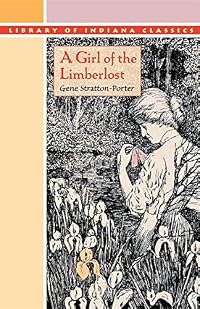
Gene Stratton-Porter was fond of writing romantic novels with settings that emphasized the wonders and beauty of nature. The Harvester is one of her most successful works. Like Freckles and A Girl of the Limberlost it is set near the fictional Indiana town of Onabasha in 1910. David Langston lives alone in a small cabin on the land where he has established America's only farm devoted to growing wild medicinal plants in their ideal natural conditions. Raised by his mother after his father's death, Langston has spent his life in an effort to be honest, manly, and "clean" (Stratton-Porter's code word for sexual abstinence). Each year he leaves it to his dog to decide whether he should stay on his land, or go to Onabasha to look for a wife, show more and every year the dog indicates the land is best--until this year. The Harvester is unwilling to change his lifestyle until the night he experiences a wonderful vision of his perfect woman, decides he can't live without her, and begins his search. When he does find her, he also finds that love is a harder thing than he ever anticipated, and that he will need all his strength, courage, patience, and skill to win and to keep his mate. Set in idyllic surroundings, this is one of Stratton-Porter's best-written novels, and the Harvester himself is one of her most memorable characters. show less
Members
- Recently Added By
Lists

Best 20th Century Books as of 1924
100 works; 6 members

Publisher's Weekly Bestsellers Part I - 1895-1939
399 works; 8 members

Children's Literature 1900 - 1950 in order
413 works; 8 members
Author Information

52+ Works 9,918 Members
Geneva Grace Stratton was born on a farm in Wabash County, Indiana in 1863. Stratton attended public schools. At an early age she roamed the countryside and developed a lively interest in nature and wildlife. In 1874 the family moved to the city of Wabash. She stayed in school until she was almost twenty, but did not receive a high school diploma. show more After an accident Stratton met during her recovery Charles Darwin Porter, a pharmacist from Geneva. He was 13 years her senior, but they were married in 1886. After oil was discovered on some farmland Mr. Porter owned, the Porters built a large house on the edge of the Limberlost swamp, a natural preserve for wild plants, moths, and birds. Stratton-Porter began to photograph birds and animals of the Swamp. Her early photographs appeared in the magazines Recreation and Outing. In 1901 she published her first piece of fiction in Metropolitan magazine. Stratton-Porter made her debut with The Song of the Cardinal. The next story, Freckles, about an orphan who gets a job as a timber guard in Limberlost, became a success. The book was made into a film in 1935 and 1960. During World War I Stratton-Porter moved to California. She wrote editorials for McCall's magazine and founded in 1922 Gene Stratton Porter film company to produce movies of her books. Stratton-Porter died on December 6, 1924, in Los Angeles, from injuries following a traffic accident when her limousine was hit by a trolley car. She was buried in Hollywood Cemetery in California. Her book, The Keeper of the Bees was posthumously published. The book was filmed in 1935. (Bowker Author Biography) show less
Awards and Honors
Distinctions
Series
Belongs to Publisher Series
Work Relationships
Common Knowledge
- Canonical title*
- Drömflickan
- Original publication date
- 1911
- People/Characters
- David Langston; Ruth Jameson; Granny Moreland; Doctor Carey; Henry Jameson; Doctor Harmon (show all 8); Alexander Herron; Marcella Herron
- Important places
- Onabasha, Indiana, USA; USA; Indiana, USA
- Related movies
- The Harvester (1927 | IMDb)
*Some information comes from Common Knowledge in other languages. Click "Edit" for more information.
Classifications
Statistics
- Members
- 614
- Popularity
- 47,320
- Reviews
- 10
- Rating
- (4.17)
- Languages
- English, German, Swedish
- Media
- Paper, Audiobook, Ebook
- ISBNs
- 95
- ASINs
- 44