One Step from Earth
by Harry Harrison
On This Page
Description
After years of research, man's dream of instantaneous transportation through the universe has been realized. Humanity begins to explore, settle and colonize throughout the universe, but in doing so finds itself changing. From the author of Stainless Steel Rat.Tags
Recommendations















Member Reviews
What one invention would most profoundly affect mankind? Some sort of device that, when you have misplaced scissors and are walking round the house making that ‘scissors cutting’ motion with your forefingers actually illuminates the position of your scissors, or sounds a small chime at their location? Possibly. More probably it will be something transport related. This is the theory that Harry Harrison puts forward in ‘One step from Earth’, a collection of short stories about how the practical use of the teleporter (or, Matter Transmitter or ‘M.T.’ as it is referred to throughout) would affect mankind (the answer by the way, revealed in the last short story is: a lot).
Harrison reasonably proposes that the development of show more faster transport has had a profound effect upon the human race (at least that part of it that drive and can afford air travel); that a couple of centuries ago everyone walked, then we had canals and railways and cars and airplanes. In truth, one of the most socially profound technological travel inventions ever has been the sat-nav. This is because couples who would normally have made the discovery that, after however long they have been in a relationship, they now hate one another and would turn bickering about directions to the garden centre into a full blown row and hence split up, no longer have that opportunity. The sat-nav is responsible for extending relationships into injury time.
The history of the MT is the history of colonisation. The stories take place sequentially over many many thousands of years. Although the MT has been invented, allowing instant travel from point A to point B, no matter where that point B may be, you still have to get the point B MT to point B and this has to be done in a rocket ship and this takes time.
The story sequence starts with the MT already invented but still untrusted (the first earth creature on Mars via MT is a lab rat). By the time the collection ends, far in the future, MTs are now referred to as ‘doors’ and are used unthinkingly, to the extent that one of the characters has his home in the centre of an asteroid that cannot be accessed in any other was other than by his ‘door’. He realises with a chill that if the technology were to fail, he’d be left entombed in space and that nobody would know where he was.
The various used that a MT might be put to are explored. In one of the best stories in the collection, ‘Pressure’, the MT is essentially an escape hatch for three explorers who, in a spacegoing diving bell, have descended to the ‘surface’ of Jupiter and have no other way out. In other stories the MT is seen as a vehicle for prospectors to explore and exploit the far reaches of the galaxy.
Although not directly referenced, society obviously breaks down at some point during the outward expansion of mankind to the stars. This leads to some of the best stories in the collection, with technologically superior explorers making contact with former colonies that have forgotten what the MT is for and have slid back into whatever technological age they can sustain. Harrison clearly relishes this sort of plot and the collection includes two very different takes on it, including one where an armed medical team is dispatched to ensure that a plague on a recently recontacted world does not pose a threat to the rest of the galaxy. Possibly this is the natural conclusion of the development of both new strains of disease and modern travel and, in an age where bird flu or swine flu can become a pandemic through air travel, poses interesting questions about what one would do to stop the spread of disease.
There are some strong stories here, and some very strong ideas. Especially fun and surprising are the constant throwaway remarks that bring home just how different the world would be with the MT, with characters talking about commuting from their work to their home simply by stepping through a door – not bad when you consider they work on the Moon and live in Switzerland. show less
Harrison reasonably proposes that the development of show more faster transport has had a profound effect upon the human race (at least that part of it that drive and can afford air travel); that a couple of centuries ago everyone walked, then we had canals and railways and cars and airplanes. In truth, one of the most socially profound technological travel inventions ever has been the sat-nav. This is because couples who would normally have made the discovery that, after however long they have been in a relationship, they now hate one another and would turn bickering about directions to the garden centre into a full blown row and hence split up, no longer have that opportunity. The sat-nav is responsible for extending relationships into injury time.
The history of the MT is the history of colonisation. The stories take place sequentially over many many thousands of years. Although the MT has been invented, allowing instant travel from point A to point B, no matter where that point B may be, you still have to get the point B MT to point B and this has to be done in a rocket ship and this takes time.
The story sequence starts with the MT already invented but still untrusted (the first earth creature on Mars via MT is a lab rat). By the time the collection ends, far in the future, MTs are now referred to as ‘doors’ and are used unthinkingly, to the extent that one of the characters has his home in the centre of an asteroid that cannot be accessed in any other was other than by his ‘door’. He realises with a chill that if the technology were to fail, he’d be left entombed in space and that nobody would know where he was.
The various used that a MT might be put to are explored. In one of the best stories in the collection, ‘Pressure’, the MT is essentially an escape hatch for three explorers who, in a spacegoing diving bell, have descended to the ‘surface’ of Jupiter and have no other way out. In other stories the MT is seen as a vehicle for prospectors to explore and exploit the far reaches of the galaxy.
Although not directly referenced, society obviously breaks down at some point during the outward expansion of mankind to the stars. This leads to some of the best stories in the collection, with technologically superior explorers making contact with former colonies that have forgotten what the MT is for and have slid back into whatever technological age they can sustain. Harrison clearly relishes this sort of plot and the collection includes two very different takes on it, including one where an armed medical team is dispatched to ensure that a plague on a recently recontacted world does not pose a threat to the rest of the galaxy. Possibly this is the natural conclusion of the development of both new strains of disease and modern travel and, in an age where bird flu or swine flu can become a pandemic through air travel, poses interesting questions about what one would do to stop the spread of disease.
There are some strong stories here, and some very strong ideas. Especially fun and surprising are the constant throwaway remarks that bring home just how different the world would be with the MT, with characters talking about commuting from their work to their home simply by stepping through a door – not bad when you consider they work on the Moon and live in Switzerland. show less
This reminded me a great deal of The Seedling Stars. Each book explores various facets and implications of a single technology that opens the universe to human exploration. The last story in this book even addresses the main theme of The Seedling Stars, what it means to be human, directly. And I'm sure that, as with The Seedling Stars and more than most of Larry Niven's stories involving "displacement booths," his take on the "everywhere is one step from everywhere" idea, many of the themes and situations will stick with me even though I have no inclination to reread the book anytime soon.
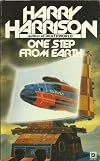
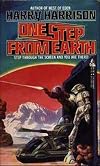
One Step from Earth – Harry Harrison (1972 my Edition 1984 Paperback) Cover : Chris Foss
I sometimes think Harry Harrison’s more serious work is overlooked. One step from the Earth is a collection of linked stories to do with Matter Transmission. In an introduction the author tells us the History of Mankind is the History of Transportation, from walking through boats and flight. Every part of our everyday lives is affected by transportation, from the delivery of good to personal transportation.
A deal good of Science Fiction explores the effects of Space travel through ships warp drives etc. Is that all? Matter Transmitters seems to have got very little attention over the years. Yes, you have the Star Trek short range Teleportation show more devices but the only case of Matter transmission between planets I can think of is Stargate and this collection of stories was written 24 years before that film appeared.
As the synopsis on the reverse of the book says is the invention of instantaneous transportation between the planets a blessing or a curse? There are 9 stories within this collection exploring these questions I will give you a brief summation of them.
The book starts with the title story One Step from earth where we read about the testing of the technology. Pressure is a the second story showing us how the use of Matter Transmission could revolutionise the exploration of deadly environments such as Saturn. No War, or battle’s sound tells us no matter the technology man will use it to make war. We then have a bit of Harrison’s trademark whimsey in Wife to the Lord which has the feel of a more fantasy based story. Waiting Place explores in a roundabout way crime and punishment. The Life Preservers in a very current conversations explores the instantaneous transmission of disease and how to control outbreaks. In 2021/22 this discussion feels very current.
The final two stories in the collection are From Fanaticism, Or For Reward another exploration of crime that includes one of Harrison’s themes throughout his career that of anti-violence. The final story within the collection A Tale of the Ending hits on ideas of self and the slow tide of specialisation and evolution. I won’t spoil the punchline.
This is a strong collection of short stories and I do like it when a collection is assembled around a theme, a few of them do appear in other collections but they all work well in this context. There is a mixture of stories from early in Harry Harrisons career as well as some from later on. As with the best Science Fiction writers, especially of the Golden Age and New Wave, even if technology sometimes overtakes the stories the concepts and themes are still relevant.
Due to the limitations of the Goodreads rating system this is a 3 star, but in reality, is more like a 31/2 rating. To me anything 3 or over is good enough to be recommended for a reread at some point. show less
I sometimes think Harry Harrison’s more serious work is overlooked. One step from the Earth is a collection of linked stories to do with Matter Transmission. In an introduction the author tells us the History of Mankind is the History of Transportation, from walking through boats and flight. Every part of our everyday lives is affected by transportation, from the delivery of good to personal transportation.
A deal good of Science Fiction explores the effects of Space travel through ships warp drives etc. Is that all? Matter Transmitters seems to have got very little attention over the years. Yes, you have the Star Trek short range Teleportation show more devices but the only case of Matter transmission between planets I can think of is Stargate and this collection of stories was written 24 years before that film appeared.
As the synopsis on the reverse of the book says is the invention of instantaneous transportation between the planets a blessing or a curse? There are 9 stories within this collection exploring these questions I will give you a brief summation of them.
The book starts with the title story One Step from earth where we read about the testing of the technology. Pressure is a the second story showing us how the use of Matter Transmission could revolutionise the exploration of deadly environments such as Saturn. No War, or battle’s sound tells us no matter the technology man will use it to make war. We then have a bit of Harrison’s trademark whimsey in Wife to the Lord which has the feel of a more fantasy based story. Waiting Place explores in a roundabout way crime and punishment. The Life Preservers in a very current conversations explores the instantaneous transmission of disease and how to control outbreaks. In 2021/22 this discussion feels very current.
The final two stories in the collection are From Fanaticism, Or For Reward another exploration of crime that includes one of Harrison’s themes throughout his career that of anti-violence. The final story within the collection A Tale of the Ending hits on ideas of self and the slow tide of specialisation and evolution. I won’t spoil the punchline.
This is a strong collection of short stories and I do like it when a collection is assembled around a theme, a few of them do appear in other collections but they all work well in this context. There is a mixture of stories from early in Harry Harrisons career as well as some from later on. As with the best Science Fiction writers, especially of the Golden Age and New Wave, even if technology sometimes overtakes the stories the concepts and themes are still relevant.
Due to the limitations of the Goodreads rating system this is a 3 star, but in reality, is more like a 31/2 rating. To me anything 3 or over is good enough to be recommended for a reread at some point. show less
Indeholder "Introduction: The Matter Transmitter", "One Step From Earth", "Pressure", "No War or Battle's Sound", "Wife to the Lord", "Waiting Place", "The Life Preservers", "From Fanaticism or for Reward", "Heavy Duty", "A Tale of the Ending".
"Introduction: The Matter Transmitter" handler om hvordan science fiction plejer at behandle opfindelser. Denne novellesamling forsøger at behandle Matter Transmission fra start til slut.
"One Step From Earth" handler om Ben Duncan, der bliver sendt gennem en MT til Mars. Her skal han og Otto Thasler samle en sender, så de kan komme hjem igen. Men Otto bliver syg og dør. Lægen der blev sendt op for at kigge på Otto, bliver også syg. Men Ben bliver ikke syg og han vil gerne tlbage til Mars i show more stede for at være i karantæne.
"Pressure" handler om Stan Brandon, Nissim og Aldo, der er inde i en kugle, der er smidt ned i atmosfæren på Saturn. Eneste vej ud er en MT, men den skal lige indstilles først for teori og praksis er lidt uldne i de omgivelser. Efter lang tids nørklen sender de Stan tilbage, men det går ikke helt godt for han ender som grønsag. Det motiverer Nissim og Aldo til at få MT'en helt i orden inden de selv forsøger.
"No War or Battle's Sound" handler om krig, hvor tropper kan sendes ind gennem MT skærme. En Dom Priego overlever et slag og bliver korporal.
"Wife to the Lord" handler om Osie, der er så smuk at brudeprisen kan købe mange landbrugsmaskiner til hendes hjemmeverden, Wirral-Lo. En bejler, Jochann fra Maabarot, vinder udbuddet og får hende til brud. På hans hjemplanet tror folket at han er Gud. Hans brud skal bære præcist eet barn, som skal være en dreng og overtage tronen efter ham. En fertilitetsklinik ordner det fornødne og ni måneder efter føder Osie en søn. Eller måske en Søn, for hvis folk tror på en Gud, så opstår der en Gud? Osie og Jochann har i alt fald fået en søn med en glorie på.
"Waiting Place" handler om Jomfri, der tager MT for at komme hjem til konen, men havner på Fangnis i stedet. En blindgyde af en glemmebog, hvor magthavere og retssystemer kan sende folk til med sindsro, for der er ikke returbillet på en tur til Fangnis. Han får faktisk kontakt med fængselsforvalterne, der slår ham op i systemet og kan fortælle at han er havnet der fordi han slog sin kone ihjel. Ikke at det hjælper på hans fornægtelse.
"The Life Preservers" handler om et hold af læger og militærfolk, der forsøger at komme igennem til en planet, som har været glemt af verden tæt på tusind år. De arbejder for EPC (Emergency Plague Control). En mikrobiolog dr Bucuros, en virolog dr Oglasiti, en epidemiolog dr Pidik, og en ny mand lægen Jan Dacosta. Holdet ledes af en dr Toledano. Den første spejder, der kom gennem MT skærmen blev skudt med en armbrøst-bolt, men hoppede tilbage gennem skærmen og blev behandlet. EPC har det som første prioritet at forhindre epidemier, ikke at helbrede eller skåne. De kører tanks efterfulgt af en hel konvoj gennem MT skærmen og fanger en indfødt. Efter en times tid har sprogfolkene en ok oversætter klar. De kører frem til første by og bliver beskudt med katapulter. De svarer igen med kanonild og får lov at komme ind i byen efter en lille paladsrevolution. Byens hersker Azpi-oyal overgiver sig og er lidt spændt på at se hvad der så vil ske. EPC holdet bruger den første måneds tid på at behandle lokale patienter og samtidig tage prøver og se den lokale mikrobiologi efter i sømmene. Så udbryder der en sygdom, som ser ud til at ramme folk i den rækkefølge de har mødt EPC folkene i. Det ser ud til at være en ricketsia infektion, en art tyfus. Imens kommer en hær nærmere og dr Toledano bliver dræbt, så Dacosta bliver pludselig øverstkommanderende. Han finder ud af at sygdommen er trigget af en allergisk reaktion på polyester og det har EPC folkene jo gjort brug af alle steder. Men når årsagen er fundet, er løsningen jo nær og mon ikke operationen lykkes?
"From Fanaticism or for Reward" handler om en snigmorder, der succesfuldt myrder en mand og dækker sine spor via en kæde af MT skærme. Men The Greater Despot sender en maskine efter ham, der til sidst sporer ham og får oplysninger halet ud af ham, som fortæller hvem der hyrede ham. Og så lader den ham gå, for han er uinteressant.
"Heavy Duty" handler om Langli, der arbejder for en organisation World Openers, der sørger for dækning med MT også på fjerne planeter, men de tager sig også betalt for det. Langli er landet på en planet, hvor arbejdskraft er alt, hvad de kan betale med og det kommer til at vare en menneskealder eller to før de har betalt for en MT, så de selv kan bruge den.
"A Tale of the Ending" handler om to væsener der i en fjern fjern fremtid diskuterer hvor menneskene kom fra oprindeligt og hvorfor de havde 12 fingre. Hmm, måske havde de kun 10 og dem med 12 er en anden slags og hvad skulle forhindre at der kommer en tredje slags?
Talestyring af computere er kommet med, men ellers er det ikke så troværdig en fremtid, der stilles op. show less
"Introduction: The Matter Transmitter" handler om hvordan science fiction plejer at behandle opfindelser. Denne novellesamling forsøger at behandle Matter Transmission fra start til slut.
"One Step From Earth" handler om Ben Duncan, der bliver sendt gennem en MT til Mars. Her skal han og Otto Thasler samle en sender, så de kan komme hjem igen. Men Otto bliver syg og dør. Lægen der blev sendt op for at kigge på Otto, bliver også syg. Men Ben bliver ikke syg og han vil gerne tlbage til Mars i show more stede for at være i karantæne.
"Pressure" handler om Stan Brandon, Nissim og Aldo, der er inde i en kugle, der er smidt ned i atmosfæren på Saturn. Eneste vej ud er en MT, men den skal lige indstilles først for teori og praksis er lidt uldne i de omgivelser. Efter lang tids nørklen sender de Stan tilbage, men det går ikke helt godt for han ender som grønsag. Det motiverer Nissim og Aldo til at få MT'en helt i orden inden de selv forsøger.
"No War or Battle's Sound" handler om krig, hvor tropper kan sendes ind gennem MT skærme. En Dom Priego overlever et slag og bliver korporal.
"Wife to the Lord" handler om Osie, der er så smuk at brudeprisen kan købe mange landbrugsmaskiner til hendes hjemmeverden, Wirral-Lo. En bejler, Jochann fra Maabarot, vinder udbuddet og får hende til brud. På hans hjemplanet tror folket at han er Gud. Hans brud skal bære præcist eet barn, som skal være en dreng og overtage tronen efter ham. En fertilitetsklinik ordner det fornødne og ni måneder efter føder Osie en søn. Eller måske en Søn, for hvis folk tror på en Gud, så opstår der en Gud? Osie og Jochann har i alt fald fået en søn med en glorie på.
"Waiting Place" handler om Jomfri, der tager MT for at komme hjem til konen, men havner på Fangnis i stedet. En blindgyde af en glemmebog, hvor magthavere og retssystemer kan sende folk til med sindsro, for der er ikke returbillet på en tur til Fangnis. Han får faktisk kontakt med fængselsforvalterne, der slår ham op i systemet og kan fortælle at han er havnet der fordi han slog sin kone ihjel. Ikke at det hjælper på hans fornægtelse.
"The Life Preservers" handler om et hold af læger og militærfolk, der forsøger at komme igennem til en planet, som har været glemt af verden tæt på tusind år. De arbejder for EPC (Emergency Plague Control). En mikrobiolog dr Bucuros, en virolog dr Oglasiti, en epidemiolog dr Pidik, og en ny mand lægen Jan Dacosta. Holdet ledes af en dr Toledano. Den første spejder, der kom gennem MT skærmen blev skudt med en armbrøst-bolt, men hoppede tilbage gennem skærmen og blev behandlet. EPC har det som første prioritet at forhindre epidemier, ikke at helbrede eller skåne. De kører tanks efterfulgt af en hel konvoj gennem MT skærmen og fanger en indfødt. Efter en times tid har sprogfolkene en ok oversætter klar. De kører frem til første by og bliver beskudt med katapulter. De svarer igen med kanonild og får lov at komme ind i byen efter en lille paladsrevolution. Byens hersker Azpi-oyal overgiver sig og er lidt spændt på at se hvad der så vil ske. EPC holdet bruger den første måneds tid på at behandle lokale patienter og samtidig tage prøver og se den lokale mikrobiologi efter i sømmene. Så udbryder der en sygdom, som ser ud til at ramme folk i den rækkefølge de har mødt EPC folkene i. Det ser ud til at være en ricketsia infektion, en art tyfus. Imens kommer en hær nærmere og dr Toledano bliver dræbt, så Dacosta bliver pludselig øverstkommanderende. Han finder ud af at sygdommen er trigget af en allergisk reaktion på polyester og det har EPC folkene jo gjort brug af alle steder. Men når årsagen er fundet, er løsningen jo nær og mon ikke operationen lykkes?
"From Fanaticism or for Reward" handler om en snigmorder, der succesfuldt myrder en mand og dækker sine spor via en kæde af MT skærme. Men The Greater Despot sender en maskine efter ham, der til sidst sporer ham og får oplysninger halet ud af ham, som fortæller hvem der hyrede ham. Og så lader den ham gå, for han er uinteressant.
"Heavy Duty" handler om Langli, der arbejder for en organisation World Openers, der sørger for dækning med MT også på fjerne planeter, men de tager sig også betalt for det. Langli er landet på en planet, hvor arbejdskraft er alt, hvad de kan betale med og det kommer til at vare en menneskealder eller to før de har betalt for en MT, så de selv kan bruge den.
"A Tale of the Ending" handler om to væsener der i en fjern fjern fremtid diskuterer hvor menneskene kom fra oprindeligt og hvorfor de havde 12 fingre. Hmm, måske havde de kun 10 og dem med 12 er en anden slags og hvad skulle forhindre at der kommer en tredje slags?
Talestyring af computere er kommet med, men ellers er det ikke så troværdig en fremtid, der stilles op. show less
Jun 22, 2012 (Edited)Danish
Ratings
Members
- Recently Added By
Author Information

440+ Works 44,399 Members
Harry Harrison was born Henry Maxwell Dempsey on March 12, 1925 in Stamford, Connecticut. He was drafted into the U. S. Air Corps in 1943 and became a sharpshooter, a military policeman, a gunnery instructor, and a specialist in the prototypes of computer-guided bomb-sights and gun turrets. After being discharged, he graduated from Hunter College show more with a degree in art. By the end of the 1940s, he was running a small studio that specialized in selling illustrations to comics and science-fiction magazines. He then moved on to editing some of the magazines. As the market for comics began to shrink, he started writing for science-fiction magazines. He wrote short science fiction stories and novels including Deathworld, Captive Universe, Montezuma's Revenge, Star Smashers of the Galaxy Rangers, Stonehenge, West of Eden, Stars and Stripes Forever. He also wrote the Stainless Steel Rat series and the Bill, the Galactic Hero series. His novel Make Room! Make Room! Was the inspiration for the movie Soylent Green. He also wrote under the pseudonyms Hank Dempsey, Felix Boyd, Wade Kaempfert, Cameron Hall, Philip St. John, and Leslie Charteris. He died on August 15, 2012 at the age of 87. (Bowker Author Biography) show less
Some Editions
Series
Belongs to Publisher Series
Prisma Science Fiction (1498)
Science Fiction Book Club (2309)
Work Relationships
Contains
Common Knowledge
- Original publication date
- 1970
- First words
- This is the history of the invention that is called the Matter Transmitter. MT for short. [Introduction]
There was a light knock on the compartment door that Adam Ward heard, ignored. [In the Beginning] - Last words
- (Click to show. Warning: May contain spoilers.)+ I think always. What thing is waiting out there, that will sometime – perhaps even now – replace us? +
- Original language
- English
- Disambiguation notice
- Short story collection.
Contents: Introduction -- In the Beginning -- One Step from Earth -- Pressure -- No War, or Battle's Sound -- Wife to the Lord -- Waiting Place -- The Life Preservers -- From Fanaticism, or for... (show all) Reward -- Heavy Duty -- A Tale of the Ending
Classifications
Statistics
- Members
- 416
- Popularity
- 74,359
- Reviews
- 4
- Rating
- (3.61)
- Languages
- Dutch, English, German
- Media
- Paper, Ebook
- ISBNs
- 7
- ASINs
- 11