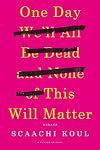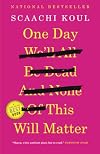
One Day We'll All Be Dead and None of This Will Matter: Essays
by Scaachi Koul
On This Page
Description
"In One Day We'll All Be Dead and None of This Will Matter, Scaachi Koul deploys her razor sharp humor to share all the fears, outrages, and mortifying moments of her life. She learned from an early age what made her miserable, and for Scaachi anything can be cause for despair. Whether it's a shopping trip gone awry; enduring awkward conversations with her bikini waxer; overcoming her fear of flying while vacationing halfway around the world; dealing with internet trolls, or navigating the show more fears and anxieties of her parents. Alongside these personal stories are pointed observations about life as a woman of color, where every aspect of her appearance is open for critique, derision, or outright scorn. Where strict gender rules bind in both Western and Indian cultures, leaving little room for a woman not solely focused on marriage and children to have a career (and a life) for herself"-- show lessTags
Recommendations
















Member Reviews
audiobook read by author (with quotes added by her father) biographical essays and observations from Canadian-born daughter of Indian immigrants
it seems like a lot of people had trouble relating to this author's experiences, but that's sort of the point. There is no "one experience" for all brown people, just as there's not one experience for all Canadians or Americans. The point is to get more of these diverse voices out there so that people can be more aware of this fact, and to help us build empathy with folks whose cultures are unfamiliar.
I strongly recommend the audio version; she's funny and it probably sets the tone better than the print version.
I did find the essay where she talks about "party culture" and getting roofied show more multiple times on different occasions to be eye-opening and important (horrifying, really), especially in light of current events. I would make every teen girl read it (and probably all genders, followed by an open discussion about consent, alcoholism, and alcohol-induced blackouts) if it would keep everyone safer. show less
it seems like a lot of people had trouble relating to this author's experiences, but that's sort of the point. There is no "one experience" for all brown people, just as there's not one experience for all Canadians or Americans. The point is to get more of these diverse voices out there so that people can be more aware of this fact, and to help us build empathy with folks whose cultures are unfamiliar.
I strongly recommend the audio version; she's funny and it probably sets the tone better than the print version.
I did find the essay where she talks about "party culture" and getting roofied show more multiple times on different occasions to be eye-opening and important (horrifying, really), especially in light of current events. I would make every teen girl read it (and probably all genders, followed by an open discussion about consent, alcoholism, and alcohol-induced blackouts) if it would keep everyone safer. show less
I was hooked from the get go. Having just read Shrill and other memoirs by Jenny Lawson, Mindy Kaling, etc. this was the perfect fit for me. This memoir by Scaachi Koul, a first generation Indian immigrant living in Canada was heartfelt, hilarious, and impossible to put down. I read it in less than a day. I especially loved the stories about her parents and her zany yet loving, upbringing. I grew up close to a loving Indian family so I know a smidge about their culture, food, and festivals and Koul's stories took me back. Koul also talks about hard subjects like: rape, alcoholism, gender bias, growing up ethnic in a white neighborhood, and struggling with body image. Each chapter is filled with wit, wisdom, and lil' nuggets that will show more get you thinking. Definitely keeping around for a re-read. show less
I first heard Canadian writer Scaachi Koul on this incredibly moving segment of This American Life about her effort to learn her parents’ native languages after resisting them for a long time. The essays in this book vary widely from a bit of Bridget-Jonesian drivel about disaster in a clothing store to a righteously angry one about creepy men in bars to the essays about her family and visits to India which range from hilarious to enlightening to unbearably poignant. I recommend them all except for the second one, “Size Me Up”, with the shopping. As a reader with roots of my own in another country I am keenly aware of the difficulty of conveying the untranslatable experience of living in another language and culture, so I really show more appreciate that the author manages to pull it off. show less
I’d been salivating over this book for a while, ever since I’d seen it on multiple lists last year of forthcoming books. A month ago I thought it was out but realized that was just in Canada and not the U.S. Found it on Netgalley and finally was able to read it after begging the publisher to approve me on Twitter. :D
Scaachi Koul is a Buzzfeed writer who’s probably best-known for when she put out a request on Twitter for non-white writers and started a completely undeserved shitstorm. The very people who often disparagingly call liberals “special snowflakes” lost their freakin’ minds. Anyway, before I go off on that tangent (and she talks about this whole episode in her life in the book)...
Koul is the child of Indian parents, show more specifically parents from the Kashmir region of India, so that’s another reason I wanted to read this: I’m really interested in reading writing of people with whom I can identify, even a little bit.
In that, the book didn’t disappoint. The struggles of an immigrant or the child of immigrants are uphill, especially when you’re younger, and Koul really gets into that, throughout multiple essays. One thing that I think a lot of brown people who grew up here can identify with is this particular line: “I tried to force myself out of brownness at her age, but the older I get, the more I tuck myself into it.” When you’re younger, you try to separate yourself from your culture to fit in (despite all the shit you face from your parents for doing so), but as you grow older you realize what a mistake that was.
Fitting is a luxury rarely given to immigrants, or the children of immigrants. We are stuck in emotional purgatory. Home, somehow, is always the last place you left, and never the place you’re in.
Some of the strongest parts of the book were when she talked about her parents: their experiences as immigrants, their relationship with her, their perceptions as people living away from their homeland. I saw a lot of my parents reflected in her parents, and it made me consider them in ways that I probably hadn’t enough thought to before. This line especially resonated:
So much of immigration is about loss. First you lose bodies: people who die, people whose deaths you missed. Then you lose history: no one speaks the language anymore, and successive generations grow more and more westernized. Then you lose memory: throughout this trip, I tried to place people, where I had met them, how I knew them. I can’t remember anything anymore.
Her experience of returning to a place in India as an adult that she’d previously visited only as a kid could have been me doing the same thing in my life. Knowing that others have these same feelings and experiences, and reading about them, is so validating. I’m so glad that voices like Koul’s have a place now in mainstream culture. You don’t think about it actively, but it’s like all the arguments being made for having more than just white people on TV and in movies: Representation matters.
The essay on rape culture, Hunting Season, was another stunning, strong piece. I’d actually read it before on Buzzfeed (which leads me to believe that much of the book may be from pieces she’s already written online), but it can certainly be read over and over and shared with everyone you know. Her insights on how men watch women are so on point.
Surveillance feeds into rape culture more than drinking ever could. It’s the part of male entitlement that makes them believe they’re owed something if they pay enough attention to you, monitor how you’re behaving to see if you seem loose and friendly enough to accommodate a conversation with a man you’ve never met. He’s not a rapist. No, he’s just offering to buy you a beer, and a shot, and a beer, and another beer, he just wants you to have a really good time. He wants you to lose the language of being able to consent. He’s drunk too, but of course, you’re not watching him like he’s watching you.
And of course, the aforementioned chapter on the disgusting harassment she faced on Twitter was another fantastic essay. I highlighted the hell out of that section but I’ll leave just this one quote here:
But all things built by humans descend into the same pitfalls: loathing, vitriol, malicious intent. All the things we build in order to communicate, to connect, to find people like us so we feel less alone, and to find people not like us at all so we learn how to adapt, end up turning against us.
Basically, throughout most of this book, I would sigh softly and highlight something and reflect on what I’d just read. There were definitely things that Koul writes that I disagree with but hers is an interesting, and often hilarious, perspective to read. I’ve been shouting about this book to everyone, even before I finished it, and I already know a couple people I’ll be buying it for. Highly recommended.
Note: I received this book from NetGalley in exchange for an honest review. show less
Scaachi Koul is a Buzzfeed writer who’s probably best-known for when she put out a request on Twitter for non-white writers and started a completely undeserved shitstorm. The very people who often disparagingly call liberals “special snowflakes” lost their freakin’ minds. Anyway, before I go off on that tangent (and she talks about this whole episode in her life in the book)...
Koul is the child of Indian parents, show more specifically parents from the Kashmir region of India, so that’s another reason I wanted to read this: I’m really interested in reading writing of people with whom I can identify, even a little bit.
In that, the book didn’t disappoint. The struggles of an immigrant or the child of immigrants are uphill, especially when you’re younger, and Koul really gets into that, throughout multiple essays. One thing that I think a lot of brown people who grew up here can identify with is this particular line: “I tried to force myself out of brownness at her age, but the older I get, the more I tuck myself into it.” When you’re younger, you try to separate yourself from your culture to fit in (despite all the shit you face from your parents for doing so), but as you grow older you realize what a mistake that was.
Fitting is a luxury rarely given to immigrants, or the children of immigrants. We are stuck in emotional purgatory. Home, somehow, is always the last place you left, and never the place you’re in.
Some of the strongest parts of the book were when she talked about her parents: their experiences as immigrants, their relationship with her, their perceptions as people living away from their homeland. I saw a lot of my parents reflected in her parents, and it made me consider them in ways that I probably hadn’t enough thought to before. This line especially resonated:
So much of immigration is about loss. First you lose bodies: people who die, people whose deaths you missed. Then you lose history: no one speaks the language anymore, and successive generations grow more and more westernized. Then you lose memory: throughout this trip, I tried to place people, where I had met them, how I knew them. I can’t remember anything anymore.
Her experience of returning to a place in India as an adult that she’d previously visited only as a kid could have been me doing the same thing in my life. Knowing that others have these same feelings and experiences, and reading about them, is so validating. I’m so glad that voices like Koul’s have a place now in mainstream culture. You don’t think about it actively, but it’s like all the arguments being made for having more than just white people on TV and in movies: Representation matters.
The essay on rape culture, Hunting Season, was another stunning, strong piece. I’d actually read it before on Buzzfeed (which leads me to believe that much of the book may be from pieces she’s already written online), but it can certainly be read over and over and shared with everyone you know. Her insights on how men watch women are so on point.
Surveillance feeds into rape culture more than drinking ever could. It’s the part of male entitlement that makes them believe they’re owed something if they pay enough attention to you, monitor how you’re behaving to see if you seem loose and friendly enough to accommodate a conversation with a man you’ve never met. He’s not a rapist. No, he’s just offering to buy you a beer, and a shot, and a beer, and another beer, he just wants you to have a really good time. He wants you to lose the language of being able to consent. He’s drunk too, but of course, you’re not watching him like he’s watching you.
And of course, the aforementioned chapter on the disgusting harassment she faced on Twitter was another fantastic essay. I highlighted the hell out of that section but I’ll leave just this one quote here:
But all things built by humans descend into the same pitfalls: loathing, vitriol, malicious intent. All the things we build in order to communicate, to connect, to find people like us so we feel less alone, and to find people not like us at all so we learn how to adapt, end up turning against us.
Basically, throughout most of this book, I would sigh softly and highlight something and reflect on what I’d just read. There were definitely things that Koul writes that I disagree with but hers is an interesting, and often hilarious, perspective to read. I’ve been shouting about this book to everyone, even before I finished it, and I already know a couple people I’ll be buying it for. Highly recommended.
Note: I received this book from NetGalley in exchange for an honest review. show less
Best for: People who enjoy strong, witty writers who are able to handle fluffy and serious topics with equal finesse.
In a nutshell: Scaachi Koul shares some snipets of her life as the child of Indian immigrant now living in Canada.
Line that sticks with me: “It changes you, when you see someone similar to you, doing the thing you might want to do yourself.” (p 123)
Why I chose it: Because Lindy West, Jessica Valenti and Samantha Irby can’t all be wrong.
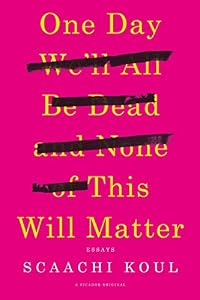
Review: I’d seen this book in my local bookstore a bunch of times and always walked past it because I thought it was a much more serious book. I didn’t fully process that the title was more of a joke than some clever way of of being hopeful (I’ve got the cover uploaded here so show more hopefully you see what I mean); that’s on me. Then I finally picked it up and flipped it over, and three of my favorite authors — and just generally awesome women — provided the blurbs. So obviously I purchased it immediately.
This is a collection of loosely connected essays in which Ms. Koul shares her perspective as a woman whose parents immigrated to Canada from India before she was born. She talks about body issues (the chapter on body hair is amazing), about being lighter skinned than other Indians. She talks about online harassment and rape culture.
I enjoyed Ms. Koul’s style of writing and her wit. Not everything is a laugh out loud joke, and some parts and extremely serious, but the book never feels heavy in a bad way. She somehow makes challenging topics feel manageable, if that makes sense. I’m so happy I got this book, and look forward to reading more from her. show less
In a nutshell: Scaachi Koul shares some snipets of her life as the child of Indian immigrant now living in Canada.
Line that sticks with me: “It changes you, when you see someone similar to you, doing the thing you might want to do yourself.” (p 123)
Why I chose it: Because Lindy West, Jessica Valenti and Samantha Irby can’t all be wrong.
Review: I’d seen this book in my local bookstore a bunch of times and always walked past it because I thought it was a much more serious book. I didn’t fully process that the title was more of a joke than some clever way of of being hopeful (I’ve got the cover uploaded here so show more hopefully you see what I mean); that’s on me. Then I finally picked it up and flipped it over, and three of my favorite authors — and just generally awesome women — provided the blurbs. So obviously I purchased it immediately.
This is a collection of loosely connected essays in which Ms. Koul shares her perspective as a woman whose parents immigrated to Canada from India before she was born. She talks about body issues (the chapter on body hair is amazing), about being lighter skinned than other Indians. She talks about online harassment and rape culture.
I enjoyed Ms. Koul’s style of writing and her wit. Not everything is a laugh out loud joke, and some parts and extremely serious, but the book never feels heavy in a bad way. She somehow makes challenging topics feel manageable, if that makes sense. I’m so happy I got this book, and look forward to reading more from her. show less
Maybe it's because I'm bi racial and from the Canadian prairies but this book really spoke to me. In these essays there are poignant notes of casual racism, growing up other, and being othered. There are moments of pure feminism, and social justice. The chapter on the culture of surveillance spoke to my 20's in ways I can't explain. Brown girl hair problems both real and imagined made me laugh quite literally out loud. The internet in Canada before twitter was my teen years. A truly wonderful book.
***after rereading my own review***
After waiting a while and rereading my won review I don't feel any different. But it does feel like I veered off topic. This book very much invites you to. To talk about what you just read. To question what the writer meant. It doesn't always end in heavy conversations. But it certainly can start them.
***Initial review***
This was such an uncomfortable read at times. It made me think about my own place in my culture. In my family. In the world. As a person. As a woman. As a child of two cultures.
But it was a good read. One of the best I had this year.
It made me cry. It made me show more angry. It made me laugh. It started uncomfortable conversations with my partner who didn't understand my reactions. It made me adore him even more. It made me angry at him for not understanding. It made me feel.
I feel like I learned something about a culture not my own while shaking my head because it felt so foreign.
I would recommend this to everyone but I do think not everyone would get something out of it like I did. The reason why would be part of the conversation about why she keeps talking that way about white people.
You either get it or you don't. And when you get it... Keep talking to other people who get it. You're not alone.
If you don't get it. Keep asking questions. And try to remove your own personal experiences from the conversation.
Scaachi Koul gets it. But even better, she tries to explain. show less
After waiting a while and rereading my won review I don't feel any different. But it does feel like I veered off topic. This book very much invites you to. To talk about what you just read. To question what the writer meant. It doesn't always end in heavy conversations. But it certainly can start them.
***Initial review***
Partner: "Why does she keep talking about white people?"
Me: "... I can't even imagine where to start with that explanation."
This was such an uncomfortable read at times. It made me think about my own place in my culture. In my family. In the world. As a person. As a woman. As a child of two cultures.
But it was a good read. One of the best I had this year.
It made me cry. It made me show more angry. It made me laugh. It started uncomfortable conversations with my partner who didn't understand my reactions. It made me adore him even more. It made me angry at him for not understanding. It made me feel.
I feel like I learned something about a culture not my own while shaking my head because it felt so foreign.
I would recommend this to everyone but I do think not everyone would get something out of it like I did. The reason why would be part of the conversation about why she keeps talking that way about white people.
You either get it or you don't. And when you get it... Keep talking to other people who get it. You're not alone.
If you don't get it. Keep asking questions. And try to remove your own personal experiences from the conversation.
Scaachi Koul gets it. But even better, she tries to explain. show less
Members
- Recently Added By
Lists

Essays/Memoir/Nonfiction
10 works; 1 member

NPR Readers Poll: 100 Favorite Funny Books
100 works; 5 members
Author Information

4 Works 715 Members
Awards and Honors
Awards
Distinctions
Notable Lists
Common Knowledge
- Original publication date
- 2017-03-07
- Important places
- Canada
- Dedication
- For my parents, who will outlive us all, one way or another.
- Blurbers
- West, Lindy; Valenti, Jessica; Irby, Samantha
- Original language
- English
Classifications
Statistics
- Members
- 642
- Popularity
- 44,909
- Reviews
- 20
- Rating
- (3.75)
- Languages
- English, Italian
- Media
- Paper, Audiobook, Ebook
- ISBNs
- 12
- ASINs
- 4