On This Page
Description
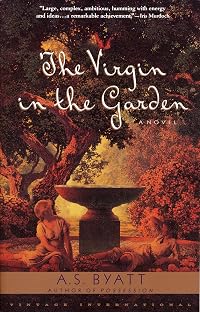
In 1953, at an isolated boys' school in the Yorkshire moors, is a young teacher, Alexander Wedderburn, whose imagination had been captured by the Queen Elizabeth of Shakespeare and Spenser and who has written an historical verse play about her. Now, suddenly, his play has been taken up by a wealthy patron of the arts who envisions its production on the most magnificent scale, for it is to be the climax of a local festival honoring the new Queen Elizabeth. The novel holds us in suspense as it show more carries us to the great event of the play itself-in its Midsummer-Night's atmosphere of dream, of magic, of transforming revelry-that will alter forever the course of all the characters' lives. show lessTags
Recommendations












Member Recommendations
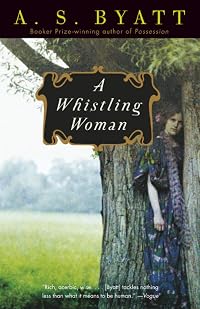
KayCliff Both novels feature Frederica Potter.
Member Reviews
This is my first attempt at reading Byatt and I'm honestly not sure what I thought. I liked it, but there were definitely aspects of the book that I didn't connect with. This is a hard book to describe. It's basically a family drama and is the first of a series of four books following the Potter family, specifically Frederica Potter. But then again, the family drama description doesn't work too well, because the family rarely interacts. The entire book is a flashback from the early 70s to 1953, the year of Elizabeth II's coronation. This event and the production of a play written by one of the main characters about the reign of Elizabeth I frame the novel.
First the positives - I very much enjoyed Byatt's style. She has a beautiful way show more of describing setting. She also strikes a good balance between wordy description and succinct characterizations. I think she's brilliant at choosing the right way to describe each setting, character and event either in a long, drawn-out way or in one sentence. That was neat. It's also rare that I like a book in which I pretty much hate every character, but somehow she did it even though it did detract from my overall enjoyment of the book.
The negatives would be, again, that I didn't really like any of the characters. Everyone was very immature and had terrible judgment. Also, there were a lot of people almost having sex and that was annoying. I felt like screaming either do it or leave each other alone !!!! to almost every character. Also, one of the characters, Marcus, who is the brother of Frederica Potter is either a genius or crazy and befriends a seriously crazy teacher. There are lots of chapters about these strange metaphysical ideas that they have that I found pretty boring to read.
So, overall I liked Byatt's writing without particularly liking this book. I'm curious to try Possession since I've heard great things about it, but I'm not sure I'll continue with this 4 book series. show less
First the positives - I very much enjoyed Byatt's style. She has a beautiful way show more of describing setting. She also strikes a good balance between wordy description and succinct characterizations. I think she's brilliant at choosing the right way to describe each setting, character and event either in a long, drawn-out way or in one sentence. That was neat. It's also rare that I like a book in which I pretty much hate every character, but somehow she did it even though it did detract from my overall enjoyment of the book.
The negatives would be, again, that I didn't really like any of the characters. Everyone was very immature and had terrible judgment. Also, there were a lot of people almost having sex and that was annoying. I felt like screaming either do it or leave each other alone !!!! to almost every character. Also, one of the characters, Marcus, who is the brother of Frederica Potter is either a genius or crazy and befriends a seriously crazy teacher. There are lots of chapters about these strange metaphysical ideas that they have that I found pretty boring to read.
So, overall I liked Byatt's writing without particularly liking this book. I'm curious to try Possession since I've heard great things about it, but I'm not sure I'll continue with this 4 book series. show less
The play's the thing...If Proust, George Eliot, and D. H. Lawrence met in a bar and struck up a conversation about art, love, nature, desire, religion, and literature, you would have something like A. S. Byatt’s work. As I said last summer in my review of The Children’s Book, I’m ashamed it’s taken me so long to get to her work after a hazy memory of a bad experience with Possession in grad school.
And after something like a month with The Virgin in the Garden, I’m ready to commit much of my upcoming summer to the rest of Byatt’s Frederica quartet. This book was such a pleasure to get lost in: filled with references to visual art, classical mythology, the 1953 coronation of Elizabeth II, and the Golden Age of the first show more Elizabeth while a verse play about her reign is being staged on the heels of the accession. Astute readers may know some references, but hardly all: Byatt’s work—and I’m going off The Children’s Book here only, as it’s more freshly imprinted on my mind—will have everyone Googling at least something. For me, that was part of the fun of it—and also why it took so long to get through.
Which leads me to a gripe: the main criticism of this book, from what I’ve read, and perhaps of Byatt’s work in general, is that it’s too showy, it’s too snobbish, it revels too much in its own intellectual curiosities. But so what? These aren’t books aimed to be bestsellers; these are for those who read to learn, those who want to delve deeply into history, art, music, literature, and how these impact and influence our daily lives. If those don’t have any impact on or relevance to your daily life, then Byatt isn’t writing for you. It’s not her, it’s you.
I really enjoyed how all of the characters were fleshed out here, from major to minor; not only can Byatt make your head spin with her impressive knowledge, but she knows how to tell a story and she knows how to make her characters come alive, feel as real as people you know, and compel you to want more. From the playwright/teacher Alexander who stands in the midst of all of the pageantry and quite a great deal of sexual rivalry, to the sensitive, withdrawn, “visionary” Marcus, whose genius for geometry is tempered by a strange foray into metaphysical realms with a tutor who claims to have the wisdom to decipher things; from Stephanie, who rebels against her secular, tyrannical father while at Cambridge only to conform—on almost all levels—once she’s back in the fold, to Frederica, the emblem of the new age, and about whose journeys I look forward to reading in the remaining three books.
These are all flesh-and-blood characters, and Byatt shifts from one to another in sometimes expected and sometimes prescient ways: even when the book flags a bit, it still soars. It’s a true performance, in every sense of the word.
Onward to Still Life. show less
https://fromtheheartofeurope.eu/the-virgin-in-the-garden-by-a-s-byatt/
I see a lot of online reviews complaining that this book is dense and incomprehensible. I loved it actually. It’s the story of Frederica Potter, turning 18 in the summer of 1953, and her crazy academic family and the English town where they live. A lot of it is about a pageant celebrating the life of Elizabeth I, with the coronation of Elizabeth II running in the background. A lot of it is about sex and love. There are some vivid set-pieces, and some well observed bits of humanity. I found Frederica’s father, dominant in his own family until his children grow up and away from him, a particularly interesting character.
I see a lot of online reviews complaining that this book is dense and incomprehensible. I loved it actually. It’s the story of Frederica Potter, turning 18 in the summer of 1953, and her crazy academic family and the English town where they live. A lot of it is about a pageant celebrating the life of Elizabeth I, with the coronation of Elizabeth II running in the background. A lot of it is about sex and love. There are some vivid set-pieces, and some well observed bits of humanity. I found Frederica’s father, dominant in his own family until his children grow up and away from him, a particularly interesting character.
This is one of those books that makes you feel ill-informed, but is enjoyable nonetheless. The prose is beautiful and the characters well-drawn, if not entirely likeable. A S Byatt even manges to make the ridiculously precocious Frederica Potter sound believable, although in my view, your changes of finding a 17 year old with her depth of knowledge and vocabulary are slim indeed.
Not quite as good as Possession, but much better than The Game. The best endorsement I can probably give is that I've moved straight on to reading Still Life, the second book in the Quartet.
Not quite as good as Possession, but much better than The Game. The best endorsement I can probably give is that I've moved straight on to reading Still Life, the second book in the Quartet.
This is (in part) another novel about a clever adolescent setting out into the unknown world of adult life, the first of four novels Byatt wrote, over a period of 25 years, about the character Frederica Potter. But it feels like a much more grown-up novel than The shadow of the sun and The game. It has the kind of scale and ambition that invites you to compare it with Middlemarch and South Riding — more especially since, like the latter, it's set in a lightly-fictionalised part of Yorkshire. Dozens of characters, four or five intertwined plot lines, lots of scenery, religion, politics, literary analysis, art-history, and all the rest.
The story is set in 1953, when Frederica is seventeen, but it's explicitly framed from the point of show more view of someone looking back from twenty years later, and thus able to comment with ironic distance on the short-lived "New Elizabethan" cultural enthusiasms of the Festival of Britain/Coronation period. (Oddly relevant again with the current British government trying to whip up enthusiasm for Mrs May's "Festival of Brexit"...). Most of the action is set around a fictional market town and a nearby small cathedral town in North Yorkshire — you could imagine them as Boroughbridge and Ripon, for instance, although Byatt is careful not to be too specific. And there are trips out to places like Knaresborough, Filey, Scarborough, Goathland and York to keep us in a Yorkshire mood.
At the centre of the plot is an outdoor production of Alexander Wedderburn's new verse-drama Astraea at a Yorkshire stately home, in which the schoolgirl Frederica has been chosen to play the young Elizabeth I. Frederica is madly in love with the romantic Alexander, but he's far too canny to get involved with a colleague's daughter, and it looks as though Frederica is going to have to make other arrangements to lose that which she has in common with the queen. Meanwhile, her elder sister Stephanie outrages their atheist/anarchist father by announcing that she intends to marry the curate, Daniel, and her younger brother Marcus becomes involved in dangerous-sounding telepathic experiments with the sinister Lucas, whose obvious derangement seems to have gone unobserved only because no-one expects biology teachers to be even slightly normal.
There's a huge amount of interesting stuff going on, with lots of characteristic Byatt themes: the irascible father, Bill, who feels trapped in the persona of "scary political ranter" that he has created for himself; the angry young man, Daniel, who has gone into the church with a great deal of energy but without any obvious religious conviction because it was the first way that offered itself to escape from his stultifying working-class childhood and narrow-minded mother; Stephanie, choosing family life with Daniel over the possibility of continuing her academic life; Marcus, subject to hyper-realistic creative visions and unsure what to do with them; and so on. And there's the interesting and detailed story of how the play comes together out of Alexander's gifted creative opportunism, the magus-like powers of Crowe, owner of the stately home and producer of the show, Frederica's fiery naivety, and the cynical pragmatism of the professional actors and director. And any number of parallels between Frederica, Elizabeth I, and the tiny flickering image of Elizabeth II on the TV screens. And a few Yorkshire in-jokes, like the way Lucas talks about tapping into the powerful "radiation" from the prehistoric cairns on Fylingdales Moor — which we know, but he doesn't, will become the site of a secretive high-powered Cold War radar installation in the 1960s.
I don't think the story manages to move outside the "1950s as seen from the 1970s" frame and bring the (Old) Elizabethans to life, though: we don't really get any closer to them than their written words as performed on stage. So that side of the book does tend to feel a bit more like academic criticism than a novel. But the imagining of the strange world of the early 1950s in England works very well. show less
The story is set in 1953, when Frederica is seventeen, but it's explicitly framed from the point of show more view of someone looking back from twenty years later, and thus able to comment with ironic distance on the short-lived "New Elizabethan" cultural enthusiasms of the Festival of Britain/Coronation period. (Oddly relevant again with the current British government trying to whip up enthusiasm for Mrs May's "Festival of Brexit"...). Most of the action is set around a fictional market town and a nearby small cathedral town in North Yorkshire — you could imagine them as Boroughbridge and Ripon, for instance, although Byatt is careful not to be too specific. And there are trips out to places like Knaresborough, Filey, Scarborough, Goathland and York to keep us in a Yorkshire mood.
At the centre of the plot is an outdoor production of Alexander Wedderburn's new verse-drama Astraea at a Yorkshire stately home, in which the schoolgirl Frederica has been chosen to play the young Elizabeth I. Frederica is madly in love with the romantic Alexander, but he's far too canny to get involved with a colleague's daughter, and it looks as though Frederica is going to have to make other arrangements to lose that which she has in common with the queen. Meanwhile, her elder sister Stephanie outrages their atheist/anarchist father by announcing that she intends to marry the curate, Daniel, and her younger brother Marcus becomes involved in dangerous-sounding telepathic experiments with the sinister Lucas, whose obvious derangement seems to have gone unobserved only because no-one expects biology teachers to be even slightly normal.
There's a huge amount of interesting stuff going on, with lots of characteristic Byatt themes: the irascible father, Bill, who feels trapped in the persona of "scary political ranter" that he has created for himself; the angry young man, Daniel, who has gone into the church with a great deal of energy but without any obvious religious conviction because it was the first way that offered itself to escape from his stultifying working-class childhood and narrow-minded mother; Stephanie, choosing family life with Daniel over the possibility of continuing her academic life; Marcus, subject to hyper-realistic creative visions and unsure what to do with them; and so on. And there's the interesting and detailed story of how the play comes together out of Alexander's gifted creative opportunism, the magus-like powers of Crowe, owner of the stately home and producer of the show, Frederica's fiery naivety, and the cynical pragmatism of the professional actors and director. And any number of parallels between Frederica, Elizabeth I, and the tiny flickering image of Elizabeth II on the TV screens. And a few Yorkshire in-jokes, like the way Lucas talks about tapping into the powerful "radiation" from the prehistoric cairns on Fylingdales Moor — which we know, but he doesn't, will become the site of a secretive high-powered Cold War radar installation in the 1960s.
I don't think the story manages to move outside the "1950s as seen from the 1970s" frame and bring the (Old) Elizabethans to life, though: we don't really get any closer to them than their written words as performed on stage. So that side of the book does tend to feel a bit more like academic criticism than a novel. But the imagining of the strange world of the early 1950s in England works very well. show less
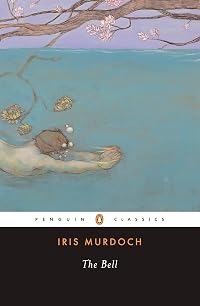
The influence of Iris Murdoch on Byatt seems to be very apparent here. Virgin reads like an intellectual’s version of Murdoch’s The Bell, written 20 years earlier, but without as strong a plot and far more musing on literature. In fact, at times you could be forgiven for wondering if Byatt was competing for the world’s longest bibliography so many references does she include.
Things Mean A Lot wrote that…
A.S. Byatt’s writing – more so in her novels than in her short stories, I think – is very much cerebral.
For me, cerebral is the perfect word. There’s really only one character I can relate to in the entire novel and that’s the only one who has subsumed his intellect with his passions: Daniel the rector. Apart from him, show more I wanted to stuff the rest into a string bag and drown them in a well.
Perhaps everyone in 1950s Yorkshire really was an intellectual. But I think I’m about as convinced of that as I am with Sarah Water’s attempts to persuade me that every Victorian woman was a lesbian.
And this is where I think the novel has its greatest weakness. It’s almost like Byatt was trying too hard. There are some great scenes such as Daniel and Stephanie on the beach at Filey (and what a beach that is) or Frederica getting mauled on the moors, and you have a feeling that Byatt really can write. But she can’t help but return to the arts as her safe haven from describing the realities of life.
This for me was such a shame, not least because the arts are (or at least are supposed to be) entirely dependent on the realities of life for their expression. It’s understanding the realities of life that helps you understand art, not the other way around.
I had a feeling that Byatt wanted us to believe that the more well-read we were, the more we’d understand life. To me, that’s the cart before the horse and the main reason why Frederica at 16 shows an equal amount of folly as the middle-aged Alexander Wedderburn.
But there’s enough in here for those who like a serious novel to enjoy. Just keep going through the rough patches and you’ll get through it. It’s not a novel that’s aged well though, and you’d be forgiven for thinking that the whole thing is just pretentious claptrap. show less
Things Mean A Lot wrote that…
A.S. Byatt’s writing – more so in her novels than in her short stories, I think – is very much cerebral.
For me, cerebral is the perfect word. There’s really only one character I can relate to in the entire novel and that’s the only one who has subsumed his intellect with his passions: Daniel the rector. Apart from him, show more I wanted to stuff the rest into a string bag and drown them in a well.
Perhaps everyone in 1950s Yorkshire really was an intellectual. But I think I’m about as convinced of that as I am with Sarah Water’s attempts to persuade me that every Victorian woman was a lesbian.
And this is where I think the novel has its greatest weakness. It’s almost like Byatt was trying too hard. There are some great scenes such as Daniel and Stephanie on the beach at Filey (and what a beach that is) or Frederica getting mauled on the moors, and you have a feeling that Byatt really can write. But she can’t help but return to the arts as her safe haven from describing the realities of life.
This for me was such a shame, not least because the arts are (or at least are supposed to be) entirely dependent on the realities of life for their expression. It’s understanding the realities of life that helps you understand art, not the other way around.
I had a feeling that Byatt wanted us to believe that the more well-read we were, the more we’d understand life. To me, that’s the cart before the horse and the main reason why Frederica at 16 shows an equal amount of folly as the middle-aged Alexander Wedderburn.
But there’s enough in here for those who like a serious novel to enjoy. Just keep going through the rough patches and you’ll get through it. It’s not a novel that’s aged well though, and you’d be forgiven for thinking that the whole thing is just pretentious claptrap. show less
I love revisiting Byatt's style, whether re-reading or reading new works for the first time, and The Virgin in the Garden doesn't disappoint. Her work is never light reading, but it is beautifully layered and textured, erudite without being overpowering, funny but never really light-hearted; it's language to lose yourself in.
Frederica is the character who goes on to become central in the later books - hence why this forms the first part of the Frederica quartet - but here she's much more part of an ensemble piece. She's still a great character to read about. Like Snape in the Harry Potter books, or Jane Austen's Emma, she's not someone whom you would particularly like were you ever to meet, but she's still fascinating to explore. Most show more of the characters were similarly finely drawn; fallible and curiously, eccentrically flawed without ever descending to the level of becoming mere grotesques.
The only part of the novel which didn't really work for me were the long digressions involving Marcus and Simmonds. The mystical aspects which they were interested in are not something which hold much attraction for me; it also seemed curiously at odds with the rest of the book, where Byatt, for all her layers of literary erudition and allusions, is very down to earth. Still a wonderful, wonderful novel, and I look forward to hunting down the rest of the quartet. show less
Frederica is the character who goes on to become central in the later books - hence why this forms the first part of the Frederica quartet - but here she's much more part of an ensemble piece. She's still a great character to read about. Like Snape in the Harry Potter books, or Jane Austen's Emma, she's not someone whom you would particularly like were you ever to meet, but she's still fascinating to explore. Most show more of the characters were similarly finely drawn; fallible and curiously, eccentrically flawed without ever descending to the level of becoming mere grotesques.
The only part of the novel which didn't really work for me were the long digressions involving Marcus and Simmonds. The mystical aspects which they were interested in are not something which hold much attraction for me; it also seemed curiously at odds with the rest of the book, where Byatt, for all her layers of literary erudition and allusions, is very down to earth. Still a wonderful, wonderful novel, and I look forward to hunting down the rest of the quartet. show less
Members
- Recently Added By
Published Reviews
The virgin in the garden is set in North Yorkshire in 1952-3, Coronation Year. The plot concerns the Festival production of a play about Elizabeth I, allowing consideration of that period and of the problems of modern poetic language. The underlying theme is of metamorphosis, birth and death. There is social history as a record of the 1950s; treatment of one character involves the problems of show more the graduate housewife. show less
added by KayCliff
Lists

The Guardian's 1000 Novels Everyone Must Read
1,005 works; 551 members

1001 Books You Must Read Before You Die
1,448 works; 1,134 members

Best Campus Novels
99 works; 18 members

Fêtes worse than death? — Village festivals in fiction
37 works; 7 members

1,001 BYMRBYD Concensus
723 works; 27 members

...read all, pay nowt (Books set in Yorkshire)
86 works; 14 members

My TBR
371 works; 3 members

Books Read in 2024
4,727 works; 128 members
Author Information

83+ Works 38,315 Members
A.S. Byatt was born on August 24, 1936 in Sheffield, England. She received a B.A. from Newnham College, Cambridge in 1957, did graduate study at Bryn Mawr College from 1957-58, and attended Somerville College, Oxford from 1958-59. She was a staff member in the extra-mural department at the University of London from 1962-71. From 1968-69, she was show more also a part-time lecturer in the liberal studies department of the Central School of Art and Design, London. She was a lecturer at University College from 1972-80 and then senior lecturer from 1981-83. She became a full-time writer in 1983. Her works include The Biographer's Tale, The Virgin in the Garden, Babel Tower, A Whistling Woman, and The Children's Book. She also wrote numerous collections of short stories including Sugar and Other Stories, The Matisse Stories, The Djinn in the Nightingale's Eye, Elementals, and Little Black Book of Stories. Byatt received the English Speaking Union fellowship in 1957-58, the Fellow of the Royal Society of Literature in 1983, the Silver Pen Award for Still Life, and the Booker Prize for Possession: A Romance in 1990. (Bowker Author Biography) show less
Some Editions
Awards and Honors
Series

Work Relationships
Is contained in
Common Knowledge
- Canonical title
- The Virgin in the Garden
- Original title
- The Virgin in the Garden
- Original publication date
- 1978
- People/Characters
- Frederica Potter; Stephanie Potter; Marcus Potter; Bill Potter; Winifred Potter; Daniel Orton (show all 19); Lucas Simmonds; Alexander Wedderburn; Mrs. Thone; Anthea Warburton; Edmund Wilkie; Jennifer Parry; Geoffrey Parry; Thomas Parry; Thomas Poole; Marina Yeo; Matthew Crowe; Felicity Wells; Mrs. Orton
- Important places
- Blesford Ride School
- Important events
- Coronation of Queen Elizabeth II (1953)
- Dedication
- For my son
Charles Byatt
July 19th 1961 – July 22nd 1972 - First words
- In 1952 history took a grip on the world of Alexander Wedderburn's imagination.
She had invited Alexander, whether on the spur of the moment or with malice aforethought he did not know, to come and hear Flora Robson do Queen Elizabeth at the National Portrait Gallery. (Prologue) - Quotations
- Susan darted to the cycle shed and eased her machine out of its concrete rut. Miss Potter [Stephanie] rode past, pedalling firmly, flowing gold and green. Susan mounted, shoved, swayed, set off. Stephanie descended into the d... (show all)eclivity of the path that crossed the crater, in bumps and starts, braking. Into the crater from the other side, ponderously manoeuvring, came a large black figure on a massive black bicycle. As though, Stephanie thought, also braking, he had simply risen up from the sooty laurels the other side of the crater. ... He came heavily on, bore down on Miss Potter in a rut, clashed their handlebars, like horned beasts engaging each other. ... Stephanie hopped a few steps. entangled, caught her calf painfully on the edge of a pedal, stopped to rub it. Susan saw a long oily streak on the smooth stocking. ... Daniel, head down, manipulated handlebars and interlocked brakeblocks with ferocity. ... He had planned the encounter with his usual care ... he ground metal and rubber.
Alexander thought, surveying Thomas Cromwell and the mock-soldiers, about the nature of modern parody. It seemed to him who did not understand or like it, undirected and aimless: they imitated anything and everything out of a... (show all)n unmanageable combination of aesthetic curiosity, mocking destructiveness and affectionate nostalgia, the desire to be anything and anywhere other than here and now. Did these soldiers loathe or secretly desire warfare? Or did they not know? Was it all a considered Astatement@, as the painter would have said, about accommodated and unaccommodated man? Or was it just a hysterical continuation of childhood dressing-up?
He was aiming at a vigorous realism, and had great trouble with a natural warp in the work towards pastiche and parody. - Last words
- (Click to show. Warning: May contain spoilers.)That was not an end, but since it went on for a considerable time, is as good a place to stop as any.
(Click to show. Warning: May contain spoilers.)He meant to say no, but said yes. (Prologue) - Blurbers
- Murdoch, Iris
- Original language
- English
Classifications
Statistics
- Members
- 1,860
- Popularity
- 11,629
- Reviews
- 33
- Rating
- (3.70)
- Languages
- 8 — Danish, English, French, German, Greek, Italian, Norwegian (Bokmål), Spanish
- Media
- Paper, Audiobook, Ebook
- ISBNs
- 29
- ASINs
- 10