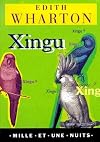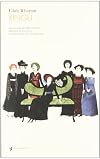
Xingu
by Edith Wharton
On This Page
Description
A group of middle class ladies are members of a lunch club. They competitively and snobbishly concern themselves with issues of 'culture' without any really serious understanding of the works they read.Tags
Recommendations




















Member Reviews
This is a story of contradictions. Even though this story is less that fifty pages long, it packs a wallop of a punch. Though billed as a satire it is also a humorous and witty commentary on human psychology. Some even think it is a cerebral jab at Henry James after he criticized Wharton's writing. No matter how "Xingu" is perceived or meant to be perceived, Mrs. Roby is my hero.
In a nutshell, a group of snobbish high society women form a lunch group to gather and discuss didactic topics and one-up each other. In their view, the weakest link is Mrs. Roby, a seemingly not-so-bright woman who doesn't appear to fit in with them. She asks all the wrong questions and clearly doesn't know societal protocol. When the group invites an even show more snobbier author to discuss her latest book, "The Wings of Death," the event falls apart. Osric Dane is even more dismissive than the snobs in the group. It isn't until Mrs. Roby one-ups them all by mentioning a xingu philosophy. No one has ever heard of xingu but they all, including author Osric Dane, must pretend they know it well. Only after Mrs. Roby and Ms. Dane leave does the group dare to look up the word xingu and discover they have been duped. Xingu is actually a river in Brazil. show less
In a nutshell, a group of snobbish high society women form a lunch group to gather and discuss didactic topics and one-up each other. In their view, the weakest link is Mrs. Roby, a seemingly not-so-bright woman who doesn't appear to fit in with them. She asks all the wrong questions and clearly doesn't know societal protocol. When the group invites an even show more snobbier author to discuss her latest book, "The Wings of Death," the event falls apart. Osric Dane is even more dismissive than the snobs in the group. It isn't until Mrs. Roby one-ups them all by mentioning a xingu philosophy. No one has ever heard of xingu but they all, including author Osric Dane, must pretend they know it well. Only after Mrs. Roby and Ms. Dane leave does the group dare to look up the word xingu and discover they have been duped. Xingu is actually a river in Brazil. show less
Easily the funniest thing I've read by Edith Wharton. Six women are hosting a celebrity author for their book club meeting. Five of them are scheming as to who can appear the most erudite, while one is more honest and down to earth.
Books were written to read; if one read them what more could be expected? To be questioned in detail regarding the contents of a volume seemed to her as great an outrage as being searched for smuggled laces at the Custom House.
Books were written to read; if one read them what more could be expected? To be questioned in detail regarding the contents of a volume seemed to her as great an outrage as being searched for smuggled laces at the Custom House.
Not quite a novella and yet more than a short story, Xingu is a witty and humorous look at pomposity, snobbery, and the inclination to derive worth from someone other than self. It was a bundle of satirical fun that made me laugh, while shaking my head and protesting to myself that "I have met these people."
If you have ever met someone who throws around big words in an effort to appear intellectual, but never bothers to know the ACTUAL meaning of them, thus betraying themselves, you cannot help enjoying this story. And, finally, it served for me as a reminder not to take myself too seriously...you never know when someone might identify you as a member of the "club".
Thank you so much to the Enchanted Readers' Breakfast Club for sharing show more this lovely read, and especially to Lori who suggested that we do it in the first place. I am so happy to be a member of this group! show less
If you have ever met someone who throws around big words in an effort to appear intellectual, but never bothers to know the ACTUAL meaning of them, thus betraying themselves, you cannot help enjoying this story. And, finally, it served for me as a reminder not to take myself too seriously...you never know when someone might identify you as a member of the "club".
Thank you so much to the Enchanted Readers' Breakfast Club for sharing show more this lovely read, and especially to Lori who suggested that we do it in the first place. I am so happy to be a member of this group! show less
Pochissime spassosissime pagine per Xingu di Edith Wharton. Trascuravo da tempo la mia adorata Edith e mi serviva questo racconto per ricordarmi le sue doti di osservatrice delle assurdità dell'alta società, della sua comicità. Questo libro fa ridere, sorridere, è cinico e ironico. Un semplice e banale episodio che dice tantissimo dei personaggi saccenti che si incontrano ogni tanto.
Mrs. Ballinger is one of the ladies who pursue Culture in bands, as though it were dangerous to meet it alone. To this end she had founded the Lunch Club, an association composed of herself and several other indomitable huntresses of erudition.
I don't normally review individual short stories, but one of my reading resolutions this year is to read works by Edith Wharton, and this story was available at Project Gutenberg.
It's an amusing tale about a group of ladies who meet to discuss artistic and intellectual subjects over lunch. When they invite the author of the acclaimed novel "The Wings of Death" to attend a meeting,they find themselves tied in knots by the argumentative author and the mischievous Mrs. Roby, whom they have always show more considered insufficently intellectual and a failure as a member of the Lunch Club. show less
I don't normally review individual short stories, but one of my reading resolutions this year is to read works by Edith Wharton, and this story was available at Project Gutenberg.
It's an amusing tale about a group of ladies who meet to discuss artistic and intellectual subjects over lunch. When they invite the author of the acclaimed novel "The Wings of Death" to attend a meeting,
What a fun story about a women’s book club trying to do and say the right thing for appearance’s sake. When a visiting author treats them horribly, one of their own—Mrs. Roby—takes it on herself to make it clear to the author she was not superior to the rest of them. But will that make Mrs. Roby the villain instead? I’m not a fan of Wharton’s style, which I find hard to read, but it worked to an advantage here!
I had no idea Edith Wharton was funny. This short story is a hilarious send-up of pretentious 1916 small-town bookclub ladies.
Members
- Recently Added By
Author Information

378+ Works 63,654 Members
Edith Wharton was a woman of extreme contrasts; brought up to be a leisured aristocrat, she was also dedicated to her career as a writer. She wrote novels of manners about the old New York society from which she came, but her attitude was consistently critical. Her irony and her satiric touches, as well as her insight into human character, show more continue to appeal to readers today. As a child, Wharton found refuge from the demands of her mother's social world in her father's library and in making up stories. Her marriage at age 23 to Edward ("Teddy") Wharton seemed to confirm her place in the conventional role of wealthy society woman, but she became increasingly dissatisfied with the "mundanities" of her marriage and turned to writing, which drew her into an intellectual community and strengthened her sense of self. After publishing two collections of short stories, The Greater Inclination (1899) and Crucial Instances (1901), she wrote her first novel, The Valley of Decision (1902), a long, historical romance set in eighteenth-century Italy. Her next work, the immensely popular The House of Mirth (1905), was a scathing criticism of her own "frivolous" New York society and its capacity to destroy her heroine, the beautiful Lily Bart. As Wharton became more established as a successful writer, Teddy's mental health declined and their marriage deteriorated. In 1907 she left America altogether and settled in Paris, where she wrote some of her most memorable stories of harsh New England rural life---Ethan Frome (1911) and Summer (1917)---as well as The Reef (1912), which is set in France. All describe characters forced to make moral choices in which the rights of individuals are pitted against their responsibilities to others. She also completed her most biting satire, The Custom of the Country (1913), the story of Undine Spragg's climb, marriage by marriage, from a midwestern town to New York to a French chateau. During World War I, Wharton dedicated herself to the war effort and was honored by the French government for her work with Belgian refugees. After the war, the world Wharton had known was gone. Even her Pulitzer Prize-winning novel, The Age of Innocence (1920), a story set in old New York, could not recapture the former time. Although the new age welcomed her---Wharton was both a critical and popular success, honored by Yale University and elected to The National Institute of Arts and Letters---her later novels show her struggling to come to terms with a new era. In The Writing of Fiction (1925), Wharton acknowledged her debt to her friend Henry James, whose writings share with hers the descriptions of fine distinctions within a social class and the individual's burdens of making proper moral decisions. R.W.B. Lewis's biography of Wharton, published in 1975, along with a wealth of new biographical material, inspired an extensive reevaluation of Wharton. Feminist readings and reactions to them have focused renewed attention on her as a woman and as an artist. Although many of her books have recently been reprinted, there is still no complete collected edition of her work. (Bowker Author Biography) show less
Work Relationships
Is contained in
Common Knowledge
- Original publication date
- 1916
- First words
- Mrs. Ballinger is one of the ladies who pursue Culture in bands, as though it were dangerous to meet alone.
- Quotations
- Books were written to read; if one read them what more could be expected? To be questioned in detail regarding the contents of a volume seemed to her as great an outrage as being searched for smuggled laces at the Custom Hous... (show all)e.
- Original language
- English
Classifications
Statistics
- Members
- 137
- Popularity
- 237,901
- Reviews
- 22
- Rating
- (3.95)
- Languages
- English, French, Italian, Spanish
- Media
- Paper, Audiobook, Ebook
- ISBNs
- 22
- ASINs
- 8