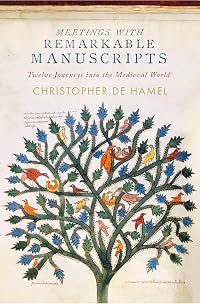
Meetings with Remarkable Manuscripts: Twelve Journeys into the Medieval World
by Christopher De Hamel
On This Page
Description
"Meetings with Remarkable Manuscripts is a captivating examination of twelve illuminated manuscripts from the medieval period. Noted authority Christopher de Hamel invites the reader into intimate conversations with these texts to explore what they tell us about nearly a thousand years of medieval history--and about the modern world, too. In so doing, de Hamel introduces us to kings, queens, saints, scribes, artists, librarians, thieves, dealers, and collectors. He traces the elaborate show more journeys that these exceptionally precious artifacts have made through time and shows us how they have been copied, how they have been embroiled in politics, how they have been regarded as objects of supreme beauty and as symbols of national identity, and who has owned them or lusted after them (and how we can tell). From the earliest book in medieval England to the incomparable Book of Kells to the oldest manuscript of the Canterbury Tales, these encounters tell a narrative of intellectual culture and art over the course of a millennium. Two of the manuscripts visited are now in libraries of North America, the Morgan Library in New York and the Getty Museum in Los Angeles. Part travel book, part detective story, part conversation with the reader, Meetings with Remarkable Manuscripts allows us to experience some of the greatest works of art in our culture to give us a different perspective on history and on how we come by knowledge"-- show lessTags
Recommendations












Member Reviews
A handsomely produced brick of a book, Meetings with Remarkable Manuscripts is an engaging introduction to twelve significant illuminated manuscripts produced in medieval Europe. Given the number of illuminated manuscripts that survive, there's no way that any such selection could claim to be definitive or truly represenative, and Christopher de Hamel makes no claim to that. These are merely twelve manuscripts—books of hours, psalters, an anthology of song lyrics, a Chaucer manuscript—that have artistic merit and historical significance and that appeal to de Hamel. He is an amiable and knowledgeable guide, who knows how to make collations and bindings interesting to a lay audience—I think, at least. (He's certainly a better hand show more at it than I am any time I try to do the same, though admittedly the manuscripts I work on are not the pretty, illuminated sort. I would never have thought to compare the weight of a manuscript to that of an average Great Dane!)
There are times when his rather Anglocentric viewpoint and privileged (privately educated, his past employers are Sotheby's and Cambridge University) background do interfere somewhat with the text. De Hamel declares the art of the Book of Kells "weird" and "grotesque" (rarely do my nationalist hackles raise except when in the presence of a patronising Englishman), and in the epilogue urges book readers to become students of medieval manuscripts themselves, to visit libraries and look at digital copies online. I think he may perhaps have forgotten that skills medievalists think commonplace (a knowledge of Latin and medieval vernaculars, palaeography, codicology, etc) are in fact rather rarefied.
Those quibbles aside, there's no denying that this is an absorbing read—and a testament to the enduring power of books. show less
There are times when his rather Anglocentric viewpoint and privileged (privately educated, his past employers are Sotheby's and Cambridge University) background do interfere somewhat with the text. De Hamel declares the art of the Book of Kells "weird" and "grotesque" (rarely do my nationalist hackles raise except when in the presence of a patronising Englishman), and in the epilogue urges book readers to become students of medieval manuscripts themselves, to visit libraries and look at digital copies online. I think he may perhaps have forgotten that skills medievalists think commonplace (a knowledge of Latin and medieval vernaculars, palaeography, codicology, etc) are in fact rather rarefied.
Those quibbles aside, there's no denying that this is an absorbing read—and a testament to the enduring power of books. show less
“This is a book about visiting important medieval manuscripts and what they tell us and why they matter.”
Job done.
Twelve chapters. Twelve manuscripts. Each chapter follows the same formula. De Hamel gives you the history of how the book came to be in its current library and describes his visit. Very interesting to see the different library cultures at play. I bet there are a few red faces at the Pierpont Morgan Library. He’s kind enough not to name names but they must know who they are. They he describes each manuscript and pulls out some of its more interesting features. Finally there’s some sort of detective work that might shine a light on the manuscript itself, but also into an obscure, or not so obscure, corner of history. show more There are lots of little discoveries along the way. Did you know that the Roman’s were aware that Venus and Mercury orbited the sun? Neither did I.
An incredibly interesting and readable book. The first night I looked up from it and realised it was four in the morning. The second night I knew what was going to happen so I napped before starting to read. The sun was up by the time I went to bed. This book has charm. I should think de Hamel does too. He managed to talk his way into examining each and every one of these books. The Codex Amiatinus. The Book of Kells. Obviously he has the credentials and knows the right people, but still... do you think they’d ever let me in to see the Hengwrt Chaucer? They’d take one look at me and think of that scene in Red Dragon where he eats the Blake. And quite right too. There’s a church near me with priceless medieval wall paintings. I went to see them and talked to the vicar for a while about the cost of insuring thatch (the church is thatched). I don’t know if I charmed her or bored her, but after a while she went off to do something, iron her cassock or something, and as soon as I was left alone with the paintings I climbed up on the pews and poked them all over.
One of the most interesting chapters for me was the Carmina Burana. I’m a fan of Orff’s musical number but mad never really thought about the source of the lyrics. It is of course a unique manuscript. All other copies are later printings edited from it. De Hamel’s analysis of its format as a kind of secular Breviary was particularly enlightening.
This is to say nothing of the illustrations in Remarkable Manuscripts. On its edge the book looks like geological strata. And those are just the illustrations that run to the edge of the page. The list of illustrations runs to seven pages of close type. Shame about the type face, but the paper is beautiful. Has a glow to it in the right light. Physically a well made book and all for thirty quid. That’s only three packets of fags. I borrowed my copy from the library. show less
Job done.
Twelve chapters. Twelve manuscripts. Each chapter follows the same formula. De Hamel gives you the history of how the book came to be in its current library and describes his visit. Very interesting to see the different library cultures at play. I bet there are a few red faces at the Pierpont Morgan Library. He’s kind enough not to name names but they must know who they are. They he describes each manuscript and pulls out some of its more interesting features. Finally there’s some sort of detective work that might shine a light on the manuscript itself, but also into an obscure, or not so obscure, corner of history. show more There are lots of little discoveries along the way. Did you know that the Roman’s were aware that Venus and Mercury orbited the sun? Neither did I.
An incredibly interesting and readable book. The first night I looked up from it and realised it was four in the morning. The second night I knew what was going to happen so I napped before starting to read. The sun was up by the time I went to bed. This book has charm. I should think de Hamel does too. He managed to talk his way into examining each and every one of these books. The Codex Amiatinus. The Book of Kells. Obviously he has the credentials and knows the right people, but still... do you think they’d ever let me in to see the Hengwrt Chaucer? They’d take one look at me and think of that scene in Red Dragon where he eats the Blake. And quite right too. There’s a church near me with priceless medieval wall paintings. I went to see them and talked to the vicar for a while about the cost of insuring thatch (the church is thatched). I don’t know if I charmed her or bored her, but after a while she went off to do something, iron her cassock or something, and as soon as I was left alone with the paintings I climbed up on the pews and poked them all over.
One of the most interesting chapters for me was the Carmina Burana. I’m a fan of Orff’s musical number but mad never really thought about the source of the lyrics. It is of course a unique manuscript. All other copies are later printings edited from it. De Hamel’s analysis of its format as a kind of secular Breviary was particularly enlightening.
This is to say nothing of the illustrations in Remarkable Manuscripts. On its edge the book looks like geological strata. And those are just the illustrations that run to the edge of the page. The list of illustrations runs to seven pages of close type. Shame about the type face, but the paper is beautiful. Has a glow to it in the right light. Physically a well made book and all for thirty quid. That’s only three packets of fags. I borrowed my copy from the library. show less
I got this book at the Getty Center, my interest peaked by the cover and the title. I didn’t read much into the description, but it sounded like it would be a fun read. And boy, did it liv up to those expectations. De Hamel was able to keep my interest throughout the entire book, and I learned more about these manuscripts than I probably would have if I had researched them on my own. De Hamel is an amazing writer, and I hope o read more of his work soon.
De hamel is a piece of work and being dragged off on tangents while attempting to learn more about the manuscripts he’s supposed to be focused on in this book was a chore. It does not help that his ego and classism are inescapable at every turn, though he seems almost wholly unaware of it, somehow.
I can’t recommend this book to anyone who wants to learn specifically about illuminated manuscripts. It’s just not really about that. They’re there, but they feel like background for everything else the author talks about, which is both a shame and waste of a reader’s time in my opinion.
This book feels like it’s for the Christian scholar who is looking to learn more about the author and the historical background of some key show more characters in history who might have owned or commissioned these manuscripts. Expect untranslated Latin, references to passages in the Bible you’re expected to know, and lots of snarky classist quips about anybody and everybody. Park the ego with your non existent car, dude. It’s a lot. show less
I can’t recommend this book to anyone who wants to learn specifically about illuminated manuscripts. It’s just not really about that. They’re there, but they feel like background for everything else the author talks about, which is both a shame and waste of a reader’s time in my opinion.
This book feels like it’s for the Christian scholar who is looking to learn more about the author and the historical background of some key show more characters in history who might have owned or commissioned these manuscripts. Expect untranslated Latin, references to passages in the Bible you’re expected to know, and lots of snarky classist quips about anybody and everybody. Park the ego with your non existent car, dude. It’s a lot. show less
I have to say that this is one of the most intriguing and unusual books I have ever read. The author, an expert on and passionately in love with extraordinarily rare and precious manuscripts, leads the reader on a personal journey to discover 12 of the rarest illuminated manuscripts in the world, dating from the 7th century to the 16th. His extraordinarily detailed examination of the minutiae of each book, including the individual quirks of the author, the damage, restoration and rebinding that each book has fone through, as well as the particular circumstances in which each book finds itself today, with a cook's tour of the reading rooms of the world's great libraries, is captivating. Although sometimes he becomes too technical for the show more lay reader, always he strains to make the magic of these miraculously surviving texts shine. This is not a light read, it demands concentration and committment to follow where he is going, but the discerning reader will reap great rewards for patience. I am fortunate enough to have personally seen just one of the manuscripts he covers (the Book of Kells), but this book has whetted my appetite to see more. Extraordinarily rewarding read that will stay with me for a long time. show less
A magnificent read ...well recommended
These are the types of books that I love. A book in which an author takes you by the hand and shares with you something which is their speciality, but not as a braggart or a technician, but as a friend and enthusiast.
I know nothing about illuminated texts (the focus of this book) and am not a collector of, and not all that interested in old books, with their special bindings and the like, nor first editions or the like. And my latin, and for that matter any language other than english, is non existent.
And yet here I am having spent the last couple of days ( admittedly whilst on holidays so I have more time to devote to something I enjoy) being led through an in depth look at 12 famous illuminated show more manuscripts from around the world, the earliest dating from the late 6th century.
OK, indepth may be the wrong description for those in the know, the specialists, but 12 manuscripts explored in some 560 pages (not counting the introduction epilogue, notes , index etc) is in depth for the novice!
He never talks down, rather he talks with the reader. It is fascinating how much can be gleaned from looking at a manuscript and asking the right questions. Obviously there is a lot of erudition in play...different languages (mainly ancient, not modern); art history; plain old history; and having observed and discussed many many times many many manuscripts.
And whilst the author's invitation (plea?) for others to take up the almost dectective story hunt for more answers, not just in relation to these particular manuscripts, but in relation to the some million he surmises are in existence, one wonders whether that is really practical, given the erudition required?
And yet...
I place this book on a par, if not above two other of my favourites in the"travel with an expert friend in an area I know nothing about " books, being:
Ansel Adam's Autobiography ( photography)
Gods, Graves and Scholars by C W Ceram (archeology)
(see my comments on those in the reviews of them )
I will be handing my copy onto my friends with invocations to read or dip into it but please hand it back or hand it on
Big Ship
9 January 2017 show less
These are the types of books that I love. A book in which an author takes you by the hand and shares with you something which is their speciality, but not as a braggart or a technician, but as a friend and enthusiast.
I know nothing about illuminated texts (the focus of this book) and am not a collector of, and not all that interested in old books, with their special bindings and the like, nor first editions or the like. And my latin, and for that matter any language other than english, is non existent.
And yet here I am having spent the last couple of days ( admittedly whilst on holidays so I have more time to devote to something I enjoy) being led through an in depth look at 12 famous illuminated show more manuscripts from around the world, the earliest dating from the late 6th century.
OK, indepth may be the wrong description for those in the know, the specialists, but 12 manuscripts explored in some 560 pages (not counting the introduction epilogue, notes , index etc) is in depth for the novice!
He never talks down, rather he talks with the reader. It is fascinating how much can be gleaned from looking at a manuscript and asking the right questions. Obviously there is a lot of erudition in play...different languages (mainly ancient, not modern); art history; plain old history; and having observed and discussed many many times many many manuscripts.
And whilst the author's invitation (plea?) for others to take up the almost dectective story hunt for more answers, not just in relation to these particular manuscripts, but in relation to the some million he surmises are in existence, one wonders whether that is really practical, given the erudition required?
And yet...
I place this book on a par, if not above two other of my favourites in the"travel with an expert friend in an area I know nothing about " books, being:
Ansel Adam's Autobiography ( photography)
Gods, Graves and Scholars by C W Ceram (archeology)
(see my comments on those in the reviews of them )
I will be handing my copy onto my friends with invocations to read or dip into it but please hand it back or hand it on
Big Ship
9 January 2017 show less
The author introduces 12 mediaeval manuscripts, where they are kept, their contents, and history.
This book is as gorgeously illustrated as one would expect. The text is for the most part interesting with lots of little nuggets of information about the manuscripts, the libraries where they are kept. and some of the deductions we can make about the scribes and origins of the books. Obviously he couldn't reproduce the complete manuscripts -- and part of the point was that much of what we can learn from the manuscripts simply cannot be seen in any reproduction however excellent -- and there were times it felt a bit like reading museum wall labels for exhibits one can't see. Despite that it was worth persisting through the occasional dry show more spell for the overall enjoyment. I did wish at that the end that he'd said more about why these 12 rather than any others. show less
This book is as gorgeously illustrated as one would expect. The text is for the most part interesting with lots of little nuggets of information about the manuscripts, the libraries where they are kept. and some of the deductions we can make about the scribes and origins of the books. Obviously he couldn't reproduce the complete manuscripts -- and part of the point was that much of what we can learn from the manuscripts simply cannot be seen in any reproduction however excellent -- and there were times it felt a bit like reading museum wall labels for exhibits one can't see. Despite that it was worth persisting through the occasional dry show more spell for the overall enjoyment. I did wish at that the end that he'd said more about why these 12 rather than any others. show less
Members
- Recently Added By
Published Reviews
ThingScore 100
Meetings With Remarkable Manuscripts is the most enjoyable work of high scholarship I have ever read, if only because its author so clearly enjoyed compiling it.
Christopher de Hamel has spent most of his life researching and thinking about his subject, for years as the chief specialist in medieval manuscripts at Sotheby's, and now as librarian of the Parker library at Corpus Christi college, show more Cambridge, which possesses some important artefacts. Now that he has decided to share his passion with us, his schema is this: to ease us into the subject, he chooses 12 of the most important surviving illustrated manuscripts from the middle ages, held by great libraries around the world, and takes us with him to examine them all for ourselves.
Some of the manuscripts are perfectly exquisite, some ungainly, some inexplicable, but, as De Hamel says himself, "intrinsic beauty is a difficult conception in art history". Although pages from all 12 are beautifully reproduced in his book, and although he describes them, their histories and their meanings in minute detail, still the power of this volume lies not so much in its scholarship as in its love. show less
Christopher de Hamel has spent most of his life researching and thinking about his subject, for years as the chief specialist in medieval manuscripts at Sotheby's, and now as librarian of the Parker library at Corpus Christi college, show more Cambridge, which possesses some important artefacts. Now that he has decided to share his passion with us, his schema is this: to ease us into the subject, he chooses 12 of the most important surviving illustrated manuscripts from the middle ages, held by great libraries around the world, and takes us with him to examine them all for ourselves.
Some of the manuscripts are perfectly exquisite, some ungainly, some inexplicable, but, as De Hamel says himself, "intrinsic beauty is a difficult conception in art history". Although pages from all 12 are beautifully reproduced in his book, and although he describes them, their histories and their meanings in minute detail, still the power of this volume lies not so much in its scholarship as in its love. show less
added by Cynfelyn
Lists

Top Five Books of 2017
757 works; 231 members

Recommend the 20 best books you've read in the last five years
2,168 works; 606 members

Books Read in 2024
4,623 works; 126 members

el
1,139 works; 1 member
Talk Discussions
Past Discussions
OT-Book of potential interest in Folio Society Devotees (October 2022)
Author Information

33+ Works 3,609 Members
Christopher De Hamel is the Fellow Librarian of Corpus Christi College, Cambridge. For 25 years he was responsible for all sales of medieval and illuminated manuscripts at Sotheby's in London. He has a doctorate from Oxford University and an honorary doctorate from St John's University, Collegeville, Minnesota. He is a Fellow of the Society of show more Antiquaries show less
Awards and Honors
Awards
Notable Lists
Common Knowledge
- Original publication date
- 2016
- People/Characters
- Jeanne de Navarre; Margaret of Austria
- Important places
- Cambridge, England; Dublin, Ireland (Book of Kells); Florence, Italy; Leiden University, Netherlands; Morgan Library, New York, USA; Oxford, England (show all 12); Copenhagen, Denmark; Staatsbibliothek, Munich, Germany (Carmina Burana); Paris, France; National Library of Wales; National Library of Russia; Getty Center, Los Angeles, California, USA
- Dedication
- Scott Schwartz of New York
Classifications
- Genres
- History, Art & Design, Nonfiction, General Nonfiction, Religion & Spirituality
- DDC/MDS
- 091 — Computer science, information & general works Manuscripts & rare books (books about rare books) Manuscripts
- LCC
- Z106.5 .E85 .D44 — Bibliography, Library Science and Information Resources Books (General). Writing. Paleography Manuscripts. Paleography
- BISAC
Statistics
- Members
- 1,230
- Popularity
- 20,091
- Reviews
- 17
- Rating
- (4.49)
- Languages
- English, German, Italian, Spanish
- Media
- Paper, Audiobook, Ebook
- ISBNs
- 13
- UPCs
- 1
- ASINs
- 5