
Seb Falk
Author of The Light Ages: The Surprising Story of Medieval Science
About the Author
Seb Falk is a historian, broadcaster, and lecturer at the University of Cambridge, where he teaches medieval history and the history of science. His research is focused on scientific instruments of the Middle Ages, specializing in the history of astronomy, navigation, and mathematics. In 2016, Falk show more was named one of the BBC's New Generation Thinkers. He lives in Cambridge, England. show less
Works by Seb Falk
Tagged
Common Knowledge
- Birthdate
- 20th century
- Gender
- male
- Education
- University of Oxford (BA|History and Spanish)
University of Cambridge (MPhil|History and Philosophy of Science; PhD) - Short biography
- [from author's website]
Seb teaches medieval history and history of science at Cambridge University, where he is Senior Proctor and a Fellow of Girton College. He specialises in the history of astronomy, navigation and mathematics - theories and technologies - from their ancient origins to modern developments.
Seb is a qualified teacher and a yachtmaster. He has led mountain expeditions and run many marathons, worked in government and served as a Special Constable. He is as comfortable sailing by the stars – while singing old sea shanties – as demonstrating ancient mathematical techniques. As a lecturer and museum curator, he makes past science come alive, using authentic historic instruments and helping participants get hands-on with replicas.
Seb received his B.A. in History and Spanish from Oxford University, and an M.Phil. in History and Philosophy of Science from Cambridge. He stayed at Cambridge for a Ph.D., completing his thesis on late medieval astronomical instruments in 2016.
He lives in Cambridge, UK, with his wife and two children. - Places of residence
- Cambridge, Cambridgeshire, England, UK
- Associated Place (for map)
- England, UK
Members
Reviews
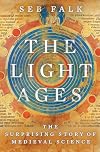
The Firesign Theatre did a sketch of which the catchphrase was "Everything you know is wrong." That phrase could be a sub-title for this book. The author starts with the history of a manuscript that seemed to contain the handwriting of Geoffrey Chaucer. An newly discovered poem? No, a treatise on the use of the astrolabe, an instrument for determining the positions of various stars and planets. This is the beginning of a tour of medieval science, its origins in the need for accurate show more calendars to determine the timing of feast days, the calculations necessary and the instruments invented to aid in those calculations. An English monk of the 14th century is the center of the story as he labors in St. Albans Abbey to copy, amend and improve charts and eventually to invent a device known as the Equatorium. Seb Falk takes us on a tour of a Middle Ages in which Islamic, Jewish and Christian scholars shared information; the study of nature was seen as part of learning the glory of the Creator, and the great universities of Europe were created. Although much of the work concentrates on the astronomy/astrology that was the focus of John of Westwyk's work, Falk also mentions medieval medicine, war and trade. Very interesting, although the explanations of some of the calculations are somewhat dry. Line drawings and photos clarify the concepts. show less
Centering on the prestigious St Albans Abbey, Falk takes readers on an illuminating tour of medieval English science. Readers are introduced to John of Westwyk, a 14th c. monk-astronomer, and his equatorium: a device that provided the correct longitudes of celestial bodies, despite a belief in a geo-centric solar system! For these Benedictine monks, learning required more than memorization and recitation: natural, sympathetic and image "magic" were practiced, Arabic mathematical treatises show more were translated into Latin - i.e. "al-Khwarizmi" became "algorithm"; Bede's method of decimal arithmetic allowed one to count to 9,999 on two hands; sundials, dioptras, and astrolabes tracked the heavens, not to mention the abbey had its own astronomical clock! The monks utilized clever mnemonics to remember the various saint feast days per month and entertained themselves with board games to master multiplication. Books were not mass printed "static objects " but rather ever evolving, and monks were inspired to add their own contributions. Like the monks, the reader is encouraged to participate, learn and understand. The only other book that accomplished such an instructional feat this year was "Secrets of the English War Bow." Falk, with well-researched patience and humor, makes it all accessible and comprehensible.
I had to take off a star because it did not follow through on its premise as a "guide...through the life of a crusading astronomer-monk." John of Westwyk is a decent jumping off point at best. He is featured about as equally as any other member of St Albans, or bows to much more "remarkable" figures. However, "Light Ages" succeeds in every other way and was well worth the read. These are complex - some obsolete - scientific instruments and methods that, at first, can seem intimidating. This is not a speed read, and you'll realize quickly that the intention is to teach. No other book this year has given my brain such a refreshing workout. You don't need to be an expert in astrology, geometry, etc. I was never great at science or math, and I genuinely enjoyed this book! show less
I had to take off a star because it did not follow through on its premise as a "guide...through the life of a crusading astronomer-monk." John of Westwyk is a decent jumping off point at best. He is featured about as equally as any other member of St Albans, or bows to much more "remarkable" figures. However, "Light Ages" succeeds in every other way and was well worth the read. These are complex - some obsolete - scientific instruments and methods that, at first, can seem intimidating. This is not a speed read, and you'll realize quickly that the intention is to teach. No other book this year has given my brain such a refreshing workout. You don't need to be an expert in astrology, geometry, etc. I was never great at science or math, and I genuinely enjoyed this book! show less
Seb Falk's The Light Ages is written both with enthusiastic erudition and a clear sense of affection and empathy for the humanity of medieval thinkers and inventors. This is not a standard pillar-to-post overview of the history of science in Europe during the Middle Ages, but rather an evocation of the medieval mindset through an exploration of the career of one man: the rather obscure fourteenth-century English monk, John Westwyk. Falk uses Westwyk to disprove the popular misconceptions of show more the Middle Ages as a time of scientific stagnation, of religiose passivity and disdain for innovation. Rather, medieval people were keenly interested in the world around them and had a knack for technological innovation—even if their motivations and the kinds of questions they thought most interesting were often quite different from those we might ask today.
There are points where Falk lost me a bit—at times, the descriptions of how astrolabes and so on worked got too detailed for me, though in fairness, I have read many descriptions of their workings over the years and it's never really clicked with me. (As soon as I read phrases like "sexadecimal number systems", my brain just shuts down.) Still, The Light Ages is overall an impressive read, and one which achieves what it sets out to do: to shed light. show less
There are points where Falk lost me a bit—at times, the descriptions of how astrolabes and so on worked got too detailed for me, though in fairness, I have read many descriptions of their workings over the years and it's never really clicked with me. (As soon as I read phrases like "sexadecimal number systems", my brain just shuts down.) Still, The Light Ages is overall an impressive read, and one which achieves what it sets out to do: to shed light. show less
In the 19th century, Kaiser Wilhelm had a nightmare in which Asians loomed over him as yellow threats. He told others about his dream, and the Yellow Peril came into existence, tarring Asians with the absurd slur of yellow skin ever since. Seb Falk thinks the same sort of thing happened to the Middle Ages, often called the Dark Ages. In his The Light Ages, he follows the life of an English monk to represent the scientific advances that continued to occur, despite the negative adjectives show more slapped on the era. His passion was the astrolabe, the smartphone everyone had to have. It became indispensible.
The action took place around St. Albans, reputed to be the best school in England in the 1100s. It was progressive enough to save 16 places for Poor Scholars, who paid no fees to attend. Our hero, a monk called John Westwyck, was in and out of the picture there, traveling to other churches within his Benedictine Order, and always, always focused on astronomy, his real passion and life’s work.
The Middle Ages was a time of settling on standards. The various calendars in use converged towards our current system of 12 months with plus or minus 30 days each. Different cultures began the day at sunrise or noon, sunset, or midnight. Some number systems used base 20 or ten or even 60, making figures difficult to understand. For example, the French (base 20) still call 70 sixty-ten, and 80 is four-twenty. Base 60 numbers take a lot of getting used to in print, with their component parts separated by commas. English money made no sense to anyone outside the country until the 1970s, as it stubbornly refused to follow the rest of the world into decimalization until then.
Actual numbers transitioned from Roman numerals to Arabic-Hindu numbers, popularized by Leonardo of Pisa – aka Fibonacci. The systems all coexisted for a long time, requiring the educated to be “bilingual” or “trilingual”: comfortable in all of them and able to switch between them. It was also at this time that English started to compete with Latin, thanks in no small part to Geoffrey Chaucer. Clear winners were not yet evident. It was just the way everything was.
It was a time to leverage the astrolabe, an instrument invented in the Arabic world. It kept improving, until with Westwyk’s help, it could allow the user to tell the time of day, the positions of the planets, the direction north and true north, and much more. It was the smartphone of its day. People wore them hanging from their belts. They became a status symbol, if not a fashion statement. Their encyclopedic data informed legal and medical decisions. And of course, they kept travelers on the right path, often literally. These were all key apps from this one CPU.
Westwyck spent years running up tables of endless tiny numbers, describing the movements of stars and planets throughout the day down to the second. In a time before actual mathematics, observations of great accuracy were the state of the art for scientists. The movement of a star or the moon was so tightly measured, users could tell the time of day to within a minute. In an era when it was assumed that all days had twelve equal daylight hours, summer and winter, this was an order of magnitude higher science.
The astrolabe was an incredibly intricate slide rule. Lining it up with the sun, a plate attached to one side would indicate everything that was possible to know about the universe from that location at that instant. Since the stars looked different at different locations on Earth, interchangeable plates (think floppy disks, if you can) had to be laboriously eked out and etched out for every latitude the end user might find himself in. The encyclopedic knowledge built into every astrolabe was nothing less than astonishing. Never mind that it was perfected by an English monk in the Dark Ages.
But really, the only other major innovation of the era was another measurement device, the mechanical clock. Richard of Wallingford, another St. Albans superstar, (its Abbot in the 1320s) built the world’s most accurate mechanical clock – and by far the most expensive one ever attempted, for his church. Falk calls the mechanical clock the most significant invention of the Middle Ages. This major development changed mankind, and Falk wants credit to go to the Middle Ages. It, along with Westwyk’s work on the astrolabe, made St. Albans the Silicon Valley of the Middle Ages.
On the other hand, the Middle Ages were a time of narrowly focused advances, shrouded in ignorance. Progress was all derivative, not original, Falk admits. It was also the era of Crusades, where ragtag armies were raised, then decimated by dysentery, in a neverending quest to impose Christianity on the western world and the Middle East. It was a time of dueling popes, papal armies and constant wars. The church, as well as local kings, laid siege to walled towns, starving them to submission, or death, or both. The clergy ruled, and ruled absolutely and arrogantly. They would withhold sacraments unless substantial donations were forthcoming. Indulgences could buy a parishioner’s way out of any dilemma in life. And all of the knowledge accumulated in the era seems to have come from monks, as they made up the majority of those who could read and write, and who had the time to pursue their hobbies without fear of starving to death themselves. How much farther ahead mankind could have come without these constraints is outside the scope of the book, which looks at the glass as half full, despite everything.
The icing on the cake was astrology. It was in this era that people like Westwyk devised the divisions of the sky. The final blow was the pie slices of “houses”, in which planets crossed into the purview of 12 different constellations that rotate around the north pole every night. Monks fabricated attributes, values and meanings for these events and cosmological bodies. Far too quickly, the meanings became set in concrete. The suddenly self-evident attributes of planets, cross-fertilized with the suddenly self-evident attributes of constellations, could portend success or failure, sickness or health, life or death. All without even the slightest hint of evidence. Or even theory.
There were philosophers who spoke up, showing there was not only no proof of the significance of the stars in people’s individual lives, but there was no possibility of a faraway star having any effect whatsoever, never mind its presence at a time of day, or month or year, in or outside the star of a constellation. These philosophers were overruled, and ignorance solidified around the unfounded theories. Expertise in the effects of the planets and stars became the key to success around the world. Even Galileo had to produce horoscopes for clients.
In France, 1437 “arbitrators” ruled that: “all physicians and surgeons must have a full almanac, showing the sign of the moon on any day, and which planets it relates to, good or bad. And with it they must have an astrolabe to select, for any day, hour, and fractions of hours, the ascendant sign corresponding to the sign where the moon is, at the hour chosen for bloodletting or laxatives.” People like Westwyk, despite their claimed total devotion to Christianity, were actively complicit in the invention of modern astrology. The astrolabe, a sophisticated instrument of pure observational science, incorporated the nonsense.
As the ignorance took hold, France banned even discussion of alternative/rejected theories. That was in 1277, a couple of hundred years before the Renaissance threw open the doors to other possibilities. So while the Middle Ages was a time when experiments became a way of scientific endeavor, and instruments and gadgets became must-haves, poverty, greed and ignorance still ruled. A tiny minority had the freedom to tinker.
Falk cobbles a biography out of the fragments of evidence that Westwyk even lived. He makes (probably decent) assumptions about where and how he lived, and who he served. But it also gets to be a bit much, as Falk examines Westwyk’s handwriting, spacing and layout of his thoughts on parchment. He guesses what was a last minute addition and what was a correction to an earlier oversight. It becomes tedious at times, because the book is supposed to be about how bright the Middle Ages really were. Westwyk might be an unsung hero, but he did not represent the Middle Ages in any way.
That the book is not always fascinating is a clue. Readers will be left wondering whether Falk made his case.
But the astrolabe still rocked.
David Wineberg show less
The action took place around St. Albans, reputed to be the best school in England in the 1100s. It was progressive enough to save 16 places for Poor Scholars, who paid no fees to attend. Our hero, a monk called John Westwyck, was in and out of the picture there, traveling to other churches within his Benedictine Order, and always, always focused on astronomy, his real passion and life’s work.
The Middle Ages was a time of settling on standards. The various calendars in use converged towards our current system of 12 months with plus or minus 30 days each. Different cultures began the day at sunrise or noon, sunset, or midnight. Some number systems used base 20 or ten or even 60, making figures difficult to understand. For example, the French (base 20) still call 70 sixty-ten, and 80 is four-twenty. Base 60 numbers take a lot of getting used to in print, with their component parts separated by commas. English money made no sense to anyone outside the country until the 1970s, as it stubbornly refused to follow the rest of the world into decimalization until then.
Actual numbers transitioned from Roman numerals to Arabic-Hindu numbers, popularized by Leonardo of Pisa – aka Fibonacci. The systems all coexisted for a long time, requiring the educated to be “bilingual” or “trilingual”: comfortable in all of them and able to switch between them. It was also at this time that English started to compete with Latin, thanks in no small part to Geoffrey Chaucer. Clear winners were not yet evident. It was just the way everything was.
It was a time to leverage the astrolabe, an instrument invented in the Arabic world. It kept improving, until with Westwyk’s help, it could allow the user to tell the time of day, the positions of the planets, the direction north and true north, and much more. It was the smartphone of its day. People wore them hanging from their belts. They became a status symbol, if not a fashion statement. Their encyclopedic data informed legal and medical decisions. And of course, they kept travelers on the right path, often literally. These were all key apps from this one CPU.
Westwyck spent years running up tables of endless tiny numbers, describing the movements of stars and planets throughout the day down to the second. In a time before actual mathematics, observations of great accuracy were the state of the art for scientists. The movement of a star or the moon was so tightly measured, users could tell the time of day to within a minute. In an era when it was assumed that all days had twelve equal daylight hours, summer and winter, this was an order of magnitude higher science.
The astrolabe was an incredibly intricate slide rule. Lining it up with the sun, a plate attached to one side would indicate everything that was possible to know about the universe from that location at that instant. Since the stars looked different at different locations on Earth, interchangeable plates (think floppy disks, if you can) had to be laboriously eked out and etched out for every latitude the end user might find himself in. The encyclopedic knowledge built into every astrolabe was nothing less than astonishing. Never mind that it was perfected by an English monk in the Dark Ages.
But really, the only other major innovation of the era was another measurement device, the mechanical clock. Richard of Wallingford, another St. Albans superstar, (its Abbot in the 1320s) built the world’s most accurate mechanical clock – and by far the most expensive one ever attempted, for his church. Falk calls the mechanical clock the most significant invention of the Middle Ages. This major development changed mankind, and Falk wants credit to go to the Middle Ages. It, along with Westwyk’s work on the astrolabe, made St. Albans the Silicon Valley of the Middle Ages.
On the other hand, the Middle Ages were a time of narrowly focused advances, shrouded in ignorance. Progress was all derivative, not original, Falk admits. It was also the era of Crusades, where ragtag armies were raised, then decimated by dysentery, in a neverending quest to impose Christianity on the western world and the Middle East. It was a time of dueling popes, papal armies and constant wars. The church, as well as local kings, laid siege to walled towns, starving them to submission, or death, or both. The clergy ruled, and ruled absolutely and arrogantly. They would withhold sacraments unless substantial donations were forthcoming. Indulgences could buy a parishioner’s way out of any dilemma in life. And all of the knowledge accumulated in the era seems to have come from monks, as they made up the majority of those who could read and write, and who had the time to pursue their hobbies without fear of starving to death themselves. How much farther ahead mankind could have come without these constraints is outside the scope of the book, which looks at the glass as half full, despite everything.
The icing on the cake was astrology. It was in this era that people like Westwyk devised the divisions of the sky. The final blow was the pie slices of “houses”, in which planets crossed into the purview of 12 different constellations that rotate around the north pole every night. Monks fabricated attributes, values and meanings for these events and cosmological bodies. Far too quickly, the meanings became set in concrete. The suddenly self-evident attributes of planets, cross-fertilized with the suddenly self-evident attributes of constellations, could portend success or failure, sickness or health, life or death. All without even the slightest hint of evidence. Or even theory.
There were philosophers who spoke up, showing there was not only no proof of the significance of the stars in people’s individual lives, but there was no possibility of a faraway star having any effect whatsoever, never mind its presence at a time of day, or month or year, in or outside the star of a constellation. These philosophers were overruled, and ignorance solidified around the unfounded theories. Expertise in the effects of the planets and stars became the key to success around the world. Even Galileo had to produce horoscopes for clients.
In France, 1437 “arbitrators” ruled that: “all physicians and surgeons must have a full almanac, showing the sign of the moon on any day, and which planets it relates to, good or bad. And with it they must have an astrolabe to select, for any day, hour, and fractions of hours, the ascendant sign corresponding to the sign where the moon is, at the hour chosen for bloodletting or laxatives.” People like Westwyk, despite their claimed total devotion to Christianity, were actively complicit in the invention of modern astrology. The astrolabe, a sophisticated instrument of pure observational science, incorporated the nonsense.
As the ignorance took hold, France banned even discussion of alternative/rejected theories. That was in 1277, a couple of hundred years before the Renaissance threw open the doors to other possibilities. So while the Middle Ages was a time when experiments became a way of scientific endeavor, and instruments and gadgets became must-haves, poverty, greed and ignorance still ruled. A tiny minority had the freedom to tinker.
Falk cobbles a biography out of the fragments of evidence that Westwyk even lived. He makes (probably decent) assumptions about where and how he lived, and who he served. But it also gets to be a bit much, as Falk examines Westwyk’s handwriting, spacing and layout of his thoughts on parchment. He guesses what was a last minute addition and what was a correction to an earlier oversight. It becomes tedious at times, because the book is supposed to be about how bright the Middle Ages really were. Westwyk might be an unsung hero, but he did not represent the Middle Ages in any way.
That the book is not always fascinating is a clue. Readers will be left wondering whether Falk made his case.
But the astrolabe still rocked.
David Wineberg show less
Lists
Awards

You May Also Like


Statistics
- Works
- 1
- Members
- 535
- Popularity
- #46,548
- Rating
- 3.8
- Reviews
- 19
- ISBNs
- 13
- Languages
- 4