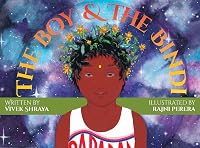
The Boy & The Bindi
by Vivek Shraya
On This Page
Description
A young boy becomes fascinated with his mother's bindi, and asks her to explain what it is and why she wears it. She tells him that the red dot is commonly worn by Hindu women to indicate the point at which creation begins. When he wishes to have one of his own, she agrees to it, and teaches him about its cultural significance, allowing the boy to discover the magic of the bindi, which in turn gives him permission to be more fully himself.Tags
Recommendations







Member Reviews
In this beautiful children’s picture book by Vivek Shraya, author of the acclaimed God Loves Hair, a five-year-old South Asian boy becomes fascinated with his mother’s bindi, the red dot commonly worn by Hindu women to indicate the point at which creation begins, and wishes to have one of his own. Rather than chastise her son, she agrees to it, and teaches him about its cultural significance, allowing the boy to discover the magic of the bindi, which in turn gives him permission to be more fully himself.
A young boy is fascinated by his mother's bindi in this rhyming picture-book from Canadian artist and author Vivek Shraya. Attracted to the "bright and pretty spot," he is given a poetic explanation of what a bindi is and does, keeping one "safe and true," and reminding the wearer of where she comes from. When the boy asks his mother if he can have a bindi, she gives him one to wear, and he immediately feels calm and happy...
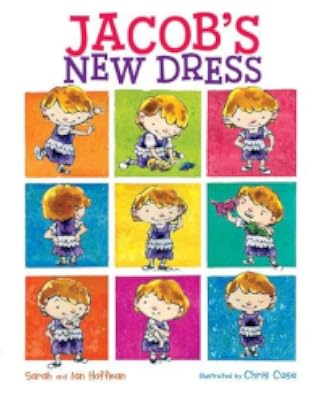
Although not associated exclusively with women in all Asian cultures, in India the use of the bindi - a decorative mark that is situated over the spot in the forehead considered the location of the mystical "third eye" - does seem to be a gendered practice. I have vivid memories of a college friend from India who show more would become very incensed about the topic, considering the bindi a symbol of the oppression of women. For my part, having not studied the subject, I have no strong or fixed opinion on the matter, and approached The Boy & The Bindi with curiosity. Here the practice seems more a marker of identity, although its spiritual aspects are touched upon as well. The text is somewhat clunky at times (always a risk, with rhyming tales), but overall the narrative is positive and upbeat, and the artwork, done by Rajni Perera, is lovely. This one reminded me of Jacob's New Dress, a similar story of a boy embracing traditionally female attire, but it is nice to see a story bringing in South Asian culture as well. Recommended to anyone looking for children's stories in which the characters experiment with gendered behavior and dress. show less
Although not associated exclusively with women in all Asian cultures, in India the use of the bindi - a decorative mark that is situated over the spot in the forehead considered the location of the mystical "third eye" - does seem to be a gendered practice. I have vivid memories of a college friend from India who show more would become very incensed about the topic, considering the bindi a symbol of the oppression of women. For my part, having not studied the subject, I have no strong or fixed opinion on the matter, and approached The Boy & The Bindi with curiosity. Here the practice seems more a marker of identity, although its spiritual aspects are touched upon as well. The text is somewhat clunky at times (always a risk, with rhyming tales), but overall the narrative is positive and upbeat, and the artwork, done by Rajni Perera, is lovely. This one reminded me of Jacob's New Dress, a similar story of a boy embracing traditionally female attire, but it is nice to see a story bringing in South Asian culture as well. Recommended to anyone looking for children's stories in which the characters experiment with gendered behavior and dress. show less
While the rhymes were a bit clunky at times, I appreciate that this book exists. Finding children's books by queer authors in the library is so encouraging, especially when I think about how much I would have appreciated these kinds of things when I was younger. (Which really wasn't all that long ago, but things have changed so much in even just the past fifteen years, I'm so excited to see more LGBTQA literature out there.)
This book touches on identity, gender, culture, and it's all done in a really positive way. I like that it doesn't treat any of those things as a "very special" issue -- the story itself feels really down to earth and authentic, despite the sometimes awkward writing.
This book touches on identity, gender, culture, and it's all done in a really positive way. I like that it doesn't treat any of those things as a "very special" issue -- the story itself feels really down to earth and authentic, despite the sometimes awkward writing.
While I am no expert on children’s books by any stretch of the imagination, I did enjoy reading them to my nieces and nephews when they were younger. Some books originally intended for younger audiences can be enjoyed at any age, and I think that ‘The Boy and the Bindi’ is a good example. The target age may be 4 to 8 years, but the message behind this beautifully illustrated story is compelling and applicable to people of any age.
On the face of it, the story is simple. A young boy is fascinated by the red bindi his mother wears in the middle of her forehead. Like for many other Indian and South Asian women, it might have religious meaning for her, or it could be a signal that she is married. The explanation she gives her son is show more that it reminds her of where she is from and of her own mother. The boy, of course, wants one as well, and the mother gives him one of a different color. The boy’s bindi is yellow, and he goes on to explore its effect on himself and his environment.
Like another children’s book I read recently, this one challenges the gender stereotype that “only girls wear bindis”. This has not been the case historically, according to my (brief) research bindis have been worn by men as well as women, and in some regions of Asia they still are. But for many young children who grow up with the majority belief that “bindis are for girls”, this book may help open their eyes to a different reality.
There is also a powerful message for children (and adults) outside the Indian culture. It shows what a bindi is and what it can mean. But it is also a book with nonwhite characters, and in that sense, celebrates diversity through its existence and the message it sends. As the author says in one of the press releases about this book:
“The Boy & the Bindi is about the relationships between a boy and his mother, his family, his culture, his friends, his gender, and social norms. There is a need for books that address these themes, especially through the lens of a boy of colour. In 2014, of the 3,500 children’s books received by Cooperative Children’s Book Center, only 112 were about Asian Pacific Americans (just under 4%).”
I can recommend this book for many reasons: its celebration of diversity and the fact that its main characters are people of color - although it makes me sad that this is celebration-worthy, it should be the norm! Then there are the beautiful illustrations, the awe in the boy’s telling of how he figures out what the bindi means to him personally, and the message about how his different approach to tradition is accepted. It’s a beautiful fairy tale and a great vision of how things might be one day. I loved it!
NOTE: This book was provided by the author for the purpose of a review on Rainbow Book Reviews. show less
On the face of it, the story is simple. A young boy is fascinated by the red bindi his mother wears in the middle of her forehead. Like for many other Indian and South Asian women, it might have religious meaning for her, or it could be a signal that she is married. The explanation she gives her son is show more that it reminds her of where she is from and of her own mother. The boy, of course, wants one as well, and the mother gives him one of a different color. The boy’s bindi is yellow, and he goes on to explore its effect on himself and his environment.
Like another children’s book I read recently, this one challenges the gender stereotype that “only girls wear bindis”. This has not been the case historically, according to my (brief) research bindis have been worn by men as well as women, and in some regions of Asia they still are. But for many young children who grow up with the majority belief that “bindis are for girls”, this book may help open their eyes to a different reality.
There is also a powerful message for children (and adults) outside the Indian culture. It shows what a bindi is and what it can mean. But it is also a book with nonwhite characters, and in that sense, celebrates diversity through its existence and the message it sends. As the author says in one of the press releases about this book:
“The Boy & the Bindi is about the relationships between a boy and his mother, his family, his culture, his friends, his gender, and social norms. There is a need for books that address these themes, especially through the lens of a boy of colour. In 2014, of the 3,500 children’s books received by Cooperative Children’s Book Center, only 112 were about Asian Pacific Americans (just under 4%).”
I can recommend this book for many reasons: its celebration of diversity and the fact that its main characters are people of color - although it makes me sad that this is celebration-worthy, it should be the norm! Then there are the beautiful illustrations, the awe in the boy’s telling of how he figures out what the bindi means to him personally, and the message about how his different approach to tradition is accepted. It’s a beautiful fairy tale and a great vision of how things might be one day. I loved it!
NOTE: This book was provided by the author for the purpose of a review on Rainbow Book Reviews. show less
While the rhymes were a bit clunky at times, I appreciate that this book exists. Finding children's books by queer authors in the library is so encouraging, especially when I think about how much I would have appreciated these kinds of things when I was younger. (Which really wasn't all that long ago, but things have changed so much in even just the past fifteen years, I'm so excited to see more LGBTQA literature out there.)
This book touches on identity, gender, culture, and it's all done in a really positive way. I like that it doesn't treat any of those things as a "very special" issue -- the story itself feels really down to earth and authentic, despite the sometimes awkward writing.
This book touches on identity, gender, culture, and it's all done in a really positive way. I like that it doesn't treat any of those things as a "very special" issue -- the story itself feels really down to earth and authentic, despite the sometimes awkward writing.
“The Boy and the Bindi” is a colorful, portrayal of a mother and her son, sharing in the story of the traditional “Bindi”. The mother, called “Ammi” is asked by her son what the dot on her forehead is, and she shares with him that it’s a “bindi”, which “keeps [her] safe and true” (Vivek Shraya), and was lovingly passed down to her as a traditional custom by her mother. Bindi’s are more typically worn by women, but “Ammi” never mentions that to her son when he asks to wear one; she simply hands him a yellow dot happily, inviting him into the culture of peace and safety connected to the “dot” on his head. This young boy is learning that a value in his mother and grandmother’s life is wearing a bindi, and show more the connection that allows them to feel to themselves, their ancestors and to their inner peace and trust. His mother showed him the value of family, culture and individual identity is far more important than gender roles, through the easy introduction she provided him to the bindi, with no regard to the fact that women are the ones who typically wear it, and that those in their neighborhood may not understand it. This book portrays gender roles as being less important than family connection. This is a highly recommended read for any family or class. show less
A boy learns about the cultural significance of the bindi and explores his own identity. A thought-provoking book that can foster discussions on cultural traditions and gender expression.
Members
- Recently Added By
Lists

Youth: Sexuality & Gender
119 works; 1 member

Children's Picture Books
188 works; 1 member
Author Information

12+ Works 1,311 Members
All Editions
Awards and Honors
Notable Lists
Common Knowledge
- Canonical title
- The Boy & The Bindi
Classifications
Statistics
- Members
- 166
- Popularity
- 197,751
- Reviews
- 15
- Rating
- (4.21)
- Languages
- English
- Media
- Paper, Ebook
- ISBNs
- 6
- ASINs
- 1