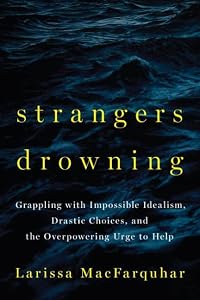
Strangers Drowning: Grappling with Impossible Idealism, Drastic Choices, and the Overpowering Urge to Help
by Larissa MacFarquhar
On This Page
Description
"What does it mean to devote yourself wholly to helping others? In Strangers Drowning, Larissa MacFarquhar seeks out people living lives of extreme ethical commitment and tells their deeply intimate stories; their stubborn integrity and their compromises; their bravery and their recklessness; their joys and defeats and wrenching dilemmas. A couple adopts two children in distress. But then they think: If they can change two lives, why not four? Or ten? They adopt twenty. But how do they weigh show more the needs of unknown children in distress against the needs of the children they already have? Another couple founds a leprosy colony in the wilderness in India, living in huts with no walls, knowing that their two small children may contract leprosy or be eaten by panthers. The children survive. But what if they hadn't? How would their parents' risk have been judged? A woman believes that if she spends money on herself, rather than donate it to buy life-saving medicine, then she's responsible for the deaths that result. She lives on a fraction of her income, but wonders: when is compromise self-indulgence and when is it essential? We honor such generosity and high ideals; but when we call people do-gooders there is skepticism in it, even hostility. Why do moral people make us uneasy? Between her stories, MacFarquhar threads a lively history of the literature, philosophy, social science, and self-help that have contributed to a deep suspicion of do-gooders in Western culture. Through its sympathetic and beautifully vivid storytelling, Strangers Drowning confronts us with fundamental questions about what it means to be human. In a world of strangers drowning in need, how much should we help, and how much can we help? Is it right to care for strangers even at the expense of those we are closest to? Moving and provocative, Strangers Drowning challenges us to think about what we value most, and why."--Dust jacket. show lessTags
Recommendations



























Member Reviews
I first learned of Larissa MacFarquhar from her excellent New Yorker piece, "The Kindest Cut," on altruistic kidney donation. It's sixteen years old now and much of the stigma and suspicion around non-directed donation has softened with time, but I still found the article thoughtful and fascinating.
See, in a month I'm due to donate my own kidney to a stranger. I read everything I could about the process as I went through it—accounts from living donors, medical articles documenting complications and success rates, even surgery videos. And, when I saw that MacFarquhar had written a book about extreme altruists, I read that too, since it promised to answer a question that came up when I told my family and a few close friends about my show more intention to donate: Why did people react as though this was such an extreme act, when, to me, it seemed both simple and natural?
I'm not an extreme altruist, not by a long shot. The people profiled in Strangers Drowning reside in the furthest reaches of generosity, often veering into the pathological (at least in my opinion). It's fascinating to read about their chosen causes—from chickens to children to the suicidally depressed—and the way they see this flawed world of ours. I had a gut reaction to something practically every time I picked up this book, whether that was the ethics of endangering one's children during charity work or fasting to try to stop nuclear bombs or the morality of adopting twenty-two children you can barely afford to care for. And I think that's a great thing, to have a book that's able to provoke me to that extent, so I could reassess my own values and beliefs. I also realized that other people must feel about my kidney donation what I felt about some of the do-gooders in this book: that they were going too far, that they were acting out of guilt or fear and justifying it post-hoc with moral superiority.
MacFarquhar is exceptionally measured in her descriptions of her subjects, never once appearing in the narrative itself, lingering instead like an omniscient ghost above them and their lives. This authorial absence and her unconventional way of quoting—framing them directly as a subject's thoughts or placing dialogue exchanges into the text like sections of a play—is controversial. And it's occasionally ill-advised, as in this quote, randomly dropped between paragraphs:
...What? And MacFarquhar never revisits or explains this. She's so averse to judgment or any sort of editorializing that she tends to take her subjects at their word without contextualizing, and that can leave the reader wanting for explanation.
Which leads into my two other main critiques of this book. First, the balance of content is off: there are just too many profiles, which are straight reportage, in comparison to the scant criticism. Second, the format is wonky. There are occasional shorter chapters titled "The Undermining of Do-Gooders," which give context to the actions and beliefs of the altruists profiled in the rest of the book, as well as the larger societal beliefs to which they stand in contrast. But I wish this stuff was incorporated into the profiles themselves, rather than being relegated to these short, weird chapters that feel random and out-of-place ("The Kindest Cut" is retooled into one of these).
Overall, this is a worthy and immensely thought-provoking book. I'm glad I read it and I certainly hope Larissa MacFarquhar writes more; her articles are wonderful and she pulls off long-form writing just as well. show less
See, in a month I'm due to donate my own kidney to a stranger. I read everything I could about the process as I went through it—accounts from living donors, medical articles documenting complications and success rates, even surgery videos. And, when I saw that MacFarquhar had written a book about extreme altruists, I read that too, since it promised to answer a question that came up when I told my family and a few close friends about my show more intention to donate: Why did people react as though this was such an extreme act, when, to me, it seemed both simple and natural?
I'm not an extreme altruist, not by a long shot. The people profiled in Strangers Drowning reside in the furthest reaches of generosity, often veering into the pathological (at least in my opinion). It's fascinating to read about their chosen causes—from chickens to children to the suicidally depressed—and the way they see this flawed world of ours. I had a gut reaction to something practically every time I picked up this book, whether that was the ethics of endangering one's children during charity work or fasting to try to stop nuclear bombs or the morality of adopting twenty-two children you can barely afford to care for. And I think that's a great thing, to have a book that's able to provoke me to that extent, so I could reassess my own values and beliefs. I also realized that other people must feel about my kidney donation what I felt about some of the do-gooders in this book: that they were going too far, that they were acting out of guilt or fear and justifying it post-hoc with moral superiority.
MacFarquhar is exceptionally measured in her descriptions of her subjects, never once appearing in the narrative itself, lingering instead like an omniscient ghost above them and their lives. This authorial absence and her unconventional way of quoting—framing them directly as a subject's thoughts or placing dialogue exchanges into the text like sections of a play—is controversial. And it's occasionally ill-advised, as in this quote, randomly dropped between paragraphs:
FISHER: When I was born my brother tried to stab me with a fork. I was my dad's favorite; he favored my over my brothers and sisters. I died in the hospital when I was little and came back to life. And then a gypsy lady told me I would take on the troubles of the family.
...What? And MacFarquhar never revisits or explains this. She's so averse to judgment or any sort of editorializing that she tends to take her subjects at their word without contextualizing, and that can leave the reader wanting for explanation.
Which leads into my two other main critiques of this book. First, the balance of content is off: there are just too many profiles, which are straight reportage, in comparison to the scant criticism. Second, the format is wonky. There are occasional shorter chapters titled "The Undermining of Do-Gooders," which give context to the actions and beliefs of the altruists profiled in the rest of the book, as well as the larger societal beliefs to which they stand in contrast. But I wish this stuff was incorporated into the profiles themselves, rather than being relegated to these short, weird chapters that feel random and out-of-place ("The Kindest Cut" is retooled into one of these).
Overall, this is a worthy and immensely thought-provoking book. I'm glad I read it and I certainly hope Larissa MacFarquhar writes more; her articles are wonderful and she pulls off long-form writing just as well. show less
Strangers Drowning by Larissa MacFarquhar begins with the hypothetical question: “If you had to choose between saving two complete strangers of your mom from drowning, would you pick the strangers?”
This concept grabs you right from the beginning. The book is a compilation of stories from people who were more than compelled to help others. Some instances so extreme, so drastic they damaged their own families. This book enlightened me in the area of idealism but also granted me the gift of knowing where to draw the line.
Strangers Drowning brought to mind the conflict of the two natures featured in the bible (Romans 7: 14-20). Many of these people started with good intentions, but they lost their way and ended up going so far beyond show more realism, they found they couldn't stop. They abandoned wives in labor, families and even a hospital to save the life of an unborn child- All in the name of helping others! Although God was sometimes mentioned, the book was not biblically based and was not preachy. There was also no true moral to the story. It was what it was, a great telling of people with an acute sense of obligation.
I appreciated the author’s writing style. MacFarquhar allowed you to come to your own conclusions and search yourself as to what you would do in each situation. I would definitely read more from this author. show less
This concept grabs you right from the beginning. The book is a compilation of stories from people who were more than compelled to help others. Some instances so extreme, so drastic they damaged their own families. This book enlightened me in the area of idealism but also granted me the gift of knowing where to draw the line.
Strangers Drowning brought to mind the conflict of the two natures featured in the bible (Romans 7: 14-20). Many of these people started with good intentions, but they lost their way and ended up going so far beyond show more realism, they found they couldn't stop. They abandoned wives in labor, families and even a hospital to save the life of an unborn child- All in the name of helping others! Although God was sometimes mentioned, the book was not biblically based and was not preachy. There was also no true moral to the story. It was what it was, a great telling of people with an acute sense of obligation.
I appreciated the author’s writing style. MacFarquhar allowed you to come to your own conclusions and search yourself as to what you would do in each situation. I would definitely read more from this author. show less
This book was put together in a creative way; it wasn't just philosophy and it wasn't just case studies, it was both, but interspersed chapter-by-chapter, sometimes multiple chapters of one followed by one chapter of the other, or vice versa.
MacFarquhar is fascinated by extreme altruists, or as she likes to call them, "do-gooders." She interviews a wide variety of them and lets them tell their stories, sometimes directly with their own words, sometimes through her. In between, she ponders what we owe to others vs. ourselves, and how we each answer that question differently, and what we lose - as well as gain - when we put others' needs above our own. "Others" in all these contexts means those who are neither ourselves NOR our family show more members, nor even our friends, acquaintances, or neighbors - the do-gooders chronicled here are all dedicated to helping strangers.
Personal interest: One case study involved a family that adopted 22 children, hailing from none other than my home state, in Barre, Vermont.
Enjoy her interview here with Tyler Cowen:
https://medium.com/conversations-with-tyler/tyler-cowen-larissa-macfarquhar-writ... show less
MacFarquhar is fascinated by extreme altruists, or as she likes to call them, "do-gooders." She interviews a wide variety of them and lets them tell their stories, sometimes directly with their own words, sometimes through her. In between, she ponders what we owe to others vs. ourselves, and how we each answer that question differently, and what we lose - as well as gain - when we put others' needs above our own. "Others" in all these contexts means those who are neither ourselves NOR our family show more members, nor even our friends, acquaintances, or neighbors - the do-gooders chronicled here are all dedicated to helping strangers.
Personal interest: One case study involved a family that adopted 22 children, hailing from none other than my home state, in Barre, Vermont.
Enjoy her interview here with Tyler Cowen:
https://medium.com/conversations-with-tyler/tyler-cowen-larissa-macfarquhar-writ... show less
The subtitle kinda says it all, but the book itself holds some fascinating case studies of those people we sometimes call saints or heroes or idealists or do-gooders (each title describing something a little different). We admire these folks and also hold them in deep suspicion; praise them and seek to punish them; sometimes seek them out and other times avoid them at all costs. Has a fascinating little passage toward the end about how most novelists paint very unflattering portraits of these types. You would "do good" to obtain a copy and read it...will keep you thinking about these issues long after the book is closed.
This non-fiction book takes an in-depth look at what motivates “do-gooders”, those who are extremely committed to helping others, often at the expense of their own loved ones. It’s an ambitious work and is broken down into chapters telling true stories of do-gooders, like the woman in her 80’s, who after a lifelong commitment to nursing others, begins to teach midwives and the man who donates his kidney to a stranger, along with the history of completely unselfish people and society’s perception of them through the years.
The books starts off with the thought experiment of whether you should save your mother drowning or two strangers. What number of strangers that you could save would it take to leave your mother to drown? show more Would two be enough or would it take twenty or twenty thousand? Or would you save your mother no matter how many other lives could be saved instead?
While everyone knows there are thousands of people in the world who are starving or dying, life would be intolerable if we cared about each of those people the way we care for our family members. How would we face each day? Should you feel guilty if you spend money to go to a movie when that money might have helped a starving child? When a person is a truly committed do-gooder, their survival and needs are secondary to those of others. Their own needs feel like selfishness and there is no room for wants or desires.
While each of the stories have their own merits, I also enjoyed reading about the history of do-gooders and society’s perception of them. At times do-gooders were looked upon as hypocrites and as doing good deeds just to appear virtuous, to get into heaven when they died or to make themselves feel better. So their acts weren’t selfish at all, but actually supreme selfishness as they were actually doing charitable works for themselves. During other times in history, they were deemed to be saints. The many cases of people helping hide Jews during the Holocaust were explored. Were these cases a matter of circumstance (war) or of character?
To me, the most fascinating story was about Baba Amte, who set up a leper’s colony in India. He came to believe that suffering was at the core of what it meant to be human. He brought his family into contact with lepers and neglected them when they were sick in order to care for the lepers. He even offered to be a human experiment where he was injected with the leprosy bacillus only to learn that he was immune to the disease. He and his family lived in horrendous conditions. His children barely had enough to eat. But it’s truly amazing what Amte was able to accomplish in his lifetime on behalf of lepers.
This is a fascinating look at the motives behind courageous people who commit their lives to others in an attempt to make the world a better place.
This book was given to me by the publisher through First to Read in return for an honest review.
http://marjorie.booklikes.com/post/1241361/extraordinary-study-of-the-motives-an... show less
The books starts off with the thought experiment of whether you should save your mother drowning or two strangers. What number of strangers that you could save would it take to leave your mother to drown? show more Would two be enough or would it take twenty or twenty thousand? Or would you save your mother no matter how many other lives could be saved instead?
While everyone knows there are thousands of people in the world who are starving or dying, life would be intolerable if we cared about each of those people the way we care for our family members. How would we face each day? Should you feel guilty if you spend money to go to a movie when that money might have helped a starving child? When a person is a truly committed do-gooder, their survival and needs are secondary to those of others. Their own needs feel like selfishness and there is no room for wants or desires.
While each of the stories have their own merits, I also enjoyed reading about the history of do-gooders and society’s perception of them. At times do-gooders were looked upon as hypocrites and as doing good deeds just to appear virtuous, to get into heaven when they died or to make themselves feel better. So their acts weren’t selfish at all, but actually supreme selfishness as they were actually doing charitable works for themselves. During other times in history, they were deemed to be saints. The many cases of people helping hide Jews during the Holocaust were explored. Were these cases a matter of circumstance (war) or of character?
To me, the most fascinating story was about Baba Amte, who set up a leper’s colony in India. He came to believe that suffering was at the core of what it meant to be human. He brought his family into contact with lepers and neglected them when they were sick in order to care for the lepers. He even offered to be a human experiment where he was injected with the leprosy bacillus only to learn that he was immune to the disease. He and his family lived in horrendous conditions. His children barely had enough to eat. But it’s truly amazing what Amte was able to accomplish in his lifetime on behalf of lepers.
This is a fascinating look at the motives behind courageous people who commit their lives to others in an attempt to make the world a better place.
This book was given to me by the publisher through First to Read in return for an honest review.
http://marjorie.booklikes.com/post/1241361/extraordinary-study-of-the-motives-an... show less
The subtitle kinda says it all, but the book itself holds some fascinating case studies of those people we sometimes call saints or heroes or idealists or do-gooders (each title describing something a little different). We admire these folks and also hold them in deep suspicion; praise them and seek to punish them; sometimes seek them out and other times avoid them at all costs. Has a fascinating little passage toward the end about how most novelists paint very unflattering portraits of these types. You would "do good" to obtain a copy and read it...will keep you thinking about these issues long after the book is closed.
Strangers Drowning, Larissa MacFarquhar, author and narrator
The book addresses the do-gooders of the world, those who place the needs of others ahead of their own, those that want to bring compassion to everyone in need, those that want to save others regardless of the risk to themselves, those that do it instinctively and those that do it by choice. In short, there are several categories of do-gooders and she explains how all types of do-gooders are perceived and why. Some are ridiculed, some are pariahs, and some are occasionally honored and revered. The way they are viewed has changed over time. At one time they were abhorred as abnormal, unstable, needy, unbalanced, but today their behavior is more accepted and appreciated. show more Schadenfreude often played a role in judging them. Also, no one wanted Jiminy Cricket on their shoulders all the time, judging their ability to be “as good”, as they were. How much “do-gooding” was enough? The author describes all types, but concentrates on those with the ability to totally self-sacrifice even at the expense of family and friends which is at the extreme end of do-gooders. They are those that perceive their journey as noble, caring for those in greater need, greater in number, in greater pain. Throughout the book she asks a variation of this question: “Who would you save, your mother or two strangers?” In this way she segregates into separate groups, the types of do-gooders that exist. It is well researched with references, and well known scholars and professionals are quoted to back up conclusions, but none seemed hard and fast. I thought it was really well written, clear and easy to follow, but I still felt that it was a bit too scholarly in some ways and too much of an opinion piece in another.
The sciences that study behavior do not necessarily have hard and fast rules or conclusions. I struggled to find a reason for the research and still am not sure what the author’s purpose was in writing this book. I feel almost as if she started out with a negative approach against people who were “extreme do-gooders”. She points out that doing good for someone else necessitated a choice of doing less for yourself, or in some cases if you helped strangers it was at the expense of your own loved ones, or perhaps the do-gooder only helped to serve their own need to help, rather than helping for the sake of the service itself. Still, what does it matter? If the person helping is getting satisfaction and the person receiving is positively affected, does the reason for doing the good works really matter?
The book is based on real people, in several countries, from several different backgrounds who perform a variety of different acts of self sacrifice in the interest of helping others. In some cases, the names have been changed, but most accomplished great things, even when the results were not long lasting. Some of the efforts may seem less concerning or worthy to the reader and some of the sacrifices may seem too far fetched to be in the realm of normal behavior. Such acts like donating organs to strangers rather than relatives, taking in or adopting dozens of children and families, fighting for animal rights, the rights of chickens, starting an adoption agency, becoming a monk, living a subsistence existence, and starting a leper colony are addressed. She addresses the subject of women who love too much and codependency. Whose need are they serving, the dependent’s or the codependent’s? She even addresses the needs of some social workers who feel they must give up their own lives to help others and feel guilty if they do not. She calls them the moral delusions of aid workers. They are satisfying their own need, their own guilt, their own inability to bring balance into their life’s choices and believe they have to give up their own lives to help others because they are less deserving. Surely this might be true in some cases, but I wondered, does that lessen their self sacrifice or their accomplishments? Can you really place a negative value on someone who is doing good regardless of their reasons? Apparently some do; they view the do-gooder almost as their alter ego, the alter ego that they cannot measure up to, the alter ego judging them as failures for not being as good a do-gooder.
She also addressed donors of organs to strangers. She said that sometimes the relationship between donor and recipient got complicated. She raised the question of why would someone would give up their organ to a stranger while they were alive? She said that organ donors in that category have to be psychoanalyzed before they are given permission to do so. She said that over time, the donators and organ donations have ceased being viewed as gifts from unstable donors and are viewed as more normal behaviors and contributions. She raises the issue of moral equivalents for do-gooders. Which is the greater cause, which is the better cause? Are chickens as important as humans? Are family needs greater than the needs of strangers? These are some of the questions she poses? Are aid workers self serving? Is helping a pernicious disease? Is it a choice or a need?The do-gooders in the book are of the extreme kind who put everyone and everything before their own needs. Each individual she reviewed was damaged in some way or came from damaged, dysfunctional families dealing with mental illness, alcoholism, fanaticism, and drugs. They were idealists for their own specific causes, chickens, orphans, women, lepers.
As you read, I think you must accept her premise that extreme do-gooders are not happy unless they are helping others, helping those that suffer and go unnoticed. They are not simply performing acts of kindness. Their happiness and reward comes from the joy they bring to others, not from themselves or their own lives. Many eventually become aware of their own needs and modify their self-destructive behavior. They believed they were bad and had to become better. Their guilt consumed them. The idea of pseudo-altruism was introduced as opposed to sincere efforts to help as in universal altruism. It was suggested that altruism is a form of selfishness to insure one’s own survival. Some in the field of psychology equated altruism with feelings of guilt or masochism and even sadomasochism. They described the altruists as compulsive. Did they lose their sense of balance in favor of complete sacrifice working for the benefit of strangers, others, whose need they believed was greater? Were they required to give up everything in order to be good? They grappled with those kinds of questions. How much giving was enough, how much sacrifice was necessary to make life better for everyone and everything? Was it even possible?
I never quite understood how these people actually supported themselves or their causes, and actually, I felt that the subject and the subjects were over analyzed. When did kindness, in any form, become something that was considered dysfunctional? I would like to pose that question to Mother Theresa, the sainted queen of “doing good”. show less
The book addresses the do-gooders of the world, those who place the needs of others ahead of their own, those that want to bring compassion to everyone in need, those that want to save others regardless of the risk to themselves, those that do it instinctively and those that do it by choice. In short, there are several categories of do-gooders and she explains how all types of do-gooders are perceived and why. Some are ridiculed, some are pariahs, and some are occasionally honored and revered. The way they are viewed has changed over time. At one time they were abhorred as abnormal, unstable, needy, unbalanced, but today their behavior is more accepted and appreciated. show more Schadenfreude often played a role in judging them. Also, no one wanted Jiminy Cricket on their shoulders all the time, judging their ability to be “as good”, as they were. How much “do-gooding” was enough? The author describes all types, but concentrates on those with the ability to totally self-sacrifice even at the expense of family and friends which is at the extreme end of do-gooders. They are those that perceive their journey as noble, caring for those in greater need, greater in number, in greater pain. Throughout the book she asks a variation of this question: “Who would you save, your mother or two strangers?” In this way she segregates into separate groups, the types of do-gooders that exist. It is well researched with references, and well known scholars and professionals are quoted to back up conclusions, but none seemed hard and fast. I thought it was really well written, clear and easy to follow, but I still felt that it was a bit too scholarly in some ways and too much of an opinion piece in another.
The sciences that study behavior do not necessarily have hard and fast rules or conclusions. I struggled to find a reason for the research and still am not sure what the author’s purpose was in writing this book. I feel almost as if she started out with a negative approach against people who were “extreme do-gooders”. She points out that doing good for someone else necessitated a choice of doing less for yourself, or in some cases if you helped strangers it was at the expense of your own loved ones, or perhaps the do-gooder only helped to serve their own need to help, rather than helping for the sake of the service itself. Still, what does it matter? If the person helping is getting satisfaction and the person receiving is positively affected, does the reason for doing the good works really matter?
The book is based on real people, in several countries, from several different backgrounds who perform a variety of different acts of self sacrifice in the interest of helping others. In some cases, the names have been changed, but most accomplished great things, even when the results were not long lasting. Some of the efforts may seem less concerning or worthy to the reader and some of the sacrifices may seem too far fetched to be in the realm of normal behavior. Such acts like donating organs to strangers rather than relatives, taking in or adopting dozens of children and families, fighting for animal rights, the rights of chickens, starting an adoption agency, becoming a monk, living a subsistence existence, and starting a leper colony are addressed. She addresses the subject of women who love too much and codependency. Whose need are they serving, the dependent’s or the codependent’s? She even addresses the needs of some social workers who feel they must give up their own lives to help others and feel guilty if they do not. She calls them the moral delusions of aid workers. They are satisfying their own need, their own guilt, their own inability to bring balance into their life’s choices and believe they have to give up their own lives to help others because they are less deserving. Surely this might be true in some cases, but I wondered, does that lessen their self sacrifice or their accomplishments? Can you really place a negative value on someone who is doing good regardless of their reasons? Apparently some do; they view the do-gooder almost as their alter ego, the alter ego that they cannot measure up to, the alter ego judging them as failures for not being as good a do-gooder.
She also addressed donors of organs to strangers. She said that sometimes the relationship between donor and recipient got complicated. She raised the question of why would someone would give up their organ to a stranger while they were alive? She said that organ donors in that category have to be psychoanalyzed before they are given permission to do so. She said that over time, the donators and organ donations have ceased being viewed as gifts from unstable donors and are viewed as more normal behaviors and contributions. She raises the issue of moral equivalents for do-gooders. Which is the greater cause, which is the better cause? Are chickens as important as humans? Are family needs greater than the needs of strangers? These are some of the questions she poses? Are aid workers self serving? Is helping a pernicious disease? Is it a choice or a need?The do-gooders in the book are of the extreme kind who put everyone and everything before their own needs. Each individual she reviewed was damaged in some way or came from damaged, dysfunctional families dealing with mental illness, alcoholism, fanaticism, and drugs. They were idealists for their own specific causes, chickens, orphans, women, lepers.
As you read, I think you must accept her premise that extreme do-gooders are not happy unless they are helping others, helping those that suffer and go unnoticed. They are not simply performing acts of kindness. Their happiness and reward comes from the joy they bring to others, not from themselves or their own lives. Many eventually become aware of their own needs and modify their self-destructive behavior. They believed they were bad and had to become better. Their guilt consumed them. The idea of pseudo-altruism was introduced as opposed to sincere efforts to help as in universal altruism. It was suggested that altruism is a form of selfishness to insure one’s own survival. Some in the field of psychology equated altruism with feelings of guilt or masochism and even sadomasochism. They described the altruists as compulsive. Did they lose their sense of balance in favor of complete sacrifice working for the benefit of strangers, others, whose need they believed was greater? Were they required to give up everything in order to be good? They grappled with those kinds of questions. How much giving was enough, how much sacrifice was necessary to make life better for everyone and everything? Was it even possible?
I never quite understood how these people actually supported themselves or their causes, and actually, I felt that the subject and the subjects were over analyzed. When did kindness, in any form, become something that was considered dysfunctional? I would like to pose that question to Mother Theresa, the sainted queen of “doing good”. show less
Members
- Recently Added By
Author Information
4+ Works 362 Members
Awards and Honors
Classifications
Statistics
- Members
- 359
- Popularity
- 87,261
- Reviews
- 15
- Rating
- (3.65)
- Languages
- Dutch, English, Portuguese
- Media
- Paper, Audiobook, Ebook
- ISBNs
- 11
- ASINs
- 5