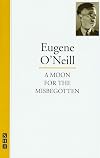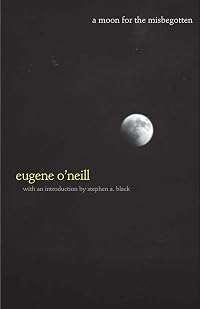
A Moon for the Misbegotten
by Eugene O'Neill
On This Page
Description
Josie, a towering woman with a quick tongue and a ruined reputation lives in a dilapidated Connecticut farmhouse with her conniving father. Together, they're a formidable force as they scrape together a livelihood. But Josie's softer side is exposed through her love of Jim Tyrone, her father's drinking buddy - a third-rate actor whose dreams of stardom were washed away by alcohol. The companion pieces are "Long Day's Journey" and "The Iceman Cometh."Tags
Recommendations

























Member Reviews
I don't know how else to describe this play other than "heart-breakingly beautiful". I absolutely love it. What a fabulous insight into raw human emotion. The tragedy is that the love between Josie and Tyrone isn't unrequited at all--it's very real, and very deep; it's impossible to say who needs eachother more. Yet despite the strength of the the emotion between them, regret, shame, and pride keep them apart. For just one night they let their follies fall away, but each has a conflicting view on what it means to show their love to each other. This play reminds me very much of Gone with the Wind-- the complexity of the characters and their relations, the pride that keeps them from letting each other in. The challenge of this play's show more character development would be a gift to any actor. As a counselor and an actress, this is one of my favorite pieces of American writing. show less
It is rare when we can touch the soul of another. Eugene O'Neill provides us with an even rarer gift, to touch three souls who congregate on one summer day on a farm in Connecticut. Three souls who live only in his imagination but who are still very real. I have nothing in common Josie Hogan, her father, Phil Hogan, and Jim Thornton, young landlord to their tenant farm. Not their brogue, their hardscrabble way of life, their harsh words that wedge a family apart, their hard drinking, their despondency. But O'Neill brought me into the center of their life, to experience, first hand, this one day in their life where their fear, pain, hope and loss culminate. A day when they face each other, face the truth in themselves, to discover that show more this, and no other, is their one life to live.
Phil Hogan has just seen his youngest son leave farm and family, unable to cope with his father's harsh attitude. Only Josie and Father Hogan remain, and they maintain a mutual understanding and respect. They have each other and the farm, which Jim has promised to sell them for a pittance. But their hostile neighbor has tendered an offer for the farm which will be hard for Jim to refuse. Is their livelihood now at stake?
Nothing is as it seems. Phil comes home from the Inn with a story that Jim will sell to the neighbor. Is that true, or is Phil just using Jim's joke as the means to set a honey trap with Josie as bait? And is Phil motivated by concern for the farm or concern for Josie's happiness? Or both? Does he himself know which it is? We don't know, Josie doesn't know, she has to decide nonetheless. She decides to trust Jim and to give Phil the benefit of the doubt, that he was acting in her interest.
She is right to trust Jim, and from the trust they build together comes a miracle--Josie regains her virginity! At least in any sense that matters. But it is not their fate to build a future together. Jim has died inside, killed by the ghosts of his past, his sense of self shattered by a dead father who likely treated him as Phil treated his own sons, a self made unrecoverable by his mother's death. Josie and Jim have had their one night together, under the moon, and facing a dawn that "will wake in the sky like a promise of God's peace in the soul's dark sadness." show less
Phil Hogan has just seen his youngest son leave farm and family, unable to cope with his father's harsh attitude. Only Josie and Father Hogan remain, and they maintain a mutual understanding and respect. They have each other and the farm, which Jim has promised to sell them for a pittance. But their hostile neighbor has tendered an offer for the farm which will be hard for Jim to refuse. Is their livelihood now at stake?
Nothing is as it seems. Phil comes home from the Inn with a story that Jim will sell to the neighbor. Is that true, or is Phil just using Jim's joke as the means to set a honey trap with Josie as bait? And is Phil motivated by concern for the farm or concern for Josie's happiness? Or both? Does he himself know which it is? We don't know, Josie doesn't know, she has to decide nonetheless. She decides to trust Jim and to give Phil the benefit of the doubt, that he was acting in her interest.
She is right to trust Jim, and from the trust they build together comes a miracle--Josie regains her virginity! At least in any sense that matters. But it is not their fate to build a future together. Jim has died inside, killed by the ghosts of his past, his sense of self shattered by a dead father who likely treated him as Phil treated his own sons, a self made unrecoverable by his mother's death. Josie and Jim have had their one night together, under the moon, and facing a dawn that "will wake in the sky like a promise of God's peace in the soul's dark sadness." show less
O'Neil earned (won?) a Nobel prize for Iceman Cometh, Morning Becomes Elektra and other plays. This gem, and I use the term loosely, follows the action of Long Day's Journey Into the Night (I think that's the one).
The play revolves around the twin moons of Jim Tyrone and Josie. Jim Tyrone has recently come home, searching for some semblence of forgiveness in the depthos of a bottle. Josie, the daughter of his tenent, has been flirting and falling in love with him all the while. After months and years of unrequited passion, the pair finally share a moment of truth and forgiveness one moonlit night.
Doesn't that paragraph make it sound wonderful? O'Neill precedes this play with a disclaimer - he wrote it in 1942, didn't edit it, never got show more it produced and finally published it in the fifties. The wait did not make this play sweeter. Moon isn't a classic, just middling at best. If O'Neill couldn't get his work produced, there probably was a reason - the work just stunk. show less
The play revolves around the twin moons of Jim Tyrone and Josie. Jim Tyrone has recently come home, searching for some semblence of forgiveness in the depthos of a bottle. Josie, the daughter of his tenent, has been flirting and falling in love with him all the while. After months and years of unrequited passion, the pair finally share a moment of truth and forgiveness one moonlit night.
Doesn't that paragraph make it sound wonderful? O'Neill precedes this play with a disclaimer - he wrote it in 1942, didn't edit it, never got show more it produced and finally published it in the fifties. The wait did not make this play sweeter. Moon isn't a classic, just middling at best. If O'Neill couldn't get his work produced, there probably was a reason - the work just stunk. show less
I alla hans pjäser görs ett allvarligt försök att förklara livet.
Jan 7, 2010Swedish
Ratings
Members
- Recently Added By
Lists

My Play Collection
769 works; 3 members

Plays I Saw / 2025
37 works; 1 member
Author Information

Eugene O'Neill was born in New York City on October 16, 1888, the son of popular actors James O'Neill and Ellen Quinlan. As a young child, he frequently went on tour with his father and later attended a Catholic boarding school and a private preparatory school. He entered Princeton University but stayed for only a year. He took a variety of jobs, show more including prospecting for gold, shipping out as a merchant sailor, joining his father on the stage, and writing for newspapers. In 1912, he was hospitalized for tuberculosis and emotional exhaustion. While recovering, he read a great deal of dramatic literature and, after his release from the sanitarium, began writing plays. O'Neill got his theatrical start with a group known as the Provincetown Players, a company of actors, writers, and other theatrical newcomers, many of whom went on to achieve commercial and critical success. His first plays were one-act works for this group, works that combined realism with experimental forms. O'Neill's first commercial successes, Beyond the Horizon (1920) and Anna Christie (1921) were traditional realistic plays. Anna Christie is still frequently performed. It is the story of a young woman, Anna, whose hard life has led her to become a prostitute. Anna comes to live with her long-lost father, who is unaware of her past, and she falls in love with a sailor, who is also unaware. When Anna finds the two men fighting over her as though she were property, she is so angry and disgusted that she insists on telling them the truth. The man she loves rejects her at first, but then later returns to marry her. Soon O'Neill began to experiment more, and over the next 12 years used a wide variety of unusual techniques, settings, and dramatic devices. It is no exaggeration to say that, virtually on his own, O'Neill created a tradition of serious American theater. His influence on the playwrights who followed him has been enormous, and much of what is taken today for granted in modern American theater originated with O'Neill. A major legacy has been the nine plays he wrote between 1924 and 1931, tragedies that made heavy use of the new Freudian psychology just coming into fashion. His one comedy, Ah, Wilderness (1933), was the basis for the musical comedy, Oklahoma!, itself a groundbreaking event in American theater. O'Neill later began to write the intense, brooding, and highly autobiographical plays that are now considered to his best work. The Iceman Cometh (1946) is set in a bar in Manhattan's Bowery, or skid-row district. In the course of the play, a group of apparently happy men are forced to recognize the true emptiness of their lives. In A Long Day's Journey into Night (1956), O'Neill examines his own family and their tormented lives, a subject he continues in A Moon for the Misbegotten (1957). O'Neill's work was highly honored. He was awarded the Nobel Prize for literature in 1936 and Pulitzer Prizes for Anna Christie, Beyond the Horizon, Strange Interlude (1928), and A Long Day's Journey Into Night, which also received the New York Drama Critics Circle Award. O'Neill died in Room 401 of the Sheraton Hotel on Bay State Road in Boston, on November 27, 1953, at the age of 65. He was also born in a hotel room in Times Square, NYC. (Bowker Author Biography) show less
Some Editions
Awards and Honors
Awards
Work Relationships
Is contained in
Is a (non-series) sequel to
Common Knowledge
- Canonical title
- A Moon for the Misbegotten
- Original title
- A Moon for the Misbegotten
- Original publication date
- 1952
- People/Characters
- Josie Hogan; Phil Hogan; Mike Hogan; James Tyrone, Jr. (Jim); T. Stedman Harder
- Important places
- Connecticut, USA
- First words
- Josie: Ah, thank God.
- Quotations
- Like a dead man walking slow behind his own coffin.
- Last words
- (Click to show. Warning: May contain spoilers.)Josie: May you rest forever in forgiveness and peace.
- Blurbers
- Watts, Richard; Kerr, Walter; Barnes, Clive
- Original language
- American English
Classifications
Statistics
- Members
- 444
- Popularity
- 69,181
- Reviews
- 4
- Rating
- (4.01)
- Languages
- 9 — Catalan, Danish, English, French, German, Italian, Russian, Spanish, Swedish
- Media
- Paper, Ebook
- ISBNs
- 13
- ASINs
- 10