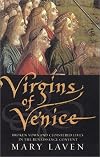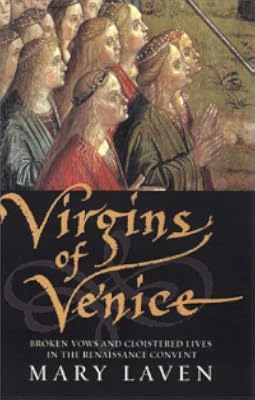
Virgins of Venice: Broken Vows and Cloistered Lives in the Renaissance Convent
by Mary Laven
On This Page
Description
"Venice in the late Renaissance was a city of fabulous wealth, reckless creativity, and growing social unrest as its maritime empire crumbled. It was also a city of walls and secrets, ghettos and cloisters - including fifty convents housing three thousand nuns, many of them refined, upper-class women who had been immured against their will. In this utterly fascinating book, Cambridge historian Mary Lavan uncovers the long-hidden stories of the "Virgins of Venice" and the secret, often show more surprising, lives they led." "Sifting through records kept during the Counter-Reformation, Laven has created a detailed and dramatic tapestry of resourceful, determined, often passionate women who managed to lead fulfilling lives despite their virtual imprisonment. Far from being precincts of piety and silence, the convents of Venice were hotbeds of political scheming, colorful pageantry, gorgeous decoration, and illicit love affairs. One nun was so determined to sleep with her lover that she painstakingly chipped a hole in a stone wall so he could climb through under cover of night. Another expressed her individuality through obsessive gift giving while keeping records of the dangerous flirtations going on around her. Still others exercised considerable clandestine power in the dangerous game of Venetian politics."--Jacket. show lessTags
Recommendations

































Member Reviews
A short work, at not quite two hundred pages in paperback, but still an excellent and very readable history of female religious in Venice during the sixteenth and seventeenth centuries. Laven is wonderful at balancing her tone between popular history and more scholarly works, tempering a rigorous examination of the sources with compassion and humour. There were times when she could have stood to flesh out some of her points a little more, but having written on the history of female religious myself, and knowing how hard it is to find any relevant documentation, I can't fault her too much on that score—especially since she often acknowledges just how difficult it often is to find out what went on behind closed doors. A great starting show more point if you have any interest in the subject, and well worth reading even if you haven't. show less
I've a lot less experience with reading non-fiction - especially for enjoyment, not cruising for essay material - than I do with fiction, so I find myself uncertain about how to encapsulate the things I did and didn't enjoy about this. In general, I felt it had too much focus on presenting the historical record, which in this case was primarily the records of church inspections and investigations of Venetian convents. So there were a lot of "take the interesting case of Sister X", or "here's what the inspector said about Y convent", but I felt frustrated by the close focus. I wanted to be a step further back, looking at broader context, and the wider meanings of these isolated incidents. While the author gave quite a bit of explanatory show more context, especially for things that directly impacted on the convents and nuns, there was still a lot missing (comparative circumstances in monasteries, for instance). Where the broader stuff was filled in, I enjoyed this tremendously. In the chapters where it was lacking - and especially toward the end, as the author started digging into sexuality in the convents without any real notes of the "regular" practice of sexuality at that time and place - I felt bogged down in voyeuristic detail with any notion of its real meaning.
Anyway, I'm off to read more about Venetian society of the sixteenth/seventeenth centuries or so, because there was some wacky stuff going on there, and I am all about the wacky stuff people do to themselves. show less
Anyway, I'm off to read more about Venetian society of the sixteenth/seventeenth centuries or so, because there was some wacky stuff going on there, and I am all about the wacky stuff people do to themselves. show less
Laven's scholarly study (originally her doctoral's thesis) is nonetheless a readable account of nunnery life in early Renaissance Venice. She describes a fascinating slice of 16th century life. What is remarkable is that the 'slice' is actually quite large. As Laven relates, noble women (most professed nuns were noble) had few options. Most families concentrated their financial resources in a dowry for only one daughter and the rest commonly went to the convent. For many of these women life in a nunnery was not voluntary.
As part of the Church's defensive reaction in the Counter-Reformation, Venetian convents became much more strictly enclosed by the strictures of the Council of Trent. The enclosure laws greatly benefited Laven's work show more because most of her material comes directly from court records. These sources are both book's greatest strength and its weakness. The records provide insight into the behavior of real people, individuals with names and families, in and around nunneries. Given the lack of other available resources, the reliance on court records distorts our view because we mostly only read about those situations that made it to court. Fortunately for us, convent life was quite strictly regulated, yet nuns were also determined to have dealings with the outside world - many of them non-sexual - so Laven has access to many records.
A very interesting case study. The Church was so central to medieval and Renaissance life that anyone who wants to understand those periods must understand the role of religion and the Church as an institution. Laven's book is highly instructive and highly recommended. show less
As part of the Church's defensive reaction in the Counter-Reformation, Venetian convents became much more strictly enclosed by the strictures of the Council of Trent. The enclosure laws greatly benefited Laven's work show more because most of her material comes directly from court records. These sources are both book's greatest strength and its weakness. The records provide insight into the behavior of real people, individuals with names and families, in and around nunneries. Given the lack of other available resources, the reliance on court records distorts our view because we mostly only read about those situations that made it to court. Fortunately for us, convent life was quite strictly regulated, yet nuns were also determined to have dealings with the outside world - many of them non-sexual - so Laven has access to many records.
A very interesting case study. The Church was so central to medieval and Renaissance life that anyone who wants to understand those periods must understand the role of religion and the Church as an institution. Laven's book is highly instructive and highly recommended. show less
This was a very informative book on the nuns of Venice during the Renaissance. It describes the living conditions of the nuns, and the ways in which they were treated by the church and the world around them. In some ways, Laven seems to repeat herself (the book is divided into chapters, but it sometimes seems as though she is covering the same topic in several different chapters), and this might be because the book is an extention of her dissertation. The subject was interesting, though, and the book was a quick read at only 200 pages.
Interesting topic but I felt it could have been better.
Quite Interesting
slow moving... we will see
Members
- Recently Added By
Author Information

4 Works 413 Members
Mary Laven is Lecturer at the University of Cambridge and a Fellow of Jesus College.
Awards and Honors
Awards
Common Knowledge
- Canonical title
- Virgins of Venice: Broken Vows and Cloistered Lives in the Renaissance Convent
- Original publication date
- 2003
- Important places
- Venice, Veneto, Italy
- Dedication
- For Nubar and Pallina
Classifications
- Genres
- History, Nonfiction, Religion & Spirituality, General Nonfiction, Sexuality and Gender Studies
- DDC/MDS
- 271.9004531 — Religion History of Christianity Religious congregations and orders in church history Orders of Women
- LCC
- BX4220 .I8 .L38 — Philosophy, Psychology and Religion Christian Denominations Christian Denominations Catholic Church Monasticism. Religious orders Religious orders of women
- BISAC
Statistics
- Members
- 341
- Popularity
- 92,888
- Reviews
- 8
- Rating
- (3.42)
- Languages
- Dutch, English, German, Swedish
- Media
- Paper
- ISBNs
- 8
- ASINs
- 3