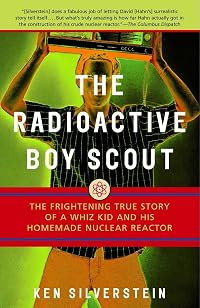
The Radioactive Boy Scout: The True Story of a Boy and His Backyard Nuclear Reactor
by Ken Silverstein
On This Page
Description
Growing up in suburban Detroit, David Hahn was fascinated by science, and his basement experiments were far more ambitious than those of other boys. While working on his Atomic Energy merit badge for the Boy Scouts, David's obsessive attention turned to nuclear energy. Throwing caution to the wind, he plunged into a new project: building a model nuclear breeder reactor in his backyard garden shed. Ken Silverstein re-creates in brilliant detail the months of David's improbable nuclear quest. show more His unsanctioned and wholly unsupervised project finally sparked an environmental catastrophe that put his town's forty thousand residents at risk and caused the EPA to shut down his lab and bury it at a radioactive dumpsite in Utah. show lessTags
Recommendations










Member Recommendations
Member Reviews
This cautionary tale of a teenaged Michigan chemistry enthusiast who managed to construct a rudimentary nuclear reactor in his shed incorporates digressions about tangents such as the quest for the breeder reactor, America's enthusiasm for radioactive consumer products a century ago, and a history of the atomic bomb. These are necessary to bring the book up to a scant 200 pages; the teen's story is interesting enough, but really only worthy of a long magazine article in and of itself. The author clearly finds the episode troubling, and quite rightly so; our mad scientist was thwarted quite by accident during a routine traffic stop when the police found an aggregation of junk he had in his trunk and thought it might be a bomb, and, even show more then, it took authorities months to discover the reactor, and the secrecy-obsessed EPA cleanup crew came within a couple of hours of destroying the radioactive shed without media showing up. Both the main story and the digressions are interestingly related, and the author explains the chemistry involved in the story very clearly, directly, and briefly. show less
David Hahn, Boy Scout, almost single-mindedly obsessed with science, attempted to build a breeder reactor – a type of nuclear reactor that produces more of its own fuel than it needs to power it – in his mother’s backyard shed. This is the story of how close he came, and how the extent of his experiments remained undiscovered for so long.
Wilfully unaware of the risks, and misguided though his attempt to build a breeder reactor without any sort of ventilation, safeguarding or guidance, it must be said that this degree of focus is the sort that often enables people to achieve great things. It is no less intriguing to read the biography of someone whose dedication and off-the-wall genius peaked a little too early, and fixed on show more something so enormously unsafe, than someone who took risks and achieved their goal.
David Hahn himself is a rather sad subject – that is, until Silverstein depicts him poring over the Golden Book of Science Experiments, passing himself off as a professor to gain insight into technical difficulties and bombarding his neighbourhood with radiation (while thankfully never achieving ‘critical mass’). His reckless desire for a breakthrough and the attendant acclaim are so understandable that the reader can forgive him his blindness and follow Silverstein’s account with a sort of breathless awe at – yes, the stupidity – but also the determination.
Aside from David’s story, the best aspect of this book is the insight into the different materials involved in nuclear energy, how they are formed, how they react and decay, what actually happens to them during processes involving irradiation or detonation… the science behind the story and the enthusiasm for the science that Silverstein brings to the book make this a biography of nuclear experimentation as much as the story of David’s obsession. show less
Wilfully unaware of the risks, and misguided though his attempt to build a breeder reactor without any sort of ventilation, safeguarding or guidance, it must be said that this degree of focus is the sort that often enables people to achieve great things. It is no less intriguing to read the biography of someone whose dedication and off-the-wall genius peaked a little too early, and fixed on show more something so enormously unsafe, than someone who took risks and achieved their goal.
David Hahn himself is a rather sad subject – that is, until Silverstein depicts him poring over the Golden Book of Science Experiments, passing himself off as a professor to gain insight into technical difficulties and bombarding his neighbourhood with radiation (while thankfully never achieving ‘critical mass’). His reckless desire for a breakthrough and the attendant acclaim are so understandable that the reader can forgive him his blindness and follow Silverstein’s account with a sort of breathless awe at – yes, the stupidity – but also the determination.
Aside from David’s story, the best aspect of this book is the insight into the different materials involved in nuclear energy, how they are formed, how they react and decay, what actually happens to them during processes involving irradiation or detonation… the science behind the story and the enthusiasm for the science that Silverstein brings to the book make this a biography of nuclear experimentation as much as the story of David’s obsession. show less
How had I never heard of this? This was so incredibly interesting. It is about a boy who at the age of 17 built a homemade neutron source in 1994, completely on his own, in his backyard shed.
While it sounds incredible, it is true. Hahn sourced the small amounts of the radioactive element americium-241 found inside many smoke detectors to build his neutron source. He was arrested in 2007 for larceny, accused of stealing smoke detectors again, and struggled with mental illness and substance abuse, and tragically passed away at the young age of 39 in 2016 due to a combination of alcohol, diphenhydramine, and fentanyl. It is a shame that no one was able to harness his attention to be utilized safely.
While it sounds incredible, it is true. Hahn sourced the small amounts of the radioactive element americium-241 found inside many smoke detectors to build his neutron source. He was arrested in 2007 for larceny, accused of stealing smoke detectors again, and struggled with mental illness and substance abuse, and tragically passed away at the young age of 39 in 2016 due to a combination of alcohol, diphenhydramine, and fentanyl. It is a shame that no one was able to harness his attention to be utilized safely.
The story of David Hahn should be given as a cautionary tale to any parent that feels the best course of action is to stay largely uninvolved in their child's life since they'll likely have friends, school and even some social clubs where someone else is bound to pick up some of the slack when it comes to raising a young adult. Doubly-so for anyone that thinks that their kid is incredibly smart and somehow immune to actual trouble.
Silverstein tells David Hahn's story of an obsession with chemistry that eventually led him to attempt to build his own breeder reactor at 17. Not a model, not a lego simulation, not a cute presentation - an actual breeder reactor replete with radioactive materials (including samples of uranium) that show more eventually led to his backyard shed being declared a Superfund site.
Silverstein does a great job of explaining how Hahn got to that level of obsession, how no one thought to stop his experiments and how a teenager would have access to so many of the materials needed to even begin building a breeder reactor. While the story clearly shows all the things that Hahn did wrong, Silverstein also balances this out a bit by giving glimpse into the home and community life that would allow something like this to take place. While not looking to absolve Hahn, what it does is make your wish that someone along the line would have been able to have mentored him and helped him focus his love of chemistry into something more positive. show less
Silverstein tells David Hahn's story of an obsession with chemistry that eventually led him to attempt to build his own breeder reactor at 17. Not a model, not a lego simulation, not a cute presentation - an actual breeder reactor replete with radioactive materials (including samples of uranium) that show more eventually led to his backyard shed being declared a Superfund site.
Silverstein does a great job of explaining how Hahn got to that level of obsession, how no one thought to stop his experiments and how a teenager would have access to so many of the materials needed to even begin building a breeder reactor. While the story clearly shows all the things that Hahn did wrong, Silverstein also balances this out a bit by giving glimpse into the home and community life that would allow something like this to take place. While not looking to absolve Hahn, what it does is make your wish that someone along the line would have been able to have mentored him and helped him focus his love of chemistry into something more positive. show less
In June 1995, 16-1/2 year-old David Hahn built himself a working breeder reactor in his Mother's back-yard garden shed. His chemical and nuclear education was provided by Robert Brent's "The Golden Book of Chemistry Experiments" and the local Scout troop. Parental neglect, money from several jobs and his own car contributed to his success. David would drive around town with the geiger counter that he built himself looking for interesting things in the dump and in antique stores. He was fortunate to find an old vial of radium paint in the back of an old clock for his neutron source. He moderated it with tritium taken from the night scopes of guns which he borrowed from a local store. (He was grounded when the scopes didn't work after he show more returned them and his Dad had to pay for them.) For fuel, he used thorium which he extracted from hundreds of Coleman gas-lanterns.
It took a couple of tries with different material, but he produced a reactor that worked. After several weeks of increasing countrates (yes it was critical) he realized he hadn't built a shut-off mechanism. He tried using cobalt drill bits, but that didn't work. He got scared, and disassembled it, when he started to detect increased radiation levels in the driveway, yards away from the garden shed.
The book tells the story of David's family environment, his education, the reactor development process, and its ultimate clean-up. It ends rather sadly. He's currently enlisted in the US navy, but they won't let him near the submarine reactors. What a waste.
The book is a tad drawn-out, but I enjoyed it. show less
It took a couple of tries with different material, but he produced a reactor that worked. After several weeks of increasing countrates (yes it was critical) he realized he hadn't built a shut-off mechanism. He tried using cobalt drill bits, but that didn't work. He got scared, and disassembled it, when he started to detect increased radiation levels in the driveway, yards away from the garden shed.
The book tells the story of David's family environment, his education, the reactor development process, and its ultimate clean-up. It ends rather sadly. He's currently enlisted in the US navy, but they won't let him near the submarine reactors. What a waste.
The book is a tad drawn-out, but I enjoyed it. show less
This is the unbelievable story of David Hahn, a misguided youth who attempted to build a small breeder reactor in his mom's garden shed. He began his journey when given a copy of "The Golden Book of Chemistry," a book long since out of print and essentially banned as dangerous.
Hahn was obsessed with Chemistry and Physics, and his attempt to build a breeder reactor had its genesis in his path to becoming an Eagle Scout, when he was working on his Atomic Energy merit badge. The project culminates in a process that puts the entire neighborhood in danger.
This true story was not covered much in the media and Silverstein does a good job of laying out both Hahn's back story and the facts of the case. He also gives a good general history of show more atomic energy. However, I gave this book 3 stars out of 5 mainly because Silverstein let his personal bias against nuclear power become a distraction in an otherwise fascinating story. show less
Hahn was obsessed with Chemistry and Physics, and his attempt to build a breeder reactor had its genesis in his path to becoming an Eagle Scout, when he was working on his Atomic Energy merit badge. The project culminates in a process that puts the entire neighborhood in danger.
This true story was not covered much in the media and Silverstein does a good job of laying out both Hahn's back story and the facts of the case. He also gives a good general history of show more atomic energy. However, I gave this book 3 stars out of 5 mainly because Silverstein let his personal bias against nuclear power become a distraction in an otherwise fascinating story. show less
Occasionally, when talking to family members or friends, a book title will come up that sounds particularly interesting. That’s how I first heard about The Radioactive Boy Scout, and the description was fascinating enough that I immediately looked up the title in Libby and placed a hold on the audiobook. It took several months for the book to become available, but when it did come, several in our family picked it up and listened to it.
What a fascinating story! This is something of a history of nuclear power, as well as being the story of a chemistry whiz who built his own reactor. Combining the two is an effective way of sharing both stories.
There were many moments in this book that I found especially interesting. For example, it show more discussed the difference between books of experiments for children and how the experiments changed dramatically between the 1960s and the 1990s/2000s. While in the 1960s science was seen as exciting, cutting-edge, and the danger level associated with experiments was more or less ignored in favor of inspiring the next generation of scientists, in the late 1990s, experiments for children had become highly safety-first, resulting in generally uninspiring outcomes.
This book also shared the story of how the Boy Scouts started; I never knew that history, so I found that fascinating.
Then there was the off-handed comment about the statistics that many of the more famous scientists came from broken homes—they found their stability in science, and since they didn’t have much of a home-life, they had more time to focus on their studies. Fascinating!
I wouldn’t call this the most gripping story ever, but because of the unusual story and the amount of history contained in these pages, it’s well worth a read. show less
What a fascinating story! This is something of a history of nuclear power, as well as being the story of a chemistry whiz who built his own reactor. Combining the two is an effective way of sharing both stories.
There were many moments in this book that I found especially interesting. For example, it show more discussed the difference between books of experiments for children and how the experiments changed dramatically between the 1960s and the 1990s/2000s. While in the 1960s science was seen as exciting, cutting-edge, and the danger level associated with experiments was more or less ignored in favor of inspiring the next generation of scientists, in the late 1990s, experiments for children had become highly safety-first, resulting in generally uninspiring outcomes.
This book also shared the story of how the Boy Scouts started; I never knew that history, so I found that fascinating.
Then there was the off-handed comment about the statistics that many of the more famous scientists came from broken homes—they found their stability in science, and since they didn’t have much of a home-life, they had more time to focus on their studies. Fascinating!
I wouldn’t call this the most gripping story ever, but because of the unusual story and the amount of history contained in these pages, it’s well worth a read. show less
Members
- Recently Added By
Published Reviews
ThingScore 75
Like Susan Orlean's The Orchid Thief, which sprouted from The New Yorker, The Radioactive Boy Scout originated as a mesmerizing magazine story (published in Harper's) and has been padded to book-length. Do we really need a mini-history of nuclear power plants? Still, Silverstein, a reporter for the Los Angeles Times, keeps the narrative snappy, with many telling details and just the right show more touch of sensationalism to remind readers that what Hahn accomplished was truly surreal. show less
added by stephmo
Journalist Ken Silverstein gathered material from extensive interviews with David and his family and from police and EPA reports about this backyard experiment. The story appeared as a Harper's Magazine article in 1998, and now Silverstein has expanded it into some 200 pages.
added by stephmo
Though David's character is overshadowed by the science, Silverstein's details of atomic history are fascinating.
added by stephmo
Lists

Adult Books for YA Readers
194 works; 6 members

Books Read in 2015
3,299 works; 129 members
Author Information

6+ Works 796 Members
Ken Silverstein is an investigative reporter for the Washington, D.C., bureau of the Los Angeles Times.
Awards and Honors
Awards
Distinctions
Common Knowledge
- Canonical title
- The Radioactive Boy Scout: The True Story of a Boy and His Backyard Nuclear Reactor
- Original publication date
- 2004
- People/Characters
- David Hahn; Ken Hahn; Kathy Missig Hahn; Patty Spaulding Hahn; Kristina; Michael Polasek (show all 7); Heather Beaudette
- Important places
- Commerce Township, Michigan, USA; Clinton Township, Michigan, USA
- Dedication
- To My Parents
- First words
- David Hahn's earliest memory seems appropriate in light of later events; it is of conducting an experiment in the bathroom when he was perhaps four years old.
- Last words
- (Click to show. Warning: May contain spoilers.)Does David ultimately have the focus and disposition--and support--needed to excel at more conventional forms of scientific inquiry? That's an open question, but given the central role of the atom in his emotional and intellectual life, it' almost certain that David has reached a fork in his nuclear road, not its end point.
- Blurbers
- Kushner, David
Classifications
- Genres
- Science & Nature, General Nonfiction, Nonfiction, Biography & Memoir
- DDC/MDS
- 621.483092 — Applied science & technology Engineering Applied physics Engines, Power Plants, Tools Nuclear Engineering Nuclear Safety and Waste Biographies
- LCC
- TK9014 .H34 .S54 — Technology Electrical engineering. Electronics. Nuclear engineering Electrical engineering. Electronics. Nuclear Nuclear engineering. Atomic power
- BISAC
Statistics
- Members
- 580
- Popularity
- 50,589
- Reviews
- 21
- Rating
- (3.75)
- Languages
- English
- Media
- Paper, Ebook
- ISBNs
- 9
- ASINs
- 2