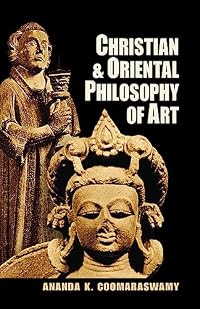
Christian and Oriental Philosophy of Art
by Ananda Coomaraswamy
On This Page
Description
The late Ananda K. Coomaraswamy, curator of Indian art at the Boston Museum of Fine Arts, uniquely combined art historian, philosopher, orientalist, linguist, and expositor in his person. His knowledge of the arts and handcrafts of the Orient was unexcelled and his numerous monographs on Oriental art either established or revolutionized entire fields. He was also a great Orientalist, with an almost unmatched understanding of traditional culture. He covered the philosophic and religious show more experience of the entire premodern world, east and west, and for him primitive, medieval European, and classical Indian experiences of truth and art were only different dialects in a common language. Finally, Coomaraswamy was a provocative writer, whose erudition was expressed in a delightful, aphoristic style. The nine essays in this book are among his most stimulating. They discuss such matters as the true function of aesthetics in art, the importance of symbolism, and the importance of intellectual and philosophical background to the artist; they analyze the role of traditional culture in enriching art; they demonstrate that abstract art and primitive art, despite superficial resemblances, are completely divergent; and they deal with the common philosophy which pervades all great art, the nature of medieval art, folklore and modern art, the beauty inherent in mathematics, and the union of traditional symbolism and individual portraiture in premodern cultures. show lessTags
Recommendations
















Member Reviews
The slender Christian & Oriental Philosophy of Art (originally issued as Why Exhibit Works of Art?) consists of four lectures and five brief papers, representing what is probably the cream of the polemical writings of Ananda K. Coomaraswamy. The author was one of the original proponents of the Traditionalist school of comparative religion, and he spent the later decades of his career as curator of the Indian collection at the Boston Museum of Fine Arts. The writings collected here do not so much exercise the discipline of art history, which barely existed as such in the Anglophone world at that time, as much as they propound a theory of material culture, and advocate an idealist philosophy.
Coomaraswamy uses the word "aesthetic" as a show more pejorative, insisting on the intellectual value of artwork, and he champions the dignity of what museums call "decorative" arts, over and against the "fine" arts which try to segregate expression from utility. He is as likely, or more, to cite Augustine, Thomas Aquinas, and Bonaventure as he is to refer to the Upanishads or other Indian texts, but he claims that these equally reflect a "Unanimous Tradition." For Coomaraswamy, the name of the ideological enemy is the humanist, whom he characterizes as "a sentimentalist, materialist, or cynic." (63) His perspective on the history of European culture--in favor of antiquity and the middle ages, and contemptuous of the renaissance and modernity--is in keeping with that of Guénon and other Traditionalists, and the essay on "Folklore" (originally written for a Traditionalist journal) presumes the rectitude of the Indian Chatur Varna so beloved of European Traditionalists who discourse on political themes. (136-7)
Students of the work of Aleister Crowley may be familiar with Coomaraswamy as a figure cuckolded--willingly, to all appearances--by the Beast with Coomaraswamy's second wife Alice (a.k.a. Ratan Devi). In fact, Crowley's ostensible review of Coomaraswamy's book The Dance of Shiva in the 1919 Equinox journal consists of nothing but a rehearsal of their personal interactions, framed by an unfriendly biography of Coomaraswamy. Ironically, the later writings of Coomaraswamy collected in Christian & Oriental Philosophy of Art often emphasize certain elements that are sympathetic to Crowley's doctrines.
In particular, the first talk "Why Exhibit Works of Art?" includes a long argument for individual vocation that is an excellent fit with the Thelemic notion of True Will. "[W]hen each man makes one kind of thing, doing only that kind of work for which he is fitted by his own nature and for which he is therefore destined...a man at work is doing what he likes best, and the pleasure that he takes in his work perfects the operation." (15) And in the second lecture, which lends its title to the whole volume, there is a discussion of what Crowley calls the Holy Guardian Angel: "No man, considered as So-and-so, can be a genius: but all men have a genius, to be served or disobeyed at their own peril." (38)
In his paper on "Beauty and Truth," Coomaraswamy draws on medieval theory of rhetoric to support his more general ideas about art, and the author is indeed no mean rhetorician. "Industry without art is brutality." (92) These essays at the very least make provocative reading for anyone interested in the course of what he calls the "museum militant." (22) show less
Coomaraswamy uses the word "aesthetic" as a show more pejorative, insisting on the intellectual value of artwork, and he champions the dignity of what museums call "decorative" arts, over and against the "fine" arts which try to segregate expression from utility. He is as likely, or more, to cite Augustine, Thomas Aquinas, and Bonaventure as he is to refer to the Upanishads or other Indian texts, but he claims that these equally reflect a "Unanimous Tradition." For Coomaraswamy, the name of the ideological enemy is the humanist, whom he characterizes as "a sentimentalist, materialist, or cynic." (63) His perspective on the history of European culture--in favor of antiquity and the middle ages, and contemptuous of the renaissance and modernity--is in keeping with that of Guénon and other Traditionalists, and the essay on "Folklore" (originally written for a Traditionalist journal) presumes the rectitude of the Indian Chatur Varna so beloved of European Traditionalists who discourse on political themes. (136-7)
Students of the work of Aleister Crowley may be familiar with Coomaraswamy as a figure cuckolded--willingly, to all appearances--by the Beast with Coomaraswamy's second wife Alice (a.k.a. Ratan Devi). In fact, Crowley's ostensible review of Coomaraswamy's book The Dance of Shiva in the 1919 Equinox journal consists of nothing but a rehearsal of their personal interactions, framed by an unfriendly biography of Coomaraswamy. Ironically, the later writings of Coomaraswamy collected in Christian & Oriental Philosophy of Art often emphasize certain elements that are sympathetic to Crowley's doctrines.
In particular, the first talk "Why Exhibit Works of Art?" includes a long argument for individual vocation that is an excellent fit with the Thelemic notion of True Will. "[W]hen each man makes one kind of thing, doing only that kind of work for which he is fitted by his own nature and for which he is therefore destined...a man at work is doing what he likes best, and the pleasure that he takes in his work perfects the operation." (15) And in the second lecture, which lends its title to the whole volume, there is a discussion of what Crowley calls the Holy Guardian Angel: "No man, considered as So-and-so, can be a genius: but all men have a genius, to be served or disobeyed at their own peril." (38)
In his paper on "Beauty and Truth," Coomaraswamy draws on medieval theory of rhetoric to support his more general ideas about art, and the author is indeed no mean rhetorician. "Industry without art is brutality." (92) These essays at the very least make provocative reading for anyone interested in the course of what he calls the "museum militant." (22) show less
Ananda K. Coomaraswamy is an art critic and spokesperson for the perennial philosophy of Plato, Plotinus, Bonaventura, Aquinas, Meister Eckhart, the Upanishads, and the Bhagavad Gita. There is not a word in these nine essays about the aesthetic theories by authors writing at the same time as Coomaraswamy, writers such as John Dewey, George Santayana, or Ernest Gombrich. Why? Because Coomaraswamy does not have the slightest interest in aesthetics or aesthetic experience. To have a clear understanding of Coomarasway's foundational and key ideas about art, here are several quotes from his main essay in this collection. Beneath each quote is my own brief commentary.
"The artist is not a special kind of man, but every man who is not an artist show more in some field, every man without a vocation, is an idler." Coomaraswamy tells us in traditional societies the artist is not a special kind of man but every man is a special kind of artist. Think here of a medieval cathedral that was built by vast numbers of craftsmen who wouldn't think of signing their work. He rebels against our modern world were we make a sharp distinction between an artist (the special kind of man) painting his artwork to be displayed in a museum and the factory worker (an ordinary or `un-special' kind of man) on the assembly line. Thus, Coomaraswamy says, "Industry without art is brutality."
"(The practice of art) can never be, unless for the sentimentalist who lives for pleasure, an "art for art's sake," that is to say a production of "fine" or useless objects only that we may be delighted by "fine colors and sounds" . . . The greater part of our boasted "love of art" is nothing but the enjoyment of comfortable feelings." For Coomaraswamy, the fine colors of impressionist painters like Monet, Cezanne, Renoir, and Seurat are only that, fine colors, the aesthetic surface of life, where the viewer is encouraged to `love art' and enjoy comfortable feelings. These fine colors are a world away from the metaphysical and spiritual ideas represented by statues in a medieval monastery or an ancient Buddhist temple.
"It is just insofar as we do now see only the things as they are in themselves, and only ourselves as we are in ourselves, that we have killed the metaphysical man and shut ourselves up in the dismal cave of functional and economic determinism." Here Coomaraswamy observes how we in our modern technological world of high specialization have shattered the wholeness of our spiritual inner selves; our everyday life of activity (making of things) and interaction with the world is not an expression of our total human nature, but rather is reduced to mere function and utility. The art produced in such a society also reflects this alienation. One can imagine what must have gone through Coomaraswamy's mind when viewing Duchamp's Fountain (a porcelain urinal) or a painting of Max Ernst or Piet Mondrian.
.
"Our conception of art as essentially the expression of a personality, or whole view of genius, our impertinent curiosities about the artist's private life, all these things are the products of a perverted individualism and prevent our understanding of the nature of medieval and oriental art." How many biographies and commentaries have been written on the life of Picasso, Jackson Pollock, Andy Warhol? Coomaraswamy would not be impressed; rather, he would see all such writing as so much obsession with personality and an expression of perverse individualism. What would be at the absolute opposite end of the artistic spectrum from Coomaraswamy's philosophy? How about three quotes from Andy Warhol - 1) Art is what you can get away with. 2) An artist is a person who produces things that people don't need to have. 3) I am a deeply superficial person.
"We have emphasized that art is for the man, and not the man for art: that whatever is made only to give pleasure is a luxury and that the love of art under these conditions becomes a mortal sin." I recommend a careful reading of this collection of Coomaraswamy's essays. You don't necessarily have to agree with his philosophy of art to appreciate his perspective on how art was integrated into traditional societies and how our modern world has gone off in other directions. show less
Ananda K. Coomaraswamy is an art critic and spokesperson for the perennial philosophy of Plato, Plotinus, Bonaventura, Aquinas, Meister Eckhart and the Upanishads. There is not a word in these nine essays about the aesthetic theories by authors writing at the same time as Coomaraswamy, writers such as John Dewey, George Santayana, or Ernest Gombrich. Why? Because Coomaraswamy does not have the slightest interest in aesthetics or aesthetic experience. To have a clear understanding of Coomarasway's foundational and key ideas about art, here are several quotes from his main essay in this collection. Beneath each quote is my own brief commentary.
"The artist is not a special kind of man, but every man who is not an artist in some field, show more every man without a vocation, is an idler." Coomaraswamy tells us in traditional societies the artist is not a special kind of man but every man is a special kind of artist. Think here of a medieval cathedral that was built by vast numbers of craftsmen who wouldn't think of signing their work. He rebels against our modern world were we make a sharp distinction between an artist (the special kind of man) painting his artwork to be displayed in a museum and the factory worker (an ordinary or `un-special' kind of man) on the assembly line. Thus, Coomaraswamy says, "Industry without art is brutality."
"The practice of art can never be, unless for the sentimentalist who lives for pleasure, an 'art for art's sake', that is to say a production of 'fine' or useless objects only that we may be delighted by 'fine colors and sounds'. The greater part of our boasted 'love of art' is nothing but the enjoyment of comfortable feelings." For Coomaraswamy, the fine colors of impressionist painters like Monet, Cezanne, Renoir, and Seurat are only that, fine colors, the aesthetic surface of life, where the viewer is encouraged to `love art' and enjoy comfortable feelings. These fine colors are a world away from the metaphysical and spiritual ideas represented by statues in a medieval monastery or an ancient Buddhist temple.
"It is just insofar as we do now see only the things as they are in themselves, and only ourselves as we are in ourselves, that we have killed the metaphysical man and shut ourselves up in the dismal cave of functional and economic determinism." Here Coomaraswamy observes how we in our modern technological world of high specialization have shattered the wholeness of our spiritual inner selves; our everyday life of activity (making of things) and interaction with the world is not an expression of our total human nature, but rather is reduced to mere function and utility. The art produced in such a society also reflects this alienation. One can imagine what must have gone through Coomaraswamy's mind when viewing Duchamp's Fountain (a porcelain urinal) or a painting of Max Ernst or Pablo Picasso.
"Our conception of art as essentially the expression of a personality, or whole view of genius, our impertinent curiosities about the artist's private life, all these things are the products of a perverted individualism and prevent our understanding of the nature of medieval and oriental art." How many biographies and commentaries have been written on the life of Picasso, Jackson Pollock, Andy Warhol? Coomaraswamy would not be impressed; rather, he would see all such writing as so much obsession with personality and an expression of perverse individualism. What would be at the absolute opposite end of the artistic spectrum from Coomaraswamy's philosophy? How about three quotes from Andy Warhol - 1) Art is what you can get away with. 2) An artist is a person who produces things that people don't need to have. 3) I am a deeply superficial person.
"We have emphasized that art is for the man, and not the man for art: that whatever is made only to give pleasure is a luxury and that the love of art under these conditions becomes a mortal sin." I recommend a careful reading of this collection of Coomaraswamy's essays. You don't necessarily have to entirely agree with his philosophy of art to appreciate his perspective on how art was integrated into traditional societies and how our modern world has gone off in other directions. show less
Ratings
Members
- Recently Added By
Author Information

117+ Works 2,052 Members
Ananda Kentish Coomaraswamy was Curator of Indian Art in the Boston Museum.
Series
Belongs to Publisher Series
Common Knowledge
- Original title
- Why Exhibit Works of Art
- Alternate titles
- Christian and Oriental philosophy of Art
- Original publication date
- 1943
- Original language
- English
Classifications
Statistics
- Members
- 192
- Popularity
- 169,934
- Reviews
- 3
- Rating
- (4.33)
- Languages
- 5 — English, French, Hungarian, Italian, Spanish
- Media
- Paper, Ebook
- ISBNs
- 12
- UPCs
- 1
- ASINs
- 7