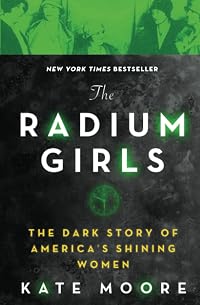
The Radium Girls: The Dark Story of America's Shining Women
by Kate Moore
On This Page
Description
As World War I raged across the globe, hundreds of young women toiled away at the radium-dial factories, where they painted clock faces with a mysterious new substance called radium. Assured by their bosses that the luminous material was safe, the women themselves shone brightly in the dark, covered from head to toe with the glowing dust. With such a coveted job, these "shining girls" were considered the luckiest alive--until they began to fall mysteriously ill. As the fatal poison of the show more radium took hold, they found themselves embroiled in one of America's biggest scandals and a groundbreaking battle for workers' rights. The Radium Girls explores the strength of extraordinary women in the face of almost impossible circumstances and the astonishing legacy they left behind. show lessTags
Recommendations












































Member Recommendations

JenniferRobb Both books deal with employers who knew more about the problems their product was causing employees than they let on to the employees.
Member Reviews
I listened to this on audiobook, and was often aware that people watching me might think it odd that I was walking my dog and and crying. This book is *heartrending*. It's full of the small heroic acts that normal people are heir to when they are forced into horrible situations.
The worst part, besides of course the tragic circumstances that these women endured, is the pulling back of the curtain. The real life villains. The casual disregard for life.
I recommend this for any human being with a pulse. If you struggle with empathy, think of this book as a prescription.
The worst part, besides of course the tragic circumstances that these women endured, is the pulling back of the curtain. The real life villains. The casual disregard for life.
I recommend this for any human being with a pulse. If you struggle with empathy, think of this book as a prescription.
This is a true horror story. Do not read before bedtime unless you want nightmares about jawbones literally falling apart and coming loose in a woman's mouth. While I think the book could have been a little shorter, it is a fascinating, sad and ultimately somewhat uplifting true story about the businesss world's willingness to lie, cover up and sacrifice women's lives for the sake of profit. While in the end the Radium Girls got some justice and set the stage for organizations like OSHA, the postscript and our own knowledge demonstrate that, in a lot of ways, not much has changed.
Next time I feel a little sick and don't feel like going to work, I'll remember Catherine Donohue, weighing less than 100 pounds and in constant pain, show more testifying at her bedside against the Radium Dial Company - and hopefully I'll buck up and stop whining. show less
Next time I feel a little sick and don't feel like going to work, I'll remember Catherine Donohue, weighing less than 100 pounds and in constant pain, show more testifying at her bedside against the Radium Dial Company - and hopefully I'll buck up and stop whining. show less
The Radium Girls: The Dark Story of America’s Shining Women is not only a cautionary tale or a documentary on what the girls went through after their employment. It is a history lesson properly done, complete with detailed, well-documented research and personages that become more than just names on a page. Ms. Moore tackles the girls’ stories as well as adding historical, socioeconomic, legal, and cultural details that provides context to their stories. In so doing, she brings the girls back to life to tell their story one last time.
Reading The Radium Girls in our post-Cold War era is an exercise in separating one’s current knowledge and experiences from one’s reading experience to avoid letting them taint one’s feelings or show more reactions to the girls’ actions. After all, just as laudanum and cocaine were popular medicines in their day, we cannot fault the girls for getting excited about working with radium all day or the rest of the country for the popularity of radium-filled beauty products. The casualness with which everyone, including scientists, handled radium is cringe-inducing to the modern reader but perfectly acceptable during the time of the events. We cannot condemn them nor find fault with them for their actions. It is a surreal reading experience though to read their story and how they would paint their nails and eyelids with radium powder and eat their lunches next to their work stations, etc., and not shudder at their innocence. This then makes you wonder what we are currently doing or using or eating that future generations will view in a similar light. It is a sobering thought.
Where the story takes off though is in the legal battles the girls fight in order to obtain a modicum of financial relief. Again, the modern reader is at a disadvantage because the idea of workers’ compensation or of a company liable for the long-term health and welfare of its employees is an ingrained right in our minds. We have plenty of modern-day context in which companies are held responsible for the ill effects of chemicals or processes used in everyday work environments. To not hold a company responsible is inconceivable to our modern mind. Yet, most of the Radium Girls did feel this way for a long time. Whether their lack of litigious nature (at least initially) is a sign of their innocence or a commentary on the suspicious nature of modern society, that is yet to be determined.
The story is not all innocence though, for the businesses for which the girls worked went to great lengths to prove their own innocence in the lawsuits and protect themselves from culpability. Their actions are simultaneously disturbing and yet not surprising, as a company’s sole purpose is to make money and the radium dial business was big money. Seen from their perspective, they were just trying to maintain their profitability. However, the callousness of capitalism is still disturbing to watch unfold, especially when a company’s employees’ lives are on the line.
Throughout the book, Ms. Moore showcases the girls’ resilience in the face of unspeakable pain and disfigurement. She packs no punches in her descriptions either, assaulting the reader with sparse, take-no-pity descriptions of their illnesses. Even readers with cast-iron stomachs will find themselves nauseous at times, not just because of the descriptions but also because this is not a horror story but real life. Still, feeling sick to one’s stomach is only mildly inconvenient when compared to everything the radium girls faced and suffered at the hands of the court as well as with their health. In The Radium Girls, Ms. Moore makes sure that the legacy of the Radium Girls lives on not just in OSHA-mandated policies and procedures but in the knowledge of their dreams and battles that all readers take away of the girls who once thought their future was a bright and shiny as the powder they painted onto watch dials. show less
Reading The Radium Girls in our post-Cold War era is an exercise in separating one’s current knowledge and experiences from one’s reading experience to avoid letting them taint one’s feelings or show more reactions to the girls’ actions. After all, just as laudanum and cocaine were popular medicines in their day, we cannot fault the girls for getting excited about working with radium all day or the rest of the country for the popularity of radium-filled beauty products. The casualness with which everyone, including scientists, handled radium is cringe-inducing to the modern reader but perfectly acceptable during the time of the events. We cannot condemn them nor find fault with them for their actions. It is a surreal reading experience though to read their story and how they would paint their nails and eyelids with radium powder and eat their lunches next to their work stations, etc., and not shudder at their innocence. This then makes you wonder what we are currently doing or using or eating that future generations will view in a similar light. It is a sobering thought.
Where the story takes off though is in the legal battles the girls fight in order to obtain a modicum of financial relief. Again, the modern reader is at a disadvantage because the idea of workers’ compensation or of a company liable for the long-term health and welfare of its employees is an ingrained right in our minds. We have plenty of modern-day context in which companies are held responsible for the ill effects of chemicals or processes used in everyday work environments. To not hold a company responsible is inconceivable to our modern mind. Yet, most of the Radium Girls did feel this way for a long time. Whether their lack of litigious nature (at least initially) is a sign of their innocence or a commentary on the suspicious nature of modern society, that is yet to be determined.
The story is not all innocence though, for the businesses for which the girls worked went to great lengths to prove their own innocence in the lawsuits and protect themselves from culpability. Their actions are simultaneously disturbing and yet not surprising, as a company’s sole purpose is to make money and the radium dial business was big money. Seen from their perspective, they were just trying to maintain their profitability. However, the callousness of capitalism is still disturbing to watch unfold, especially when a company’s employees’ lives are on the line.
Throughout the book, Ms. Moore showcases the girls’ resilience in the face of unspeakable pain and disfigurement. She packs no punches in her descriptions either, assaulting the reader with sparse, take-no-pity descriptions of their illnesses. Even readers with cast-iron stomachs will find themselves nauseous at times, not just because of the descriptions but also because this is not a horror story but real life. Still, feeling sick to one’s stomach is only mildly inconvenient when compared to everything the radium girls faced and suffered at the hands of the court as well as with their health. In The Radium Girls, Ms. Moore makes sure that the legacy of the Radium Girls lives on not just in OSHA-mandated policies and procedures but in the knowledge of their dreams and battles that all readers take away of the girls who once thought their future was a bright and shiny as the powder they painted onto watch dials. show less
This audiobook was engaging and well-narrated. And what an amazing story! The girls were told that the radium paint was harmless and even beneficial. I can imagine how they daubed their faces, their lips, their eyebrows with leftover paint and stepped into the dark room to glow, laughing and dancing, with no idea of what was coming. Like watching a slow-moving train wreck.
The story takes us through the painful deterioration of their health, some short-term, some long, before their inevitable deaths. We got to know the young women and their families and their very personal stories. One painful part for me is that these were mostly "good Catholic girls" who were loyal to the company and never challenged authority. But they summoned the show more courage to find an attorney (who worked for free, as the families were poor) and start lawsuits, though the women were often too sick to appear at trial.
The company owners lied and manipulated in court. But the effort was ultimately successful in changing legal protections, though some companies exposed their employees to radium all the way up to 1978.
An important part of history as we entered the nuclear age.
Highly recommended! show less
The story takes us through the painful deterioration of their health, some short-term, some long, before their inevitable deaths. We got to know the young women and their families and their very personal stories. One painful part for me is that these were mostly "good Catholic girls" who were loyal to the company and never challenged authority. But they summoned the show more courage to find an attorney (who worked for free, as the families were poor) and start lawsuits, though the women were often too sick to appear at trial.
The company owners lied and manipulated in court. But the effort was ultimately successful in changing legal protections, though some companies exposed their employees to radium all the way up to 1978.
An important part of history as we entered the nuclear age.
Highly recommended! show less
To say this is a powerful book hardly does it justice. Kate Moore combines the wide variety of topics that tell the story, making it fast-paced and effortlessly readable. The only reason I found it hard to read was because it made me alternately angry, upset, and sad. I have never read another book that exemplified the hashtag #neverthelessshepersisted more precisely.
Radium was discovered by Marie and Pierre Curie in 1898. It was considered a miracle cure-all at the time, and was widely used in all kinds of tonics and treatments. The scientist who co-founded the first company selling luminous radium-painted dials said of it, “What radium means to us today is a great romance in itself. But what it may mean to us tomorrow, no man can show more foretell.” He had no idea just how much it would mean to the people (mostly women in their late teens and early twenties) who worked to make the company a success.
If you enjoy reading a book about mystery medical diagnosis and treatment, while getting to know the patient, this book is for you. Each "radium girl" has a different experience with her failing health, which makes it that much more fascinating.
If you enjoy a good legal procedural story - true or fictional - this one is for you. The story of the Girls' legal battles is so hard to believe, you'd think it was fiction. But it's not.
If you enjoy a book that champions the underdog, this one is for you. These young women were told many times that radium was completely safe, and it was far from that. With a half-life of 1,600 years, it will be here long after we all have gone. No matter what the corporations who profited from it said at the time.
Reading about poisons and chemicals has made me question everything I put on my face, my hair, and my body. Not to mention the food I eat. Understanding toxicity isn't a story from the past, but a continued concern for today and the future.
I read this book as a digital ARC from NetGalley and Sourcebooks, but I'm definitely buying a finished copy for my shelf. show less
Radium was discovered by Marie and Pierre Curie in 1898. It was considered a miracle cure-all at the time, and was widely used in all kinds of tonics and treatments. The scientist who co-founded the first company selling luminous radium-painted dials said of it, “What radium means to us today is a great romance in itself. But what it may mean to us tomorrow, no man can show more foretell.” He had no idea just how much it would mean to the people (mostly women in their late teens and early twenties) who worked to make the company a success.
If you enjoy reading a book about mystery medical diagnosis and treatment, while getting to know the patient, this book is for you. Each "radium girl" has a different experience with her failing health, which makes it that much more fascinating.
If you enjoy a good legal procedural story - true or fictional - this one is for you. The story of the Girls' legal battles is so hard to believe, you'd think it was fiction. But it's not.
If you enjoy a book that champions the underdog, this one is for you. These young women were told many times that radium was completely safe, and it was far from that. With a half-life of 1,600 years, it will be here long after we all have gone. No matter what the corporations who profited from it said at the time.
Reading about poisons and chemicals has made me question everything I put on my face, my hair, and my body. Not to mention the food I eat. Understanding toxicity isn't a story from the past, but a continued concern for today and the future.
I read this book as a digital ARC from NetGalley and Sourcebooks, but I'm definitely buying a finished copy for my shelf. show less
This is an essential and infuriating book about the women who worked as dial painters with the United States Radium Corporation and other companies that made watches and clocks with luminous dials. The women used paint that contained minute quantities of radium, and they were instructed to use their mouths to point their paintbrushes to a point sharp enough for the tiniest of watch faces. What the women were not told was that radium was hazardous to their health. Scientists working in the labs that produced the radium and the paint were given proper protections and sent on vacations to reduce their exposure; the girls in the lab were allowed to eat their lunches in the studio without washing their hands first and were paid piecework for show more each dial painted, so there was an incentive to work long hours, thereby increasing one's exposure to radium.
Gradually the women became ill, in a variety of horrendous ways: disintegrating skeletons, locking joints, crushed vertebrae, bruising and anemia, miscarriages, children born prematurely and with their own health problems, and sarcomas. Their concerns were dismissed by the company, and sometimes the sick workers themselves would be dismissed FROM the company because they were lowering morale. Eventually, they had enough, and they fought back.
This is an important story and everyone should know about it. The suffering that the women went through is staggering; by the end of the book, I was weeping at the physical and mental hardships they faced. Especially frustrating is the condescending attitude taken by the (male) executives at the firm, refusing to give the women the results of medical tests performed on THEIR OWN BODIES, yet discussing those same results behind the women's back. And the callousness of their legal arguments, stating in one suit that radium was a poison and therefore not covered by workplace legislation, and in another suit stating that it was NOT a poison and therefore they didn't have to pay compensation. This book prompted a lot of angry exclamations and leaping up to share the latest outrage with whoever was nearby.
Although it is a large book, it is one that will keep you flipping the pages to find out how the women will continue their fight. And the women come to life on the page: Moore is excellent at bringing to the fore details about their personalities. They were not just "the living dead": Peg read the dictionary and wanted to be a schoolteacher; Albina and Maggie were devoted sisters; Edna, with her delicate features, was known the "Dresden Doll"; Grace saved her money for a rainy day rather than spending it; and many of the girls loved to go to dances and dress smartly. Most of the pictures in the book show them in happier times, although there are a few pictures of sarcomas and a "moth-eaten" jawbone. You can probably find more gruesome examples online; Moore wisely makes the medical pictures small and black-and-white, and keeps them to one page.
Occupational health and safety in the United States really came into being thanks to the efforts of these women. They deserve to be remembered. show less
Gradually the women became ill, in a variety of horrendous ways: disintegrating skeletons, locking joints, crushed vertebrae, bruising and anemia, miscarriages, children born prematurely and with their own health problems, and sarcomas. Their concerns were dismissed by the company, and sometimes the sick workers themselves would be dismissed FROM the company because they were lowering morale. Eventually, they had enough, and they fought back.
This is an important story and everyone should know about it. The suffering that the women went through is staggering; by the end of the book, I was weeping at the physical and mental hardships they faced. Especially frustrating is the condescending attitude taken by the (male) executives at the firm, refusing to give the women the results of medical tests performed on THEIR OWN BODIES, yet discussing those same results behind the women's back. And the callousness of their legal arguments, stating in one suit that radium was a poison and therefore not covered by workplace legislation, and in another suit stating that it was NOT a poison and therefore they didn't have to pay compensation. This book prompted a lot of angry exclamations and leaping up to share the latest outrage with whoever was nearby.
Although it is a large book, it is one that will keep you flipping the pages to find out how the women will continue their fight. And the women come to life on the page: Moore is excellent at bringing to the fore details about their personalities. They were not just "the living dead": Peg read the dictionary and wanted to be a schoolteacher; Albina and Maggie were devoted sisters; Edna, with her delicate features, was known the "Dresden Doll"; Grace saved her money for a rainy day rather than spending it; and many of the girls loved to go to dances and dress smartly. Most of the pictures in the book show them in happier times, although there are a few pictures of sarcomas and a "moth-eaten" jawbone. You can probably find more gruesome examples online; Moore wisely makes the medical pictures small and black-and-white, and keeps them to one page.
Occupational health and safety in the United States really came into being thanks to the efforts of these women. They deserve to be remembered. show less
First of all, I can't believe I didn't know about the 'radium girls'. Everybody should know about these women who were told that ingesting radioactive paint was harmless and were then treated like dirt by their employers and the law when they got sick in the most horrendous ways and eventually died. Secondly, now that I do know, I AM SO MAD!
During the First World War, the Radium Luminous Material Corporation - later renamed the United States Radium Corporation - was founded in New York, and a factory in Newark, New Jersey, hired young girls - some were under sixteen - to paint the 'luminescent' numbers on watch and clock dials, which were hugely popular at the time. The only problem was that the glow in the dark effect was produced by show more radium, which is obviously highly radioactive and when ingested goes straight to the bones and either decays or mutates into cancerous growths. And the men behind the industry KNEW this, but let the women in their employ play around with the paint and lick the tiny brushes to maintain a point on the bristles - lip, dip and paint. When the women started showing signs of radium poisoning - from teeth falling out and rotting jaws to aching bones and growths - the USRC denied all knowledge and employed company doctors to attribute the early deaths (the first to die were in their twenties) to conditions like diphtheria and syphilis! The industry bosses and their lawyers lied and cheated and ignored these women for years, and were allowed to get away with such treatment because radium equalled money and money is obviously worth more than human lives in the American Dream, but also because these young women from poor backgrounds - in Newark and also Ottawa, Illinois, where the Radium Dial Company was guilty of the same crimes - were considered expendable. Only when the first man died of radium poisoning in 1925 did anyone start asking questions. Honestly, Kate Moore's writing is a little flowery at times - I though this might be a contemporary account from the 1920s to start with! - but the emotion in her delivery certainly packs a punch. I HATED these men, from the lying bosses to the dismissive doctors (and the 'doctor' for the USRC wasn't even an MD but a PhD!), and was so glad when Grace Fryer and Catherine Donahue finally found lawyers to fight for them, even though they were already facing their own death sentences. What utter stinking capitalist cowards, 'which cared nothing for the lives of their workers, but only sought to guard their profits'!
The suffering of the women was actually traumatic to read, and their graves are still radioactive today, but I was even more startled to read that the company which took over from the notorious USRC - Luminous Processes - only folded in 1978, and that the land where these factories were based was still being 'cleaned up' well into the twenty-first century. I am absolutely flabbergasted that anyone could think, 'Yes, a woman's jaw actually broke off and another had to have her arm amputated, but hey, people really love those glow in the dark watch dials, so f**k 'em!'
No wonder a film has been made about the Radium Girls - these women were strong and selfless heroines and their story should never be forgotten! show less
During the First World War, the Radium Luminous Material Corporation - later renamed the United States Radium Corporation - was founded in New York, and a factory in Newark, New Jersey, hired young girls - some were under sixteen - to paint the 'luminescent' numbers on watch and clock dials, which were hugely popular at the time. The only problem was that the glow in the dark effect was produced by show more radium, which is obviously highly radioactive and when ingested goes straight to the bones and either decays or mutates into cancerous growths. And the men behind the industry KNEW this, but let the women in their employ play around with the paint and lick the tiny brushes to maintain a point on the bristles - lip, dip and paint. When the women started showing signs of radium poisoning - from teeth falling out and rotting jaws to aching bones and growths - the USRC denied all knowledge and employed company doctors to attribute the early deaths (the first to die were in their twenties) to conditions like diphtheria and syphilis! The industry bosses and their lawyers lied and cheated and ignored these women for years, and were allowed to get away with such treatment because radium equalled money and money is obviously worth more than human lives in the American Dream, but also because these young women from poor backgrounds - in Newark and also Ottawa, Illinois, where the Radium Dial Company was guilty of the same crimes - were considered expendable. Only when the first man died of radium poisoning in 1925 did anyone start asking questions. Honestly, Kate Moore's writing is a little flowery at times - I though this might be a contemporary account from the 1920s to start with! - but the emotion in her delivery certainly packs a punch. I HATED these men, from the lying bosses to the dismissive doctors (and the 'doctor' for the USRC wasn't even an MD but a PhD!), and was so glad when Grace Fryer and Catherine Donahue finally found lawyers to fight for them, even though they were already facing their own death sentences. What utter stinking capitalist cowards, 'which cared nothing for the lives of their workers, but only sought to guard their profits'!
The suffering of the women was actually traumatic to read, and their graves are still radioactive today, but I was even more startled to read that the company which took over from the notorious USRC - Luminous Processes - only folded in 1978, and that the land where these factories were based was still being 'cleaned up' well into the twenty-first century. I am absolutely flabbergasted that anyone could think, 'Yes, a woman's jaw actually broke off and another had to have her arm amputated, but hey, people really love those glow in the dark watch dials, so f**k 'em!'
No wonder a film has been made about the Radium Girls - these women were strong and selfless heroines and their story should never be forgotten! show less
Members
- Recently Added By
Lists

Top Five Books of 2017
757 works; 230 members
Top Five Books of 2018
802 works; 265 members

Top Five Books of 2021
604 works; 181 members

2018 Notable Books for Adults
26 works; 4 members

Science
13 works; 1 member

2019 Abraham Lincoln Teen Readers' Choice Award
20 works; 5 members

Biographies or Memoirs
36 works; 1 member

To Read List
21 works; 1 member

Books Read in 2025
4,128 works; 98 members

Weirdo Nonfiction
138 works; 3 members

Top Five Books of 2023
767 works; 317 members

The Re-Reads
12 works; 1 member

Books Read in 2023
5,638 works; 147 members

Community or Social Activism
14 works; 1 member

Books Read in 2021
5,361 works; 113 members

SHOULD Read Books!
354 works; 9 members

Books Read in 2020
4,379 works; 124 members

Five star books
1,767 works; 110 members

1900s: America
31 works; 2 members

Favourite Books
1,819 works; 316 members
Books We Want To Read Again For The First Time
384 works; 160 members
Author Information

6+ Works 5,571 Members
Kate Moore is a New York Times bestselling author who writes across many genres, including biography, memoir, and history. She was also the director of the acclaimed play about the Radium Girls called 'These Shining Lives'. (Bowker Author Biography)
Some Editions
Awards and Honors
Awards
Distinctions
Work Relationships
Common Knowledge
- Canonical title
- The Radium Girls: The Dark Story of America's Shining Women
- Original publication date
- 2016
- People/Characters
- Sarah Carlough Maillefer; Amelia "Mollie" Maggia; Grace Fryer; Katherine Schaub; Catherine Donahue; Tom Donahue (show all 18); Irene Rudolph; Albina Maggia Larice; Mercedes "Mercy" Reed; Margaret 'Peg' Looney; Edna Bolz Hussman; Anna Rooney; Sabin Arnold von Sochocky (doctor); Arthur Roeder; Marguerite Carlough; Harrison Stanford Martland (doctor); Helen Quinlan; Hazel Vincent Kuser
- Important places
- Orange, New Jersey, USA; Ottawa, Illinois, USA; Chicago, Illinois, USA
- Important events
- World War I; World War II; Discovery of Radium
- Epigraph
- I shall never forget you... Hearts that know you love you And lips that have given you laughter Have gone to their lifetime of grief and of roses Searching for dreams that they lost In the world, far away from your walls. --... (show all)-Ottawa High School yearbook, 1925
- Dedication
- For all the dial-painters And those who loved them.
- First words
- (Prologue) The scientist had forgotten all about the radium.
Katherine Schaub had a jaunty spring in her step as she walked the brief four blocks to work. - Last words
- (Click to show. Warning: May contain spoilers.)She has a simple, flat gravestone, as unobtrusive, and as neat and tidy, as she herself had been in life.
(Click to show. Warning: May contain spoilers.)(Epilogue) They made every second count.
(Click to show. Warning: May contain spoilers.)(Postscript) How quickly we forget. - Blurbers
- Ignotofsky, Rachel; Buck, Rinker; Holt, Nathalia; Marshall, Megan; Stark, Peter
- Original language
- English
- Canonical DDC/MDS
- 363.17990820973
- Canonical LCC
- HD6067.2.U6
Classifications
- Genres
- General Nonfiction, History, Nonfiction, Science & Nature, Biography & Memoir
- DDC/MDS
- 363.17990820973 — Society, government, & culture Social problems and social services Public Safety - Police, Crime Investigation Public safety from hazards Hazardous materials Specific types of hazardous materials Radioactive materials, nuclear accidents Women United States
- LCC
- HD6067.2 .U6 — Social sciences Industries. Land use. Labor Industries. Land use. Labor Labor. Work. Working class Classes of labor
- BISAC
Statistics
- Members
- 4,268
- Popularity
- 3,549
- Reviews
- 233
- Rating
- (4.14)
- Languages
- English, Polish, Portuguese, Spanish
- Media
- Paper, Audiobook, Ebook
- ISBNs
- 28
- UPCs
- 2
- ASINs
- 9
