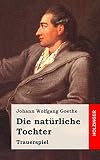
Die natürliche Tochter
by Johann Wolfgang von Goethe
On This Page
Description
"La Fille naturelle" par Johann Wolfgang von Goethe. Johann Wolfgang von Goethe était un poète, romancier, dramaturge, théoricien de l'art et homme d'État allemand (1749-1832).Tags
Recommendations




































Member Reviews
Review contains spoilers!
"Die natürliche Tochter" (The natural daughter, meaning an illegitimate daughter) is not considered to be one of Goethe's grand plays and I started reading it without any previous knowledge. It's a classic verse drama, similar to a bourgeois tragedy, written in 1803.
The bespoke daughter is Eugenie (the only character whose name is known to the audience). Her father plans to take her to court and to present her as his official daughter following her mother's recent death, and the young woman cannot wait. The anticipation is apparent when, against her father's wishes, she opens the chest containing the luxurious dresses and jewelry she is to wear at court. But alas, of course there is a conspiracy, led by her show more half-brother, who is legitimate and not too pleased at the prospect of a sister and a rival. Eugenie is abducted, her father is told that she had a riding accident and was buried immediately because she was disfigured.
Her governess - still standing with Eugenie but herself powerless - takes Eugenie to a harbor, as she is commanded to do. The order is to board a ship to the islands (presumably the South Sea), which is considered close to murder because of the unknown illnesses and the climate there.
They meet an advocate who proposes to marry Eugenie to save her from the journey. At first, Eugenie refuses because she does not want to marry below her station. The simple life of an advocate's wife seems too boring after all the dreams of a life at court. However, Eugenie realizes that her most important wish is to stay in her home country, and she agrees to marry the advocate.
The play is written in a beautiful and artistic style, and Goethe's language is as soothing and precious as ever. The story itself has an interesting start, but then becomes lengthy. Even Schiller said that the play had too many words and not enough action - and who am I to disagree!
It is an enjoyable play, presenting the choice of renunciation as a possibility to lead a happy and free life.
According to Goethe, this was planned as a trilogy (sketchy notes on a second part were found, but none on a third part) on the French Revolution. While the conflict between the bourgeoisie and the court is already present in "Die natürliche Tochter", I wonder if it would have been dealt with more clearly in the other parts. show less
"Die natürliche Tochter" (The natural daughter, meaning an illegitimate daughter) is not considered to be one of Goethe's grand plays and I started reading it without any previous knowledge. It's a classic verse drama, similar to a bourgeois tragedy, written in 1803.
The bespoke daughter is Eugenie (the only character whose name is known to the audience). Her father plans to take her to court and to present her as his official daughter following her mother's recent death, and the young woman cannot wait. The anticipation is apparent when, against her father's wishes, she opens the chest containing the luxurious dresses and jewelry she is to wear at court. But alas, of course there is a conspiracy, led by her show more half-brother, who is legitimate and not too pleased at the prospect of a sister and a rival. Eugenie is abducted, her father is told that she had a riding accident and was buried immediately because she was disfigured.
Her governess - still standing with Eugenie but herself powerless - takes Eugenie to a harbor, as she is commanded to do. The order is to board a ship to the islands (presumably the South Sea), which is considered close to murder because of the unknown illnesses and the climate there.
They meet an advocate who proposes to marry Eugenie to save her from the journey. At first, Eugenie refuses because she does not want to marry below her station. The simple life of an advocate's wife seems too boring after all the dreams of a life at court. However, Eugenie realizes that her most important wish is to stay in her home country, and she agrees to marry the advocate.
The play is written in a beautiful and artistic style, and Goethe's language is as soothing and precious as ever. The story itself has an interesting start, but then becomes lengthy. Even Schiller said that the play had too many words and not enough action - and who am I to disagree!
It is an enjoyable play, presenting the choice of renunciation as a possibility to lead a happy and free life.
According to Goethe, this was planned as a trilogy (sketchy notes on a second part were found, but none on a third part) on the French Revolution. While the conflict between the bourgeoisie and the court is already present in "Die natürliche Tochter", I wonder if it would have been dealt with more clearly in the other parts. show less
This was a decent play, but I did not feel like it was nothing out of the ordinary and, for expectations of Goethe, that sort of falls by the wayside.
3 stars.
3 stars.
Members
- Recently Added By
Author Information

Johann Wolfgang von Goethe, 1749-1832 Johann Wolfgang von Goethe was born in Frankfurt am Main. He was greatly influenced by his mother, who encouraged his literary aspirations. After troubles at school, he was taught at home and gained an exceptionally wide education. At the age of 16, Goethe began to study law at Leipzig University from 1765 to show more 1768, and he also studied drawing with Adam Oeser. After a period of illness, he resumed his studies in Strasbourg from 1770 to 1771. Goethe practiced law in Frankfurt for two years and in Wetzlar for a year. He contributed to the Frankfurter Gelehrte Anzeigen from 1772 to 1773, and in 1774 he published his first novel, self-revelatory Die Leiden des Jungen Werthers. In 1775 he was welcomed by Duke Karl August into the small court of Weimar, where he worked in several governmental offices. He was a council member and member of the war commission, director of roads and services, and managed the financial affairs of the court. Goethe was released from day-to-day governmental duties to concentrate on writing, although he was still general supervisor for arts and sciences, and director of the court theatres. In the 1790s Goethe contributed to Friedrich von Schiller´s journal Die Horen, published Wilhelm Meister's Apprenticeship, and continued his writings on the ideals of arts and literature in his own journal, Propyläen. The first part of his masterwork, Faust, appeared in 1808, and the second part in 1832. Goethe had worked for most of his life on this drama, and was based on Christopher Marlowe's Faust. From 1791 to 1817, Goethe was the director of the court theatres. He advised Duke Carl August on mining and Jena University, which for a short time attracted the most prominent figures in German philosophy. He edited Kunst and Altertum and Zur Naturwissenschaft. Goethe died in Weimar on March 22, 1832. He and Duke Schiller are buried together, in a mausoleum in the ducal cemetery. (Bowker Author Biography) show less
Some Editions
Series
Belongs to Publisher Series
Work Relationships
Common Knowledge
- Canonical title*
- Die natürliche Tochter
- Original language*
- Deutsch
*Some information comes from Common Knowledge in other languages. Click "Edit" for more information.
Classifications
- Genre
- Fiction and Literature
- DDC/MDS
- 832.6 — Literature & rhetoric German & related literatures German drama 1750–1832 : 18th century; classical period; romantic period
- LCC
- PT1958 .N2 — Language and Literature German, Dutch and Scandinavian literatures German literature Individual authors or works 1700-ca. 1860/70 Goethe Works
- BISAC
Statistics
- Members
- 24
- Popularity
- 1,106,741
- Reviews
- 2
- Rating
- (3.25)
- Languages
- English, French, German
- Media
- Paper, Ebook
- ISBNs
- 4
- ASINs
- 2