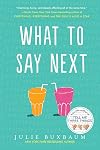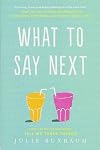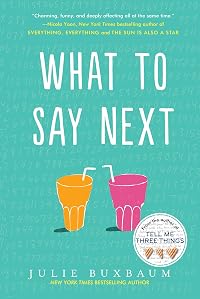
What to Say Next
by Julie Buxbaum 
On This Page
Description
When an unlikely friendship is sparked between relatively popular Kit Lowell and socially isolated David Drucker, Kit asks David for his help figuring out the how and why of her father's tragic car accident.Tags
Recommendations

























Member Recommendations
Member Reviews
The characterization and representation of autism of all time. /s
I’m just going to get right into it- I had so many problems with this book. Way too many problems, problems that shouldn’t exist in the first place. Julie Buxbaum has written a very ableist and ignorant portrayal of autism in the form of David Drucker, one of the two main protagonists in What To Say Next. If you have seen my review on Serena Kaylor’s ‘Long Story Short’, then you know how much I take autistic and neurodivergent portrayals in media seriously as an autistic person. What To Say Next was highly disappointing (and somewhat disturbing), to say the least.
Trigger Warnings Beyond This Point: Discussions of ableism, bullying, discrimination, stalking, show more racism, reverse racism, mentions of anti-semitism, death, grief, depression. It’s going to be very ranty and all-over-the-place. /srs
Some Of The Problems I Had With ‘What To Say Next’ As An Autistic Person:
• David tells us in the first chapter that he doesn’t believe he is autistic in an ablephobic way… despite portraying multiple of the widest-known stereotypes of autism.
• David/Buxbaum uses labels such as Asperger’s and high-functioning, the former of which is rooted in anti-semitism as the doctor who named Asperger’s (after himself) was a Nazi and killed autistic people. The fact that it’s not in the DSM anymore is acknowledged, and yet the term is still used. The latter is considered ableist and autistic people have been urging for neurotypicals to stop using functioning labels.
• David is a stalker, and he tries to blame it on his neurodivergency and that he’s bad with names. He even comments on Kit and her friends’ “larger than average breasts” in his notebook.
And everything listed above is all in the first chapter alone.
David forms an unlikely friendship with a semi-popular girl Kit Lowell (the other main protagonist), who is suffering from grief and depression after her dad’s passing, and he agrees to help her investigate the car accident that killed him (which is barely addressed afterward). He is bullied throughout the story, notably by two neurotypical classmates named Justin and Gabriel. They call him slurs and go as far as to steal his notebook and post the contents on a site called “The […] Guide To Mapleview,” leading to further discrimination by his community. Kit must become his neurotypical knight in shining armor to defend him and his honor multiple times, because apparently autistic people need neurotypicals to stand up for us. (How do you decide to write a book about an autistic main character and wind up using him as a plot point to glorify neurotypicals? Like c’mon.) Buxbaum begins to close out this book with revealing that David’s guitar teacher is actually a social skills tutor and that his newfound “popularity” is the perfect excuse for him to start masking his autistic traits. Kit and David go to sensory hell a party, they kiss. Everything falls apart again, everything gets solved, the end.
So what is the end-goal message here? That autistic people can defend themselves physically but not verbally unless we have a neurotypical to do it for us? That the “good ending” for autistic people is to mask our autism? This book left such a sour taste in my mouth, then I look at my friends four and five-star reviews of this book and ask myself, “Did we read the same novel?
I wanted to note two quick things; First, that I was uncomfortable with Buxbaum’s usage of the r-slur. As she confirms she is not autistic and is in fact an “ally” in her acknowledgments, the word is not hers to reclaim and use even if she is attempting to use it in a sensitive or educational way (which I am not even sure about). Either way, it is extremely disrespectful.
The second thing I wanted to note is Buxbaum writing Kit’s Indian grandparents as “racist towards white people.” There is no such thing as reverse racism, period. However, I’m not Indian so I do not believe I am the person to speak any more on the topic.
So I ask, when will neurotypical authors stop portraying us all as Sheldon Cooper? Buxbaum even says in her author’s note that “there is a famous expression that when you meet one person with autism, you meet one person with autism” (a statement that is ableist in itself, but that’s a whole other topic). However, despite saying this, she proceeds to write David as the most ignorant neurotypical view of autism- highly intelligent and obsessive, seen as weird/outcasted by peers, and tends to be very blunt with his words. While these are traits some autistic people may have, they are also the most commonly-seen traits by neurotypical individuals and used in their portrayals of autism, effectively turning autistic characters into ‘weirdos’, ‘creeps’ and thus making these the defining characteristics of autism in society’s eyes. While I understand Buxbaum trying to say that every autistic person is different, it would’ve helped if she had made David more than just a one-dimensional view of autism as a whole.
Then, Buxbaum clearly writes that masked autism is the “good ending” of the story. Autistic people have said it before and will say it again- unmasking our autism is the end goal. Not masking, not unmasking and re-masking, just unmasking when you’re in a safe place to do so. Buxbaum, as a neurotypical, clearly wrote David’s character development as from an autistic boy to a neurotypical-presenting masked autistic boy. It’s such a weird way to end your book after campaigning so much for David to be accepted by his peers for who he is.
Despite how much I enjoyed Buxbaum’s former novel, ‘Tell Me Three Things’, I will likely not be reading any other works by her. In her acknowledgments, she states that she is “still learning [about the autism spectrum and how to be an ally],” and I can only hope that she can recognize her mistakes and decides to learn and grow from them.
TL;DR: This book is proof of why neurotypicals, or “allies” as Buxbaum calls herself, should not write fictional books about autistic or neurodivergent people without proper research and care. And maybe having an actual autistic person read your book before you send it off to publication. show less
I’m just going to get right into it- I had so many problems with this book. Way too many problems, problems that shouldn’t exist in the first place. Julie Buxbaum has written a very ableist and ignorant portrayal of autism in the form of David Drucker, one of the two main protagonists in What To Say Next. If you have seen my review on Serena Kaylor’s ‘Long Story Short’, then you know how much I take autistic and neurodivergent portrayals in media seriously as an autistic person. What To Say Next was highly disappointing (and somewhat disturbing), to say the least.
Trigger Warnings Beyond This Point: Discussions of ableism, bullying, discrimination, stalking, show more racism, reverse racism, mentions of anti-semitism, death, grief, depression. It’s going to be very ranty and all-over-the-place. /srs
Some Of The Problems I Had With ‘What To Say Next’ As An Autistic Person:
• David tells us in the first chapter that he doesn’t believe he is autistic in an ablephobic way… despite portraying multiple of the widest-known stereotypes of autism.
• David/Buxbaum uses labels such as Asperger’s and high-functioning, the former of which is rooted in anti-semitism as the doctor who named Asperger’s (after himself) was a Nazi and killed autistic people. The fact that it’s not in the DSM anymore is acknowledged, and yet the term is still used. The latter is considered ableist and autistic people have been urging for neurotypicals to stop using functioning labels.
• David is a stalker, and he tries to blame it on his neurodivergency and that he’s bad with names. He even comments on Kit and her friends’ “larger than average breasts” in his notebook.
And everything listed above is all in the first chapter alone.
David forms an unlikely friendship with a semi-popular girl Kit Lowell (the other main protagonist), who is suffering from grief and depression after her dad’s passing, and he agrees to help her investigate the car accident that killed him (which is barely addressed afterward). He is bullied throughout the story, notably by two neurotypical classmates named Justin and Gabriel. They call him slurs and go as far as to steal his notebook and post the contents on a site called “The […] Guide To Mapleview,” leading to further discrimination by his community. Kit must become his neurotypical knight in shining armor to defend him and his honor multiple times, because apparently autistic people need neurotypicals to stand up for us. (How do you decide to write a book about an autistic main character and wind up using him as a plot point to glorify neurotypicals? Like c’mon.) Buxbaum begins to close out this book with revealing that David’s guitar teacher is actually a social skills tutor and that his newfound “popularity” is the perfect excuse for him to start masking his autistic traits. Kit and David go to sensory hell a party, they kiss. Everything falls apart again, everything gets solved, the end.
So what is the end-goal message here? That autistic people can defend themselves physically but not verbally unless we have a neurotypical to do it for us? That the “good ending” for autistic people is to mask our autism? This book left such a sour taste in my mouth, then I look at my friends four and five-star reviews of this book and ask myself, “Did we read the same novel?
I wanted to note two quick things; First, that I was uncomfortable with Buxbaum’s usage of the r-slur. As she confirms she is not autistic and is in fact an “ally” in her acknowledgments, the word is not hers to reclaim and use even if she is attempting to use it in a sensitive or educational way (which I am not even sure about). Either way, it is extremely disrespectful.
The second thing I wanted to note is Buxbaum writing Kit’s Indian grandparents as “racist towards white people.” There is no such thing as reverse racism, period. However, I’m not Indian so I do not believe I am the person to speak any more on the topic.
So I ask, when will neurotypical authors stop portraying us all as Sheldon Cooper? Buxbaum even says in her author’s note that “there is a famous expression that when you meet one person with autism, you meet one person with autism” (a statement that is ableist in itself, but that’s a whole other topic). However, despite saying this, she proceeds to write David as the most ignorant neurotypical view of autism- highly intelligent and obsessive, seen as weird/outcasted by peers, and tends to be very blunt with his words. While these are traits some autistic people may have, they are also the most commonly-seen traits by neurotypical individuals and used in their portrayals of autism, effectively turning autistic characters into ‘weirdos’, ‘creeps’ and thus making these the defining characteristics of autism in society’s eyes. While I understand Buxbaum trying to say that every autistic person is different, it would’ve helped if she had made David more than just a one-dimensional view of autism as a whole.
Then, Buxbaum clearly writes that masked autism is the “good ending” of the story. Autistic people have said it before and will say it again- unmasking our autism is the end goal. Not masking, not unmasking and re-masking, just unmasking when you’re in a safe place to do so. Buxbaum, as a neurotypical, clearly wrote David’s character development as from an autistic boy to a neurotypical-presenting masked autistic boy. It’s such a weird way to end your book after campaigning so much for David to be accepted by his peers for who he is.
Despite how much I enjoyed Buxbaum’s former novel, ‘Tell Me Three Things’, I will likely not be reading any other works by her. In her acknowledgments, she states that she is “still learning [about the autism spectrum and how to be an ally],” and I can only hope that she can recognize her mistakes and decides to learn and grow from them.
TL;DR: This book is proof of why neurotypicals, or “allies” as Buxbaum calls herself, should not write fictional books about autistic or neurodivergent people without proper research and care. And maybe having an actual autistic person read your book before you send it off to publication. show less
Kit Lowell, 16, lost her father in a car accident a month before the beginning of this very good novel for young adults. Suddenly she finds it hard to be “normal” around her friends, or anyone else. As she explains:
“They were all chatty, sipping their matching Starbucks lattes, talking about what guy they were hoping was going to ask them to junior prom, assuming I just had a bad case of the Mondays. I was expected to chime in. I am somehow supposed to have bounced back.”
She just can’t. She feels so much pain, she finds it hard to get from one moment to the next: “Time has turned interminable and impenetrable, something to be endured and passed through, however possible.” It’s very hard for someone not going through a show more loss of someone close to know just how hard it is.
Kit’s dad was big on having provisions stocked in the house in case of emergencies, but after his accident, she realized:
“. . . we all walk around pretending we have some control over our fate, because to recognize the truth - that no matter what we do, the bottom will fall out when we least expect it - is just too unbearable to live with.”
Because Kit couldn’t abide even trying to be “normal” at her usual lunch table at school, she started sitting with David Drucker, a boy in her class with a borderline case of Asperger’s (as he himself describes it). Kit said “I chose David’s table for his silence and for his refuge.” But David feels he should say something even though he has no skill at “chit chat.” He begins to talk to Kit about things that matter, rather than the usual teen banter. He also doesn’t mouth platitudes about what happened to her dad; he allows it wasn’t fair, and talks to her about death and heaven and science versus religion.
His conversation helps Kit, and hers helps him. As it happens, not only has David always had a crush on Kit, but he savors having a friend:
“Here’s the thing about making a friend I didn’t understand before I started talking to Kit: They grow your world. Allow for previously inconceivable possibilities. Before Kit, I never used the word lonely, though that’s exactly what I was. My mind felt too tight, too populated by a single voice. . . . my consciousness . . . still longs for personal connection. Just like everyone else’s.”
But the other kids, especially the bullies, hate that pretty and popular Kit is hanging out with such a “loser” instead of them, and they take their revenge. Both Kit and David are at risk of floundering now. Fortunately, David’s family is strong and supportive toward him, as is Kit’s mom toward her. Kit’s mom tells her: “The thing is, sometimes people grow from breaking.”
Kit has a lot to think about with respect to her group of friends and with David: “We are left to choose whether to grow or to wither. To forgive or fester.” Kit’s mother advises her: “One of the few perks of the shit so monumentally hitting the fan is you discover who your real tribe is. It’s the only way through. So make sure you find yours, Kit.”
Evaluation: This is a lovely story, full of humor as well as heartbreak. Like Rainbow Rowell, Buxbaum has a way of making an unlikely and unexpected adolescent relationship seem convincing and authentic. The two main characters have a number of problems to overcome, but are so charming and smart and funny that each of them becomes irresistible to the other (and to the readers). You will find yourself rooting for both of them. This moving story was a delight to read. show less
“They were all chatty, sipping their matching Starbucks lattes, talking about what guy they were hoping was going to ask them to junior prom, assuming I just had a bad case of the Mondays. I was expected to chime in. I am somehow supposed to have bounced back.”
She just can’t. She feels so much pain, she finds it hard to get from one moment to the next: “Time has turned interminable and impenetrable, something to be endured and passed through, however possible.” It’s very hard for someone not going through a show more loss of someone close to know just how hard it is.
Kit’s dad was big on having provisions stocked in the house in case of emergencies, but after his accident, she realized:
“. . . we all walk around pretending we have some control over our fate, because to recognize the truth - that no matter what we do, the bottom will fall out when we least expect it - is just too unbearable to live with.”
Because Kit couldn’t abide even trying to be “normal” at her usual lunch table at school, she started sitting with David Drucker, a boy in her class with a borderline case of Asperger’s (as he himself describes it). Kit said “I chose David’s table for his silence and for his refuge.” But David feels he should say something even though he has no skill at “chit chat.” He begins to talk to Kit about things that matter, rather than the usual teen banter. He also doesn’t mouth platitudes about what happened to her dad; he allows it wasn’t fair, and talks to her about death and heaven and science versus religion.
His conversation helps Kit, and hers helps him. As it happens, not only has David always had a crush on Kit, but he savors having a friend:
“Here’s the thing about making a friend I didn’t understand before I started talking to Kit: They grow your world. Allow for previously inconceivable possibilities. Before Kit, I never used the word lonely, though that’s exactly what I was. My mind felt too tight, too populated by a single voice. . . . my consciousness . . . still longs for personal connection. Just like everyone else’s.”
But the other kids, especially the bullies, hate that pretty and popular Kit is hanging out with such a “loser” instead of them, and they take their revenge. Both Kit and David are at risk of floundering now. Fortunately, David’s family is strong and supportive toward him, as is Kit’s mom toward her. Kit’s mom tells her: “The thing is, sometimes people grow from breaking.”
Kit has a lot to think about with respect to her group of friends and with David: “We are left to choose whether to grow or to wither. To forgive or fester.” Kit’s mother advises her: “One of the few perks of the shit so monumentally hitting the fan is you discover who your real tribe is. It’s the only way through. So make sure you find yours, Kit.”
Evaluation: This is a lovely story, full of humor as well as heartbreak. Like Rainbow Rowell, Buxbaum has a way of making an unlikely and unexpected adolescent relationship seem convincing and authentic. The two main characters have a number of problems to overcome, but are so charming and smart and funny that each of them becomes irresistible to the other (and to the readers). You will find yourself rooting for both of them. This moving story was a delight to read. show less
This was a short and sweet romance between Kit and David. Similarly to Julie Buxbaum's "Tell Me Three Things," Kit is dealing with the recent loss of a parent, and how that is affecting her changed perspective on life. I enjoyed Kit's character, but particularly David's, who deals with being neuroatypical by keeping a journal of "rules" of how to survive high school and notes on his classmates--who can be trusted and who can't, when a comment should be interpreted as safe and when it's someone trying to mock him and he should steer clear. It's so poignant in the way Buxbaum illustrates the difficulty he has navigating those social rules of human interaction that come easily to everyone else, at least on some level, and that was really show more the strongest point in the book.
And of course, their romance was just adorable. The soft insecurities. The genuine connection. I also loved the way the book examined familial and friend relationships, and how those are affected by tragedy, and also how people can change and become better versions of themselves. Just a good message overall. 4.5/5 stars.
Please excuse typos. Entered on screen reader. show less
And of course, their romance was just adorable. The soft insecurities. The genuine connection. I also loved the way the book examined familial and friend relationships, and how those are affected by tragedy, and also how people can change and become better versions of themselves. Just a good message overall. 4.5/5 stars.
Please excuse typos. Entered on screen reader. show less
So this was a pretty great portrayal of 1) dealing with the grief of losing ones father and 2) showing readers how the mind of someone on the spectrum could work.
This isn't necessarily the best 'romance' book but the relationship that grows between David and Kit is pretty great. A lot of people make snap judgments when it comes to those of us who aren't neurotypical, freak, retard, loser, stupid, you name it. I loved that Kit eventually saw that David was ... amazing. Funny, smart and his brain! I fell a little in love with him through the course of this book if we're being honest.
The one thing that kinda bothered me was, David reminded me a lot of Shay Savages MC from
[bc:Win Some, Lose Some|31558066|Win Some, Lose Some|Shay show more Savage|https://images.gr-assets.com/books/1474621700s/31558066.jpg|52240614] David didn't have the same OCD symptoms but the whole, they just happen to be really hot and take martial arts ??? Still a great read don't get me wrong it just made me a little uncomfortable when it got to that part because it seemed a little too similar. show less
This isn't necessarily the best 'romance' book but the relationship that grows between David and Kit is pretty great. A lot of people make snap judgments when it comes to those of us who aren't neurotypical, freak, retard, loser, stupid, you name it. I loved that Kit eventually saw that David was ... amazing. Funny, smart and his brain! I fell a little in love with him through the course of this book if we're being honest.
The one thing that kinda bothered me was, David reminded me a lot of Shay Savages MC from
[bc:Win Some, Lose Some|31558066|Win Some, Lose Some|Shay show more Savage|https://images.gr-assets.com/books/1474621700s/31558066.jpg|52240614] David didn't have the same OCD symptoms but the whole, they just happen to be really hot and take martial arts ??? Still a great read don't get me wrong it just made me a little uncomfortable when it got to that part because it seemed a little too similar. show less
Kit's father died in a car accident a month ago and today she can't handle how normal her friends are acting so she sits with David instead. Throughout their high school career, he's sat alone at lunch with huge noise-cancelling headphones on. Kit is taken aback by David's straightforward honesty, but finds it more refreshing than the way everyone talks around the subject of her father's death. David appreciates Kit's questions and attention when most find him odd and annoying. A friendship develops between the two, confusing everyone at their school, including themselves.
David is on the autism spectrum and the fact that "autism" and "Asperger's" where basically treated like dirty words throughout the novel was disappointing. There was show more a continual feeling that David always had to be the one to change and act more "normal" and no one else had to accommodate him or adjust their behavior for him. For example,David's makeover at the hands of his sister felt supremely unnecessary. He dressed the way he dressed because it was comfortable. His new clothes were too stimulating and distracting, which is why he didn't want to change his clothes in the first place. Why should it matter whether he's wearing fashionable clothing or not? Why does he need to be suddenly attractive to be liked and respected by his peers? On the one hand, Lauren's desire to see David treated better is laudable but why does that have to happen just because he's wearing different clothes? Her gift of the journal feels like a more sympathetic way of helping David navigate difficult social situations without changing who he is or what he's comfortable with.
And don't get me started on the school principal and the way she was willing to punish David for self-defense without addressing the root issues of the bullies because the bullies were football players. David should not have gone through 12 years of school in the same district without these problems ever being addressed. He definitely shouldn't be the only one punished because he was more capable of defending himself than anyone expected. The fact that there was no real resolution to this problem with the principal felt wrong. There should have been more follow-up, rather than having the whole episode be dropped.
David's stealth social skills tutor also felt incredibly sketchy. Why not tell him from the beginning that that's what Trey was? Why hide it under the guise of guitar lessons? It seems infantalizing not to be upfront with him. He's capable of making these decisions himself. And as he displayed when he did find out, he would have agreed to the social skills tutor anyway because he knows that's something he isn't going to get on his own and that he can't learn online.
For the most part, the book was good. The relationship was nice. I loved David as a character and Kit was pretty wonderful as well. I loved David's relationship with Lauren (A siblings) and Kit's relationship with her mom was nuanced and compelling. But some of the ways the narrative treated David was very disappointing, which prevents this from being any higher rated. show less
David is on the autism spectrum and the fact that "autism" and "Asperger's" where basically treated like dirty words throughout the novel was disappointing. There was show more a continual feeling that David always had to be the one to change and act more "normal" and no one else had to accommodate him or adjust their behavior for him. For example,David's makeover at the hands of his sister felt supremely unnecessary. He dressed the way he dressed because it was comfortable. His new clothes were too stimulating and distracting, which is why he didn't want to change his clothes in the first place. Why should it matter whether he's wearing fashionable clothing or not? Why does he need to be suddenly attractive to be liked and respected by his peers? On the one hand, Lauren's desire to see David treated better is laudable but why does that have to happen just because he's wearing different clothes? Her gift of the journal feels like a more sympathetic way of helping David navigate difficult social situations without changing who he is or what he's comfortable with.
And don't get me started on the school principal and the way she was willing to punish David for self-defense without addressing the root issues of the bullies because the bullies were football players. David should not have gone through 12 years of school in the same district without these problems ever being addressed. He definitely shouldn't be the only one punished because he was more capable of defending himself than anyone expected. The fact that there was no real resolution to this problem with the principal felt wrong. There should have been more follow-up, rather than having the whole episode be dropped.
David's stealth social skills tutor also felt incredibly sketchy. Why not tell him from the beginning that that's what Trey was? Why hide it under the guise of guitar lessons? It seems infantalizing not to be upfront with him. He's capable of making these decisions himself. And as he displayed when he did find out, he would have agreed to the social skills tutor anyway because he knows that's something he isn't going to get on his own and that he can't learn online.
For the most part, the book was good. The relationship was nice. I loved David as a character and Kit was pretty wonderful as well. I loved David's relationship with Lauren (A siblings) and Kit's relationship with her mom was nuanced and compelling. But some of the ways the narrative treated David was very disappointing, which prevents this from being any higher rated. show less
My feelings about this YA book were all over the place. I love that more authors are looking at the experiences of teens with high functioning autism. I loved the character of David and how the author helped bring a bit of understanding to the reader of the possible motivations and experiences of someone on the spectrum - a tiny glance into the complex inner life that many people might not bother to look for. On the other hand, people only started to look at David AFTER a physical makeover. It is so frustrating that people only want to start thinking about acceptance after a person on the spectrum is willing to go really far to fit in. Toward the end of the book, I started to come back around. Definitely worth a read.
I must say, I was surprised at how quickly I devoured this book. Once I started, I just couldn't stop. I loved both Kit and David, especially David, and soon found myself caring deeply for them both. They had their battles, David with Asperger's and Kit with the death of her father, yet their friendship developed out of tragedy. I loved watching their relationship form and blossom. It was so cute and endearing and believable. Their stories wove together seamlessly, and I was moved by their gradual attraction to each other despite being implausible at the start of the novel.
"What to Say Next" was narrated by both Kit and David, which I enjoyed, as it gave an insight into their thoughts and feelings. They had unique voices and I loved how show more David saw the world with mathematical logic and always spoke his mind, often with brutal honesty. He knew he wasn't 'normal' and didn't socially fit in at school. Instead he was often ignored or labelled 'weird'. However, it was his honesty that Kit appreciated when she felt no one else knew what she was going through.
I also loved that both Kit and David had strong family connections, something you don't always find in YA novels and Lauren (Miney), David's older sister, was one of my favourite characters. She was always there for him providing both emotional and practical support, especially through social mindfields, by giving him instructions, advice and a notebook of dos and don'ts.
Despite its cover "What to Say Next" is more than a light, fluffy romance. It deals with some serious issues as well as having some lighter, very humorous moments. Well written, this charming, heartwarming book will especially delight fans of "Eleanor and Park". show less
"What to Say Next" was narrated by both Kit and David, which I enjoyed, as it gave an insight into their thoughts and feelings. They had unique voices and I loved how show more David saw the world with mathematical logic and always spoke his mind, often with brutal honesty. He knew he wasn't 'normal' and didn't socially fit in at school. Instead he was often ignored or labelled 'weird'. However, it was his honesty that Kit appreciated when she felt no one else knew what she was going through.
I also loved that both Kit and David had strong family connections, something you don't always find in YA novels and Lauren (Miney), David's older sister, was one of my favourite characters. She was always there for him providing both emotional and practical support, especially through social mindfields, by giving him instructions, advice and a notebook of dos and don'ts.
Despite its cover "What to Say Next" is more than a light, fluffy romance. It deals with some serious issues as well as having some lighter, very humorous moments. Well written, this charming, heartwarming book will especially delight fans of "Eleanor and Park". show less
Members
- Recently Added By
Lists

Books for 2020 Book Club
53 works; 3 members

Books Read in 2017
4,249 works; 129 members

Books Read in 2024
4,727 works; 128 members
Author Information

21 Works 3,450 Members
Julie Buxbaum is a graduate of the University of Pennsylvania and Harvard Law School. She is the author of The Opposite of Love, After You, and the New York Times bestseller, Tell Me Three Things. (Bowker Author Biography)
Julie Buxbaum is a LibraryThing Author, an author who lists their personal library on LibraryThing.
Awards and Honors
Awards
Distinctions
Notable Lists
Common Knowledge
- Canonical title
- What to Say Next
- Original title
- What to Say Next
- Original publication date
- 2017-07-11
- People/Characters
- Katherine "Kit" Lowell; David Drucker; Lauren "Miney" Drucker; Violet; Annie; Gabriel Forsyth (show all 17); Justin Cho; Jose Gutierrez; Jack; Mandip Lowell; Robert Lowell; Mrs. Drucker; Mr. Drucker; Trey; Willow; Jessica; Abby
- Important places
- Maplewood, New Jersey, USA
- Epigraph
- The book of love is long and boring.
No one can lift the damn thing.
--THE MAGNETIC FIELDS - Dedication
- For Josh, the president of my first tribe.
So happy you let me keep my lifetime membership.
I love you.
And for Indy, Elili, and Luca: my heart,
My reason, my home, my tribe, my life. - First words
- An unprecedented event: Kit Lowell just sat down next to me in the cafeteria.
- Quotations
- Much like ordering steak and naming children, language seems inherently and irrationally optimistic; we just assume other people understand what we are talking about.
- Last words
- (Click to show. Warning: May contain spoilers.)Maybe the best one.
- Blurbers
- Yoon, Nicola; Niven, Jennifer
Classifications
Statistics
- Members
- 579
- Popularity
- 50,990
- Reviews
- 33
- Rating
- (3.97)
- Languages
- Dutch, English, German, Hungarian
- Media
- Paper, Audiobook, Ebook
- ISBNs
- 21
- ASINs
- 2