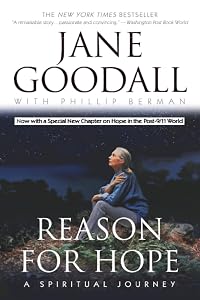
Reason for Hope: A Spiritual Journey
by Jane Goodall, Phillip L. Berman
On This Page
Description
From world-renowned scientist Jane Goodall, as seen in the new National Geographic documentary Jane, comes a poignant memoir about her spiritual epiphany and an appeal for why everyone can find a reason for hope. Dr. Jane Goodall's revolutionary study of chimpanzees in Tanzania's Gombe preserve forever altered the very, definition of humanity. Now, in a poignant and insightful memoir, Jane Goodall explores her extraordinary life and personal spiritual odyssey, with observations as profound show more as the knowledge she has brought back from the forest. show lessTags
Recommendations





Member Recommendations
Member Reviews
3 1/2 stars: Good
You know who she is; this book is as its subtitled - her spiritual journey. Specifically how to reconcile what she saw as a young child in the aftermath of WWII with her very supportive, idealistic family and her deep religious beliefs. My interpretation is that hope is a verb, its an action that we take. That we must continually make meaningful actions to counteract negative forces. I didn't love this book as much as I wanted to (I rated it 7 stars, a solid good) but I did gift it quite a few times this holiday season. If you are struggling with existential angst in this difficult time we live in, you may find some inspiration from Dr. Goodall -- and then find ways for you to take action and thus reclaim your hope. show more
-------------
From amazon:
From world-renowned scientist Jane Goodall, as seen in the National Geographic documentary Jane, comes a poignant memoir about her spiritual epiphany and an appeal for why everyone can find a reason for hope.
Dr. Jane Goodall's revolutionary study of chimpanzees in Tanzania's Gombe preserve forever altered the very, definition of humanity. Now, in a poignant and insightful memoir, Jane Goodall explores her extraordinary life and personal spiritual odyssey, with observations as profound as the knowledge she has brought back from the forest. show less
You know who she is; this book is as its subtitled - her spiritual journey. Specifically how to reconcile what she saw as a young child in the aftermath of WWII with her very supportive, idealistic family and her deep religious beliefs. My interpretation is that hope is a verb, its an action that we take. That we must continually make meaningful actions to counteract negative forces. I didn't love this book as much as I wanted to (I rated it 7 stars, a solid good) but I did gift it quite a few times this holiday season. If you are struggling with existential angst in this difficult time we live in, you may find some inspiration from Dr. Goodall -- and then find ways for you to take action and thus reclaim your hope. show more
-------------
From amazon:
From world-renowned scientist Jane Goodall, as seen in the National Geographic documentary Jane, comes a poignant memoir about her spiritual epiphany and an appeal for why everyone can find a reason for hope.
Dr. Jane Goodall's revolutionary study of chimpanzees in Tanzania's Gombe preserve forever altered the very, definition of humanity. Now, in a poignant and insightful memoir, Jane Goodall explores her extraordinary life and personal spiritual odyssey, with observations as profound as the knowledge she has brought back from the forest. show less
I began reading this book late December 2009, so counting it as one of my 52 books of this year is cheating a little. However, I'm hoping to make it beyond 52 books this year, and another of my goals is finishing books that I put down prematurely.
Jane Goodall has been a hero of mine for nearly my entire life, so when I saw this book on my cousin's bookshelf, I had to ask to borrow it. (Thanks Carrell!) For those who are not familiar with her, you should know that Goodall is a scientist, a conservationist and, I feel, one of the most important women in the history of mankind.
Her work in the Gombe National Forest in Tanzania, Africa, called into question what it is that makes each of us "human," and what separates us from our closest show more relatives -- chimpanzees, with whom less than 1 percent of our DNA differs.
Reason for Hope details not only Goodall's life and accomplishments, but also her spiritual journey. The book stems from a PBS special and a series of interviews conducted with theologian Phillip Berman. It's clear from the reading that Goodall poured a lot of her heart and soul into this book. Her writing is seamless, skillful yet conversational.
To give you a taste, from the inside cover:
"As a toddler she was entranced by all living things, and over the years the little girl inspired by Tarzan and The Jungle Book became the woman who found herself working with famed paleontologist Dr. Louis Leakey; accomplished scientific breakthroughs in Gombe; and ultimately, became a champion of the environment.
It has been a life blessed with faith, resolve and purpose, though not without its crises. Jane Goodall endured the horrors of the London blitz and World War II, postwar hardships, vicious rumors and "establishment" assaults on the integrity of her work, a terrorist attack and hostage taking in Africa, and her husband's slow, agonizing death. But throughout, her religious convictions, although tested, have helped her survive -- and Jane Goodall's pursuit of science has enhanced, not eroded, her belief in God."
In the book, Goodall tells her life story in the context of her spiritual life and awakenings. It is, as most tales of spiritual journeys are, a deeply personal look not just at the accomplishments of her life, but at her very soul. I think one of the keys of Goodall's success is her openness with others; it is very easy to feel as though you know her, we all know her, just by watching her films or reading her words.
This book definitely gave me a deeper glimpse into the life and mind of one of my heroes. Like Goodall, from an early age I've felt called to cherish and protect animals and the environment. My parents tell stories of me as a toddler in the Kentucky bluegrass fields of my grandaddy's farm, standing on the highest rung of a fence and hooking my arms around the neck of a young, green filly. My parents were terrified the horse would pull away, dragging me along with her, or that I would get hurt by her sharp hooves. Instead, my beloved friend hooked her nose around me, returning the embrace.
I do not think that Goodall or myself are alone in our love of animals, or in the feeling that this earth is something entrusted into our stewardship. There are so many in this world who think the Earth is ours to rape; but, in Goodall's words a diffrent message rings true: There is no unholy ground, only holy and desecrated.
"Reason for Hope" has the literary feel of sitting at Goodall's feet while she recounts her life's lessons and passes on that wisdom. The reader is with her through the horrors of World War II and the bombings that England endured; with her in the forests of Gombe, when the first chimpanzee, David Graybeard, holds her hand, communicating his trust; and the reader is with her through her two marriages -- one ending in divorce, the other ending when her husband is taken by cancer. Even after that devestating tragedy she lives on -- she learns again to thrive -- and in the words of the book a window to her inner peace, her strength, is open.
I would highly reccomend this book to anyone who is looking to go on a journey with Goodall, but I feel it especially poignant for those -- like me -- who are afraid of what the future of this earth holds. In a time of so much destruction, chaos, warfare and pollution, it is easy to feel lost. In the end, Goodall really does offer hope for mankind and the Earth our lives are linked to. show less
Jane Goodall has been a hero of mine for nearly my entire life, so when I saw this book on my cousin's bookshelf, I had to ask to borrow it. (Thanks Carrell!) For those who are not familiar with her, you should know that Goodall is a scientist, a conservationist and, I feel, one of the most important women in the history of mankind.
Her work in the Gombe National Forest in Tanzania, Africa, called into question what it is that makes each of us "human," and what separates us from our closest show more relatives -- chimpanzees, with whom less than 1 percent of our DNA differs.
Reason for Hope details not only Goodall's life and accomplishments, but also her spiritual journey. The book stems from a PBS special and a series of interviews conducted with theologian Phillip Berman. It's clear from the reading that Goodall poured a lot of her heart and soul into this book. Her writing is seamless, skillful yet conversational.
To give you a taste, from the inside cover:
"As a toddler she was entranced by all living things, and over the years the little girl inspired by Tarzan and The Jungle Book became the woman who found herself working with famed paleontologist Dr. Louis Leakey; accomplished scientific breakthroughs in Gombe; and ultimately, became a champion of the environment.
It has been a life blessed with faith, resolve and purpose, though not without its crises. Jane Goodall endured the horrors of the London blitz and World War II, postwar hardships, vicious rumors and "establishment" assaults on the integrity of her work, a terrorist attack and hostage taking in Africa, and her husband's slow, agonizing death. But throughout, her religious convictions, although tested, have helped her survive -- and Jane Goodall's pursuit of science has enhanced, not eroded, her belief in God."
In the book, Goodall tells her life story in the context of her spiritual life and awakenings. It is, as most tales of spiritual journeys are, a deeply personal look not just at the accomplishments of her life, but at her very soul. I think one of the keys of Goodall's success is her openness with others; it is very easy to feel as though you know her, we all know her, just by watching her films or reading her words.
This book definitely gave me a deeper glimpse into the life and mind of one of my heroes. Like Goodall, from an early age I've felt called to cherish and protect animals and the environment. My parents tell stories of me as a toddler in the Kentucky bluegrass fields of my grandaddy's farm, standing on the highest rung of a fence and hooking my arms around the neck of a young, green filly. My parents were terrified the horse would pull away, dragging me along with her, or that I would get hurt by her sharp hooves. Instead, my beloved friend hooked her nose around me, returning the embrace.
I do not think that Goodall or myself are alone in our love of animals, or in the feeling that this earth is something entrusted into our stewardship. There are so many in this world who think the Earth is ours to rape; but, in Goodall's words a diffrent message rings true: There is no unholy ground, only holy and desecrated.
"Reason for Hope" has the literary feel of sitting at Goodall's feet while she recounts her life's lessons and passes on that wisdom. The reader is with her through the horrors of World War II and the bombings that England endured; with her in the forests of Gombe, when the first chimpanzee, David Graybeard, holds her hand, communicating his trust; and the reader is with her through her two marriages -- one ending in divorce, the other ending when her husband is taken by cancer. Even after that devestating tragedy she lives on -- she learns again to thrive -- and in the words of the book a window to her inner peace, her strength, is open.
I would highly reccomend this book to anyone who is looking to go on a journey with Goodall, but I feel it especially poignant for those -- like me -- who are afraid of what the future of this earth holds. In a time of so much destruction, chaos, warfare and pollution, it is easy to feel lost. In the end, Goodall really does offer hope for mankind and the Earth our lives are linked to. show less
Another British author. Another book checked off the list. What a sad thing to say about a book, especially when the author says she has "laid bare a lot of my mind, heart, and soul" (p. 276). Being a good person doesn't mean one can express their life and motivations in an interesting manner. There are some gems here, mixed in with the pedantry and polemics. My God, so many chapters dragging us thru all the ways humans are destroying the world and harming animals. Well, since people are still doing it, I guess it needs to be said.
Her stated reason for writing, tho, is to answer the question "where do you find hope?" And that, despite her rambling about the importance to her of Jesus, seems to be "from nature". Which is the same message show more now being promoted by Louv as the cure for Nature Deficit Disorder. I am glad for this message to be spread however it can. Additionally she finds that "Herein lies the real hope for our future--we are moving toward the ultimate destiny of our species--a state of compassion and love." (p. 251) She was stongly influenced by having lived through WWII, in Britain, and by what she heard about the horrors of the concentration camps. These are the horrors which forced her to ponder our humanity, and search out glimmers of hope.
She does her best to show how evolutionary theory fits with Christianity. In some of the chapters it is apparent Goodall is disputing some other labels: Dawkins' selfish gene theory, Erikson's Pseudospeciation (which she relabels cultural speciation).
With her discovery of tool use by chimpanzees, scientists have had to redefine what it means to be humans. Her definition seems to be that we are the language users. "the uniquely human ability to talk about that which is not present, share events of the distant past, plan for the far-off future, and, most important, discuss ideas, bouncing them back and forth to share the accumulated wisdom of an entire group...to aritculate feelings of awe, feelings that would lead to religious belief..." (p.188)
Just as important, I feel, are her observations on parenting by chimpanzees, which meshes with what is experienced by humans. "a secure childhood was likely to lead to self-reliance and independence in adulthood while a disturbed early life might well result in an insecure adult...Mothers whe were...playful, affectionate, tolerant, and above all supportive, seemed to raise offspriing who, as adults, had good relaxed relationships with community members." (p.88-89)
Goodall ends with a challenge for us to each "take responsibility for our own lives" because "Each one of us matters, has a role to play, and makes a difference" (p.266)
What are some other of the gems in this book?
"How sad it would be...if we humans ultimately were to lose all sense of mystery, all sense of awe. If our left brains were utterly to dominate the right so that logic and reason triumphed over intuition and alienated us absolutely from our innermost being, from our hearts, our souls." (p.177)
"That which is loved...can grow. We had to learn to understand and love this Spirit within in order to find peace within. And only then could we reach out beyond the narrow prison of our own lives..." (p.199)
"We cannot live through a day without impacting the world around us--and we have a choice: What sort of impact do we want to make?" (p.242)
This gem is a quote she used from Schweitzer: "A man who possesses a veneration of life will not simply say his prayers. He will throw himself into the battle to preserve life..." (p.251) show less
Her stated reason for writing, tho, is to answer the question "where do you find hope?" And that, despite her rambling about the importance to her of Jesus, seems to be "from nature". Which is the same message show more now being promoted by Louv as the cure for Nature Deficit Disorder. I am glad for this message to be spread however it can. Additionally she finds that "Herein lies the real hope for our future--we are moving toward the ultimate destiny of our species--a state of compassion and love." (p. 251) She was stongly influenced by having lived through WWII, in Britain, and by what she heard about the horrors of the concentration camps. These are the horrors which forced her to ponder our humanity, and search out glimmers of hope.
She does her best to show how evolutionary theory fits with Christianity. In some of the chapters it is apparent Goodall is disputing some other labels: Dawkins' selfish gene theory, Erikson's Pseudospeciation (which she relabels cultural speciation).
With her discovery of tool use by chimpanzees, scientists have had to redefine what it means to be humans. Her definition seems to be that we are the language users. "the uniquely human ability to talk about that which is not present, share events of the distant past, plan for the far-off future, and, most important, discuss ideas, bouncing them back and forth to share the accumulated wisdom of an entire group...to aritculate feelings of awe, feelings that would lead to religious belief..." (p.188)
Just as important, I feel, are her observations on parenting by chimpanzees, which meshes with what is experienced by humans. "a secure childhood was likely to lead to self-reliance and independence in adulthood while a disturbed early life might well result in an insecure adult...Mothers whe were...playful, affectionate, tolerant, and above all supportive, seemed to raise offspriing who, as adults, had good relaxed relationships with community members." (p.88-89)
Goodall ends with a challenge for us to each "take responsibility for our own lives" because "Each one of us matters, has a role to play, and makes a difference" (p.266)
What are some other of the gems in this book?
"How sad it would be...if we humans ultimately were to lose all sense of mystery, all sense of awe. If our left brains were utterly to dominate the right so that logic and reason triumphed over intuition and alienated us absolutely from our innermost being, from our hearts, our souls." (p.177)
"That which is loved...can grow. We had to learn to understand and love this Spirit within in order to find peace within. And only then could we reach out beyond the narrow prison of our own lives..." (p.199)
"We cannot live through a day without impacting the world around us--and we have a choice: What sort of impact do we want to make?" (p.242)
This gem is a quote she used from Schweitzer: "A man who possesses a veneration of life will not simply say his prayers. He will throw himself into the battle to preserve life..." (p.251) show less
After Jane Goodall's death just a short while ago, I wanted to honor her memory by reading one of her books. I chose "Reason for Hope". Jane has written a beautiful book that traces her childhood in England, to her time researching in Gombe, and her work as a real power in the environmental conservancy community. The book is viewed through the lens of Jane's spiritual beliefs and how that has shaped her life.
It's beautiful, it's quotable, it's a look at a life well-done. Read it and you won't be disappointed.
It's beautiful, it's quotable, it's a look at a life well-done. Read it and you won't be disappointed.
I appreciate Jane Goodall as a person. Her work and her life have certainly been remarkable and inspirational. I like the idea that humans are on this earth to fulfill their spiritual and ethical development as a species. There is a lot of food for thought in this book from Jane's own experience. It makes a case for our collective responsibility to mother earth and all creatures great and small.
That said, there are a few things that were mentioned here that annoyed me a little, and I would like to think that they are the fault of the people who abridged this edition. The full description of the crime of the holocaust and the horrors of Auschwitz / Birkenau stands jarringly against a small paragraph about Palestinian children show more proclaiming their wish to kill Jews and become suicide bombers. The "bad guys" here are all nicely compartmentalized, they are Germans, Arabs and African. Meanwhile Petrol companies like BP are trying to do something for the environment, give me a break.
I do not want to belittle a good book but these two observations made it lose some credibility in my eyes (3 1/2 stars) instead of a full 4. show less
That said, there are a few things that were mentioned here that annoyed me a little, and I would like to think that they are the fault of the people who abridged this edition. The full description of the crime of the holocaust and the horrors of Auschwitz / Birkenau stands jarringly against a small paragraph about Palestinian children show more proclaiming their wish to kill Jews and become suicide bombers. The "bad guys" here are all nicely compartmentalized, they are Germans, Arabs and African. Meanwhile Petrol companies like BP are trying to do something for the environment, give me a break.
I do not want to belittle a good book but these two observations made it lose some credibility in my eyes (3 1/2 stars) instead of a full 4. show less
The book is by the famous anthropologist Jane Goodall, whose studies of chimpanzees revolutionized how we think of our closest relative among living species and thus how we define being human. Her title signals this book is about a lot more than that groundbreaking work. This was found in the Nature section of my neighborhood bookstore, but was recommended to me as "inspirational non-fiction" on the Ultimate Reading List. Her credited co-author Philip Berman is a theologian and the project was first conceived as "a book of interviews--questions from a theologian to an anthropologist."
Reading this I could have wished for a lot more of the anthropological and less of the spiritual. This memoir of her experiences had its pleasures and show more moving moments. I loved the story about how Louis Leakey recruited Goodall, who at the time had never attended a university, to go off to study chimpanzees in the wild. And I certainly found moving her story about the death of her husband from cancer. I thought she was at her best though in chapters such as "The Roots of Evil," "Precursors to War" and "Compassion and Love" when she spoke directly out of her study and observations of chimpanzees. But there's a lot in her moral, political and spiritual outlook I find antithetical to mine that made it hard at times to hear her out. Frequently I found myself irritated, and found myself skimming large parts of chapters. I frankly squirmed reading about her psychic experiences. Her style is lucid enough, but having recently read Isak Dinesen's Out of Africa, Goodall's prose did strike me in comparison as prosaic--this isn't a memoir you read out of literary merit. And when it came to so many of her political and spiritual views, there was so little I felt I hadn't heard many times before--that didn't feel like boilerplate. It's because there was so much in the book I couldn't take seriously, things outside the scope of her expertise, that despite fascinating bits in the book I can't rate this higher.
Was there any point in her arguments on issues I disagreed with where she got through to me? Interestingly, yes. Primarily in the Chapter "On the Road to Damascus" regarding animal research. I think it's significant that this was an issue where I didn't feel she was just repeating what many others had said. Her experiences observing chimpanzees, and her discussion of the cruelty of how they're treated in laboratories--ones she actually visited--resonated. Precisely because she spoke with the authority of direct experience. She also deflected a lot of my defenses by admitting the good that animal research had done; her own mother is alive because of animal research and the pig valve implanted in her heart. Yes, Goodall would like to someday eliminate animal experimentation, but the thrust of her argument was for treating the animals in laboratories as humanely as possible, and looking for alternatives. She didn't give anything like the PETA line that "A rat is a pig is a dog is a boy." And she gained my respect because of how she related how she actually sat down with researchers and worked with them to better the conditions of research animals--she didn't just hurl rhetorical bricks from outside the walls. So besides the fascinating look here and there at the experiences of a pioneering women in the study of primates, I learned a little about what it is that can break down resistance to truly considering the other side of an argument. And despite my disagreements with Goodall, at the finish of her book she had my admiration, liking and respect. show less
Reading this I could have wished for a lot more of the anthropological and less of the spiritual. This memoir of her experiences had its pleasures and show more moving moments. I loved the story about how Louis Leakey recruited Goodall, who at the time had never attended a university, to go off to study chimpanzees in the wild. And I certainly found moving her story about the death of her husband from cancer. I thought she was at her best though in chapters such as "The Roots of Evil," "Precursors to War" and "Compassion and Love" when she spoke directly out of her study and observations of chimpanzees. But there's a lot in her moral, political and spiritual outlook I find antithetical to mine that made it hard at times to hear her out. Frequently I found myself irritated, and found myself skimming large parts of chapters. I frankly squirmed reading about her psychic experiences. Her style is lucid enough, but having recently read Isak Dinesen's Out of Africa, Goodall's prose did strike me in comparison as prosaic--this isn't a memoir you read out of literary merit. And when it came to so many of her political and spiritual views, there was so little I felt I hadn't heard many times before--that didn't feel like boilerplate. It's because there was so much in the book I couldn't take seriously, things outside the scope of her expertise, that despite fascinating bits in the book I can't rate this higher.
Was there any point in her arguments on issues I disagreed with where she got through to me? Interestingly, yes. Primarily in the Chapter "On the Road to Damascus" regarding animal research. I think it's significant that this was an issue where I didn't feel she was just repeating what many others had said. Her experiences observing chimpanzees, and her discussion of the cruelty of how they're treated in laboratories--ones she actually visited--resonated. Precisely because she spoke with the authority of direct experience. She also deflected a lot of my defenses by admitting the good that animal research had done; her own mother is alive because of animal research and the pig valve implanted in her heart. Yes, Goodall would like to someday eliminate animal experimentation, but the thrust of her argument was for treating the animals in laboratories as humanely as possible, and looking for alternatives. She didn't give anything like the PETA line that "A rat is a pig is a dog is a boy." And she gained my respect because of how she related how she actually sat down with researchers and worked with them to better the conditions of research animals--she didn't just hurl rhetorical bricks from outside the walls. So besides the fascinating look here and there at the experiences of a pioneering women in the study of primates, I learned a little about what it is that can break down resistance to truly considering the other side of an argument. And despite my disagreements with Goodall, at the finish of her book she had my admiration, liking and respect. show less
I enjoyed this book. Of course, I had heard of Jane Goodall and her foundation but didn't realize that her passion is driven from a spiritual base. The story of her life is amazing to me, especially as I learned that she really just ventured out to Africa to fulfill a dream with no real training to do what she hoped to do.
I was challenged by the way she weaves together her spiritual understanding of creation with her scientific understanding of evolution ... not just physical, but also social and moral.
The purpose of her book can be summed up by a quote toward the end where she says … "every human, every unique being, plays some role in the shaping of progress, though only some get into history books. Throughout every second of every show more day there is change abroad in the world, change due to the impact of mind on mind; teacher and pupil, parent and child, world leader and citizen, writer or actor and the general public. Each one of us carries seeds for change. Seeds that need nurturing to realize their potential." (p. 203) show less
I was challenged by the way she weaves together her spiritual understanding of creation with her scientific understanding of evolution ... not just physical, but also social and moral.
The purpose of her book can be summed up by a quote toward the end where she says … "every human, every unique being, plays some role in the shaping of progress, though only some get into history books. Throughout every second of every show more day there is change abroad in the world, change due to the impact of mind on mind; teacher and pupil, parent and child, world leader and citizen, writer or actor and the general public. Each one of us carries seeds for change. Seeds that need nurturing to realize their potential." (p. 203) show less
Members
- Recently Added By
Published Reviews
ThingScore 75
Die Autobiografie Jane Goodalls ist mehr als nur eine Rückschau auf die Zeit bei den Schimpansen in Gombe. Sie gibt Einblicke in ihr Denken und ihre Überzeugungen, auch jenseits der Primatenforschung; in ihre Spiritualität und in ihr Privatleben, aus dem sie aufschlussreich berichtet und Schicksalsschläge nicht ausklammert. Jane Goodalls Erinnerungen sind ein bewegendes Plädoyer für den show more Erhalt des Planeten Erde, für Artenvielfalt und für mehr Güte und Mitgefühl im Umgang mit der Kreatur. Sie sind aber auch das Porträt einer faszinierenden Frau, die vor allem Courage besitzt - egal ob sie sich allein nach Afrika einschifft, als tierliebe Schreibkraft den Weg zur modernen Primatologie beschreitet oder in aller Welt die Rechte der engsten Verwandten des Menschen, aber auch der notleidenden afrikanischen Bevölkerung einklagt. Aus ihrem Glauben schöpft Jane Goodall die Kraft, sich von Rückschlägen nicht entmutigen zu lassen. "Grund zur Hoffnung" lautet deshalb der Titel ihrer Lebensberichts und ist gleichsam ihr Lebensmotto. Jane Goodalls Engagement als streitbare Wissenschaftlerin, die einfühlsam, aber energisch ihr Ziel verfolgt, ist beeindruckend, das Faszinierende an ihrer Autobiographie ist aber die Liebe zu den Schimpansen, die aus jeder Zeile spricht. show less
added by Indy133
Lists

Books Read in 2012
816 works; 34 members
Author Information

69+ Works 10,133 Members
Jane Goodall, 1934 - Jane Goodall, a well-respected English zoologist, is famous for her fieldwork with chimpanzees in Africa. An early interest in African wild animals and the opportunity, at age 18, to stay on a friend's farm in Kenya, led her to Dr. Louis Leakey; then curator of the National Museum of Natural History in Nairobi. Almost show more immediately Leakey hired Goodall as his assistant secretary, and she was soon accompanying Leakey and his wife on their expeditions. Following Leakey's suggestion that a field study of some of the higher primates would be a major contribution to the understanding of animal behavior, she began studying the chimpanzees of the Gombe Stream Research Center in Tanganyika (now Tanzania) in 1960. Although she had no undergraduate degree, Goodall earned a Ph.D. from Cambridge University in 1965, based on her first five years of research at the Gombe Center. After more than 20 years of extensive study and direct contact with wild chimpanzees in their natural habitat, Goodall continues to research, teach, and write about primate behavior today. (Bowker Author Biography) Jane Goodall's research at Gombe, Tanzania, is entering its fifth decade. Her books include "In the Shadow of Man", "Through a Window: My Thirty Years with the Chimpanzees of Gombe", & "Africa in My Blood: An Autobiography in Letters", edited by Dale Peterson. She resides in Dar es Salaam, Tanzania. (Bowker Author Biography) show less
9 Works 1,389 Members
Awards and Honors
Awards
Distinctions
Common Knowledge
- Original title
- Reason For Hope: A Spiritual Journey
- Original publication date
- 1999
- People/Characters
- Louis Leakey; Derek Bryceson; Jane Goodall
- Important places
- Gombe, Tanzania
- Important events
- World War II, British Home Front
- Dedication
- For Vanne, Judy, and all my wonderful family.
And in vivid memory of Danny, Derek, Louis, Rusty, and David Greybeard - First words
- Many years ago, in the spring of 1974, I visited the cathedral of Notre Dame in Paris.
- Quotations
- Herein lies the real hope for our future--we are moving toward the ultimate destiny of our species--a state of compassion and love. (p. 251)
...the uniquely human ability to talk about that which is not present, share events of the distant past, plan for the far-off future, and, most important, discuss ideas, bouncing them back and forth to share the accumulated w... (show all)isdom of an entire group...to aritculate feelings of awe, feelings that would lead to religious belief... (p.188)
Each one of us matters, has a role to play, and makes a difference. Each one of us must take responsibility for our own lives, and above all, show respect and love for living things around us, especially each other. (p.266-7... (show all))
How sad it would be...if we humans ultimately were to lose all sense of mystery, all sense of awe. If our left brains were utterly to dominate the right so that logic and reason triumphed over intuition and alienated us absol... (show all)utely from our innermost being, from our hearts, our souls. (p.177)
...it honestly didn't matter how we humans got to be the way we are, whether evolution or special creation was responsible. What mattered and mattered desperately was our future development...were we going to find ways to liv... (show all)e in greater harmony with each other and with the natural world? (p.179)
That which is loved...can grow. We had to learn to understand and love this Spirit within in order to find peace within. And only then could we reach out beyond the narrow prison of our own lives... (p.199)
We cannot live through a day without impacting the world around us--and we have a choice: What sort of impact do we want to make? (p.242)
...there are things which I, with my finite mind, shall never be able to understand. And that, although I can never accept evil...and though I shall always fight it, I do not have to account for its presence among us" (p.260) - Last words
- (Click to show. Warning: May contain spoilers.)And the end...will be the beginning?
Classifications
Statistics
- Members
- 1,198
- Popularity
- 20,826
- Reviews
- 21
- Rating
- (3.98)
- Languages
- 6 — Chinese, Dutch, English, German, Hungarian, Spanish
- Media
- Paper, Audiobook, Ebook
- ISBNs
- 29
- UPCs
- 1
- ASINs
- 9
