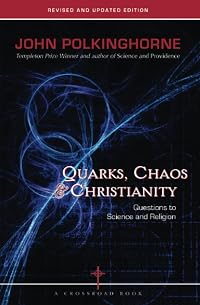
Quarks, Chaos & Christianity: Questions to Science And Religion
by John Polkinghorne
On This Page
Description
Templeton Award winner and theoretical physicist John Polkinghorne explores the gap between science and religion. "Do we have to choose between the scientific and religious views of the world, or are they complementary understandings that give us a fuller picture than either on their own would provide?" Quarks, Chaos, & Christianity shows the ways that both science and religion point to something greater than ourselves. Topics include: chaos theory; evolution; miracles; cosmology; guest for show more God; how God answers prayer; our human nature; religious fact and opinion; scientists and prayer. show lessTags
Recommendations







Member Recommendations
Member Reviews
The author is at his best when presenting complex scientific notions to the uninitiated, and when dispelling common misapprehensions on how science and religion proceed in their respective fields of inquiry – pointing out at the same time that both seek rational responses to their questions, a motivated assent to things seen and unseen. Such misapprehensions have led many to consider them - mistakenly - as contradictory and mutually exclusive, rather than as complementary paths to the truth.
Half-way the book slides from scientific questions and, in the author's opinion, their compatibility with religious belief, into a more apologetic tone, making more openly a case for Christianity. Mind you, being myself a Roman Catholic priest, I show more do not have any major objection to this, but it is not what I expected from this book...
The author rightly rejects the views of God either as a puppet-master or as an indifferent spectator. He presents creation as a continuous process, and puzzles over the problem of evil. But for some of his explanations, or proposed solutions, he takes a very liberal view of Christian doctrine, advancing notions that contradict what the Christian faith has historically asserted – for example, regarding God’s efficiency in the work of creation, or regarding God’s will and His knowledge of the future.
Although I strongly disagree with much of the author’s theology, the book is nonetheless worth reading – it makes many good points, and is thought-provoking. It may not give you acceptable solutions to the problems posed, but it is a good starting point for thinking seriously about them and sheds some light on the path ahead... show less
Half-way the book slides from scientific questions and, in the author's opinion, their compatibility with religious belief, into a more apologetic tone, making more openly a case for Christianity. Mind you, being myself a Roman Catholic priest, I show more do not have any major objection to this, but it is not what I expected from this book...
The author rightly rejects the views of God either as a puppet-master or as an indifferent spectator. He presents creation as a continuous process, and puzzles over the problem of evil. But for some of his explanations, or proposed solutions, he takes a very liberal view of Christian doctrine, advancing notions that contradict what the Christian faith has historically asserted – for example, regarding God’s efficiency in the work of creation, or regarding God’s will and His knowledge of the future.
Although I strongly disagree with much of the author’s theology, the book is nonetheless worth reading – it makes many good points, and is thought-provoking. It may not give you acceptable solutions to the problems posed, but it is a good starting point for thinking seriously about them and sheds some light on the path ahead... show less
Polkinghorne is a former physicist who became an Anglican priest and now writes of the complimentary nature of science and religion. Of course both physics and theology are complex topics to understand so while thin this book is a bit dense. Still fascinating stuff and encouraging too.
“God knows things as they really are. In a world of true becoming, therefore, will God not know them in their becomingness, that is, in their temporal succession? In other words, if the future is truly open, not just a rearrangement of the past, will not God have to know the world in time as it develops? If this is the case, even God does not yet know the unformed future. This is not an imperfection in God, for the future is not yet there to be show more known.” (p. 91)
“When we pray…we offer our will to be aligned with divine will. I believe that when this alignment takes place, things become possible that are not possible when human and divine wills are at cross purposes. Therefore, prayer is genuinely instrumental. It genuinely changes the world.” (p. 93) show less
“God knows things as they really are. In a world of true becoming, therefore, will God not know them in their becomingness, that is, in their temporal succession? In other words, if the future is truly open, not just a rearrangement of the past, will not God have to know the world in time as it develops? If this is the case, even God does not yet know the unformed future. This is not an imperfection in God, for the future is not yet there to be show more known.” (p. 91)
“When we pray…we offer our will to be aligned with divine will. I believe that when this alignment takes place, things become possible that are not possible when human and divine wills are at cross purposes. Therefore, prayer is genuinely instrumental. It genuinely changes the world.” (p. 93) show less
Ratings
Members
- Recently Added By
Author Information

49+ Works 4,304 Members
John Polkinghorne, K.B.E., F.R.S., is past president and now fellow of Queens' College, Cambridge, and Canon Theologian of Liverpool, England. (Bowker Author Biography)
Common Knowledge
- Original publication date
- 1994
Classifications
- Genres
- Nonfiction, Religion & Spirituality, General Nonfiction, Philosophy
- DDC/MDS
- 261.55 — Religion Christian organization, social work & worship Social theology and interreligious relations and attitudes Christianity and secular disciplines Mathematics And Science
- LCC
- BL240.2 .P5754 — Philosophy, Psychology and Religion Religions. Mythology. Rationalism Religions. Mythology. Rationalism Natural theology Religion and science
- BISAC
Statistics
- Members
- 284
- Popularity
- 113,166
- Reviews
- 2
- Rating
- (3.11)
- Languages
- Dutch, English
- Media
- Paper, Ebook
- ISBNs
- 6
- ASINs
- 2