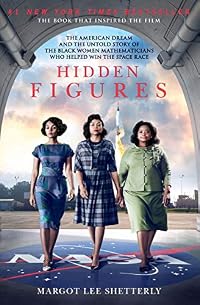
Hidden Figures: The American Dream and the Untold Story of the Black Women Mathematicians Who Helped Win the Space Race
by Margot Lee Shetterly
On This Page
Description
The phenomenal true story of the black female mathematicians at NASA whose calculations helped fuel some of America's greatest achievements in space. Soon to be a major motion picture starring Taraji P. Henson, Octavia Spencer, Janelle Monae, Kirsten Dunst, and Kevin Costner.Before John Glenn orbited the earth, or Neil Armstrong walked on the moon, a group of dedicated female mathematicians known as "human computers" used pencils, slide rules and adding machines to calculate the numbers show more that would launch rockets, and astronauts, into space.
Among these problem-solvers were a group of exceptionally talented African American women, some of the brightest minds of their generation. Originally relegated to teaching math in the South's segregated public schools, they were called into service during the labor shortages of World War II, when America's aeronautics industry was in dire need of anyone who had the right stuff. Suddenly, these overlooked math whizzes had a shot at jobs worthy of their skills, and they answered Uncle Sam's call, moving to Hampton, Virginia and the fascinating, high-energy world of the Langley Memorial Aeronautical Laboratory.
Even as Virginia's Jim Crow laws required them to be segregated from their white counterparts, the women of Langley's all-black "West Computing" group helped America achieve one of the things it desired most: a decisive victory over the Soviet Union in the Cold War, and complete domination of the heavens.
Starting in World War II and moving through to the Cold War, the Civil Rights Movement and the Space Race, Hidden Figures follows the interwoven accounts of Dorothy Vaughan, Mary Jackson, Katherine Johnson and Christine Darden, four African American women who participated in some of NASA's greatest successes. It chronicles their careers over nearly three decades they faced challenges, forged alliances and used their intellect to change their own lives, and their country's future.
. show less
Tags
Recommendations















Member Recommendations
themulhern Similar stories about overlooked and discriminated against mathematicians and computers.
20
JenniferRobb My Remarkable Journey is Katherine Johnson's story in her own words while Hidden Figures tells the story from the perspective of several women including Katherine Johnson.
20
Member Reviews
I was happy to receive Hidden Figures as an ER book, and it easily lived up to my hopes. First time author Margot Lee Shetterly has done an admirable job of depicting the black female mathematicians who became employed at NASA (originally NACA) as human "computers" in the 1940s, and their successors to the present day. We get insights not only into the African American experience in the USA beginning in WWII, but also the space program as it developed, including the sometimes fevered emotions underlying it.
Shetterly says in the Acknowledgments at the end that, "As the child of a Hampton University English professor and a NASA research scientist, it was probably inevitable that I would eventually write a book about scientists." In the show more prologue she remembers her father's "engineering colleagues with their rumpled style and distracted manner. . . . That so many of them were African American, many of them my grandmother's age, struck me as simply the natural order of things: growing up in Hampton, the face of science was brown."
WWII caused aeronautic engineering to move front and center in the USA as a critical part of the war effort. Just as previously unemployed or underemployed women were needed in many industries at that time, NASA needed reliable mathematicians who could execute complicated mathematical assignments, and could make sure their computations were correct. Small errors could have big effects. Eventually black women from good engineering programs at black schools were targeted. That they succeeded in an era in which "just 2 per cent of all black women earned college degrees" is impressive. Of course, once they started, certain adjustments had to be made (some may wish to read these details first in the book, so I've covered some of this with the "spoiler" indication):
"in 1943, America existed in the urgent present. Responding to the needs of the here and now, Butler took the next step, *SPOILER* making a note to add another item to Sherwood's seemingly endless requisition list: a metal bathroom sign bearing the words COLORED GIRLS." Of course. The young black women were segregated into their own section of NASA, West Computing, and were relegated to their own lunch table, which had a stenciled cardboard sign stating: COLORED COMPUTERS. One of the black computers tossed the sign in the garbage every time it showed up, and finally the person posting the sign gave up. But the black female mathematicians continued to sit at that table.. *END OF SPOILER*
One of the featured women is pioneer Dorothy Vaughan.
"Education topped her list of ideals; it was the surest hedge against a world that would require more of her children than white children, and attempt to give them less in return. The Negro's ladder to the American dream was missing rungs, with even the most outwardly successful blacks worried that in a moment the forces of discrimination could lay waste to their economic security."
"Separate but equal" was the shamefully accepted law and social divider. Dorothy rises to lead West Computing, but it is not until the landmark decision Brown v. Board of Education in the mid-50s that school integration begins to happen and segregation begins to break down. Shetterly adeptly interweaves the social environment of the times through the lives of these women and their families. When West Computing finally is dispersed and its members scattered throughout NASA, it was,
"a bittersweet moment for Dorothy Vaughan. It had taken her eight years to reach the seat at the front of the office. For seven years she ruled the most unlikely of realms: a room full of black female mathematicians doing research at the world's most prestigious aeronautical laoratory."
As full scale integration is beginning, the female mathematicians also find themselves urgently involved in a space race. It is kicked off by Russia orbiting Sputnik over the USA (causing both fear and offended national pride), and President Kennedy promising to land on the moon by decade's end - a seemingly impossible task. "As fantastical as America's space ambitions may have seemed, sending a man into space was starting to feel like a straightforward task compared to putting black and white students together in the same Virginia classrooms." One VA school system actually closes its public schools for five years to avoid integration!
Eventually, indefatigable Katherine Johnson will insist her way into the engineering inner circles, and become critical to the space missions. "Sending a man into space was a damn tall order, but it was the part about returning him safely to Earth that kept Katherine Johnson and the rest of the space pilgrims awake at night." John Glenn insists that she be the one to "check the numbers" before he'll go up. "I loved every single day of it", she says. "There wasn't one day when I didn't wake up excited to go to work." Her work in celestial navigation was essential to the space program's success, including her work product in connection with the moon landing and return. She ends up receiving the Presidential Medal of Freedom, among many other awards.
What a remarkable story Shetterley has given us. Among many other things, we also get to see the huge social importance of the tv show Star Trek, with its futuristic multi-cultural crew and black officer Nyota Uhuru, played by Nichelle Nichols. You'll want to read about Nichols' encounter with Dr. Martin Luther King, Jr., and its effect on her career.
This is a fascinating book, and a good resource both for a little known part of African American history in the U.S., and a behind-the-scenes look at the space program. Four and a half stars. show less
Shetterly says in the Acknowledgments at the end that, "As the child of a Hampton University English professor and a NASA research scientist, it was probably inevitable that I would eventually write a book about scientists." In the show more prologue she remembers her father's "engineering colleagues with their rumpled style and distracted manner. . . . That so many of them were African American, many of them my grandmother's age, struck me as simply the natural order of things: growing up in Hampton, the face of science was brown."
WWII caused aeronautic engineering to move front and center in the USA as a critical part of the war effort. Just as previously unemployed or underemployed women were needed in many industries at that time, NASA needed reliable mathematicians who could execute complicated mathematical assignments, and could make sure their computations were correct. Small errors could have big effects. Eventually black women from good engineering programs at black schools were targeted. That they succeeded in an era in which "just 2 per cent of all black women earned college degrees" is impressive. Of course, once they started, certain adjustments had to be made (some may wish to read these details first in the book, so I've covered some of this with the "spoiler" indication):
"in 1943, America existed in the urgent present. Responding to the needs of the here and now, Butler took the next step, *SPOILER* making a note to add another item to Sherwood's seemingly endless requisition list: a metal bathroom sign bearing the words COLORED GIRLS." Of course. The young black women were segregated into their own section of NASA, West Computing, and were relegated to their own lunch table, which had a stenciled cardboard sign stating: COLORED COMPUTERS. One of the black computers tossed the sign in the garbage every time it showed up, and finally the person posting the sign gave up. But the black female mathematicians continued to sit at that table.. *END OF SPOILER*
One of the featured women is pioneer Dorothy Vaughan.
"Education topped her list of ideals; it was the surest hedge against a world that would require more of her children than white children, and attempt to give them less in return. The Negro's ladder to the American dream was missing rungs, with even the most outwardly successful blacks worried that in a moment the forces of discrimination could lay waste to their economic security."
"Separate but equal" was the shamefully accepted law and social divider. Dorothy rises to lead West Computing, but it is not until the landmark decision Brown v. Board of Education in the mid-50s that school integration begins to happen and segregation begins to break down. Shetterly adeptly interweaves the social environment of the times through the lives of these women and their families. When West Computing finally is dispersed and its members scattered throughout NASA, it was,
"a bittersweet moment for Dorothy Vaughan. It had taken her eight years to reach the seat at the front of the office. For seven years she ruled the most unlikely of realms: a room full of black female mathematicians doing research at the world's most prestigious aeronautical laoratory."
As full scale integration is beginning, the female mathematicians also find themselves urgently involved in a space race. It is kicked off by Russia orbiting Sputnik over the USA (causing both fear and offended national pride), and President Kennedy promising to land on the moon by decade's end - a seemingly impossible task. "As fantastical as America's space ambitions may have seemed, sending a man into space was starting to feel like a straightforward task compared to putting black and white students together in the same Virginia classrooms." One VA school system actually closes its public schools for five years to avoid integration!
Eventually, indefatigable Katherine Johnson will insist her way into the engineering inner circles, and become critical to the space missions. "Sending a man into space was a damn tall order, but it was the part about returning him safely to Earth that kept Katherine Johnson and the rest of the space pilgrims awake at night." John Glenn insists that she be the one to "check the numbers" before he'll go up. "I loved every single day of it", she says. "There wasn't one day when I didn't wake up excited to go to work." Her work in celestial navigation was essential to the space program's success, including her work product in connection with the moon landing and return. She ends up receiving the Presidential Medal of Freedom, among many other awards.
What a remarkable story Shetterley has given us. Among many other things, we also get to see the huge social importance of the tv show Star Trek, with its futuristic multi-cultural crew and black officer Nyota Uhuru, played by Nichelle Nichols. You'll want to read about Nichols' encounter with Dr. Martin Luther King, Jr., and its effect on her career.
This is a fascinating book, and a good resource both for a little known part of African American history in the U.S., and a behind-the-scenes look at the space program. Four and a half stars. show less
 This review was written for LibraryThing Early Reviewers.
Dorothy Vaughn, Katherine Goble Johnson, Mary Jackson, and many others worked for NACA (National Advisory Committee for Aeronautics), later called NASA, at Langley as computers. They worked in West Computing, the section for African-American computers; the White computers worked in East Computing. Both sets of women had their own hurdles to cross in the male-dominated agency, yet those in West Computing had additional barriers to contend with. This is their story.
By focusing on the lives of specific women, Shetterly easily avoids having written a “dry history book.” She brings the women’s stories to the forefront in order to highlight the various struggles and triumphs of all the women at Langley. Reading this book got me show more incredibly excited about science and math and space travel. I wanted to go back in time and tell college age me to pursue a degree in the sciences instead of liberal arts. (Not that I’m not happy being a librarian and your humble reviewer, but I just got REALLY EXCITED about science while reading Hidden Figures.) And that’s the point, right? By shining a light on the untold stories of these women, Shetterly is inspiring others to pursue careers in the sciences as well. And, really, there can be no better recommendation than that. show less
By focusing on the lives of specific women, Shetterly easily avoids having written a “dry history book.” She brings the women’s stories to the forefront in order to highlight the various struggles and triumphs of all the women at Langley. Reading this book got me show more incredibly excited about science and math and space travel. I wanted to go back in time and tell college age me to pursue a degree in the sciences instead of liberal arts. (Not that I’m not happy being a librarian and your humble reviewer, but I just got REALLY EXCITED about science while reading Hidden Figures.) And that’s the point, right? By shining a light on the untold stories of these women, Shetterly is inspiring others to pursue careers in the sciences as well. And, really, there can be no better recommendation than that. show less
It always amazes me when I come upon stories such as these – women basically lost to history. I had no idea about this cadre of women who worked for the nascent NASA. They were actually called computers; but in essence they were early engineers. They did this vital, valuable work and yet the credit fell on the men. How about that? The book singles out four women to profile – this is not historical fiction by the way – but it is the story of so many more women.
Even though this is non-fiction the book reads like a novel. Ms. Shatterly introduces her heroines and the reader learns about these amazing women in the context of their time. Despite living in horribly restrictive times – as women and as women of color they break so many show more barriers. They still deal with being all of the other issues women are still dealing with today – motherhood, discrimination, men claiming their work. But this all happened at a time when blacks were still being relegated to separate bathrooms, water fountains, etc. In fact one of the issues was finding a building for them to work in so they wouldn’t “mix” with the white workers. It does make for some uncomfortable reading at times. As it should.
I was utterly fascinated by the stories of the times, of the women, of the work they did and of how Ms. Shetterly wove it all together. I didn’t know about the movie when I chose to review the book but now I admit I’m looking forward to seeing it. It will add fictional elements of course but I’m sure it will be fascination. These women deserve to be celebrated and it is long overdue. show less
Even though this is non-fiction the book reads like a novel. Ms. Shatterly introduces her heroines and the reader learns about these amazing women in the context of their time. Despite living in horribly restrictive times – as women and as women of color they break so many show more barriers. They still deal with being all of the other issues women are still dealing with today – motherhood, discrimination, men claiming their work. But this all happened at a time when blacks were still being relegated to separate bathrooms, water fountains, etc. In fact one of the issues was finding a building for them to work in so they wouldn’t “mix” with the white workers. It does make for some uncomfortable reading at times. As it should.
I was utterly fascinated by the stories of the times, of the women, of the work they did and of how Ms. Shetterly wove it all together. I didn’t know about the movie when I chose to review the book but now I admit I’m looking forward to seeing it. It will add fictional elements of course but I’m sure it will be fascination. These women deserve to be celebrated and it is long overdue. show less
HIDDEN FIGURES was a compelling listen. I was swept into the early days of NASA and the lives of some of the Black women who labored diligently and mostly in the background to bring the United States into the space age.
Starting with World War II and the labor shortage that provided openings for bright Black women to work in the aerospace industry in Hampton, Virginia, and ending some forty years later, the accounts of the Black mathematicians who dealt with all the issues of segregation when they weren't at work was a story woven between the developments of flight and spaceflight and the gradual social changes of Black-White interactions.
I enjoyed the author's thoughts in both the Prologue and Epilogue that illuminates her journey to show more learn about the times and these extraordinary women who accomplishments were mainly hidden in the background of a burgeoning industry.
I was reminded over and over again that the adage of having to work twice as hard to get half as far was a reality for women of the time and even more so for Black women. show less
Starting with World War II and the labor shortage that provided openings for bright Black women to work in the aerospace industry in Hampton, Virginia, and ending some forty years later, the accounts of the Black mathematicians who dealt with all the issues of segregation when they weren't at work was a story woven between the developments of flight and spaceflight and the gradual social changes of Black-White interactions.
I enjoyed the author's thoughts in both the Prologue and Epilogue that illuminates her journey to show more learn about the times and these extraordinary women who accomplishments were mainly hidden in the background of a burgeoning industry.
I was reminded over and over again that the adage of having to work twice as hard to get half as far was a reality for women of the time and even more so for Black women. show less
HIDDEN FIGURES was a compelling listen. I was swept into the early days of NASA and the lives of some of the Black women who labored diligently and mostly in the background to bring the United States into the space age.
Starting with World War II and the labor shortage that provided openings for bright Black women to work in the aerospace industry in Hampton, Virginia, and ending some forty years later, the accounts of the Black mathematicians who dealt with all the issues of segregation when they weren't at work was a story woven between the developments of flight and spaceflight and the gradual social changes of Black-White interactions.
I enjoyed the author's thoughts in both the Prologue and Epilogue that illuminates her journey to show more learn about the times and these extraordinary women who accomplishments were mainly hidden in the background of a burgeoning industry.
I was reminded over and over again that the adage of having to work twice as hard to get half as far was a reality for women of the time and even more so for Black women. show less
Starting with World War II and the labor shortage that provided openings for bright Black women to work in the aerospace industry in Hampton, Virginia, and ending some forty years later, the accounts of the Black mathematicians who dealt with all the issues of segregation when they weren't at work was a story woven between the developments of flight and spaceflight and the gradual social changes of Black-White interactions.
I enjoyed the author's thoughts in both the Prologue and Epilogue that illuminates her journey to show more learn about the times and these extraordinary women who accomplishments were mainly hidden in the background of a burgeoning industry.
I was reminded over and over again that the adage of having to work twice as hard to get half as far was a reality for women of the time and even more so for Black women. show less
I don't read a whole lot of nonfiction and I struggle to pay attention to nonfiction audiobooks in particular. However, I love Robin Miles' narration (she also narrated [b:The Fifth Season|19161852|The Fifth Season (The Broken Earth, #1)|N.K. Jemisin|https://images.gr-assets.com/books/1386803701s/19161852.jpg|26115977] which I loved) and that is really the reason I chose to "read" this at all. I loved the movie and wanted more information on the women portrayed in it. While the movie focuses on three characters predominantly, the book tells the story of a number of black women who worked for the NACA/NASA during and after World War II. I was also expecting the story to center on John Glenn's 1962 orbit around earth but it, instead, show more tells a more liesurely history of the NACA/NASA- with a focus on the projects the women were most involved with. So, it wasn't exactly what I was expecting/hoping for but I did enjoy it. What I took away from it was this: often, the narrative of Black History is of one extraordinary black person who did one extraordinary thing; but the reality is that behind every one black person we celebrate for their accomplishments there are so many more we don't. I am not trying to minimize the accomplishments of the men and women you were taught about during Black History Month in school- I am saying that there are so many more black people who made equally important contributions whose names we don't know. This story was also, at times, as much a story about being a woman working in the field of science as it was a story about being a person of color working in the field of science. It also made me nostaglic for a time I never knew- a time when the general public was passionate about space exploration and voraciously curious about the things we don't know. John Glenn's orbit around Earth and the Apollo missions were the heydays of NASA and the public's love for it and I so wish we could say that about the program now, but the reality is that priorties changed and with it the spirit of the program changed too. show less
Margot Lee Shetterly’s Hidden Figures: The American Dream and the Untold Story of the Black Women Mathematicians Who Helped Win the Space Race traces the women who worked first at NACA, the National Advisory Committee for Aeronautics, that later became NASA. Their work helped develop the planes that won World War II and the rockets that won the Space Race. In addition to tracing their scientific work, Shetterly examines the women’s lives in detail, discussing the educational opportunities they pursued in order to become mathematicians and engineers. Shetterly uses her subjects’ education and work as a case-study for desegregation in education and federal offices.
Shetterly writes of postwar changes to federal offices, “Truman show more issued Executive Order 9980, sharpening the teeth of the wartime mandate that had helped bring West Area Computing into existence. The new law went further than the measure brought to life by A. Philip Randolph and President Roosevelt by making the heads of each federal department ‘personally responsible’ for maintaining a work environment free of discrimination on the basis of race, color, religion, or national origin” (pg. 104). Discussing the lines of segregation, Shetterly writes, “At Langley, the boundaries were fuzzier. Blacks were ghettoed into separate bathrooms, but they had also been given an unprecedented entrée into the professional world. Some of Goble’s colleagues were Yankees or foreigners who’d never so much as met a black person before arriving at Langley. Others were folks from the Deep South with calcified attitudes about racial mixing. It was all a part of the racial relations laboratory that was Langley, and it meant that both blacks and whites were treading new ground together” (pg. 123). Shetterly points out that Southern segregation limited options for both poor whites and African-Americans. She writes, “Throughout the South, municipalities maintained two parallel inefficient school systems, which gave the short end of the stick to the poorest whites as well as blacks. The cruelty of racial prejudice was so often accompanied by absurdity, a tangle of arbitrary rules and distinctions that subverted the shared interests of people who had been taught to see themselves as irreconcilably different” (pg. 145). Further, “As fantastical as America’s space ambitions might have seemed, sending a man into space was starting to feel like a straightforward task compared to putting black and white students together in the same Virginia classrooms” (pg. 185). In this way, “Virginia, a state with one of the highest concentrations of scientific talent in the world, led the nation in denying education to its youth” (pg. 204).
Shetterly brilliantly juxtaposes both the promise of American ingenuity and the cultural place of the space race against the reality of Jim Crow and racial violence. All those looking to reconcile the paradox of America must read this book. This Easton Press edition is gorgeously leather-bound with gilt page edges and signed by the author. It makes a lovely gift for recent college or university graduates studying history. show less
Shetterly writes of postwar changes to federal offices, “Truman show more issued Executive Order 9980, sharpening the teeth of the wartime mandate that had helped bring West Area Computing into existence. The new law went further than the measure brought to life by A. Philip Randolph and President Roosevelt by making the heads of each federal department ‘personally responsible’ for maintaining a work environment free of discrimination on the basis of race, color, religion, or national origin” (pg. 104). Discussing the lines of segregation, Shetterly writes, “At Langley, the boundaries were fuzzier. Blacks were ghettoed into separate bathrooms, but they had also been given an unprecedented entrée into the professional world. Some of Goble’s colleagues were Yankees or foreigners who’d never so much as met a black person before arriving at Langley. Others were folks from the Deep South with calcified attitudes about racial mixing. It was all a part of the racial relations laboratory that was Langley, and it meant that both blacks and whites were treading new ground together” (pg. 123). Shetterly points out that Southern segregation limited options for both poor whites and African-Americans. She writes, “Throughout the South, municipalities maintained two parallel inefficient school systems, which gave the short end of the stick to the poorest whites as well as blacks. The cruelty of racial prejudice was so often accompanied by absurdity, a tangle of arbitrary rules and distinctions that subverted the shared interests of people who had been taught to see themselves as irreconcilably different” (pg. 145). Further, “As fantastical as America’s space ambitions might have seemed, sending a man into space was starting to feel like a straightforward task compared to putting black and white students together in the same Virginia classrooms” (pg. 185). In this way, “Virginia, a state with one of the highest concentrations of scientific talent in the world, led the nation in denying education to its youth” (pg. 204).
Shetterly brilliantly juxtaposes both the promise of American ingenuity and the cultural place of the space race against the reality of Jim Crow and racial violence. All those looking to reconcile the paradox of America must read this book. This Easton Press edition is gorgeously leather-bound with gilt page edges and signed by the author. It makes a lovely gift for recent college or university graduates studying history. show less
Members
- Recently Added By
Published Reviews
ThingScore 75
Ms. Shetterly happened upon the idea for the book six years ago, when she and her husband, Aran Shetterly, then living in Mexico, were visiting her parents here. The couple and Ms. Shetterly’s father were driving around in his minivan when he mentioned, very casually, that one of Ms. Shetterly’s former Sunday school teachers had worked as a mathematician at NASA, and that another woman she show more knew calculated rocket trajectories for famous astronauts.
Ms. Shetterly remembers her husband perking up and asking why he had never heard this tale before. “I knew women who worked at NASA as mathematicians and engineers,” Ms. Shetterly said, “but it took someone from the outside saying, ‘Wait a minute’ for me to see the story there.” show less
Ms. Shetterly remembers her husband perking up and asking why he had never heard this tale before. “I knew women who worked at NASA as mathematicians and engineers,” Ms. Shetterly said, “but it took someone from the outside saying, ‘Wait a minute’ for me to see the story there.” show less
added by rybie2
Lists

Black Authors
381 works; 32 members

Top Five Books of 2016
795 works; 229 members

2017 Notable Books for Adults
26 works; 5 members
Books Read in 2017
4,249 works; 130 members

HarperCollins Publishers
144 works; 3 members

Carole's List
445 works; 13 members

To Read
617 works; 7 members

HS Mathematics class library
79 works; 6 members

Books Read in 2018
4,360 works; 110 members

Female Author
1,235 works; 66 members

Books Read in 2023
5,547 works; 145 members

To be read
7 works; 1 member

Great Films Based on Books
319 works; 140 members

Club Read's Recommended Nonfiction Written by Women
618 works; 30 members

Books Read in 2024
4,623 works; 126 members

Biographies: Women
112 works; 1 member

el
1,139 works; 1 member
Author Information

10 Works 10,433 Members
Margot Lee Shetterly was born in Hampton, Virginia in 1969. She is a graduate of the University of Virginia's McIntire School of Commerce. After college she worked in investment banking for several years. Her other career moves have included working in the media industry for the website Volume .com, publishing an English language magazine, Inside show more Mexico; marketing consultant in the Mexican tourism industry; and writing. Hidden Figures is her first book, a New York Times Bestseller and was optioned for a feature film. (Bowker Author Biography) show less
Some Editions
Awards and Honors
Awards
Distinctions
Notable Lists
Work Relationships
Common Knowledge
- Original publication date
- 2016-09
- People/Characters
- Dorothy Vaughan; Mary Jackson; Katherine Johnson; Christine Darden; Miriam Mann
- Important places
- Hampton, Virginia, USA
- Important events
- Space Race; African-American Civil Rights Movement; World War II
- Related movies
- Hidden Figures (2017 | IMDb)
- Dedication
- To my parents, Margaret G. Lee and Robert B. Lee III, and to all of the women at the NACA and NASA who offered their shoulders to stand on.
- First words
- "Mrs. Land worked as a computer out at Langley," my father said, taking a right turn out of the parking lot of First Baptist Church in Hampton, Virginia.
- Quotations
- The astronauts, by background and by nature, resisted the computers and their ghostly intellects. In a test flight, a pilot staked his reputation and his life on his ability to exercise total, direct, and constant control ove... (show all)r the plane. A tiny error of judgment or a spec of delay in deciding on a course of action might mean the difference between safety and calamity. In a plane, at least, it was the pilot’s call; the “fly-by-wire” setup of the Mercury missions, here the craft and its controls were tethered via radio communications to the whirring electronic computers on the ground, pushed the hands-on astronauts out of their comfort zone. Every engineer and mathematician has a story of double-checking the machines’ data only to find errors. What if the computer lost power or seized up and stopped working during the flight? That too was something that happened often enough to give the entire team pause. The human computers crunching all of those numbers—now that the astronauts understood. The women mathematicians dominated there mechanical planes. The numbers went into the machines one at a time, came out one at a time, and were stored on a piece of paper for anyone to see. Most importantly, the figures flowed in and out of the mind of a real person, someone who could be reasoned with, questioned, challenged, looked in the eye if necessary. The process of arriving at a final result was tried and true, and completely transparent. Spaceship-flying computers might be the future, but it didn’t mean John Glenn had to trust them. He did, however, trust the brainy fellas who controlled the computers. And the brainy fellas who controlled the computers trusted their computer, Katherine Johnson. It was as simple as eighth-grade math: by the transitive property of equality, therefore John Glenn trusted Katherine Johnson. The message got through to John Mayer or Ted Skopinski, who relayed it to Al Hamer or Alton Mayo, who delivered it to the person it was intended for. Get the girl to check the numbers,” said the astronaut. If she says the numbers are good, he told them, I’m ready to go.
The results were what mattered, she told classrooms of students. Math was either right or wrong, and if you got it right, it didn’t matter what color you were. - Last words
- (Click to show. Warning: May contain spoilers.)The greatest part of her legacy—Christine Darden and the generation of younger women who were standing on the shoulders of the West Computers—was still in the office.
- Publisher's editor
- Daly, Trish; Kahan, Rachel
- Original language
- English US
Classifications
Statistics
- Members
- 5,743
- Popularity
- 2,264
- Reviews
- 227
- Rating
- (3.91)
- Languages
- 11 — Danish, Dutch, English, French, German, Hungarian, Italian, Polish, Spanish, Swedish, Portuguese (Portugal)
- Media
- Paper, Audiobook, Ebook
- ISBNs
- 56
- UPCs
- 2
- ASINs
- 15
