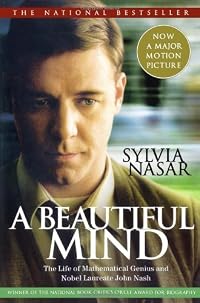
A Beautiful Mind: The Life of Mathematical Genius and Nobel Laureate John Nash
by Sylvia Nasar
On This Page
Description
John Forbes Nash, Jr., a prodigy and legend by the age of thirty, dazzled the mathematical world by solving a series of deep problems deemed "impossible" by other mathematicians. But at the height of his fame, Nash suffered a catastrophic mental breakdown and began a harrowing descent into insanity, resigning his post at MIT, slipping into a series of bizarre delusions, and eventually becoming a dreamy, ghostlike figure at Princeton, scrawling numerological messages on blackboards. He was show more all but forgotten by the outside world-until, remarkably, he emerged from his madness to win the Nobel Prize. A true drama, A Beautiful Mind is also a fascinating look at the extraordinary and fragile nature of genius. show lessTags
Recommendations


Member Reviews
https://nwhyte.livejournal.com/3806914.html
I got a lot more out of the book than the film. It is honest where the film is not about Alicia's origins, John Nash's sexuality and the nature and course of his illness and career. It goes a bit into the mathematics without trying too hard; in the end, the non-specialist has to take the word of the specialist that this was all Really Important Stuff.
But where the book excels is in its examination of the social and political construction of the environment where Nash worked. It had not occurred to me that the Princeton of Einstein (and Nash) was very different from the Princeton of Woodrow Wilson, just a few decades before. Nasar maps out very carefully how the decision of a few intellectual show more centres of excellence to invest in mathematics - or rather, in mathematicians - was driven by wider political and social currents, including McCarthyism and antisemitism (Nash himself also lurched into antisemitism, and not only when deluded). Her behind-the-scenes account of how Nash almost didn't get the 1994 Nobel Prize is one of the most gripping things I've ever read in a scientific biography. (Yeah, I know it's not technically a Nobel Prize. Sue me.)
Some of Nash's friends queried whether the biography was ethical, given that it was written without his consent or cooperation. In fact his attitude was studiedly neutral, and Nasar clearly had full cooperation from his colleagues and lovers, which he could presumably have deterred if he had really wanted to. He was apparently pleased enough with it in the end, and enjoyed the film too, though he commented (rightly enough) that it wasn't really about him. show less
I got a lot more out of the book than the film. It is honest where the film is not about Alicia's origins, John Nash's sexuality and the nature and course of his illness and career. It goes a bit into the mathematics without trying too hard; in the end, the non-specialist has to take the word of the specialist that this was all Really Important Stuff.
But where the book excels is in its examination of the social and political construction of the environment where Nash worked. It had not occurred to me that the Princeton of Einstein (and Nash) was very different from the Princeton of Woodrow Wilson, just a few decades before. Nasar maps out very carefully how the decision of a few intellectual show more centres of excellence to invest in mathematics - or rather, in mathematicians - was driven by wider political and social currents, including McCarthyism and antisemitism (Nash himself also lurched into antisemitism, and not only when deluded). Her behind-the-scenes account of how Nash almost didn't get the 1994 Nobel Prize is one of the most gripping things I've ever read in a scientific biography. (Yeah, I know it's not technically a Nobel Prize. Sue me.)
Some of Nash's friends queried whether the biography was ethical, given that it was written without his consent or cooperation. In fact his attitude was studiedly neutral, and Nasar clearly had full cooperation from his colleagues and lovers, which he could presumably have deterred if he had really wanted to. He was apparently pleased enough with it in the end, and enjoyed the film too, though he commented (rightly enough) that it wasn't really about him. show less
Sylvia Nasar's biography of John Nash tells the story of this mathematical genius with precision, excellent scholarship and attention to background details that puts the motivations and actions of this man in the context of the time in which he was most active. She describes Cold War politics and McCarthyism, both of which had profound effects on mathematicians and physicists during the 50s, 60s and 70s. So why am I giving this book only 3 stars? Well, quite frankly, I didn't like the man! As we all know from the movie (which I actually haven't seen), he becomes schizophrenic, which occurs half way through the book. Before that, he was an insecure, arrogant tyrant who belittled anyone whose intellect did not measure up to his standards. show more Although blessed with positions at some of our most prestigious institutions, he was an indifferent teacher at best and a nasty one on the bad days. I kept thinking, "why do I have to wait for him to become schizophrenic (in the second half of the book) to develop empathy for this guy?" However that was the case. I certainly have enjoyed books about far worse people (e.g. Adolf Eichmann). I guess the way he treated his lovers, wife and children really got to me. Nevertheless, the book is really an excellent biography, well-researched and worth reading. Also, the story of him recovering his intellectual abilities, conquering schizophrenia as well as winning a Nobel Prize and reestablishing a life with his loved ones is very inspiring and redeeming. show less
Where I got the book: audiobook downloaded from Audible.
I haven't had an Audible subscription for ages but I knew there were some books on there I hadn't listened to. I was surprised to find this one among them. Why, I wondered, had I picked a book about a mathematician I'd personally never heard of? By the time my youngest was in freshman year at high school I could no longer follow what she was doing in math. Actually, that was probably true in 8th grade. Ok, 7th grade. You get the picture? I'm not a mathematician.
Well, I love surprises. I was spellbound by the story of John Nash, who as a young man emerged as one of the most talented mathematicians of his generation. The discussion of how mathematics, especially game theory, was used show more during the Cold War to plan strategies was beyond fascinating even though I didn't understand it 100%. And then as Nash drew closer to middle age, at the time when he should have been riding the top of the wave, his eccentricity degenerated into outright schizophrenia and cost him his job, his marriage and his rational mind.
And THEN--I feel like one of those commercials, "Wait! There's more!"--after years spent in asylums he somehow managed to emerge from insanity and THEN, something like 40 years after he'd done the work, he was awarded a Nobel Prize for his contribution to game theory.By the end of the book he is living in a fragile balance with his ex-wife, still seeing his mathematical friends and caring for a son with schizophrenia. And, most striking of all, he is a much nicer person after his harrowing experience with insanity than he was as an arrogant wunderkind. Nasar provides a very complete, warts-and-all picture of a human thinking machine.
This was the abridged version, which was a pity. One day I'll seek out the full version and read it, or listen to it, again. The narrator, by the way, one Edward Hermann, was one of the best I've heard recently; an unremarkable voice in a way but a reading that was as smooth as silk with absolutely NO annoying mannerisms of speech. show less
I haven't had an Audible subscription for ages but I knew there were some books on there I hadn't listened to. I was surprised to find this one among them. Why, I wondered, had I picked a book about a mathematician I'd personally never heard of? By the time my youngest was in freshman year at high school I could no longer follow what she was doing in math. Actually, that was probably true in 8th grade. Ok, 7th grade. You get the picture? I'm not a mathematician.
Well, I love surprises. I was spellbound by the story of John Nash, who as a young man emerged as one of the most talented mathematicians of his generation. The discussion of how mathematics, especially game theory, was used show more during the Cold War to plan strategies was beyond fascinating even though I didn't understand it 100%. And then as Nash drew closer to middle age, at the time when he should have been riding the top of the wave, his eccentricity degenerated into outright schizophrenia and cost him his job, his marriage and his rational mind.
And THEN--I feel like one of those commercials, "Wait! There's more!"--after years spent in asylums he somehow managed to emerge from insanity and THEN, something like 40 years after he'd done the work, he was awarded a Nobel Prize for his contribution to game theory.
This was the abridged version, which was a pity. One day I'll seek out the full version and read it, or listen to it, again. The narrator, by the way, one Edward Hermann, was one of the best I've heard recently; an unremarkable voice in a way but a reading that was as smooth as silk with absolutely NO annoying mannerisms of speech. show less
At first glance, a biography of a mathematician would seem to make for a read dryer than the Sahara. However, John Nash is no ordinary mathematician and Sylvia Nasar is no ordinary biographer. In her capable hands, the life of John Nash comes to life…in all of its brilliant, dark, pessimistic, extraordinary, callous wonder.
John Forbes Nash, Jr. is a mathematical genius whose extraordinary mind developed the structure for what became known as Game Theory – revolutionizing both mathematics and economics in the second half of the twentieth century. The power of his theories culminated with him being awarded the Nobel Prize for Economics nearly fifty years after his groundbreaking work began. But it came at a heavy price. By the age of show more thirty, Nash was suffering from his first bouts of paranoid schizophrenia, a disease he would suffer with for three decades. He was institutionalized by his family on several occasions and left for dead by most of the mathematics community.
Left to wander the campus of Princeton University as a “ghost” and a “crazy man,” Nash did the unthinkable – he began recovering from a disease that there was thought to be no recovery from. He even begin to work on mathematics research again. It was a recovery that physiatrists thought was impossible.
A Beautiful Mind is really not about mathematics, but about what it means to be labeled “gifted,” “different” or “sick.” It is about how society treats people who are unusual and how few answers there are for what goes on between someone’s ears. It is also about John’s wife Alicia, who set aside her own desires to try to guide John through a world that had become hostile to him.
Ultimately, Sylvia Nasar succeeds with A Beautiful Mind because she leaves out most of the heavy-handed mathematics and focuses on who John Nash is and what his life represents. Make no mistake, John Nash not a lovable person. He is rude, thoughtless, self-centered and egotistical – all the things we don’t like in a person. His genius is both a gift and a curse.
Yet, we cheer for him the whole way because there is an innocence about him; a childlike quality of someone who doesn’t quite understand other people but has to function within society none-the-less. And it is a society of the 1950s and 1960s with little understanding or tolerance for mental illness. His story also gives us hope that no matter how hopeless a person’s situation may seem, here is an example of someone who was able to climb out of that hole and rejoin life and be happy again. That is what makes John Nash’s story so important – it demonstrates that anyone’s life can be turned around. It demonstrates hope. It demonstrates redemption. It is a story well worth your time. show less
John Forbes Nash, Jr. is a mathematical genius whose extraordinary mind developed the structure for what became known as Game Theory – revolutionizing both mathematics and economics in the second half of the twentieth century. The power of his theories culminated with him being awarded the Nobel Prize for Economics nearly fifty years after his groundbreaking work began. But it came at a heavy price. By the age of show more thirty, Nash was suffering from his first bouts of paranoid schizophrenia, a disease he would suffer with for three decades. He was institutionalized by his family on several occasions and left for dead by most of the mathematics community.
Left to wander the campus of Princeton University as a “ghost” and a “crazy man,” Nash did the unthinkable – he began recovering from a disease that there was thought to be no recovery from. He even begin to work on mathematics research again. It was a recovery that physiatrists thought was impossible.
A Beautiful Mind is really not about mathematics, but about what it means to be labeled “gifted,” “different” or “sick.” It is about how society treats people who are unusual and how few answers there are for what goes on between someone’s ears. It is also about John’s wife Alicia, who set aside her own desires to try to guide John through a world that had become hostile to him.
Ultimately, Sylvia Nasar succeeds with A Beautiful Mind because she leaves out most of the heavy-handed mathematics and focuses on who John Nash is and what his life represents. Make no mistake, John Nash not a lovable person. He is rude, thoughtless, self-centered and egotistical – all the things we don’t like in a person. His genius is both a gift and a curse.
Yet, we cheer for him the whole way because there is an innocence about him; a childlike quality of someone who doesn’t quite understand other people but has to function within society none-the-less. And it is a society of the 1950s and 1960s with little understanding or tolerance for mental illness. His story also gives us hope that no matter how hopeless a person’s situation may seem, here is an example of someone who was able to climb out of that hole and rejoin life and be happy again. That is what makes John Nash’s story so important – it demonstrates that anyone’s life can be turned around. It demonstrates hope. It demonstrates redemption. It is a story well worth your time. show less
"A man all alone in a strange world"
By sally tarbox on 3 April 2018
Format: Kindle Edition
A very interesting biography of mathematician and Nobel prize winner John Forbes Nash. From a 'good' background, Nash soon graduated on to becoming one of the top students at university, developing new theories and re-examining older problems (having only O level maths, much of this went right over my head.) But his behaviour - odd, arrogant, often unsocial - gradually morphed into something much worse, with a diagnosis of schizophrenia.
How Nash continued his work, even after years of illness, makes for a fascinating read. The arguments of the Nobel committee over whether to make an award to a person with mental illness; the gradual rapprochement show more (and re-marriage to) the wife who had divorced him; the gradual building of a relationship with his illegitimate son (and the sadness of having to cope with the fact that his other son had his father's illness.)
Nasar also helps the reader (even the non-mathematical) in having at least a vague idea of what value Nash's 'game theory' has to the man in the street. She looks at the 1994 'greatest auction ever', where the US government sold off airspace to TV companies etc; and how using the strategies of game theory helped maximize profits.
Informative and very well written. show less
By sally tarbox on 3 April 2018
Format: Kindle Edition
A very interesting biography of mathematician and Nobel prize winner John Forbes Nash. From a 'good' background, Nash soon graduated on to becoming one of the top students at university, developing new theories and re-examining older problems (having only O level maths, much of this went right over my head.) But his behaviour - odd, arrogant, often unsocial - gradually morphed into something much worse, with a diagnosis of schizophrenia.
How Nash continued his work, even after years of illness, makes for a fascinating read. The arguments of the Nobel committee over whether to make an award to a person with mental illness; the gradual rapprochement show more (and re-marriage to) the wife who had divorced him; the gradual building of a relationship with his illegitimate son (and the sadness of having to cope with the fact that his other son had his father's illness.)
Nasar also helps the reader (even the non-mathematical) in having at least a vague idea of what value Nash's 'game theory' has to the man in the street. She looks at the 1994 'greatest auction ever', where the US government sold off airspace to TV companies etc; and how using the strategies of game theory helped maximize profits.
Informative and very well written. show less
A biography of the brilliant, eccentric mathematician John Nash, whose career was cut short by a descent into schizophrenia, but who experienced a rare, astonishingly dramatic remission in time to accept the Nobel Prize in economics in 1994. Nasar's writing is simple, with no personal interjections about her research for the book and no gimmicks, but it's effective. She invokes a great sense of understanding and sympathy for Nash without sentimentalizing him or downplaying his character flaws or his sometimes reprehensible treatment of others. Her depiction of Nash's illness and recovery is poignantly bittersweet, and her examination of the arc of his life raises a lot of thought-provoking questions about the possible connections show more between genius, mental illness, and personality.
This is, by the way, the basis of the movie of the same name. I saw that long enough ago that I don't remember much about it, but I understand that the movie did fudge a number of details and leave quite a few things out. I'm thinking perhaps I ought to watch it again to compare. show less
This is, by the way, the basis of the movie of the same name. I saw that long enough ago that I don't remember much about it, but I understand that the movie did fudge a number of details and leave quite a few things out. I'm thinking perhaps I ought to watch it again to compare. show less
This enthralled me in a way I didn't actually think that it would. I picked it up out of pure curiosity, I knew vaguely what it was about, but was not biased by the film which I still haven't seen. But the portrait of John Nash's life was well done. I knew the scene...the state of the world and the state of John himself...which always makes a biography more complete. The motivations and actions of the person more understandable and easier in which to relate. The mathematics was neatly woven throughout and while not a particular fan...I could understand at least vaguely most all that was talked of in that respect..or at least connect it to something I could understand. I think the author did a wonderful job. I thoroughly recommend it.
Members
- Recently Added By
Published Reviews
ThingScore 100
Sylvia Nasar, an economics correspondent for the New York Times, presents the life "without theory" of John Forbes Nash Jr., a mathematical genius and inventor of theories of rational behavior, who was a Wunderkind at Princeton when it was populated by the likes of Albert Einstein, John von Neumann and other 20th century luminaries.
added by mikeg2
Lists

Mental health fiction
55 works; 18 members

Mustich's 1000 Books to Read Before You Die: A Life Changing List
1,001 works; 18 members

Non-Fiction
68 works; 1 member

Check Library
169 works; 1 member
Author Information

8+ Works 6,087 Members
Sylvia Nasar was born in Rosenheim, Germany on August 17, 1947. She received a bachelor's degree in literature from Antioch College in 1970 and master's degree in economics from New York University in 1976. She is an economist and author. Her books include A Beautiful Mind, which inspired the academy award winning movie, and Grand Pursuit: The show more Story of Economic Genius. She was an economics correspondent for the New York Times and is the John S. and James L. Knight Professor of Business Journalism at Columbia University. Her work has appeared in several publications including the New Yorker, Vanity Fair, and Newsweek. (Bowker Author Biography) show less
Some Editions
Awards and Honors
Awards
Distinctions
Notable Lists
Work Relationships
Has the adaptation
Common Knowledge
- Canonical title*
- A Beautiful Mind. A Biography of John Forbes Nash, Jr
- Original title
- A Beautiful Mind: The Life of Mathematical Genius and Nobel Laureate John Nash
- Original publication date
- 1998
- People/Characters
- John Forbes Nash; Alicia Nash; Armand Borel; Jacob Leon Bricker; John Danskin; Emma Duchane (show all 21); Albert Einstein; Lars Hörmander; Harold Kuhn; Martha Nash Legg; Norman Levinson; Zipporah "Fagi" Levinson; Arthur Mattuck; Solomon Lefschetz; John Charles Martin Nash; Lloyd S. Shapley; Norman Steenrod; Eleanor Stier; Albert Tucker; John von Neumann; Norbert Wiener
- Important places
- Princeton University, Princeton, New Jersey, USA; Institute for Advanced Study, Princeton, New Jersey, USA; Princeton, New Jersey, USA; New Jersey, USA
- Important events
- Nobel Prize (1994)
- Related movies
- A Beautiful Mind (2001 | IMDb)
- Epigraph
- Another race hath been, and other palms are won.
Thanks to the human heart by which we live,
Thanks to its tenderness, its joys, and fears,
To me the meanest flower that blows can give
Thoughts that do often lie ... (show all)too deep for tears.
— William Wordsworth, "Intimations of Immortality" - Dedication
- For Alicia Esther Larde Nash
- First words
- John Forbes Nash, Jr. - mathematical genius, inventor of a theory of rational behavior, visionary of the thinking machine - had been sitting with his visitor, also a mathematician, for nearly half an hour.
- Last words
- (Click to show. Warning: May contain spoilers.)As we leave him now he is perhaps just hurrying under the Eisenhart gate on his way to Fine Hall...or sitting next to Alicia on the living-room sofa watching Dr. Who on the big television...or losing a game of chess to Johnny...or spending 105 minutes on the telephone comforting Lloyd Shapley after his wife's death...or giving Harold Kuhn a look like a naughty boy's when Harold asks whether the lecture notes for Pisa are ready...or sitting at the institute math table with his lunch tray, nodding while Enrico Bombieri, who has just read the love letters of Carrington, bemoans the lost art of letter writing...or, after listening to an astronomy lecture, gazing through a telescope at some distant star glimmering in the night sky...
- Blurbers
- Sacks, Oliver; Donald, David Herbert
- Original language
- English
*Some information comes from Common Knowledge in other languages. Click "Edit" for more information.
Classifications
Statistics
- Members
- 5,226
- Popularity
- 2,586
- Reviews
- 66
- Rating
- (3.82)
- Languages
- 14 — Chinese, Dutch, English, French, German, Hungarian, Indonesian, Italian, Japanese, Korean, Portuguese, Russian, Spanish, Turkish
- Media
- Paper, Audiobook, Ebook
- ISBNs
- 59
- UPCs
- 1
- ASINs
- 31