On This Page
Description
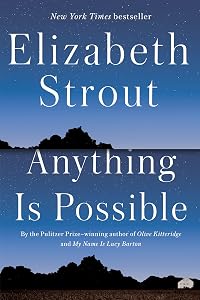
"Anything Is Possible explores the whole range of human emotion through the intimate dramas of people struggling to understand themselves and others. Here are two sisters: One trades self-respect for a wealthy husband while the other finds in the pages of a book a kindred spirit who changes her life. The janitor at the local school has his faith tested in an encounter with an isolated man he has come to help; a grown daughter longs for mother love even as she comes to accept her mother's show more happiness in a foreign country; and the adult Lucy Barton (the heroine of My Name Is Lucy Barton, the author's celebrated New York Times bestseller) returns to visit her siblings after seventeen years of absence. Reverberating with the deep bonds of family, and the hope that comes with reconciliation, Anything Is Possible again underscores Elizabeth Strout's place as one of America's most respected and cherished authors"--Amazon.com. show lessTags
Recommendations




Member Reviews
I liked My Name Is Lucy Barton well enough, but I remember wishing I had read it in a book club, where discussions might have explored some of the subtext and the minor characters. So I was thrilled when I realized that’s exactly what Strout has done here, in this collection of nine short stories that are linked through the shared characters (now grown-up) of Lucy Barton’s childhood, including Lucy herself.
Linked stories are my favorite structure of fiction, and here the linking is used to perfection, deeply exploring characters from a full-frontal perspective in one story and then from sideways glances in others. These characters and their stories interested me so much more than Lucy Barton ever did ... although they do make me show more want to re-read Lucy Barton, just to encounter the first mentions of them again, now that I know them so well.
(Review based on an advance reading copy provided by the publisher.) show less
Linked stories are my favorite structure of fiction, and here the linking is used to perfection, deeply exploring characters from a full-frontal perspective in one story and then from sideways glances in others. These characters and their stories interested me so much more than Lucy Barton ever did ... although they do make me show more want to re-read Lucy Barton, just to encounter the first mentions of them again, now that I know them so well.
(Review based on an advance reading copy provided by the publisher.) show less
Strout's "Winesburg Ohio," interconnected stories about the inner lives of people in a small town...as if that could capture it. She is in top form here, achingly real, beautifully understated, authentic dialogue that hangs in the air with all that is unsaid or unsayable. Probably should be five stars, except that Strout's next book may be even better.
Perhaps the most remarkable thing about this novel is how readable it is. I found myself having to ration out the books so that I wouldn't consume it in a single sitting.
Yet this isn't page-turning in the conventional sense. There's no complex and clever plot to unravel, no sense of threat or intrigue to tease yourself with page after page. There as just life as we all live it.
What makes it compelling is not that I want to know what happens next but I want to know these people and, in the process, I want to know more about how their experiences mirror mine.
In each chapter, I get to walk a mile in someone else's shoes. It's not a first-person experience but rather a guided tour with the authorial voice capturing every emotion, memory and show more reaction with an empathy so deep you could drown in it.
The book opens with an eighty-three-year-old man driving into town to buy his wife a birthday present and then stopping in on a neighbour on his way home. That's it as far as action goes yet during this ride I found out about the events that shaped this man's life, about his beliefs and his hopes, about his attachment to the bright but fearful and isolated Lucy Barton who was once a student at the school he was a janitor in and who now lives in New York City and is a writer of well-known books. I come to understand his ability to "live through" disaster, his impulse to help others and the relationship he believes he has with God.
There's a whole novel, just in that one chapter. Each of the other eight chapters is like that, sweeping me along not just in someone's story but in their current experience and choices. Each chapter focuses on someone who was in the supporting cast of characters when Lucy Barton was recalling her childhood in *My Name Is Lucy Barton", In "Anything Is Possible", each of them gets to be centre-stage for a while, the prime mover in their own universe. Each universe exercises a gravitational pull on at least one of the other universes in the book.
Each of the nine chapters could be seen as the free-standing short story describing how an individual sees the world, but we're being offered more than a quilt of nine squares here. This is a novel with a consistent authorial voice, leading us through the thoughts and emotions of the characters in the story and in the process, highlighting the themes that connect them and all of us as we try to live our lives.
I see this novel as a three-dimensional piece of art that, although the eye first reads it from left to right, becomes something non-linear: a set of lens viewing a common space but from different angles and different focal lengths. From their different perspectives, the chapters describe a central space, that we all recognise and share but can rarely regard clearly because we are so tangled up in our own story. It's a place where our hope, shame, anger, love, compassion and desires meet.
That all sounds rather complicated and perhaps a little dry but the experience of reading the book is one of easy access to sometimes painfully accurate experiences that resonate as real. Each room in the house is welcoming and built on a human scale. The true nature of the architecture only dawns on you later.
This is a book that, as one of the characters says of Lucy Barton's novel, "made her feel understood and less alone". There are big themes here but I believe the main one is that, while all our lives are unique, we do not have to be alone if we are prepared to forgive ourselves and others.
One of the themes of the book is the nature of love. One character sums it up by saying:
We’re all just a mess, Angelina, trying as hard we can. We love imperfectly, Angelina, and it’s ok.
One of my favourite characters, the youngest of the Pretty Nicely sisters, now sometimes called Fatty Patty by the children at the school she works in, understands that empathy is difficult because we are too self-absorbed to make space for it:
Everyone,she understood, was mainly and mostly interested in themselves.
She also understands that love is what breaks down the walls of our isolation and allows us to be better. She refers to it as a protective skin:
This was the skin that protected you from the world, this loving of another person you shared your life with.
The characters show us that we all love imperfectly BUT that it is still possible to choose our own path, to change the plot of our own story and to influence the stories of others:
One of the things that occupy that central space that the stories share is how our past shapes us. In the final chapter, the main character, once poor and now rich, is puzzled by the power of his past to shape his present:
"What puzzled Able about life was how much one forgot but then live with anyway, like a phantom limb"
In these stories, shame plays a huge part in shaping people's perception of themselves and others. Shame walks hand in hand with attitudes to class. Both create ostracism, disempowerment, unkindness, and derision. The make some people less real than others. They erode self-worth and foster abuse.
Violence, whether we commit it or are on the receiving end of it, also leaves permanent scare, whether it's PTSD from acts committed during a war on being subject to violent abuse throughout childhood.
I found one of the hardest chapters to experience was the one where Lucy Barton comes home and meets with her brother and her sisters in the tiny house they all suffered through their childhood in. The present pain caused by past abuse is almost unbearable. When the talk turns to the terrible things their parents did, Lucy cries out in denial and says "It wasn't that bad", all the while knowing that it was.
This is one of a number of examples that show how hard it is for us to see clearly, to remember honestly (or at all), and to focus on the important choices in our lives.
The message I took away from the book is that living through things we don't is unavoidable. Life cannot be pain-free. We live and love imperfectly. We drag our past after us. Compassion, forgiveness and kindness are the best salves available to us.
I think this book will become a classic. I highly recommend it.
If you'd like to get an insight into what Elizabeth Strout thinks of her novel, read the interviews below.
Seattle Times article "Talking to author Elizabeth Strout about her new novel, ‘Anything Is Possible" where Elizabeth Strout explains how she wrote the book and comments on some of the themes in it.
Interview with Penguin Books where she talks about her hope that her books will make people feel less alone.
I listened to the audiobook, which was perfectly performed by Kimberly Farr. Click on the SoundCloud link below to listen to a sample of her performance.
[soundcloud url="https://api.soundcloud.com/tracks/319870206" params="color=#ff5500&auto_play=false&hide_related=false&show_comments=true&show_user=true&show_reposts=false&show_teaser=true&visual=true" width="100%" height="300" iframe="true" /] show less
Yet this isn't page-turning in the conventional sense. There's no complex and clever plot to unravel, no sense of threat or intrigue to tease yourself with page after page. There as just life as we all live it.
What makes it compelling is not that I want to know what happens next but I want to know these people and, in the process, I want to know more about how their experiences mirror mine.
In each chapter, I get to walk a mile in someone else's shoes. It's not a first-person experience but rather a guided tour with the authorial voice capturing every emotion, memory and show more reaction with an empathy so deep you could drown in it.
The book opens with an eighty-three-year-old man driving into town to buy his wife a birthday present and then stopping in on a neighbour on his way home. That's it as far as action goes yet during this ride I found out about the events that shaped this man's life, about his beliefs and his hopes, about his attachment to the bright but fearful and isolated Lucy Barton who was once a student at the school he was a janitor in and who now lives in New York City and is a writer of well-known books. I come to understand his ability to "live through" disaster, his impulse to help others and the relationship he believes he has with God.
There's a whole novel, just in that one chapter. Each of the other eight chapters is like that, sweeping me along not just in someone's story but in their current experience and choices. Each chapter focuses on someone who was in the supporting cast of characters when Lucy Barton was recalling her childhood in *My Name Is Lucy Barton", In "Anything Is Possible", each of them gets to be centre-stage for a while, the prime mover in their own universe. Each universe exercises a gravitational pull on at least one of the other universes in the book.
Each of the nine chapters could be seen as the free-standing short story describing how an individual sees the world, but we're being offered more than a quilt of nine squares here. This is a novel with a consistent authorial voice, leading us through the thoughts and emotions of the characters in the story and in the process, highlighting the themes that connect them and all of us as we try to live our lives.
I see this novel as a three-dimensional piece of art that, although the eye first reads it from left to right, becomes something non-linear: a set of lens viewing a common space but from different angles and different focal lengths. From their different perspectives, the chapters describe a central space, that we all recognise and share but can rarely regard clearly because we are so tangled up in our own story. It's a place where our hope, shame, anger, love, compassion and desires meet.
That all sounds rather complicated and perhaps a little dry but the experience of reading the book is one of easy access to sometimes painfully accurate experiences that resonate as real. Each room in the house is welcoming and built on a human scale. The true nature of the architecture only dawns on you later.
This is a book that, as one of the characters says of Lucy Barton's novel, "made her feel understood and less alone". There are big themes here but I believe the main one is that, while all our lives are unique, we do not have to be alone if we are prepared to forgive ourselves and others.
One of the themes of the book is the nature of love. One character sums it up by saying:
We’re all just a mess, Angelina, trying as hard we can. We love imperfectly, Angelina, and it’s ok.
One of my favourite characters, the youngest of the Pretty Nicely sisters, now sometimes called Fatty Patty by the children at the school she works in, understands that empathy is difficult because we are too self-absorbed to make space for it:
Everyone,she understood, was mainly and mostly interested in themselves.
She also understands that love is what breaks down the walls of our isolation and allows us to be better. She refers to it as a protective skin:
This was the skin that protected you from the world, this loving of another person you shared your life with.
The characters show us that we all love imperfectly BUT that it is still possible to choose our own path, to change the plot of our own story and to influence the stories of others:
One of the things that occupy that central space that the stories share is how our past shapes us. In the final chapter, the main character, once poor and now rich, is puzzled by the power of his past to shape his present:
"What puzzled Able about life was how much one forgot but then live with anyway, like a phantom limb"
In these stories, shame plays a huge part in shaping people's perception of themselves and others. Shame walks hand in hand with attitudes to class. Both create ostracism, disempowerment, unkindness, and derision. The make some people less real than others. They erode self-worth and foster abuse.
Violence, whether we commit it or are on the receiving end of it, also leaves permanent scare, whether it's PTSD from acts committed during a war on being subject to violent abuse throughout childhood.
I found one of the hardest chapters to experience was the one where Lucy Barton comes home and meets with her brother and her sisters in the tiny house they all suffered through their childhood in. The present pain caused by past abuse is almost unbearable. When the talk turns to the terrible things their parents did, Lucy cries out in denial and says "It wasn't that bad", all the while knowing that it was.
This is one of a number of examples that show how hard it is for us to see clearly, to remember honestly (or at all), and to focus on the important choices in our lives.
The message I took away from the book is that living through things we don't is unavoidable. Life cannot be pain-free. We live and love imperfectly. We drag our past after us. Compassion, forgiveness and kindness are the best salves available to us.
I think this book will become a classic. I highly recommend it.
If you'd like to get an insight into what Elizabeth Strout thinks of her novel, read the interviews below.
Seattle Times article "Talking to author Elizabeth Strout about her new novel, ‘Anything Is Possible" where Elizabeth Strout explains how she wrote the book and comments on some of the themes in it.
Interview with Penguin Books where she talks about her hope that her books will make people feel less alone.
I listened to the audiobook, which was perfectly performed by Kimberly Farr. Click on the SoundCloud link below to listen to a sample of her performance.
[soundcloud url="https://api.soundcloud.com/tracks/319870206" params="color=#ff5500&auto_play=false&hide_related=false&show_comments=true&show_user=true&show_reposts=false&show_teaser=true&visual=true" width="100%" height="300" iframe="true" /] show less
There's no way that I can write anything that accurately sums up my reaction to Elizabeth Strout's new book, Anything is Possible. In form, it's most closely related to Olive Kitteridge, being a collection of closely related short stories about people from Amgash, the small town where the protagonist of Strout's previous novel, My Name is Lucy Barton grew up. Amgash is a struggling agricultural community, whose residents work as high school guidance counselors, janitors, nurse's aides and housewives. Those who leave enjoy broader prospects, but are nonetheless shaped by the town they grew up in. Lucy Barton's existence hangs over the town; she's a success story, but the residents are ashamed of how she and her family were ostracized and show more of the bleak poverty that clung to them.
Each story stands on its own, but is made richer by being situated with other stories about the same place, with central characters from one story being mentioned in another. I'm a sucker for the interconnected short story format, and I'm a fan of Strout's understated but fine writing, but I'm pretty sure this book is very, very good. show less
Each story stands on its own, but is made richer by being situated with other stories about the same place, with central characters from one story being mentioned in another. I'm a sucker for the interconnected short story format, and I'm a fan of Strout's understated but fine writing, but I'm pretty sure this book is very, very good. show less
With this book, I complete my visit to Amgash, Illinois, the small midwestern town that serves as the setting for the three-novel series by Elizabeth Strout:
(1) MY NAME IS LUCY BARTON
(2) ANYTHING IS POSSIBLE
(3) OH, WILLIAM
I did NOT read the books in 1-2-3 order, but I don't think it really mattered.
#1 is Lucy Barton's back story, focused on her disadvantaged childhood, escape from Amgash, marriage, and relationship with her mother.
#3 centers on Lucy's relationship with her husband, William and the family secret he uncovers.
#2 is different. It's not so much about Lucy, though she does make a few appearances.
Instead, like Strout's Pulitzer Prize winning book OLIVE KITTERIDGE, ANYTHING IS POSSIBLE is a collection of short stories, show more about individuals who are connected (some closely, some distantly) to Lucy. Peers who tormented her as a child -- now grown up. Siblings Lucy left behind in Amgash. A few distant relatives and acquaintances.
Like all of Strout's writing, ANYTHING IS POSSIBLE skillfully and lovingly examines people's deepest vulnerabilities. What's behind the hostility Lucy's sister displays? What is the ex-soldier with PTSD really thinking? Why did the school janitor let Lucy stay late everyday after school? Is there more contentment among those who achieved financial success? Ultimately, Strout reveals how infrequently any of us show our true selves to one another.
Underlying all these stories is Strout's exploration of the notion of loneliness. Whether single or married, old or young, living alone or with others, prospering or not -- everyone experiences aloneness. And in many different manifestations.
The portraits of these people are thoughtful, nuanced, and emotional. And they teach so much about the human condition. If that sounds interesting to you, you won't want to miss this book. show less
(1) MY NAME IS LUCY BARTON
(2) ANYTHING IS POSSIBLE
(3) OH, WILLIAM
I did NOT read the books in 1-2-3 order, but I don't think it really mattered.
#1 is Lucy Barton's back story, focused on her disadvantaged childhood, escape from Amgash, marriage, and relationship with her mother.
#3 centers on Lucy's relationship with her husband, William and the family secret he uncovers.
#2 is different. It's not so much about Lucy, though she does make a few appearances.
Instead, like Strout's Pulitzer Prize winning book OLIVE KITTERIDGE, ANYTHING IS POSSIBLE is a collection of short stories, show more about individuals who are connected (some closely, some distantly) to Lucy. Peers who tormented her as a child -- now grown up. Siblings Lucy left behind in Amgash. A few distant relatives and acquaintances.
Like all of Strout's writing, ANYTHING IS POSSIBLE skillfully and lovingly examines people's deepest vulnerabilities. What's behind the hostility Lucy's sister displays? What is the ex-soldier with PTSD really thinking? Why did the school janitor let Lucy stay late everyday after school? Is there more contentment among those who achieved financial success? Ultimately, Strout reveals how infrequently any of us show our true selves to one another.
Underlying all these stories is Strout's exploration of the notion of loneliness. Whether single or married, old or young, living alone or with others, prospering or not -- everyone experiences aloneness. And in many different manifestations.
The portraits of these people are thoughtful, nuanced, and emotional. And they teach so much about the human condition. If that sounds interesting to you, you won't want to miss this book. show less
With this book, I complete my visit to Amgash, Illinois, the small midwestern town that serves as the setting for the three-novel series by Elizabeth Strout:
(1) MY NAME IS LUCY BARTON
(2) ANYTHING IS POSSIBLE
(3) OH, WILLIAM
I did NOT read the books in 1-2-3 order, but I don't think it really mattered.
#1 is Lucy Barton's back story, focused on her disadvantaged childhood, escape from Amgash, marriage, and relationship with her mother.
#3 centers on Lucy's relationship with her husband, William and the family secret he uncovers.
#2 is different. It's not so much about Lucy, though she does make a few appearances.
Instead, like Strout's Pulitzer Prize winning book OLIVE KITTERIDGE, ANYTHING IS POSSIBLE is a collection of short stories, show more about individuals who are connected (some closely, some distantly) to Lucy. Peers who tormented her as a child -- now grown up. Siblings Lucy left behind in Amgash. A few distant relatives and acquaintances.
Like all of Strout's writing, ANYTHING IS POSSIBLE skillfully and lovingly examines people's deepest vulnerabilities. What's behind the hostility Lucy's sister displays? What is the ex-soldier with PTSD really thinking? Why did the school janitor let Lucy stay late everyday after school? Is there more contentment among those who achieved financial success? Ultimately, Strout reveals how infrequently any of us show our true selves to one another.
Underlying all these stories is Strout's exploration of the notion of loneliness. Whether single or married, old or young, living alone or with others, prospering or not -- everyone experiences aloneness. And in many different manifestations.
The portraits of these people are thoughtful, nuanced, and emotional. And they teach so much about the human condition. If that sounds interesting to you, you won't want to miss this book. show less
(1) MY NAME IS LUCY BARTON
(2) ANYTHING IS POSSIBLE
(3) OH, WILLIAM
I did NOT read the books in 1-2-3 order, but I don't think it really mattered.
#1 is Lucy Barton's back story, focused on her disadvantaged childhood, escape from Amgash, marriage, and relationship with her mother.
#3 centers on Lucy's relationship with her husband, William and the family secret he uncovers.
#2 is different. It's not so much about Lucy, though she does make a few appearances.
Instead, like Strout's Pulitzer Prize winning book OLIVE KITTERIDGE, ANYTHING IS POSSIBLE is a collection of short stories, show more about individuals who are connected (some closely, some distantly) to Lucy. Peers who tormented her as a child -- now grown up. Siblings Lucy left behind in Amgash. A few distant relatives and acquaintances.
Like all of Strout's writing, ANYTHING IS POSSIBLE skillfully and lovingly examines people's deepest vulnerabilities. What's behind the hostility Lucy's sister displays? What is the ex-soldier with PTSD really thinking? Why did the school janitor let Lucy stay late everyday after school? Is there more contentment among those who achieved financial success? Ultimately, Strout reveals how infrequently any of us show our true selves to one another.
Underlying all these stories is Strout's exploration of the notion of loneliness. Whether single or married, old or young, living alone or with others, prospering or not -- everyone experiences aloneness. And in many different manifestations.
The portraits of these people are thoughtful, nuanced, and emotional. And they teach so much about the human condition. If that sounds interesting to you, you won't want to miss this book. show less
A fine collection of short stories featuring characters mentioned in Strout’s novel My Name is Lucy Barton. Beautifully written and, for me, far more engaging than the novel as the stories are more unexpected and wonderfully varied.
As well as tenderness and humour, Strout can maintain tension in these seemingly simple stories, just because you as a reader are unsure where Strout wants to take you. For example, the final story about Abel Blaine (Lucy Barton’s cousin) should (you think) mirror the goodwill of the play of a Dickensian A Christmas Carol, but in about 30 pages Strout creates multiple ways in which the story might develop.
As well as tenderness and humour, Strout can maintain tension in these seemingly simple stories, just because you as a reader are unsure where Strout wants to take you. For example, the final story about Abel Blaine (Lucy Barton’s cousin) should (you think) mirror the goodwill of the play of a Dickensian A Christmas Carol, but in about 30 pages Strout creates multiple ways in which the story might develop.
Members
- Recently Added By
Lists

Books recommended by Barack Obama
295 works; 28 members

Top Five Books of 2017
757 works; 231 members

Five star books
1,767 works; 110 members

Books Read in 2017
4,249 works; 129 members

Books Read in 2022
5,168 works; 114 members

To Read
617 works; 7 members

Books Read in 2018
4,360 works; 110 members

Goodreads Choice Awards 2017
20 works; 2 members
Barack Obama's Favorite Books of 2017
12 works; 1 member
Author Information

23+ Works 33,412 Members
Elizabeth Strout (born January 6, 1956) is an American author of fiction. She was born in Portland, Maine. After graduating from Bates College, she spent a year in Oxford, England. In 1982 she graduated with honors, and received both a law degree from the Syracuse University College of Law and a Certificate of Gerontology from the Syracuse School show more of Social Work. Strout wrote Amy and Isabelle over the course of six or seven years, which when published was shortlisted for the 2000 Orange Prize and nominated for the 2000 PEN/Faulkner Award for fiction. Amy and Isabelle was made into a television movie starring Elisabeth Shue and was produced by Oprah Winfrey's studio, Harpo Films. Strout was a NEH (National Endowment for the Humanities) professor at Colgate University during the Fall Semester of 2007, where she taught creative writing. She was also on the faculty of the MFA program at Queens University of Charlotte in Charlotte, North Carolina. In 2009 Strout was honored with a Pulitzer Prize for Fiction for Olive Kitteridge, a collection of connected short stories she wrote about a woman and her immediate family who lived on the coast of Maine. Strout also wrote The Burgess Boys in 2013 which made The New York Times Best Seller List. Ms. Strout's title, My name is Lucy Barton, made the New York Times Best Seller List in 2016. Her newest title, Anything is Possible (2017), won the 2018 Story Prize. (Bowker Author Biography) show less
All Editions
Some Editions
Awards and Honors
Awards
Distinctions
Series

Belongs to Publisher Series
Common Knowledge
- Canonical title
- Anything Is Possible
- Original title
- Anything Is Possible
- Original publication date
- 2017-04
- People/Characters
- Lucy Barton; Pete Barton; Tommy Guptill; Shirley Guptill; Patty Nicely; Sebastian (show all 33); Linda Peterson-Cornell; Lila Lane; Charlie Macauley; Yvonne Tuttle; Karen-Lucie Toth; Jay Peterson-Cornell; Marilyn Macauley; Tracy; Angelina; Mary Mumford; Paolo; Vicky Barton Lane; Dottie Blaine; Abel Blaine; Dr. Richard Small; Shelly Small; David Sewall; Annie Appleby; Elgin Appleby; Sylvia Appleby; Jamie Appleby; Cindy Appleby; Elaine Blaine; Zoe; Sophia; Jake; Linck McKenzie
- Important places
- Amgash, Illinois, USA; Carlisle, Illinois, USA; Italy; Jennisberg, Illinois, USA
- Dedication
- For my brother, Jon Strout
- First words
- Tommy Guptill had once owned a dairy farm, which he'd inherited from his father, and which was about two miles from the town of Amgash, Illinois.
- Quotations
- This was the skin that protected you from the world--this loving of another person you shared your life with.
And you have always taken up so much space in my heart that it has sometimes felt to be a burden.
Right behind it was the last of the day's full light; generously, the colors from the setting sun sprayed upward over the open sky.
Panic, like a large minnow darting upstream, moved back and forth inside him.
He observed the way her eyes would not look at him directly, and he thought that he hated dishonesty—or lack of courage—more than anything.
The crap of class superiority would protect no man for long. Many lived whole lives and never knew this; Charlie did.
Inadvertently he glanced at himself in the mirror. He had long ago stopped looking like anyone familiar.
He felt the itch of desire that was carnal, corporeal; it included much and was not a stranger to him.
People could surprise you. Not just their kindness, but also their sudden ability to express things the right way.
And because he was Charlie, who years ago had fouled himself profoundly, because he was Charlie and not someone else, he could not say to his son: You are decent and strong, and none of this has anything to do with me; but yo... (show all)u came through it, that childhood that wasn't all roses, and I'm proud of you, I'm amazed by you. Charlie could not even say a watered-down version of whatever that feeling would be. He could not even clap his son on the shoulder in greeting, or when saying goodbye.
It occurred to him often that many did not have echoes of pain from the silent noises he carried in his head.
You never get used to pain, no matter what anyone says about it.
Shelly Small had been raised to speak about herself as though she was the most interesting thing in the world. Listening to her, Dottie almost admired this.
To listen to a person is not passive. To really listen is active, and Dottie had really listened.
Weather was different then, like a family member you couldn't avoid.
Annie had never been scared of her father the way Charlene was scared of hers. And Annie wasn't scared of her mother, who was the cozier parent but not the more important one.
She felt this more than she thought it, the way children do.
Her grandmother said, "Don't come back. Don't get married. Don't have children. All those things will bring you heartache."
All this fell into Jamie's stomach with the silence of a stone falling into the darkness of a well.
What Annie did not say was that there were many ways of not knowing things; her own experience over the years now spread like a piece of knitting in her lap with different colored yarns—some dark—all through it.
But she had many friends, and they had their disappointments too, and nights and days were spent giving support and being supported; the theater world was a cult, Annie thought. It took care of its own even while it hurt you.
their own universe and its wild recent unmooring were all that mattered now.
inside him was a tiny gasp at the ungraspable concept of time going by.
A thought came to Abel like a bat that swooped from the eaves
Abel could feel fear rising around him like dark water.
Already in the darkness people were trying to scramble to the aisle, some flipping on cellphones for the light, so that wrists and cuffs were illuminated in what seemed to be disembodied flickers of an ectoplasmic presence.
He remembered how earlier he'd thought of people reciting a line, and he understood now that he was one of them.
Fatigue was like a piece of cloth covering him.
"I wanted to talk to a person, and here you are a real person, you have no idea how hard it is—to find a real person."
When word came that Keith had died of cancer, Abel was astonished. That astonishment had to do with death, with the wiping out of a person, with the puzzlement that the man was simply gone.
The Sign: And so there's a struggle, or a contest, I guess you could say, all the time, it seems to me. And remorse, well, to be able to show remorse -- to be able to be sorry about what we've done that's hurt other people -... (show all)- that keeps us human.
Windmills: This was the skin that protected you from the world -- this loving of another person you shared your life with.
Snow-Blind: They had grown up on shame; it was the nutrient of their soil. Yet, oddly, it was her father she felt she understood the best. And for a moment Annie wondered at this, that her brother and sister, good, responsib... (show all)le, decent, fair-minded, had never known the passion that caused a person to risk everything they held dear heedlessly put in danger -- simply to be near the white dazzle of the sun that somehow for those moments seemed to leave the earth behind.
Gift: What puzzled Abel about life was how much one forgot but then lived with anyway -- like phantom limbs, he supposed. - Last words
- (Click to show. Warning: May contain spoilers.)And if such a gift could come to him at such a time, then anything---dear girl from Rockford dressed up for her meeting, rushing above the Rock River---he opened his eyes, and yes, there it was, the perfect knowledge: Anything was possible for anyone.
- Original language*
- englanti
*Some information comes from Common Knowledge in other languages. Click "Edit" for more information.
Classifications
Statistics
- Members
- 2,346
- Popularity
- 8,397
- Reviews
- 137
- Rating
- (3.91)
- Languages
- 13 — Catalan, Chinese, Danish, Dutch, English, Finnish, French, German, Italian, Polish, Portuguese, Spanish, Swedish
- Media
- Paper, Audiobook, Ebook
- ISBNs
- 43
- ASINs
- 9