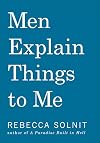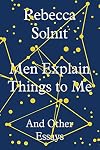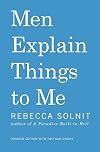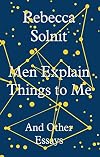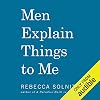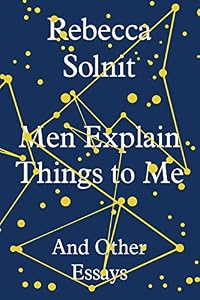
Men Explain Things to Me and Other Essays
by Rebecca Solnit
On This Page
Description
The National Book Critics Circle Award–winning author delivers a collection of essays that serve as the perfect "antidote to mansplaining" (The Stranger).In her comic, scathing essay "Men Explain Things to Me," Rebecca Solnit took on what often goes wrong in conversations between men and women. She wrote about men who wrongly assume they know things and wrongly assume women don't, about why this arises, and how this aspect of the gender wars works, airing some of her own hilariously show more awful encounters.
She ends on a serious note— because the ultimate problem is the silencing of women who have something to say, including those saying things like, "He's trying to kill me!"
This book features that now-classic essay with six perfect complements, including an examination of the great feminist writer Virginia Woolf's embrace of mystery, of not knowing, of doubt and ambiguity, a highly original inquiry into marriage equality, and a terrifying survey of the scope of contemporary violence against women.
"In this series of personal but unsentimental essays, Solnit gives succinct shorthand to a familiar female experience that before had gone unarticulated, perhaps even unrecognized." —The New York Times
"Essential feminist reading." —The New Republic
"This slim book hums with power and wit." —Boston Globe
"Solnit tackles big themes of gender and power in these accessible essays. Honest and full of wit, this is an integral read that furthers the conversation on feminism and contemporary society." —San Francisco Chronicle
"Essential." —Marketplace
"Feminist, frequently funny, unflinchingly honest and often scathing in its conclusions." —Salon
. show less
Tags
Recommendations










Member Recommendations
Member Reviews
I would have preferred to space out reading Rebecca Solnit essay collections, but they’re so heavily reserved at the library that you must enjoy them while you can. As with [b:The Mother of All Questions|29633797|The Mother of All Questions|Rebecca Solnit|https://images.gr-assets.com/books/1488470783s/29633797.jpg|49985139], the prose here is beautiful and the topics weighty: rape, violence, hope. I’ve read the titular essay previously online, of course, but it’s always worth a re-read. Solnit herself doesn’t really like the term ‘mansplaining’, although I find it very useful. I am a young-looking woman working in a male-dominated academic specialism, so the experience is familiar. Actually, my own dear father once tried to show more mansplain to me the concept of mansplaining, which was hilarious.
As ever, Solnit gives the reader much to think about by the careful deployment of relatively few words. For example, the essay on how calling gay marriage ‘marriage equality’ might destabilise the patriarchal foundations of heterosexual marriage. I hadn’t thought about that before. My favourite piece, though, concerned Virginia Woolf and despair and included some wonderful reflections on uncertainty:
Solnit is a renowned essayist for a reason. I was delighted and unsurprised to discover in this collection that Borges is one of her ‘touchstone authors’. Like his short stories, her essays always leave me wanting more, yet are so well-crafted that no additional words are required. Each provides a new and striking angle on the world. show less
As ever, Solnit gives the reader much to think about by the careful deployment of relatively few words. For example, the essay on how calling gay marriage ‘marriage equality’ might destabilise the patriarchal foundations of heterosexual marriage. I hadn’t thought about that before. My favourite piece, though, concerned Virginia Woolf and despair and included some wonderful reflections on uncertainty:
Often enough we don’t know such things even when it comes to ourselves, let alone someone who perished in an epoch whose very textures and reflexes were unlike ours. Filling in the blanks replaces truth that we don’t know entirely with the false sense that we do. We know less when we erroneously think we know than when we recognise that we don’t. Sometimes I think that these pretences at authoritative knowledge are failures of language: the language of bold assertion is simpler, less taxing, than the language of nuance and ambiguity and speculation. Woolf was unparalleled at the latter language.
[...]
Despair is a form of certainty, certainty that the future will be a lot like the present or will decline from it; despair is a confident memory of the future, in Gonzalez’s resonant phrase. Optimism is similarly confident about what will happen. Both are grounds for not acting. Hope can be the knowledge that we don’t have that memory and that reality doesn’t necessarily match our plans; hope like creative ability can come from what the Romantic poet John Keats called Negative Capability.
Solnit is a renowned essayist for a reason. I was delighted and unsurprised to discover in this collection that Borges is one of her ‘touchstone authors’. Like his short stories, her essays always leave me wanting more, yet are so well-crafted that no additional words are required. Each provides a new and striking angle on the world. show less
Que livro maravilhoso. Acho que todas que se consideram feministas conhecem o ensaio que dá título ao livro, aquele de que homens que sabem menos que você colocam em tom professoral as explicações sobre tal assunto, mas esse livro vai muito além disso, desde a analogia de que Strauss-Kahn tratava as mulheres como aos países ligados ao FMI, passando pela negatividade necessária de Woolf e o quanto a teoria freudiana da fantasia impossibilitou a voz das mulheres agredidas no século XX. Se você não está com esse livro em mãos ainda, corra, porque Solnit se evidenciou como uma das vozes poderosas do feminismo contemporâneo.
#YesAllWomen
(Trigger warning for violence, including rape and domestic violence.)
When I first heard of Men Explain Things to Me, I giddily mistook it for an extended essay on mansplaining. Alas, it's actually a collection of nine previously published essays, kicked off by the book's namesake, "Men Explain Things to Me" (which inspired the term "mansplaining," though Solnit didn't herself coin it; mainsplaining, of course, eventually led to whitesplaining and Damonsplaining). Any disappointment I might have initially felt was quickly assuaged by the general awesomeness of Solnit's other pieces.
Nearly all of the essays are loosely organized around women's rights and feminism; deconstructing and dismantling the patriarchy, if you will. show more Solnit masterfully examines and connects myriad topics: rape culture; the epidemic of violence against women; the very real threat that "gay marriage" poses to the unequal power dynamics inherent in traditional marriage; how Dominique Strauss-Kahn's ("alleged") assault of Nafissatou Diallo could be read as a microcosm of the IMF's predatory abuse of power; the disappearing of women from history, from genealogy, from public conversations and places; the voluntary policing of women that so many men (and not a few women) eagerly engage in; and the power of language to name, shame, and effect change. Especially timely (sadly, as always) is her discussion of toxic masculinity and mass shootings, in reference to the 2014 Isla Vista killings.
The only piece I didn't really care for was "Woolf's Darkness: Embracing the Explicable," which is rather dense and feels out of step with its neighbors; unlike the essays, which were originally written for online news sites, "Woolf's Darkness" was adapted from a keynote lecture to the binational Nineteenth Annual Conference on Virginia Woolf.
Also a tad disappointing is Solnit's decision not to reprint the essays with the original references and footnotes attached. Instead, she directs the reader to find the original, unedited, online versions of the essays (and doesn't give direct links to 8/9, ugh). Imho, user convenience always trumps aesthetics (at least when it comes to books, and nonfiction ones especially), and having to hop online to search out references is not terribly user-friendly. Not that the inclusion of such would stop the mouth-breathers from huffing and puffing, but still.
All in all, Men Explain Things to Me is an insightful and enjoyable (if too-small!) collection of essays that's well worth a read. 4/5 stars, although most of the individual pieces scored a 5/5 with me.
And, because this is a much shorter review than I'm accustomed to writing, here are a few choice quotes from Men Explain Things to Me. (I had already compiled them for the 2015 Book Memories Challenge, so why not?)
We have far more than eighty-seven thousand rapes in this country every year, but each of them is invariably portrayed as an isolated incident. We have dots so close they're splatters melting into a stain, but hardly anyone connects them, or names that stain. In India they did. They said that this is a civil rights issues, it's a human rights issue, it's everyone's problem, it's not isolated, and it's never going to be acceptable again. It has to change. It's your job to change it, and mine, and ours.
("The Longest War")
Language is power. When you turn "torture" into "enhanced interrogation," or murdered children into "collateral damage," you break the power of language to convey meaning, to make us see, feel, and care. But it works both ways. You can use the power of words to bury meaning or to excavate it. If you lack words for a phenomenon, and emotion, a situation, you can't talk about it, which means that you can't come together to address it, let alone change it.
("#YesAllWomen: Feminists Rewrite the Story")
Six years ago, when I sat down and wrote the essay "Men Explain Things to Me," here's what surprised me: though I began with a ridiculous example of being patronized by a man, I ended with rapes and murders. We tend to treat violence and the abuse of power as though they fit into airtight categories: harassment, intimidation, threat, battery, rape, murder. But I realize now that what I was saying is: it's a slippery slope. That's why we need to address that slope, rather than compartmentalizing the varieties of misogyny and dealing with each separately. Doing so has meant fragmenting the picture, seeing the parts, not the whole.
("#YesAllWomen: Feminists Rewrite the Story")
What doesn't go back in the jar or the box are ideas. And revolutions are, most of all, made up of ideas.
("Pandora's Box and the Volunteer Police Force")
Here's the box Pandora held and the bottles the genies were released from; they look like prisons and coffins now.
("Pandora's Box and the Volunteer Police Force")
http://www.easyvegan.info/2015/10/26/men-explain-things-to-me-by-rebecca-solnit/ show less
(Trigger warning for violence, including rape and domestic violence.)
When I first heard of Men Explain Things to Me, I giddily mistook it for an extended essay on mansplaining. Alas, it's actually a collection of nine previously published essays, kicked off by the book's namesake, "Men Explain Things to Me" (which inspired the term "mansplaining," though Solnit didn't herself coin it; mainsplaining, of course, eventually led to whitesplaining and Damonsplaining). Any disappointment I might have initially felt was quickly assuaged by the general awesomeness of Solnit's other pieces.
Nearly all of the essays are loosely organized around women's rights and feminism; deconstructing and dismantling the patriarchy, if you will. show more Solnit masterfully examines and connects myriad topics: rape culture; the epidemic of violence against women; the very real threat that "gay marriage" poses to the unequal power dynamics inherent in traditional marriage; how Dominique Strauss-Kahn's ("alleged") assault of Nafissatou Diallo could be read as a microcosm of the IMF's predatory abuse of power; the disappearing of women from history, from genealogy, from public conversations and places; the voluntary policing of women that so many men (and not a few women) eagerly engage in; and the power of language to name, shame, and effect change. Especially timely (sadly, as always) is her discussion of toxic masculinity and mass shootings, in reference to the 2014 Isla Vista killings.
The only piece I didn't really care for was "Woolf's Darkness: Embracing the Explicable," which is rather dense and feels out of step with its neighbors; unlike the essays, which were originally written for online news sites, "Woolf's Darkness" was adapted from a keynote lecture to the binational Nineteenth Annual Conference on Virginia Woolf.
Also a tad disappointing is Solnit's decision not to reprint the essays with the original references and footnotes attached. Instead, she directs the reader to find the original, unedited, online versions of the essays (and doesn't give direct links to 8/9, ugh). Imho, user convenience always trumps aesthetics (at least when it comes to books, and nonfiction ones especially), and having to hop online to search out references is not terribly user-friendly. Not that the inclusion of such would stop the mouth-breathers from huffing and puffing, but still.
All in all, Men Explain Things to Me is an insightful and enjoyable (if too-small!) collection of essays that's well worth a read. 4/5 stars, although most of the individual pieces scored a 5/5 with me.
And, because this is a much shorter review than I'm accustomed to writing, here are a few choice quotes from Men Explain Things to Me. (I had already compiled them for the 2015 Book Memories Challenge, so why not?)
We have far more than eighty-seven thousand rapes in this country every year, but each of them is invariably portrayed as an isolated incident. We have dots so close they're splatters melting into a stain, but hardly anyone connects them, or names that stain. In India they did. They said that this is a civil rights issues, it's a human rights issue, it's everyone's problem, it's not isolated, and it's never going to be acceptable again. It has to change. It's your job to change it, and mine, and ours.
("The Longest War")
Language is power. When you turn "torture" into "enhanced interrogation," or murdered children into "collateral damage," you break the power of language to convey meaning, to make us see, feel, and care. But it works both ways. You can use the power of words to bury meaning or to excavate it. If you lack words for a phenomenon, and emotion, a situation, you can't talk about it, which means that you can't come together to address it, let alone change it.
("#YesAllWomen: Feminists Rewrite the Story")
Six years ago, when I sat down and wrote the essay "Men Explain Things to Me," here's what surprised me: though I began with a ridiculous example of being patronized by a man, I ended with rapes and murders. We tend to treat violence and the abuse of power as though they fit into airtight categories: harassment, intimidation, threat, battery, rape, murder. But I realize now that what I was saying is: it's a slippery slope. That's why we need to address that slope, rather than compartmentalizing the varieties of misogyny and dealing with each separately. Doing so has meant fragmenting the picture, seeing the parts, not the whole.
("#YesAllWomen: Feminists Rewrite the Story")
What doesn't go back in the jar or the box are ideas. And revolutions are, most of all, made up of ideas.
("Pandora's Box and the Volunteer Police Force")
Here's the box Pandora held and the bottles the genies were released from; they look like prisons and coffins now.
("Pandora's Box and the Volunteer Police Force")
http://www.easyvegan.info/2015/10/26/men-explain-things-to-me-by-rebecca-solnit/ show less
This collection of essays contains the type of work I dream of doing. The writing is fantastic, and every sentence, every word serves a purpose. It is descriptive but not flowery; the author makes her case in each essay clearly and convincingly, yet still manages to challenge the reader.
You may be familiar with the titular essay in Rebecca Solnit’s collection “Men Explain Things to Me.” The essay was born from an experience she had at a party, where someone introduced her to a man by sharing, in part, that Ms. Solnit had just written a book on topic X. Before letting Ms. Solnit speak, the man started going on and on about a book Ms. Solnit just had to read on topic X. It took her three times to get him to understand that she wrote show more the book he was talking about.
If you are a woman, you’ve likely had a similar experience (although maybe not so dramatically) and can pull up examples quickly. The most immediate one for me came just a few months ago. Part of my job is planning for mass fatality incidents. I started out knowing next to nothing about it; over the past five year, however, I’ve been invited to speak on the topic at conferences, and even published a small article on it. What I’m saying is, I know more about it than your average bear. But upon meeting Dude A (slightly older white guy in a somewhat similar field), when it was shared with him that I do this work, he asked if I was familiar with DMORT. That’s sort of like asking an oncologist if she is familiar with chemotherapy. Yes, dude, I’m well aware. But thanks for assuming I’m not…
This 15-page essay takes the reader from the seemingly innocuous, eye-rolling scenario presented above and carefully walks us through the slippery slope that leads to women not being taken seriously in other realms. While being underestimated at a cocktail party is annoying, being underestimated when reporting domestic violence to the police is quite another. The running theme across the nine essays in this collection is one of voice, and credibility. Ms. Skolnit explores who we pay attention to, and who we believe.
She doesn’t discuss it, but many of her essays brought to mind the Bill Cosby case. One woman isn’t credible to the world; she is always assumed to be lying; the accused always assumed to be telling the truth. Not just in a court of law, but in discussions over dinner or at the gym. The man is assumed to be telling the truth, and only when literally dozens of women tell the same story does society even begin to consider that perhaps they are the ones who are telling the truth.
My favorite essay is her exploration of marriage equality. Her central thesis is that same-sex marriage is a threat: a threat to the power imbalance that has ruled marriage for centuries. No wonder so many people who benefit from the default model of man as head of household are scared of marriage equality; those relationships offer from the start opportunities for an equitable role for each spouse. Ms. Solnit makes this argument much more eloquently than I am, and it’s a really interesting take that I hadn’t fully considered.
I love that this collection got my mind racing. It’s reminded me that I don’t just want to finish my book or throw together hastily written blog posts; I want to really explore the issues that are relevant to me in a deeper, meaningful way. I’ve already ordered two of Ms. Solnit’s books and I cannot wait to dive into them, pen in hand, furiously scribbling marginalia throughout. show less
You may be familiar with the titular essay in Rebecca Solnit’s collection “Men Explain Things to Me.” The essay was born from an experience she had at a party, where someone introduced her to a man by sharing, in part, that Ms. Solnit had just written a book on topic X. Before letting Ms. Solnit speak, the man started going on and on about a book Ms. Solnit just had to read on topic X. It took her three times to get him to understand that she wrote show more the book he was talking about.
If you are a woman, you’ve likely had a similar experience (although maybe not so dramatically) and can pull up examples quickly. The most immediate one for me came just a few months ago. Part of my job is planning for mass fatality incidents. I started out knowing next to nothing about it; over the past five year, however, I’ve been invited to speak on the topic at conferences, and even published a small article on it. What I’m saying is, I know more about it than your average bear. But upon meeting Dude A (slightly older white guy in a somewhat similar field), when it was shared with him that I do this work, he asked if I was familiar with DMORT. That’s sort of like asking an oncologist if she is familiar with chemotherapy. Yes, dude, I’m well aware. But thanks for assuming I’m not…
This 15-page essay takes the reader from the seemingly innocuous, eye-rolling scenario presented above and carefully walks us through the slippery slope that leads to women not being taken seriously in other realms. While being underestimated at a cocktail party is annoying, being underestimated when reporting domestic violence to the police is quite another. The running theme across the nine essays in this collection is one of voice, and credibility. Ms. Skolnit explores who we pay attention to, and who we believe.
She doesn’t discuss it, but many of her essays brought to mind the Bill Cosby case. One woman isn’t credible to the world; she is always assumed to be lying; the accused always assumed to be telling the truth. Not just in a court of law, but in discussions over dinner or at the gym. The man is assumed to be telling the truth, and only when literally dozens of women tell the same story does society even begin to consider that perhaps they are the ones who are telling the truth.
My favorite essay is her exploration of marriage equality. Her central thesis is that same-sex marriage is a threat: a threat to the power imbalance that has ruled marriage for centuries. No wonder so many people who benefit from the default model of man as head of household are scared of marriage equality; those relationships offer from the start opportunities for an equitable role for each spouse. Ms. Solnit makes this argument much more eloquently than I am, and it’s a really interesting take that I hadn’t fully considered.
I love that this collection got my mind racing. It’s reminded me that I don’t just want to finish my book or throw together hastily written blog posts; I want to really explore the issues that are relevant to me in a deeper, meaningful way. I’ve already ordered two of Ms. Solnit’s books and I cannot wait to dive into them, pen in hand, furiously scribbling marginalia throughout. show less
First of all, the title alone... YES! I'm an Ivy League educated fully bilingual woman who has lived all over the world ... and yet, so many men attempt to explain things to me all the time. I buddy read this with a close friend and as she said, it's the kind of book where I was nodding along constantly. Nodding emphatically! I'm fortunate to have as mentors several women who support me in addressing toxic masculinity and the patriarchy, and they have done so at various stages of my life and career, and reflect my experiences back to me. This book does the same, and it is so important. She addresses both the blatant and the insidious ways in which men attempt to silence and control women. It's a quick listen, and an engaging one. I show more rarely read nonfiction (less than 10 books/year versus several hundred novels) and I'm so glad this book crossed my path. Recommend. show less
"Women worldwide ages 15 through 44 are more likely to die or be maimed because of male violence than because of cancer, malaria, war and traffic accidents combined."
Solnit's collection of essays is scathing at times, poetic at others, as she meanders from Woolf's writings about female independence to the meaning of true marriage equality to the systematic violence against women and the emergence of rape culture as a critical issue. A brief but invigorating read, Men Explain Things to Me is a powerful introduction to where modern feminism is leading and why it continues to be important for people of all genders. These essays stand as a revelation both for those already advocating for women and those who see feminism as greedy, show more delusional, and obsolete and the global war on women as a myth. show less
Solnit's collection of essays is scathing at times, poetic at others, as she meanders from Woolf's writings about female independence to the meaning of true marriage equality to the systematic violence against women and the emergence of rape culture as a critical issue. A brief but invigorating read, Men Explain Things to Me is a powerful introduction to where modern feminism is leading and why it continues to be important for people of all genders. These essays stand as a revelation both for those already advocating for women and those who see feminism as greedy, show more delusional, and obsolete and the global war on women as a myth. show less
Solnit is quickly becoming one of my top auto-buy authors.
Her writing is honest and cuts write to the heart of the matter. She doesn't pull any punches when it comes to making her point but she takes the time to walk you through her logic and the ideas that are being discussed.
I loved all of the essays in this collection and each one I read I had that moment where you just want to stand up wherever you are and yell "YES! - THIS! ALL OF THIS!"
Her writing is honest and cuts write to the heart of the matter. She doesn't pull any punches when it comes to making her point but she takes the time to walk you through her logic and the ideas that are being discussed.
I loved all of the essays in this collection and each one I read I had that moment where you just want to stand up wherever you are and yell "YES! - THIS! ALL OF THIS!"
Members
- Recently Added By
Lists

Best Feminist Literature
188 works; 26 members

Non-Fiction Worth Reading
1,015 works; 261 members

Recommend the 20 best books you've read in the last five years
2,168 works; 606 members

Top Five Books of 2016
795 works; 228 members

Literature About Women and Girls
391 works; 39 members

Books Read in 2015
3,298 works; 126 members
Books Read in 2016
4,666 works; 199 members

Books With Complete Sentence Titles
374 works; 15 members

Haymarket Books
13 works; 2 members

Books Read in 2017
4,249 works; 129 members

Five star books
1,755 works; 108 members

Women's History Month: Suggested Reads
63 works; 6 members

Books Read in 2020
4,379 works; 123 members

Best 21st Century Books (So Far)
670 works; 86 members
Author Information

47+ Works 17,066 Members
Rebecca Solnit writes extensively on photography and landscape. She is a contributing editor to Art Issues and Creative Camera and is the author of three books. She has contributed essays to several museum catalogues including Crimes and Splendors: The Desert Cantos of Richard Misrach and the Whitney Museum's Beat Culture and the New America. She show more was a 1993 recipient of a National Endowment for the Arts Fellowship. (Bowker Author Biography) show less
Some Editions
Awards and Honors
Awards
Notable Lists
Series
Belongs to Publisher Series
El fil d'Ariadna (96)
Work Relationships
Is contained in
Contains
Common Knowledge
- Canonical title
- Men Explain Things to Me and Other Essays
- Original title
- Men explain things to me
- Original publication date
- 2014
- Dedication
- For the grandmothers, the levelers, the dreamers, the men who get it, the young women who keep going, the older ones who opened the way, the conversations that don't end, and a world that will let Ella Nachimovitz (born Ja... (show all)nuary 2014) bloom to her fullest
- First words
- I still don't know why Sallie and I bothered to go to that party in the forest slope above Aspen.
- Quotations
- The difference between these online gamers and the Taliban men who, last October, tried to murder fourteen-year-old Malala Yousafzai for speaking out about the right of Pakistani women to education is one of degree. Both are ... (show all)trying to silence and punish women for claiming voice, power, and the right to participate. Welcome to Manistan. "The Longest War"
Kindness and gentleness never had a gender, and neither did empathy. "The Longest War"
Every woman who appears wrestles with the forces that would have her disappear. She struggles with the forces that would tell her story for her, or write her out of the story, the genealogy, the rights of man, the rule of law... (show all). The ability to tell your own story, in words or images, is already a victory, already a revolt. "Grandmother Spider"
It's the job of writers and explorers to see more, to travel light when it comes to preconception, to go into the dark with their eyes open. "Woolf's Darkness"
To me, the grounds for hope are simply that we don't know what will happen next, and that the unlikely and the unimaginable transpire quite regularly. "Woolf's Darkness"
Despair is a form of certainty, certainty that the future will be a lot like the present or will decline from it; despair is a confident memory of the future, in Gonzalez's resonant phrase. Optimism is similarly confident abo... (show all)ut what will happen. Both are grounds for not acting. Hope can be the knowledge that we don't have that memory and that reality doesn't necessarily match our plans; hope like creative ability can come from what the Romantic poet John Keats called Negative Capability. "Woolf's Darkness"
At times, thinking is an outdoor activity, and a physical one. "Woolf's Darkness"
There is a kind of counter-criticism that seeks to expand the work of art, by connecting it, opening up its meanings, inviting in the possibilities. A great work of criticism can liberate a work of art, to be seen fully, to r... (show all)emain alive, to engage in a conversation that will not ever end but will instead keep feeding the imagination. Not against interpretation, but against confinement, against the killing of the spirit. Such criticism is itself great art.
The ways creative work gets done are always unpredictable, demanding room to roam, refusing schedules and systems. They cannot be reduced to replicable formulas. "Woolf's Darkness"
Ultimately the destruction of the Earth is due in part, perhaps in large part, to a failure of the imagination or to its eclipse by systems of accounting that can't count what matters. "Woolf's Darkness"
The idea that loss of credibility is tied to asserting rights over your own body was there all along. "Cassandra Among the Creeps" - Last words
- (Click to show. Warning: May contain spoilers.)People die in this war, but the ideas cannot be erased.
- Original language
- English
- Canonical DDC/MDS
- 305.42
- Canonical LCC
- HQ1155.S665
- Disambiguation notice
- Original edition, six essays only. See contents under Members Descriptions on Community page.
Classifications
- Genres
- Nonfiction, Sexuality and Gender Studies, General Nonfiction
- DDC/MDS
- 305.42 — Society, Government, and Culture Social sciences, sociology & anthropology Social group - Age, Gender, Ethnicity Women Social role and status of women
- LCC
- HQ1155 .S665 — Social sciences The family. Marriage, Women and Sexuality The Family. Marriage. Women Women. Feminism
- BISAC
Statistics
- Members
- 801
- Popularity
- 34,434
- Reviews
- 26
- Rating
- (4.01)
- Languages
- 11 — Catalan, Dutch, English, French, German, Italian, Korean, Polish, Portuguese (Portugal), Spanish, Swedish
- Media
- Paper, Audiobook, Ebook
- ISBNs
- 34
- UPCs
- 1
- ASINs
- 18