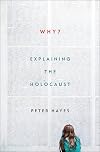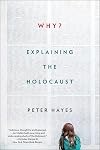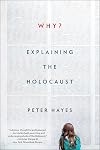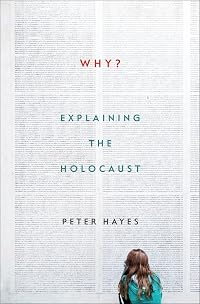
Why?: Explaining the Holocaust
by Peter Hayes
On This Page
Description
"Despite the outpouring of books, movies, museums, memorials, and courses devoted to the Holocaust, a coherent explanation of why such ghastly carnage erupted from the heart of civilized Europe in the twentieth century still seems elusive even seventy years later. Numerous theories have sprouted in an attempt to console ourselves and to point the blame in emotionally satisfying directions--yet none of them are fully convincing. As witnesses to the Holocaust near the ends of their lives, it show more becomes that much more important to unravel what happened and to educate a new generation about the horrors inflicted by the Nazi regime on Jews and non-Jews alike. Why? dispels many misconceptions and answers some of the most basic--yet vexing--questions that remain: why the Jews and not another ethnic group? Why the Germans? Why such a swift and sweeping extermination? Why didn't more Jews fight back more often? Why didn't they receive more help? While responding to the questions he has been most frequently asked by students over the decades, world-renowned Holocaust historian and professor Peter Hayes brings a wealth of scholarly research and experience to bear on conventional, popular views of the history, challenging some of the most prominent recent interpretations. He argues that there is no single theory that "explains" the Holocaust; the convergence of multiple forces at a particular moment in time led to catastrophe."--Publisher's description. show lessTags
Recommendations












Member Reviews
While visiting the Holocaust museum in Israel last year, I often asked myself "Why?" And as I exited through the gift shop (some things never change) I saw this book and hoped it would answer my question.
The book is extremely well written and explains how and why the Holocaust happened from examining key questions: Why the Jews? Why the Germans? Why murder? Why so fast and sweeping? Why didn't more victims fight back? Why such limited help from outside? I learned so much!
One strength of the book is the final chapter which examines legacies and lessons that are relevant to our time in a very thoughtful and thought-provoking manner.
Why? I understand much more than before I read this book, but in a fundamental way, that question remains show more partly unanswerable in my mind. show less
The book is extremely well written and explains how and why the Holocaust happened from examining key questions: Why the Jews? Why the Germans? Why murder? Why so fast and sweeping? Why didn't more victims fight back? Why such limited help from outside? I learned so much!
One strength of the book is the final chapter which examines legacies and lessons that are relevant to our time in a very thoughtful and thought-provoking manner.
Why? I understand much more than before I read this book, but in a fundamental way, that question remains show more partly unanswerable in my mind. show less
Reading this book is like having gauze removed from your eyes. Even if you are familiar with the Holocaust, Hayes, by using a multidisciplinary approach, provides an acuity with is astounding. Importantly, many of his observations have applications to any culture in which authoritarianism threatens empathy and diversity. Thus, he dates the beginning of the Holocaust to a day in 1933 when Germany's leading industrialists caved in to Hitler's demand that they fire all Jewish employees. If they had refused, history might have taken a different course. Which is why he ends his work with a German proverb: "Beware the beginnings." Hayes writes beautifully, and having been trained as an economic historian, he often frames his arguments in a show more numerical fashion--which aids understanding. This is a magnificent work. show less
Very sober and unsentimental book, which is a rarity for this subject. Isn't afraid to bust myths that were created with the best of intentions, or to review controversial topics like the lack of real resistance. Still, for a book that sets itself the premise of answering why, there's a lot more how, & the concluding wrap-up that attempts to use the established facts to establish the why falls short of the aim. Perhaps fundamentally an unanswerable question, I still got a lot closer to the why reading Ryback's Hitler's Private Library which lays out some of the fundamental influences in his thinking and the antisemitism of the era.
This book was eye-opening in a way I could not have guessed. My knowledge of this event was clearly not thorough, even though I thought I understood it. I didn't. Great educator. "Wehret den Anfängen."
9.78039E 12
Ratings
Members
- Recently Added By
Lists

History: Holocaust
106 works; 1 member
Author Information
16+ Works 429 Members
Peter Hayes is professor of history and German and Theodore Zev Weiss Holocaust Educational Foundation Professor of Holocaust Studies emeritus at Northwestern University, and chair of the Academic Committee of the United States Holocaust Memorial Museum.
Common Knowledge
- Canonical title
- Why?: Explaining the Holocaust
- Dedication
- In grateful memory of inspiring teachers: Mary Faherty, James McGillivray, Athern Park Daggett, John C. Rensenbrink, Timothy W. Mason, Henry Ashby Turner Jr.
- First words
- Seventy years after the Holocaust ended, it continues to resist comprehension.
- Last words
- (Click to show. Warning: May contain spoilers.)Beware the beginnings.
- Blurbers
- Kertzer, David I.; Marrus, Michael R.; Herzog, Dagmar
- Canonical DDC/MDS
- 940.531811
- Canonical LCC
- D804.3
Classifications
- Genres
- History, Nonfiction, General Nonfiction
- DDC/MDS
- 940.531811 — History & geography History of Europe History of Europe 1918- World War II, 1939-1945 Social, political, economic history; Holocaust Holocaust General topics of Holocaust
- LCC
- D804.3 — History of Europe, Asia, Africa and Oceania History (General) World War II (1939-1945)
- BISAC
Statistics
- Members
- 244
- Popularity
- 133,498
- Reviews
- 5
- Rating
- (4.09)
- Languages
- English
- Media
- Paper, Audiobook, Ebook
- ISBNs
- 4
- ASINs
- 2