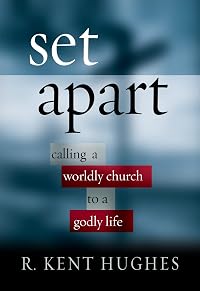
Set Apart: Calling a Worldly Church to a Godly Life
by R. Kent Hughes
On This Page
Description
The church must be distinct from the world to reach the world. - From Chapter 1 "But you are a chosen race, a royal priesthood, a holy nation, a people for [God's] own possession, that you may proclaim the excellencies of him who called you out of darkness into his marvelous light" (1 Peter 2:9, ESV). Holy and dedicated to declaring the excellencies of God-this is the church, or is it? Can we really call the church holy? A minority of those who claim to be born again say they believe in show more moral absolutes (Source: Barna Research). One third of evangelicals between the ages of 18 and 35 have no problem with unmarried men and women living together (Source: Evangelical Alliance). Evangelical Christianity is becoming increasingly worldly. Materialism, hedonism, violence, sexual misconduct, pluralism, and divorce are becoming as common within the church as without. As a result the church is losing its distinct identity as a people set apart to reach the world. In this book, R. Kent Hughes builds a case for godliness in the church-a case that echoes the biblical call to holiness. The church can reach the world only if it keeps itself from being ensnared by the world. Hughes is not simply urging Christians to say no to worldliness-he is calling the church to say yes to Christ and to his call to reach our lost world.". show lessTags
Recommendations



Member Reviews
Set Apart: Calling a Worldly Church to a Godly Life by R. Kent Hughes, the author of The Disciplines of a Godly Man, is one of the best books I have read on the subject of Christian separation and holiness. It is very practical and hard-hitting, confronting Christians with their love for the world while maintaining a positive, encouraging spirit.
Hughes begins with the story of Lot, a righteous man who, though vexed by Sodom’s worldliness, still allowed it to drag him and his family down. He points out that though Lot was influential in Sodom, he could not and would not impact Sodom for good because he was worldly. We, like Lot, cannot reach the world unless we are distinct from the world. God’s plan is for us to be “a people set show more apart from the world to reach the world.”
Hughes then identifies nine different areas in which the church today must recognize their worldliness and correct it:materialism, hedonism, sensuality, violence and voyeurism (vicarious participation in sin), sexual conduct, modesty, pluralism, marriage, and the church and the Lord’s Day. In each of these areas the church is pointedly confronted with her sin and called upon to repent. Yet, Hughes deals with each of these areas very tastefully.In addition Hughes does not lapse into negativity. Instead he focuses on the blessings that result from obedience in these areas.
In the last chapter especially, Hughes describes the “unending yes.” He states, “There is no power in the no. . . . A people set apart merely by the noes have no power. . . .The power is in the yes because all the yeses are yeses to Christ: yes to his riches, yes to his pleasures, yes to his mind, yes to his peace, yes to his relationship, yes to his clothing, yes to the cross and the covenant and Christ, yes to him as the only way, yes to his body the church, and yes to the Gospel of God.” There is great joy and blessing in separation unto God.
Also in the final chapter, Hughes issues a call to return to historic fundamentalism. He says, “the instincts of early fundamentalists were right in their attempt to maintain theological orthodoxy and separation from the world, but that movement was sidetracked . . . into a shallow separatism. What is needed today is a new old fundamentalism. . . that while being in the world is morally separated from the world and that unashamedly preaches the Gospel.”
I wholeheartedly agree with this assessment, and I am very encouraged to hear it. I do have a couple of minor disagreements with the book. In connection with the chapter on materialism, Hughes strongly emphasizes tithing as mandatory for believers today. I believe that the tithe is not taught in the New Testament – having a giving heart is emphasized instead. A tithe may be a good standard to go by, but cannot be imposed as law upon Christians. Similarly Hughes conflates the concepts of the Old Testament Sabbath with the Lord’s Day.
I highly recommend this book for any Christian. It inspired and encouraged me, fueling a greater desire for holiness. show less
Hughes begins with the story of Lot, a righteous man who, though vexed by Sodom’s worldliness, still allowed it to drag him and his family down. He points out that though Lot was influential in Sodom, he could not and would not impact Sodom for good because he was worldly. We, like Lot, cannot reach the world unless we are distinct from the world. God’s plan is for us to be “a people set show more apart from the world to reach the world.”
Hughes then identifies nine different areas in which the church today must recognize their worldliness and correct it:materialism, hedonism, sensuality, violence and voyeurism (vicarious participation in sin), sexual conduct, modesty, pluralism, marriage, and the church and the Lord’s Day. In each of these areas the church is pointedly confronted with her sin and called upon to repent. Yet, Hughes deals with each of these areas very tastefully.In addition Hughes does not lapse into negativity. Instead he focuses on the blessings that result from obedience in these areas.
In the last chapter especially, Hughes describes the “unending yes.” He states, “There is no power in the no. . . . A people set apart merely by the noes have no power. . . .The power is in the yes because all the yeses are yeses to Christ: yes to his riches, yes to his pleasures, yes to his mind, yes to his peace, yes to his relationship, yes to his clothing, yes to the cross and the covenant and Christ, yes to him as the only way, yes to his body the church, and yes to the Gospel of God.” There is great joy and blessing in separation unto God.
Also in the final chapter, Hughes issues a call to return to historic fundamentalism. He says, “the instincts of early fundamentalists were right in their attempt to maintain theological orthodoxy and separation from the world, but that movement was sidetracked . . . into a shallow separatism. What is needed today is a new old fundamentalism. . . that while being in the world is morally separated from the world and that unashamedly preaches the Gospel.”
I wholeheartedly agree with this assessment, and I am very encouraged to hear it. I do have a couple of minor disagreements with the book. In connection with the chapter on materialism, Hughes strongly emphasizes tithing as mandatory for believers today. I believe that the tithe is not taught in the New Testament – having a giving heart is emphasized instead. A tithe may be a good standard to go by, but cannot be imposed as law upon Christians. Similarly Hughes conflates the concepts of the Old Testament Sabbath with the Lord’s Day.
I highly recommend this book for any Christian. It inspired and encouraged me, fueling a greater desire for holiness. show less
From Daniel Christensen
Ratings
Members
- Recently Added By
Lists

Develop Your Personal Christian Library
101 works; 15 members
Author Information

74+ Works 13,731 Members
R. Kent Hughes (DMin, Trinity Evangelical Divinity School) is senior pastor emeritus of College Church in Wheaton, Illinois, and a founder of the Charles Simeon Trust, which conducts expository preaching conferences throughout out North America and worldwide. He serves as the series editor for the Preaching the Word commentary Series and is the show more author or coauthor of many books. show less
Classifications
Statistics
- Members
- 277
- Popularity
- 116,363
- Reviews
- 2
- Rating
- (4.33)
- Languages
- English, Korean
- Media
- Paper, Ebook
- ISBNs
- 6
- ASINs
- 1