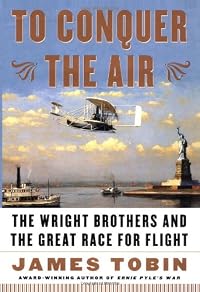
To Conquer the Air: The Wright Brothers and the Great Race for Flight
by James Tobin
On This Page
Description
"For some years I have been afflicted with the belief that flight is possible to man. My disease has increased in severity and I feel that it will soon cost me an increased amount of money if not my life." So wrote a quiet young Ohioan in 1900, one in an ancient line of men who had wanted to fly, men who wanted it passionately, fecklessly, hopelessly. But now, at the turn of the twentieth century, Wilbur Wright and a scattered handful of other adventurers conceived a conviction that the show more dream lay at last within reach, and in a headlong race across ten years and two continents, they competed to conquer the air. James Tobin, winner of the National Book Critics Circle Award in biography, has at last given this inspiring story its definitive telling. For years Wright and his younger brother, Orville, experimented in utter obscurity, supported only by their exceptional family. Meanwhile, the world watched as the imperious Samuel Langley, armed with a rich contract from the U.S. War Department and all the resources of the Smithsonian Institution, sought to scale up his unmanned models to create the first manned flying machine. But while Langley became obsessed with flight as a problem of power, the Wrights grappled with it as a problem of balance. Thus their machines took two very different paths, his toward oblivion, theirs toward the heavens. As Tobin relates, the Wrights' 1903 triumph at Kitty Hawk, however hallowed in American lore, was ill-reported and disbelieved. So, while the two brothers struggled to transform their delicate contraption into a practical airplane, others moved to overtake them as the leading pioneers of flight. In France, rivals scoffed at the Wrights even as they rushed to imitate them. At home, the great inventor Alexander Graham Bell seized the fallen banner of his friend Langley and thrust it into the hands of a circle of young daredevils, urging them "to get into the air." From this group emerged the motorcyclist Glenn Curtiss, "fastest man in the world," whose aerial challenge to Wilbur Wright culminated in an unforgettable showdown over New York harbor. To Conquer the Air is a hero's tale of overcoming obstacles within and without that plumbs the depths of creativity and character. With a historian's accuracy and a novelist's eye, Tobin has captured the interplay of remarkable personalities at an extraordinary moment in our history, in the centennial year of human flight. To Conquer the Air is itself a heroic achievement. An award-winning historian offers a gripping narrative of the fierce competition on the centennial of the Wright Brothers' achievement. show lessTags
Recommendations







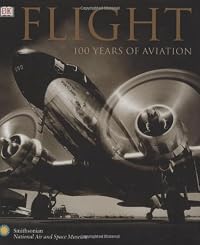

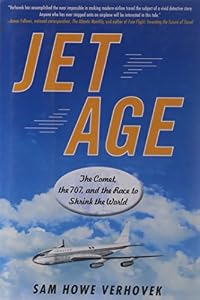


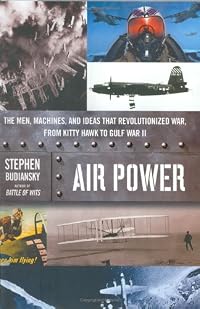


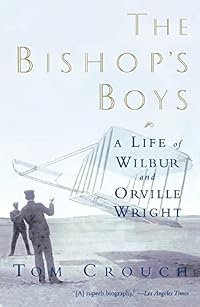





Member Recommendations
Member Reviews
Tobin has created a tremendously engaging work detailing the pursuit of manned flight. The author takes a sympathetic view of the Wright brothers and yet maintains an admirable degree of objectivity concerning the other major players as well. The result is a story of conflicting personalities, attitudes, ideas, and even nations. The Wrights labored patiently in the midst of persistent skepticism and were rewarded with the glory that they deserved.
James Tobin did a great job filling in the many gaps in my knowledge about the Wright brothers and their historic first flight. Especially interesting was the description of the multiple iterations they went through to create their first planes, other key contributors the the development of practical aircraft, and how their historic first flight quickly led to the development of widespread and practical motorized airplanes. An enjoyable and informative book.
James Tobin's "To Conquer the Air: The Wright Brothers and the Great Race for Flight" tells the story of three efforts (mainly) to prove that man could take to the skies. Its major focus is on the success of the Wilbur and Orville Wright, who were the first to successfully fly an airplane on the fields at Kitty Hawk, N.C. It also features the stories of Samuel Langley and Alexander Graham Bell, who approached the problem of flight with different (and less successful) ideas.
Overall, I found the book to be very comprehensive and well written. It contains lots of little insights into the personalities and differing attitudes of the major players in the "Great Race for Flight." My only real complaint is that sometimes there was a little too show more much information so the story started to drag a little bit. Definitely a great book for someone interested in the history of flight.... not as interesting for the casual reader though. show less
Overall, I found the book to be very comprehensive and well written. It contains lots of little insights into the personalities and differing attitudes of the major players in the "Great Race for Flight." My only real complaint is that sometimes there was a little too show more much information so the story started to drag a little bit. Definitely a great book for someone interested in the history of flight.... not as interesting for the casual reader though. show less
a more interesting story than i expected. they had their troubles, family, planes that would not fly--they tried everything, competitors, accidents.
Decent history of the Wright Brothers and their quest to invent a flying machine.
Ratings
Members
- Recently Added By
Author Information

7 Works 730 Members
James Tobin won the National Book Critics Circle Award for his first book, Ernie Pyle's War, and the J. Anthony Lukas Work-in-Progress Award for To Conquer the Air. Twice nominated for the Pulitzer Prize in journalism, he holds a Ph.D. in history from the University of Michigan
Awards and Honors
Awards
Notable Lists
Common Knowledge
- Original title
- To Conquer the Air: The Wright Brothers and the Great Race for Flight
- Original publication date
- 2003
- People/Characters
- Orville Wright; Wilbur Wright; Louis Bleriot
- Important places
- Kitty Hawk, North Carolina, USA; Dayton, Ohio, USA
- Important events
- First powered airplane flight by the Wright brothers (1903-12-17); First Sustained Powered Flight
- Dedication
- For my parents James and Dorothy Tobin with thanks and love
- First words
- His father and sister had gone to Woodland Cemetery to plant flowers at the grave of his mother.
- Last words
- (Click to show. Warning: May contain spoilers.)Gilbert said again that the country was proud of him, and "while I was saying this he shook hands with me warmly and looked me straight in the face evidently deeply appreciating the sincerity with which it was said, and I felt that he fully responded to it although he did not express it in words."
Classifications
- Genres
- Nonfiction, History, General Nonfiction, Biography & Memoir, Technology
- DDC/MDS
- 629.13 — Applied Science & Technology Engineering Transportation Vehicles Airplanes, Helicopters, and other aircrafts Aviation engineering
- LCC
- TL540 .W7 .T63 — Technology Motor vehicles. Aeronautics. Astronautics Motor vehicles. Aeronautics. Astronautics Aeronautics. Aeronautical engineering
- BISAC
Statistics
- Members
- 247
- Popularity
- 130,426
- Reviews
- 5
- Rating
- (4.10)
- Languages
- English, German
- Media
- Paper, Audiobook, Ebook
- ISBNs
- 11
- UPCs
- 1
- ASINs
- 4