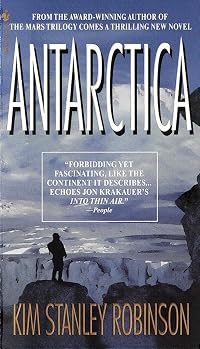
On This Page
Description
Eco-terrorists battle capitalists, seeking to open Antarctica to commercial exploitation. The time is the 21st century, the world is an ecological disaster, and the treaty banning mineral exploration of Antarctica has expired. By the author of Red Mars.Tags
Recommendations



Member Recommendations
PghDragonMan A rebuttal to Michael Crichton's State of Fear.
Member Reviews
Is 'landscape writer' a thing? Kim Stanley Robinson makes it his thing, and in this book he takes us to Antarctica, continent of ice and rock, the last great wilderness, a beautiful and deadly place.
I've been there, just as a tourist during one of the nicest summers on record, but KSR nails the ineffable qualities of the place and the strangeness of light and distance. Robinson spent a season in Antarctica with the NSF's Artists and Writer's Program, and it was time well spent on all sides. By far my favorite character was Ta Shu, a feng shui geomancer and artistic resident streaming the landscape back to an audience of millions with a running commentary on its five-dimensional harmony and nano-poems. Ta Shu feels both entirely show more authentic and very alien.
blue sky
white snow
There are more mundane people as well, and the A plot concerns the future of the Antarctica and the Earth, as scientists wrestle with evidence for the last warm period, support staff grumble under the feudal structure of science, oil exploration teams prepare to extract natural resources, 'native Antarcticans' try to stay below the radar, and ecological saboteurs plan a massive attack in the name of the planet. There's a sorta a love triangle between X, a blue collar General Field Assistant, Val, an elite expedition guide, and Wade, senator's aide, but the characters, while round and unique, feel somewhat muted compared to the landscape and the simply trials of getting anywhere alive on the continent. The only true shared culture of Antarctica; the early expeditions of Scott, Shackleton, and Amundsen, come through again and again, along with the disagreements between different political factions. Though this is science fiction, the issues that Robinson explores are still very much alive. show less
I've been there, just as a tourist during one of the nicest summers on record, but KSR nails the ineffable qualities of the place and the strangeness of light and distance. Robinson spent a season in Antarctica with the NSF's Artists and Writer's Program, and it was time well spent on all sides. By far my favorite character was Ta Shu, a feng shui geomancer and artistic resident streaming the landscape back to an audience of millions with a running commentary on its five-dimensional harmony and nano-poems. Ta Shu feels both entirely show more authentic and very alien.
blue sky
white snow
There are more mundane people as well, and the A plot concerns the future of the Antarctica and the Earth, as scientists wrestle with evidence for the last warm period, support staff grumble under the feudal structure of science, oil exploration teams prepare to extract natural resources, 'native Antarcticans' try to stay below the radar, and ecological saboteurs plan a massive attack in the name of the planet. There's a sorta a love triangle between X, a blue collar General Field Assistant, Val, an elite expedition guide, and Wade, senator's aide, but the characters, while round and unique, feel somewhat muted compared to the landscape and the simply trials of getting anywhere alive on the continent. The only true shared culture of Antarctica; the early expeditions of Scott, Shackleton, and Amundsen, come through again and again, along with the disagreements between different political factions. Though this is science fiction, the issues that Robinson explores are still very much alive. show less
It happened again: I tried to read a Kim Stanley Robinson novel and put it down before I was halfway through. Don't take that as a bad review, though, or let it put you off picking up the book yourself. You should pick up Antarctica, at least to try: It's packed with atmospheric writing, details of life on the ice, and glimpses into the history of polar exploration . . . not to mention a plot involving ecoterrorism, international relations, really bad weather, and intrigue both personal and political.
If all that sounds interesting, you'll probably love it. Most people who've read it seem to. There's just something about me and Kim Stanley Robinson.
For some reason that I can't even come close to understanding, I cannot get engrossed in show more his novels. I've tried four times now: Forty Signs of Rain, Years of Rice and Salt, Red Mars, and now Antarctica -- and every damn time I've bounced off. I start out full of anticipation, not to mention determination that this time will be different, and somewhere around page 100 (or 50 or 300) I start to slog, picking up the book because I feel like I should, not because I want to. I'm never actively bored by Robinson's novels . . . never annoyed by the unrealistic behavior of the characters . . . never put off by the writing (either because it's clumsy or because it's self-consciously flashy). It's just that, somewhere along the line, I stop caring whether I read the next chapter.
So I'm done trying Kim Stanley Robinson, and trying to figure out why I don't enjoy his books when everything about them says I should. He's got enough fans that he won't miss one extra, and life is too short to read -- for fun, anyway -- books you don't care about. show less
If all that sounds interesting, you'll probably love it. Most people who've read it seem to. There's just something about me and Kim Stanley Robinson.
For some reason that I can't even come close to understanding, I cannot get engrossed in show more his novels. I've tried four times now: Forty Signs of Rain, Years of Rice and Salt, Red Mars, and now Antarctica -- and every damn time I've bounced off. I start out full of anticipation, not to mention determination that this time will be different, and somewhere around page 100 (or 50 or 300) I start to slog, picking up the book because I feel like I should, not because I want to. I'm never actively bored by Robinson's novels . . . never annoyed by the unrealistic behavior of the characters . . . never put off by the writing (either because it's clumsy or because it's self-consciously flashy). It's just that, somewhere along the line, I stop caring whether I read the next chapter.
So I'm done trying Kim Stanley Robinson, and trying to figure out why I don't enjoy his books when everything about them says I should. He's got enough fans that he won't miss one extra, and life is too short to read -- for fun, anyway -- books you don't care about. show less
Antarctica is a novel full of strong, genuinely interesting ideas: international governance, environmental ethics, post-national spaces, survival versus stewardship. Kim Stanley Robinson clearly knows the terrain—political, historical, and physical—and the writing itself is controlled and competent.
For me, though, the execution never quite matches the promise.
The book is intensely bureaucratic in a setting that should feel existential. Antarctica here is less a hostile force than an administrative problem to be managed. Fires, sabotage, and danger arise, but they are repeatedly absorbed by systems—more fuel is coming, another station exists, procedures will handle it. As a result, very little feels irrevocable, and the ice never show more truly threatens to win.
The historical interludes—especially those invoking Shackleton—only sharpen this disconnect. They gesture toward a brutal, unforgiving Antarctica, but that version of the continent never meaningfully intrudes on the present-day narrative. Instead of haunting the story, history feels footnoted.
Characterization also suffers from the novel’s priorities. Many figures blur together as functional roles rather than distinct people, a problem amplified in audio format by heavy pronoun use and limited interior grounding. Wade, positioned as a questioning presence, moves through ideas rather than choices, and other figures—such as the nomads—feel introduced for thematic completeness rather than narrative necessity.
Ultimately, Antarctica reads more like a symposium of plausible positions than a story forged by consequence. I appreciated the ideas and respected the craft, but I wanted a novel about surviving on the ice to feel colder, riskier, and less administratively cushioned.
A solid, thoughtful book—but one whose systems-thinking mutes the very danger that should give it force. show less
For me, though, the execution never quite matches the promise.
The book is intensely bureaucratic in a setting that should feel existential. Antarctica here is less a hostile force than an administrative problem to be managed. Fires, sabotage, and danger arise, but they are repeatedly absorbed by systems—more fuel is coming, another station exists, procedures will handle it. As a result, very little feels irrevocable, and the ice never show more truly threatens to win.
The historical interludes—especially those invoking Shackleton—only sharpen this disconnect. They gesture toward a brutal, unforgiving Antarctica, but that version of the continent never meaningfully intrudes on the present-day narrative. Instead of haunting the story, history feels footnoted.
Characterization also suffers from the novel’s priorities. Many figures blur together as functional roles rather than distinct people, a problem amplified in audio format by heavy pronoun use and limited interior grounding. Wade, positioned as a questioning presence, moves through ideas rather than choices, and other figures—such as the nomads—feel introduced for thematic completeness rather than narrative necessity.
Ultimately, Antarctica reads more like a symposium of plausible positions than a story forged by consequence. I appreciated the ideas and respected the craft, but I wanted a novel about surviving on the ice to feel colder, riskier, and less administratively cushioned.
A solid, thoughtful book—but one whose systems-thinking mutes the very danger that should give it force. show less
Part ecothriller, part history lesson, part meditation. It's a travelogue, a PBS special, a socio-eco manifesto, presented as a landscape painting in words. Along the way it takes some good hard looks at our relationship with nature, the role of science in society, and overall what it means to lead a fulfilling life.
The slow and meandering pace may bother some readers, as will the barely fleshed out characters and rather flimsy plot. In a lesser writer's hands these would be fatal flaws, but KSR keeps things just grounded enough to get away with it, while using the story to get at the real points of the book.
Part of what makes it so good is the way that KSR is able to express competing viewpoints better than the people themselves, from show more ecoterrorists to oil company executives, Marxists to Republicans. His characters deliver political speeches about environmental issues better than Al Gore, defenses of direct action better than Paul Watson, he depicts cold weather adventures better than Jon Krakauer, delves into the philosophy of nature deeper than Werner Herzog, describes physics experiments better than Sean Carroll, etc. show less
The slow and meandering pace may bother some readers, as will the barely fleshed out characters and rather flimsy plot. In a lesser writer's hands these would be fatal flaws, but KSR keeps things just grounded enough to get away with it, while using the story to get at the real points of the book.
Part of what makes it so good is the way that KSR is able to express competing viewpoints better than the people themselves, from show more ecoterrorists to oil company executives, Marxists to Republicans. His characters deliver political speeches about environmental issues better than Al Gore, defenses of direct action better than Paul Watson, he depicts cold weather adventures better than Jon Krakauer, delves into the philosophy of nature deeper than Werner Herzog, describes physics experiments better than Sean Carroll, etc. show less
I hate the word "relevant/premonitory" when applied to SF. It seems a horribly pessimistic idea that we can only relate to things that are right in front of us or directly to do with us and our own tribe or corner of the world rather than just relating to a shared experience of being human. I´m not an Argentinian but I love Borges and Cortázar. I never grew up in the post-revolutionary USSR but I love the work of Andrey Platonov. Ditto with Iceland in the 1900s and Halldor Laxness´s “Independent People”. They´re relevant to me because they describe the experience of being humans. All books, no matter how contemporary, will one day be set in "the past". All books will one day describe a world that no longer exists. Re-reading for show more example "Lanark" by Alasdair Gray, somewhat closer in time and geography to my own upbringing at the British Council, I was struck by how that too is set in, both in terms of actual setting and in its mental landscape and attitudes, a Scotland that has now largely passed into myth just as much as the Scotland of clans and crofters and clearances had before it. Our world, or rather our worlds, our individual experiences and memories and perceptions that mold our realities, are always doomed to oblivion, even if the physical places survive. That´s what I like about “Antarctica” - it preserves these individual slices of worlds from being forgotten, at least for a little while, before climate change changes it forever.
For me, that´s where the relevance of SF comes from and it´ll remain relevant as long as humans still exist. I think people will always want to read about the past - people haven't stopped reading Dickens or Jane Austen, Shakespeare or Graham Greene because the world they describe has largely disappeared. The human conflicts and dramas they describe are as relevant as ever. So, even if our world changes beyond recognition - some people will still read books, and mostly they'll read the new stuff, the stuff that hasn't been written yet, but a few people will read the old books like “Antarctica”, because we all want to be Wade (one of the characters in the novel) and not because they are relevant, but because they're good. Unfortunately, I had to go back to one of Stanley Robinson’s earlier ones to recover the feeling that he can still write good SF. Will people read Stanley Robinson in the future…? Who knows? What I do know is that “Antarctica” is his best work so far.
SF = Speculative Fiction.
Book Review SF = Speculative Fiction show less
For me, that´s where the relevance of SF comes from and it´ll remain relevant as long as humans still exist. I think people will always want to read about the past - people haven't stopped reading Dickens or Jane Austen, Shakespeare or Graham Greene because the world they describe has largely disappeared. The human conflicts and dramas they describe are as relevant as ever. So, even if our world changes beyond recognition - some people will still read books, and mostly they'll read the new stuff, the stuff that hasn't been written yet, but a few people will read the old books like “Antarctica”, because we all want to be Wade (one of the characters in the novel) and not because they are relevant, but because they're good. Unfortunately, I had to go back to one of Stanley Robinson’s earlier ones to recover the feeling that he can still write good SF. Will people read Stanley Robinson in the future…? Who knows? What I do know is that “Antarctica” is his best work so far.
SF = Speculative Fiction.
Book Review SF = Speculative Fiction show less
This is the most perfect novel by KSR that I've read. The Mars books and Galileo's dream were more ambitious and perhaps achieved more but at the cost of some flaws. That often seems to happen when writers really reach out and try to grasp something big and complicated but I would encourage them to try it anyway...however Antarctica tackles a fair bit and succeeds every which way I look at it: narrative drive, characterisation, subtext, prose style (apart from an occassional jarring line here and there).
Weird things are happening in Antractica: robberies, hijackings. Senator Chase's aide Wade is sent South to find out what is going on and so an adventure starts... As is usual for KSR, the story is told as a patchwork of perspectives show more from diverse utterly convincing characters. Sometimes this leads to problems of pacing and digression, but not here. A whirlwind tour of Antarctica, a cold weather adventure and some real surprises are mixed with tales of the (human) history of the continent and the usual concern for the environment, in a scenario that is all to plausible a view of the near future where the Antarctic Treaty has broken down and mineral exploitation is in the exploratory phase.
KSR went to Antarctica and saw much of what he describes first hand - he describes it vividly and with proper awe. Few people writing today can describe landscape and its effect on people who live in it as well as KSR consistently does let alone with as much appreciation of its fragility and importance or concern for its imperilled future.
And of course, here Kim is making the same points he does elsewhere with regard to ecology, sustainability, population, corporations, co-operation and self-interest. It's not subtle but it isn't detrimental to a good story, either.
One of the characters is a Chinese feng shui expert who wrote minimalist poems in response to a previous visit to the cold continent. Some of these appear at the head of chapters and they get better as one progresses through the book. My favourite is:
white white white
white green white
white white white
which, in context, is a delight.
I'm not sure how well known it is that this book precedes the Forty, Fifty, Sixty series: it's miles better than any of those and all of them taken together, too. Read this one if you like KSR, cold weather or survival tales. show less
Weird things are happening in Antractica: robberies, hijackings. Senator Chase's aide Wade is sent South to find out what is going on and so an adventure starts... As is usual for KSR, the story is told as a patchwork of perspectives show more from diverse utterly convincing characters. Sometimes this leads to problems of pacing and digression, but not here. A whirlwind tour of Antarctica, a cold weather adventure and some real surprises are mixed with tales of the (human) history of the continent and the usual concern for the environment, in a scenario that is all to plausible a view of the near future where the Antarctic Treaty has broken down and mineral exploitation is in the exploratory phase.
KSR went to Antarctica and saw much of what he describes first hand - he describes it vividly and with proper awe. Few people writing today can describe landscape and its effect on people who live in it as well as KSR consistently does let alone with as much appreciation of its fragility and importance or concern for its imperilled future.
And of course, here Kim is making the same points he does elsewhere with regard to ecology, sustainability, population, corporations, co-operation and self-interest. It's not subtle but it isn't detrimental to a good story, either.
One of the characters is a Chinese feng shui expert who wrote minimalist poems in response to a previous visit to the cold continent. Some of these appear at the head of chapters and they get better as one progresses through the book. My favourite is:
white white white
white green white
white white white
which, in context, is a delight.
I'm not sure how well known it is that this book precedes the Forty, Fifty, Sixty series: it's miles better than any of those and all of them taken together, too. Read this one if you like KSR, cold weather or survival tales. show less
Almost every time I read a KSR book, I'm either awestruck, amazed at the scope, or I have to say something silly like, "Every time I read a KSR book, it's the favorite book I've read by him!"
Well, guess what?
Seriously, though, this one has the added distinction of KSR actually having been to Antarctica, and plot aside, the descriptions of the 60 below landscape, the problems associated with long hikes or just plain living there at all, makes this one of the most vivid novels he's ever written. This is quite aside from the Mars Trilogy, as good as it was. This one obviously hits closer to home, with all our crazy and screwed-up personages making yet another mess of things.
Because, let's face it, no nation or corporation has a good track show more record when it comes to reckless greed, fear of the upcoming energy crisis, or just not giving a shit because "things are bad everywhere". What does this mean for Antarctica? For those oil deposits? Or every nation capable of staging an end-run around the international treaty? A treaty unenforced and possibly unenforceable?
It brings up other familiar topics from KSR's other books as well. Ecology is a big one. Antarctica is the last clean place on Earth. It's rough on us and that's the main reason why, but you and I both know that where there's a will, there's a way. But there are also people willing to fight for the love they have for the place, and this is their novel. The fighting isn't really done with guns, but there *IS* ecoterrorism going on. There are also some rather awesome ways of living with zero-impact on the continent. Political and economic ideas that deal with the full problem. And characters that immerse us readers fully in this gorgeous, stark landscape.
I totally recommend this novel for anyone in love with cold adventures. It's full of history and the present and has a strong eye to the future, in every aspect. Now it's time to close my mouth. Snow is getting in. show less
Well, guess what?
Seriously, though, this one has the added distinction of KSR actually having been to Antarctica, and plot aside, the descriptions of the 60 below landscape, the problems associated with long hikes or just plain living there at all, makes this one of the most vivid novels he's ever written. This is quite aside from the Mars Trilogy, as good as it was. This one obviously hits closer to home, with all our crazy and screwed-up personages making yet another mess of things.
Because, let's face it, no nation or corporation has a good track show more record when it comes to reckless greed, fear of the upcoming energy crisis, or just not giving a shit because "things are bad everywhere". What does this mean for Antarctica? For those oil deposits? Or every nation capable of staging an end-run around the international treaty? A treaty unenforced and possibly unenforceable?
It brings up other familiar topics from KSR's other books as well. Ecology is a big one. Antarctica is the last clean place on Earth. It's rough on us and that's the main reason why, but you and I both know that where there's a will, there's a way. But there are also people willing to fight for the love they have for the place, and this is their novel. The fighting isn't really done with guns, but there *IS* ecoterrorism going on. There are also some rather awesome ways of living with zero-impact on the continent. Political and economic ideas that deal with the full problem. And characters that immerse us readers fully in this gorgeous, stark landscape.
I totally recommend this novel for anyone in love with cold adventures. It's full of history and the present and has a strong eye to the future, in every aspect. Now it's time to close my mouth. Snow is getting in. show less
Members
- Recently Added By
Lists

Books Set in the Polar Regions
16 works; 6 members

BingoDOG - Scientists in Fiction
111 works; 17 members

Books Read in 2004
200 works; 7 members

Books Read in 2024
4,712 works; 127 members
Author Information

139+ Works 49,457 Members
Kim Stanley Robinson was born in Orange County, California on March 23, 1952. He received a B. A. and Ph. D. from the University of California at San Diego and an M. A. from Boston University. His first trilogy of books, Orange County, collectively won a Nebula Award and two Hugo Awards. His other works include the Mars trilogy, 2312, and Aurora. show more He has won an Asimov Award, a World Fantasy Award, a Locus Reader's Poll Award, and a John W. Campbell Award. (Bowker Author Biography) show less
Awards and Honors
Awards
Series

Common Knowledge
- Canonical title*
- Antarktika
- Original publication date
- 1997-09
- People/Characters
- X; Valerie Kenning; Wade Norton; Phil Chase
- Important places
- McMurdo Station, Antarctica; Amundsen-Scott South Pole Station, Antarctica
- Epigraph
- "The land looks like a fairytale."
—Roald Amundsen - First words
- First you fall in love with Antarctica, then it breaks your heart.
- Last words
- (Click to show. Warning: May contain spoilers.)Then anything could happen.
- Original language
- English
*Some information comes from Common Knowledge in other languages. Click "Edit" for more information.
Classifications
Statistics
- Members
- 1,316
- Popularity
- 18,357
- Reviews
- 34
- Rating
- (3.69)
- Languages
- 41 — Afrikaans, Albanian, Armenian, Basque, Belarusian, Bulgarian, Catalan, Czech, Danish, Dutch, English, Estonian, Finnish, French, Georgian, German, Irish, Greek, Hindi, Hungarian, Icelandic, Italian, Japanese, Korean, Latvian, Lithuanian, Macedonian, Norwegian, Polish, Romanian, Russian, Serbian, Croatian, Slovak, Slovenian, Spanish, Turkish, Welsh, Portuguese (Portugal), Chinese, traditional, Chinese, simplified
- Media
- Paper, Audiobook, Ebook
- ISBNs
- 28
- ASINs
- 11