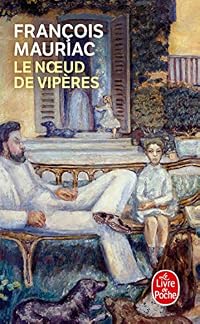
The Knot of Vipers
by François Mauriac
On This Page
Description
In this remarkable novel, Mauriac brings his extraordinary talent for probing the inmost core of the human character to what is arguably the most exciting theme in the world: the battle for the human soul. In all of literature there can be few more appalling studies of a soul devoured by pride and avarice, corroded by hatred. Louis, a wretchedly unhappy multi-millionaire, all but personifies evil. Toward the end of his life, seeking to uncover the cause of his unhappiness, he commits to show more paper his whole bitter story: his indulgent but affection-starved childhood; his first love; the trivial misunderstanding that festered until it poisoned their entire married life and the lives of their children; the old miser's struggle to disinherit his family; and finally, the powerful climax, with divine grace vying to the very end to pierce the evil encrusting Louis' soul. show lessTags
Recommendations












Member Reviews
Reason Read: tbr takedown, Reading 1001, May 2023
"Vipers' Tangle begins as a man's letter to his estranged wife, explaining his hatred for her and their children, and is transformed under Mauriac's masterful pen into a diary of spiritual and psychological battles against God, family, and self. With remarkable subtlety and sensitivity, Mauriac relates the transformation of the protagonist by the sublime workings of grace. Vipers' Tangle's superb arc and unflinching examination of the human heart makes it easily one of the greatest novels - Catholic or otherwise - of all time."
François Mauriac, who was awarded the 1952 Nobel Prize in Literature.
Written as a journal, it is a marital drama of a man who hates his wife and children and show more spends his time trying to make sure they get nothing from him. It is a novel about transformation. It is also about how we misunderstand others. For a short novel there is a lot here. show less
"Vipers' Tangle begins as a man's letter to his estranged wife, explaining his hatred for her and their children, and is transformed under Mauriac's masterful pen into a diary of spiritual and psychological battles against God, family, and self. With remarkable subtlety and sensitivity, Mauriac relates the transformation of the protagonist by the sublime workings of grace. Vipers' Tangle's superb arc and unflinching examination of the human heart makes it easily one of the greatest novels - Catholic or otherwise - of all time."
François Mauriac, who was awarded the 1952 Nobel Prize in Literature.
Written as a journal, it is a marital drama of a man who hates his wife and children and show more spends his time trying to make sure they get nothing from him. It is a novel about transformation. It is also about how we misunderstand others. For a short novel there is a lot here. show less
Excellent novel. Devoured in one sitting. Of course, this isn't much coming from me, but still.
Mauriac isn't talked about too often these days, and it's a shame - he's brilliant. I don't know why. Is it because he's thought of as a Catholic writer? Graham Greene and C. S. Lewis survive, and Dostoevsky with his Orthodox influence. Ah well.
A gripping and complex look at morality, and the deceits and lies people use against each other, with the acidity of revenge playing a major role in the book, and the malevolent intelligence of the narrator left me stunned, and how he saw his money tore apart his family with greed.
Excellent. Recommended to all.
Mauriac isn't talked about too often these days, and it's a shame - he's brilliant. I don't know why. Is it because he's thought of as a Catholic writer? Graham Greene and C. S. Lewis survive, and Dostoevsky with his Orthodox influence. Ah well.
A gripping and complex look at morality, and the deceits and lies people use against each other, with the acidity of revenge playing a major role in the book, and the malevolent intelligence of the narrator left me stunned, and how he saw his money tore apart his family with greed.
Excellent. Recommended to all.
" I am one of those who has never known what it is to be young, never known what it is to be unselfconscious. I am by nature one of Nature's wet blankets."
Francois Mauriac won the Nobel Prize for literature in 1952, "for the deep spiritual insight and the artistic intensity with which he has in his novels penetrated the drama of human life." Viper's Tangle, first published in 1932 and translated in 1951, is representative of Mauriac's focus on the spiritual. Although it has been cited as a classic example of the "Catholic" novel, a reader does not have to be religious to appreciate Viper's Tangle, which movingly portrays the life of a wealthy attorney and landowner, a man who states that he has created "about myself nothing but a show more wasteland."
As the novel opens, Louis is on his death bed at his country estate, surrounded by his family. His family fears that he is going to cheat them out of their inheritance, and in fact that is what Louis intends to do. The entire novel, with the exception of a short chapter at the end, consists of the letter Louis is writing to his wife to explain why he intends to disinherit his family--"a single act of vengeance upon which I have been brooding for almost half a century."
As he addresses his wife, Louis recounts the story of his life. Past, present and future are seamlessly interwoven. Frequently Louis's reflections on his past life are interrupted by fragments of conversations he overhears between his wife and children, and by the ordinary events of the progression of daily life on his estate as he awaits death. The shifts of time and event, and the continual juxtaposition of things that happened years ago, what happened minutes ago, and what might happen in the future are fluid and seamless. As we acquire more information, or as facts we were previously told or assumed are disproved, we must frequently reevaluate and reinterpret Louis's motives and his relationship with his family. Louis, too, evolves and reverts as he evaluates his life.
While this description may make the book sound claustophobic and static, there is in fact a lot of action--fortunes are made and lost, there are marriages of convenience and marriages of passion, a child dies, an illegitimate child appears, and so goes life.
Over the course of this remarkable book, we as readers come to sympathize with Louis, a venal, misanthropic, and thoroughly unlikeable man. On the basis of this one novel, I can agree that Mauriac is a writer deserving of a Nobel. I will be reading more by him. show less
Francois Mauriac won the Nobel Prize for literature in 1952, "for the deep spiritual insight and the artistic intensity with which he has in his novels penetrated the drama of human life." Viper's Tangle, first published in 1932 and translated in 1951, is representative of Mauriac's focus on the spiritual. Although it has been cited as a classic example of the "Catholic" novel, a reader does not have to be religious to appreciate Viper's Tangle, which movingly portrays the life of a wealthy attorney and landowner, a man who states that he has created "about myself nothing but a show more wasteland."
As the novel opens, Louis is on his death bed at his country estate, surrounded by his family. His family fears that he is going to cheat them out of their inheritance, and in fact that is what Louis intends to do. The entire novel, with the exception of a short chapter at the end, consists of the letter Louis is writing to his wife to explain why he intends to disinherit his family--"a single act of vengeance upon which I have been brooding for almost half a century."
As he addresses his wife, Louis recounts the story of his life. Past, present and future are seamlessly interwoven. Frequently Louis's reflections on his past life are interrupted by fragments of conversations he overhears between his wife and children, and by the ordinary events of the progression of daily life on his estate as he awaits death. The shifts of time and event, and the continual juxtaposition of things that happened years ago, what happened minutes ago, and what might happen in the future are fluid and seamless. As we acquire more information, or as facts we were previously told or assumed are disproved, we must frequently reevaluate and reinterpret Louis's motives and his relationship with his family. Louis, too, evolves and reverts as he evaluates his life.
While this description may make the book sound claustophobic and static, there is in fact a lot of action--fortunes are made and lost, there are marriages of convenience and marriages of passion, a child dies, an illegitimate child appears, and so goes life.
Over the course of this remarkable book, we as readers come to sympathize with Louis, a venal, misanthropic, and thoroughly unlikeable man. On the basis of this one novel, I can agree that Mauriac is a writer deserving of a Nobel. I will be reading more by him. show less
Excellent writing and story winding through the vagaries and ugly pettiness of familial relationship failures and how utterly meaningless grudges held and hate are when it comes time to take your last breath.
I heard about Vipers' Tangle by 1952 Nobel Prize winner Franciois Mauriac on Paul's thread and selected it as part of my personal challenge to read at least one book by each Nobel Prize winner. The story is written in the form of a letter of "confession" by a dying man. In it he tries to analyze what has caused him to be so lonely. In modern terms, why his family is so disfunctional. Where the lack of love, sometimes presence of hatred, jealousies, etc. have come from. He triesd to be honest with himself about where he has contributed to the problem and opens himself to the idea that the problems can be resolved and the chasms bridged.
I stared at the vines and said nothing. I was a prey to sudden doubt. Is it possible that a man can show more live for nearly half a century noticing one side only of the person who shares his life? Can it be that, from long habit, he picks and chooses from among her gestures and her words, keeping for use only those that feed his grievances and perpetuate his resentments? There is a fatal tendency in all of us to simplify others, to eliminate in them everything that might soften the indictment, give some human lineaments to the caricature that our hatred craves in order to justify itself...
Another very enjoyable and worthy read. show less
I stared at the vines and said nothing. I was a prey to sudden doubt. Is it possible that a man can show more live for nearly half a century noticing one side only of the person who shares his life? Can it be that, from long habit, he picks and chooses from among her gestures and her words, keeping for use only those that feed his grievances and perpetuate his resentments? There is a fatal tendency in all of us to simplify others, to eliminate in them everything that might soften the indictment, give some human lineaments to the caricature that our hatred craves in order to justify itself...
Another very enjoyable and worthy read. show less
1547 Vipers' Tangle, by Francois Mauriac translated by Warre B. Wells (read 24 Dec 1979) This is an extremely well-done account of an evil and miserly man who shortly before his death is touched by grace. Very expertly done, and moving, but sad. His wife dies, having gone thru hell with him, and after she dies he comes to realize she may have loved him after all. A very good book.
I liked this book. It was a different one, which probably caused me to like it. I thought at first that it would be very dull, remnenances on a life past. But, I was mistaken.
Members
- Recently Added By
Published Reviews
ThingScore 75
added by booksaplenty1949
Lists

Best of French Literature
138 works; 27 members

Pleasant Surprises: Books That Exceeded Our Expectations
418 works; 142 members

Books You Read During High School (For School)
301 works; 52 members

Llibres que he llegit el 2019
42 works; 1 member

Books Read in 2020
4,379 works; 124 members

Books translated from Romance Languages into English
102 works; 7 members

Women and the Family, European Fiction, 1900-1934
68 works; 1 member

Epistolary Books
105 works; 27 members
Author Information

236+ Works 5,755 Members
François Mauriac was born in Bordeaux, France on October 11, 1885. He was a novelist, essayist, poet, and playwright. He studied at the University of Bordeaux and the École Nationale des Chartes at Paris before leaving to focus on writing. His first published work, a volume of poems entitled Joined Hands, was published in 1909. He was better show more known as a novelist. His novels include Young Man in Chains, The Stuff of Youth, The Kiss to the Leper, The Desert of Love, Vipers' Tangle, The Frontenac Mystery, The Unknown Sea, and A Woman of the Pharisees. His plays include Asmodée and The Poorly Loved. Mauriac resisted the Nazi invaders and the Vichy regime consistently and courageously during World War II. He was elected to the French Academy in 1933 and received the Nobel Prize for Literature in 1952. He died on September 1, 1970. (Bowker Author Biography) show less
Some Editions
Awards and Honors
Awards
Series
Belongs to Publisher Series
Common Knowledge
- Canonical title
- The Knot of Vipers
- Original title
- Le Nœud de vipères; Le Nœud de vipères
- Alternate titles
- Viper's Tangle
- Original publication date
- 1932
- People/Characters*
- Louis; Isabelle; Marie; Hubert; Geneviève; Marinette (show all 9); Luc; Janine; Robert
- Epigraph*
- ...Dieu, considérez que nous ne nous entendons pas nous-mêmes et que nous ne savons pas ce que nous voulons, et que nous nous éloignons infiniment de ce que nous désirons.
Sainte Thérèse d'Avila - First words
- Te asombrará descubrir esta carta enmi arca...
- Last words
- (Click to show. Warning: May contain spoilers.)Espero querido tío que me comprenderás. Aguardo confiada tu respuesta...
- Original language
- French
*Some information comes from Common Knowledge in other languages. Click "Edit" for more information.
Classifications
Statistics
- Members
- 1,068
- Popularity
- 23,939
- Reviews
- 21
- Rating
- (4.03)
- Languages
- 16 — Catalan, Dutch, English, Finnish, French, German, Hebrew, Hungarian, Italian, Norwegian (Bokmål), Polish, Portuguese, Russian, Slovenian, Spanish, Swedish
- Media
- Paper, Audiobook, Ebook
- ISBNs
- 46
- ASINs
- 57