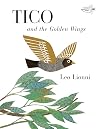
Tico and the Golden Wings
by Leo Lionni
On This Page
Description
A wingless bird is granted his wish for a pair of golden wings.Tags
Recommendations













Member Reviews
I believe that the art and the main message are meant to be lovely, and that young readers can discuss whether the other black birds are true 'friends' or not... and that when all aspects of the story are considered, the book is worth recommending. The 'Dragonfly' edition has interesting discussion questions. For example, Dragonfly asks us to consider more deeply the idea that *everyone* has memories, dreams, ambitions, fears... that are different from others... the 'friends' are not a set of clones, but are individuals themselves.
On the other hand, what would a parent say if a child took the lesson from this to heart and gave away all of his possessions except for a rice bowl? Maybe there's a reason this is set in a place that looks show more like India; I don't think it would truly fly in the US, or even in England, Ireland or Denmark, the homes of Dickens, Wilde, and Andersen respectively. show less
On the other hand, what would a parent say if a child took the lesson from this to heart and gave away all of his possessions except for a rice bowl? Maybe there's a reason this is set in a place that looks show more like India; I don't think it would truly fly in the US, or even in England, Ireland or Denmark, the homes of Dickens, Wilde, and Andersen respectively. show less
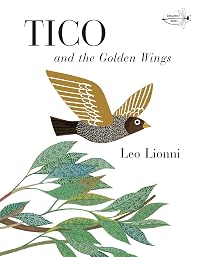
Leo Lionni is one of my favorite illustrators. His artistry is difficult to define. It is stunningly beautiful. This story contains a little bird who was born without wings. His wish was to obtain wings and be like other birds. When his wish is granted, his wings are not ordinary, but are beautiful gold. Whereas before he was ostracized for not having wings, now he is shunned because he is more beautiful than others.
Tico finds birds that are in need of wings and donates one of his beautiful gold wings to that bird in need. When a poor man tells him he cannot buy medications for his child, Tico gave him one of his feathers to sell. Where his gold wing was located, now a black one fills in. Little, by little, his gold wings are replaced show more with shiny black ones. He gave his last gold flower to a bride so she could be more beautiful.
Now, the other birds welcomed him because he was like them. The moral of this lovely story is that Tico realized he was not special because of gold wings, rather, the joy was in giving to those less fortunate, and that all are different in various ways.
This stellar book produced by Lionni who is a four-time Caldecott winner, is now one of my favorites of his books. show less
Tico finds birds that are in need of wings and donates one of his beautiful gold wings to that bird in need. When a poor man tells him he cannot buy medications for his child, Tico gave him one of his feathers to sell. Where his gold wing was located, now a black one fills in. Little, by little, his gold wings are replaced show more with shiny black ones. He gave his last gold flower to a bride so she could be more beautiful.
Now, the other birds welcomed him because he was like them. The moral of this lovely story is that Tico realized he was not special because of gold wings, rather, the joy was in giving to those less fortunate, and that all are different in various ways.
This stellar book produced by Lionni who is a four-time Caldecott winner, is now one of my favorites of his books. show less
Tico wishes more than anything to have wings like all the other birds. One day, his wishes are answered and he receives golden wings that make all the other bird jealous. Little by little he ends up giving away his golden feathers in order to help others in need. Eventually all of his golden feathers are gone, but he is granted a pair of regular feathers, just like all the other birds. Finally he is accepted as one of the birds, but he knows inside that he is unique although he now fits in, because of the experiences he has had.
This story has a little different take on acceptance. We would hope that the other birds would accept him with or without any kind of feathers, but it isn't so here. There is a definite path of struggle, and I show more think that it is a good reflection of what people may really experience in life rather than an idealized notion that we should just accept everybody. show less
This story has a little different take on acceptance. We would hope that the other birds would accept him with or without any kind of feathers, but it isn't so here. There is a definite path of struggle, and I show more think that it is a good reflection of what people may really experience in life rather than an idealized notion that we should just accept everybody. show less
I realize this intends a positive message, but I seem to come away with, "People suck, and there's no way to win."
Tico had no wings. He dreamed that he had wings and a wishingbird appeared and gave him some. His friends thought he was different and thought he was too good for them with his golden wings. They abandoned him. He realized that when he gave away his golden wings they turned brown. After his wings were fully brown, his friends were happy to play with him again. This is not one of my favorites from Lionni. However, it is still a good read. I just thought the other birds should accept Tico Golden wings or not. It thought it was powerful that Tico gave his golden wings away to others in need. However, outside looks shouldn't matter. The inside of a person should.
I really enjoyed the illustration in this story because it was so dense and colorful. The importance and value of helping others is stressed in the story of the bird's gifting away of its golden feathers. I could teach my kids that this story is about using what makes them special to help other people that are in need.
Tico is a bird, who never had wings. He was never able to fly like his friends, and was bound to the ground. One special day, a wishing bird grants him one wish. Tico chooses to have beautiful golden wings, so he could finally be able to fly. When Tico presented his new wings to his friends, they insisted that Tico would no longer be able to join them. Feeling rejected, Tico decided to give his golden feathers to those more in need. One by one, he gave away his precious golden feathers until he was left with plain black wings. In the end, his friends allowed Tico to join them again. This story gives positive support to being giving and being generous, especially to those who are more in need. What I find discouraging in the story is the show more rejection that Tico had to face when he was given his golden wings. Tico's friends should have been accepting of him, wings or no wings. show less
Members
- Recently Added By
Author Information

131+ Works 58,615 Members
Leo Lionni was born in Amsterdam on May 5, 1910. He attended the University of Zurich and also earned a doctorate in Economics from the University of Genoa in 1935. He taught himself to draw by visiting museums. After marrying Nora Maffi in 1931, Lionni moved to Milan, Italy, where he became known as a painter. In 1939 he moved to Philadelphia and show more began working in advertising design. Lionni held several positions in the artistic field including artistic director and design director. He also served as president of the American Institute of Graphic Arts. Around 1960 Lionni moved back to Italy. His first of over forty children's books was Little Blue and Little Yellow. Other titles include Inch by Inch, Frederick, Swimmy, and Alexander and the Wind-up Mouse, all of which won a Caldecott Honor. In addition, he received the American Institute of Graphic Arts Gold Medal in 1984. Lionni died on October 11, 1999 at his home in Tuscany, Italy at the age of 89. (Bowker Author Biography) show less
Awards and Honors
Series
Belongs to Publisher Series
Work Relationships
Common Knowledge
- Canonical title*
- Tico et les ailes d'or
- First words
- Many years ago I knew a little bird whose name was Tico.
- Last words
- (Click to show. Warning: May contain spoilers.)"Each for his own memories, and his own invisible golden dreams."
*Some information comes from Common Knowledge in other languages. Click "Edit" for more information.
Classifications
Statistics
- Members
- 883
- Popularity
- 30,624
- Reviews
- 40
- Rating
- (3.57)
- Languages
- 5 — Chinese, English, French, German, Italian
- Media
- Paper
- ISBNs
- 15
- ASINs
- 6