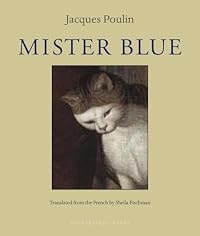
Mister Blue
by Jacques Poulin
On This Page
Description
"By the Governor General Award and Quebec-Paris Prize-winning writer, a novel about a struggling writer and Mr. Blue, his cat and sole companion until the day they discover a copy of The Arabian Nights in a cave along the beach. Understated and deeply human"--Tags
Recommendations
































Member Recommendations
Member Reviews
Rating: 4.5* of five
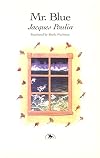
The Publisher Says: By the Governor General Award and Quebec-Paris Prize-winning writer, a novel about a struggling writer and Mister Blue, his cat and sole companion until the day they discover a copy of The Arabian Nights in a cave along the beach. Tinged with melancholy, Mister Blue is at once playful, understated, and deeply human.
Jacques Poulin (1937-) is the author of twelve novels. Among his many honors are the 1978 Governor General’s Award, the 1990 and 2000 Molson Prize for the Arts, and the Gilles-Corbeil Prize in 2008. He lives in Québec City.
My Review: This book arrived in a surprise package from my sister, and we must be sharing some aetheric connection: Two days before I got the package, I was show more dithering between this Poulin title and Translation is a Love Affair to put in my Amazon cart for Money Day! Heh. Now I can read both!
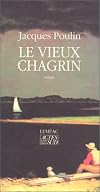
Thus speaks Jim, addressing an intimate audience, and self-talking his own, self-defined failure as a writer. You see, his (probably) imaginary love object won't show him her face, only leaving traces of herself in a riverside cave and a moored sailboat that slowly, steadily is repaired and painted and generally tarted up in the course of Jim's summer obsession.
By the end of the story, Jim's first novel-writing project has been abandoned, a love story that contains no lovers only friends. His second project, just begun as we leave the ramshackle house of Jim's youngest years, gains wind in its sails by his first, possibly first ever, emotional risk-taking act. It's not exactly a stunning shocking pearl-clutching shock, but it is amazing nonetheless. It is a pitch-perfect end to a beautiful chamber opera. I can't wait for the next one to arrive! show less
The Publisher Says: By the Governor General Award and Quebec-Paris Prize-winning writer, a novel about a struggling writer and Mister Blue, his cat and sole companion until the day they discover a copy of The Arabian Nights in a cave along the beach. Tinged with melancholy, Mister Blue is at once playful, understated, and deeply human.
Jacques Poulin (1937-) is the author of twelve novels. Among his many honors are the 1978 Governor General’s Award, the 1990 and 2000 Molson Prize for the Arts, and the Gilles-Corbeil Prize in 2008. He lives in Québec City.
My Review: This book arrived in a surprise package from my sister, and we must be sharing some aetheric connection: Two days before I got the package, I was show more dithering between this Poulin title and Translation is a Love Affair to put in my Amazon cart for Money Day! Heh. Now I can read both!
'Books contain nothing, or almost nothing, that's important: everything is in the mind of the person reading them.'
If you were trying to find an idiotic remark, that one took the cake!
Thus speaks Jim, addressing an intimate audience, and self-talking his own, self-defined failure as a writer. You see, his (probably) imaginary love object won't show him her face, only leaving traces of herself in a riverside cave and a moored sailboat that slowly, steadily is repaired and painted and generally tarted up in the course of Jim's summer obsession.
By the end of the story, Jim's first novel-writing project has been abandoned, a love story that contains no lovers only friends. His second project, just begun as we leave the ramshackle house of Jim's youngest years, gains wind in its sails by his first, possibly first ever, emotional risk-taking act. It's not exactly a stunning shocking pearl-clutching shock, but it is amazing nonetheless. It is a pitch-perfect end to a beautiful chamber opera. I can't wait for the next one to arrive! show less
Jim, the narrator of this outstanding novel, is a writer and former professor, who lives in his isolated childhood home alongside the St. Lawrence River, close to Quebec City. He lives alone, save for his old feline companion Mister Blue, as he attempts to write a "the most beautiful love story in the world." However, he has never been truly in love, and he struggles to provide a face and a voice to the woman in his novel.
One day Jim walks on the bank of the river, and he is surprised to see footsteps in the sand, leading to a nearby cave. He enters, and finds evidence that someone is living there. A copy of The Arabian Nights is alongside remnants of a campfire, which has been inscribed with the name "Marie K." The novelist changes show more her name in his mind to "Marika", and she serves as the inspiration for the woman in his novel.
He later meets a matronly woman, who knows Marika and gives him an enticing description of her. As he is befriended by the matron and a young woman, referred to as La Petite, Jim's heart is filled with Marika's presence and his growing love for her, while he awaits a reply to his letters of invitation. His friendship with La Petite deepens, as the two damaged souls find kinship and draw each other out of their emotional shells:
In spite of the difference in age and the other differences, which were many, La Petite and I had several things in common. And the most important of these common points, at least the one that brought me closest to her, was perhaps this: most of the time we were, both of us, walled up inside ourselves and busy trying to stick back together the fragments of our past.
Jim continues to search for the elusive Marika, as his heart progressively fills with love, longing and despair.
Mister Blue is a richly layered, haunting and deeply moving novel of love and memory, in which reality and fantasy blur and merge. It is both beautifully and simply written, and I adored and identified closely with Jim and La Petite, who will reside in my heart for many days. I can't recommend this novel highly enough, and I look forward to reading more of Poulin's translated works. show less
One day Jim walks on the bank of the river, and he is surprised to see footsteps in the sand, leading to a nearby cave. He enters, and finds evidence that someone is living there. A copy of The Arabian Nights is alongside remnants of a campfire, which has been inscribed with the name "Marie K." The novelist changes show more her name in his mind to "Marika", and she serves as the inspiration for the woman in his novel.
He later meets a matronly woman, who knows Marika and gives him an enticing description of her. As he is befriended by the matron and a young woman, referred to as La Petite, Jim's heart is filled with Marika's presence and his growing love for her, while he awaits a reply to his letters of invitation. His friendship with La Petite deepens, as the two damaged souls find kinship and draw each other out of their emotional shells:
In spite of the difference in age and the other differences, which were many, La Petite and I had several things in common. And the most important of these common points, at least the one that brought me closest to her, was perhaps this: most of the time we were, both of us, walled up inside ourselves and busy trying to stick back together the fragments of our past.
Jim continues to search for the elusive Marika, as his heart progressively fills with love, longing and despair.
Mister Blue is a richly layered, haunting and deeply moving novel of love and memory, in which reality and fantasy blur and merge. It is both beautifully and simply written, and I adored and identified closely with Jim and La Petite, who will reside in my heart for many days. I can't recommend this novel highly enough, and I look forward to reading more of Poulin's translated works. show less
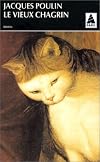
Jacques Poulin is a French Canadian author whose tender, thoughtful books are treasures. Vieux Chagrin, or Old Grief, oddly titled Mister Blue in the English translation, is another such gem. As always the writing is lyrical and expressive, and the action is quiet and philosophical. There is something otherworldly about Mister Blue, and yet the themes are ones with which we all must grapple.
Jim is a published author and Hemingway expert who lives alone in his childhood home on the shores of Île d'Orléans. By nature a quiet and dreamy sort, Jim calls himself the slowest writer in Quebec. Sticking to a regime, Jim tries to write a page a day, but is often distracted by the view from his window, the sound of the river, his cats. He is show more trying to write a love story, however, never having been in love himself, he struggles with writer's block. One day, as he and Mr. Blue the cat are walking along the beach, Jim discovers footprints leading to the cave at the end of the beach. Curious he goes in and see the remnants of a fire, a candle, a book, and a box of matches.
I went closer to look at the book: it was The Arabian Nights. I would have liked to pick it up and turn the pages, but something held me back. I had the feeling that to do so would be indiscreet. It was as if I were in some person's bedroom. I mean: in everything I could see there - the footprints, the objects, even in the air itself - there was a sense of somebody's soul. I didn't touch the book.
Jim begins to fantasize about the owner of the book, whom he calls Marika. In a beautiful note he leaves for her, Jim writes:
Now that you're there, everything seems possible, even the wildest, most secret dreams, the ones we never talk about, those that lurk beneath the surface of ourselves. I cannot help thinking that your presence is a kind of invitation to begin everything again, to start from scratch.
Things begin to change for Jim, and he opens up to a world larger than his small, introverted existence. He forms new relationships which allow him to explore being a lover, a son, and a father. He ponders his soul and its protective shelter, the idea of "two hearts" (feminine and masculine) within a single body, and the meaning of family.
What matters are the emotional ties that connect people and form a vast, invisible web without which the world would crumble. Everything else to which people devote the greater part of their time, looking very serious as they do so, is of only minor importance.
Yet overshadowing everything for the reader is the question of the boundary between reality and dream. Is everything that Jim experiences real? show less
Jim is a published author and Hemingway expert who lives alone in his childhood home on the shores of Île d'Orléans. By nature a quiet and dreamy sort, Jim calls himself the slowest writer in Quebec. Sticking to a regime, Jim tries to write a page a day, but is often distracted by the view from his window, the sound of the river, his cats. He is show more trying to write a love story, however, never having been in love himself, he struggles with writer's block. One day, as he and Mr. Blue the cat are walking along the beach, Jim discovers footprints leading to the cave at the end of the beach. Curious he goes in and see the remnants of a fire, a candle, a book, and a box of matches.
I went closer to look at the book: it was The Arabian Nights. I would have liked to pick it up and turn the pages, but something held me back. I had the feeling that to do so would be indiscreet. It was as if I were in some person's bedroom. I mean: in everything I could see there - the footprints, the objects, even in the air itself - there was a sense of somebody's soul. I didn't touch the book.
Jim begins to fantasize about the owner of the book, whom he calls Marika. In a beautiful note he leaves for her, Jim writes:
Now that you're there, everything seems possible, even the wildest, most secret dreams, the ones we never talk about, those that lurk beneath the surface of ourselves. I cannot help thinking that your presence is a kind of invitation to begin everything again, to start from scratch.
Things begin to change for Jim, and he opens up to a world larger than his small, introverted existence. He forms new relationships which allow him to explore being a lover, a son, and a father. He ponders his soul and its protective shelter, the idea of "two hearts" (feminine and masculine) within a single body, and the meaning of family.
What matters are the emotional ties that connect people and form a vast, invisible web without which the world would crumble. Everything else to which people devote the greater part of their time, looking very serious as they do so, is of only minor importance.
Yet overshadowing everything for the reader is the question of the boundary between reality and dream. Is everything that Jim experiences real? show less
"I knew that I could trust Mr. Blue. He was behaving very well. He seemed to know exactly what to do: he was curled up against her and purring, showing her how much he liked being petted by her. He was telling her in his own way that being gentle isn't necessarily a disaster and that she mustn't despair of humanity."
Mister Blue by Jacques Poulin is a gentle, serenely written novel about - what exactly? The narrator, Jim, is a former professor who lives in an isolated area near the St. Lawrence River in Quebec. He used to teach and write about Ernest Hemingway, and the influence of that author's simple declarative sentences can be felt throughout this book, despite its dreamier, more fantastic content. After his marriage dissolved, Jim show more left teaching and took up writing. Every day he labors away on a "love story", but the characters keep turning away from love to friendship instead. He believes all stories are based on real life experiences, and his writing and the novel you're reading begin overlapping in various self-referential ways.
"When you start to write a story, you're like a traveler who has spotted a castle in the distance. In the hope of arriving at it, you take a little road that descends a hillside toward a forest-covered valley. The road narrows and becomes a path that is obliterated here and there, and you're no longer very sure what place you've come to; you feel as if you're going in circles. Now and then, you walk through a clearing flooded with sunlight, or you swim across a river. . . . At the summit {of a mountain you've climbed} you catch sight of the castle, but it is on the next hill and it's not as beautiful as you thought: it's more like a country house or a villa. . . . In reality, it's not a castle or a villa or even a country home: it's just like a dilapidated old house that, oddly enough, looks very much like the one in which you spent your childhood."
Very much, in fact, like the house he's living in.
Jim's never been in love, and finds a little cave in which a woman he thinks of as "Marika" has been staying and reading Arabian Nights. He doesn't see her, but sees various indications she is near - her sailboat, her footprints which are just his size. He eventually begins to fall in love with the elusive Marika. Meanwhile, a young woman nicknamed La Petite has begun frequenting his home, dressing in his long-gone brother's and sister's clothing, reading his old articles and teaching materials, and asking him probing questions. His friendly and fatherly relationship with her is one of the highlights of the book. In the end, there is some resolution of his relationships with Marika and La Petite.
There are many threads and symbols to ponder - why the title Mister Blue, for example? The cat shows up at various critical times, including as "a wink of fate" when Jim makes an important trip to Marika's cave. I had the feeling that if one did a chart of when Mister Blue appeared joined with what happened at that time, some additional insight into the author's intent would emerge. In any event, it's a smooth, peaceful read that conveys that gentleness isn't necessarily a disaster, and that there are good souls amidst a sometimes unfortunate humanity, with Jim's and La Petite's among them. show less
Mister Blue by Jacques Poulin is a gentle, serenely written novel about - what exactly? The narrator, Jim, is a former professor who lives in an isolated area near the St. Lawrence River in Quebec. He used to teach and write about Ernest Hemingway, and the influence of that author's simple declarative sentences can be felt throughout this book, despite its dreamier, more fantastic content. After his marriage dissolved, Jim show more left teaching and took up writing. Every day he labors away on a "love story", but the characters keep turning away from love to friendship instead. He believes all stories are based on real life experiences, and his writing and the novel you're reading begin overlapping in various self-referential ways.
"When you start to write a story, you're like a traveler who has spotted a castle in the distance. In the hope of arriving at it, you take a little road that descends a hillside toward a forest-covered valley. The road narrows and becomes a path that is obliterated here and there, and you're no longer very sure what place you've come to; you feel as if you're going in circles. Now and then, you walk through a clearing flooded with sunlight, or you swim across a river. . . . At the summit {of a mountain you've climbed} you catch sight of the castle, but it is on the next hill and it's not as beautiful as you thought: it's more like a country house or a villa. . . . In reality, it's not a castle or a villa or even a country home: it's just like a dilapidated old house that, oddly enough, looks very much like the one in which you spent your childhood."
Very much, in fact, like the house he's living in.
Jim's never been in love, and finds a little cave in which a woman he thinks of as "Marika" has been staying and reading Arabian Nights. He doesn't see her, but sees various indications she is near - her sailboat, her footprints which are just his size. He eventually begins to fall in love with the elusive Marika. Meanwhile, a young woman nicknamed La Petite has begun frequenting his home, dressing in his long-gone brother's and sister's clothing, reading his old articles and teaching materials, and asking him probing questions. His friendly and fatherly relationship with her is one of the highlights of the book. In the end, there is some resolution of his relationships with Marika and La Petite.
There are many threads and symbols to ponder - why the title Mister Blue, for example? The cat shows up at various critical times, including as "a wink of fate" when Jim makes an important trip to Marika's cave. I had the feeling that if one did a chart of when Mister Blue appeared joined with what happened at that time, some additional insight into the author's intent would emerge. In any event, it's a smooth, peaceful read that conveys that gentleness isn't necessarily a disaster, and that there are good souls amidst a sometimes unfortunate humanity, with Jim's and La Petite's among them. show less
Jim is not a happy man, and his unhappiness intrudes upon his work, the writing of love stories, which proceeds at a crawl, diverts itself, pauses, grinds to a halt. He lives on an island in the St. Lawrence River in a house his father, years earlier, moved across the bay. Along with the house came memories, good and bad, of Jim’s early life, his failed marriage, his abandoned academic career, his relationship with his younger brother. It sounds like a recipe for despair, and certainly Jim borders on that state. But he has a couple of things going for him: his cats, including Mister Blue, and an inner drive for love, which in this case takes the form of his artistic muse, the mysterious Marika, who haunts a cave near the shore and show more whom he longs for incessantly but never quite meets.
Much of Jacques Poulin’s novel has a dreamlike quality. It ruminates. It mulls things over. It is full of false starts, erasures, and abandoned story lines. It is, in short, perhaps, an exploration of writerly creativity. Jim’s infatuation with (the possibly imaginary) Marika, who curiously seems to share his love of story (e.g. The Arabian Nights) and his shoe size (as evidenced by her footprints in the sand), traces the pattern of the difficulty he is having writing his current novel. Along the way, Jim encounters others who have been disappointed by love, or damaged by it. Each is working to reclaim some semblance of equanimity, or the possibility of new growth in healthier directions and locales.
I wondered, as I read this short novel, how much the island in the stream (which is nevertheless close enough to the sea to be affected by the tides) symbolises the artist. But I suspect there are a number of levels of meaning interweaving here, some of which might only surface if one were to read it in its original French. Gently recommended. show less
Much of Jacques Poulin’s novel has a dreamlike quality. It ruminates. It mulls things over. It is full of false starts, erasures, and abandoned story lines. It is, in short, perhaps, an exploration of writerly creativity. Jim’s infatuation with (the possibly imaginary) Marika, who curiously seems to share his love of story (e.g. The Arabian Nights) and his shoe size (as evidenced by her footprints in the sand), traces the pattern of the difficulty he is having writing his current novel. Along the way, Jim encounters others who have been disappointed by love, or damaged by it. Each is working to reclaim some semblance of equanimity, or the possibility of new growth in healthier directions and locales.
I wondered, as I read this short novel, how much the island in the stream (which is nevertheless close enough to the sea to be affected by the tides) symbolises the artist. But I suspect there are a number of levels of meaning interweaving here, some of which might only surface if one were to read it in its original French. Gently recommended. show less
This is the story of a writer living in his childhood home, a rambling and dilapidated old house, with his cat, Mr. Blue. The writer falls in love with a woman he's never met (and we know he's in love long before he figures it out), and he befriends some other women who've arrived in his sparsely populated bay. The real friends are a wonderful, warm, down-to-earth middle-aged woman and Le Petit, a shy and needy teenage girl. Mr. Blue is a minor character, in some ways, and the novel is not so much about the cat as it is about the protagonist's dreams of love and his fear of real intimacy. I love the juxtaposition of the existential longings and the day-to-day practical; our protagonist also plays tennis with his brother. Just so.
I show more marked a couple of favorite passages.
As Le Petite is relaying some painful historical information about herself: "I knew that I could trust Mr. Blue. He was behaving very well. He seemed to know exactly what to do: he was curled up against her and purring, showing her how much he liked being petted by her. He was telling her in his own way that being gentle isn't necessarily a disaster and that she mustn't despair of humanity."
Later, as Le Petite is engaged in a tirade against adults: This was no time to tell her that, even for older people, the need for affection was still immense, infinite, out of all proportion to reality, and eternally unsatisfied."
This is not a cynical novel. It's lyrical and subtle and almost magical. Highly recommended. show less
I show more marked a couple of favorite passages.
As Le Petite is relaying some painful historical information about herself: "I knew that I could trust Mr. Blue. He was behaving very well. He seemed to know exactly what to do: he was curled up against her and purring, showing her how much he liked being petted by her. He was telling her in his own way that being gentle isn't necessarily a disaster and that she mustn't despair of humanity."
Later, as Le Petite is engaged in a tirade against adults: This was no time to tell her that, even for older people, the need for affection was still immense, infinite, out of all proportion to reality, and eternally unsatisfied."
This is not a cynical novel. It's lyrical and subtle and almost magical. Highly recommended. show less
I understood that during my whole life I’d never really been in love. I’d only looked for affection. I’d done lots of things to make people like me, but I’d never loved anybody.
No surprise then, that Jim, a solitary, middle-aged writer living outside Quebec City, develops writer’s block while drafting a love story. But how he tries to work through that writer’s- and love-block is surprising, and mysterious, and I enjoyed this short novel.
Two years ago, I enjoyed another novella by Poulin, Translation Is a Love Affair, and thought often of it while reading this one. The familiarity seemed comforting at the time but, in retrospect, I’m growing disappointed by the frank similarity in characters, story, tone, style, structure show more and length. I’m interested (and wary) to get to his Spring Tides. show less
No surprise then, that Jim, a solitary, middle-aged writer living outside Quebec City, develops writer’s block while drafting a love story. But how he tries to work through that writer’s- and love-block is surprising, and mysterious, and I enjoyed this short novel.
Two years ago, I enjoyed another novella by Poulin, Translation Is a Love Affair, and thought often of it while reading this one. The familiarity seemed comforting at the time but, in retrospect, I’m growing disappointed by the frank similarity in characters, story, tone, style, structure show more and length. I’m interested (and wary) to get to his Spring Tides. show less
Members
- Recently Added By
Author Information

18 Works 971 Members
Jacques Poulin was born in 1937 in Saint Gédéon, Québec. He received his Arts degree from the Université Laval where he focused on literature and psychology. He worked for several years as a commercial translator and later as a college guidance counsellor. It was only after the success of his second novel, Jimmy, that he was able to devote show more himself competely to his writing. Poulin's novels, Les Grandes Marées, Volkswagen Blues and Le Vieux Chagrin achieved great commercial and critical success in Québec, winning Poulin the Governor General's Award for Les Grandes Marées and the Prix France-Amérique for Le Vieux Chagrin. His eighth and most recent novel, La Tournée d'Automne was published in 1993 to excellent reviews. Poulin has written a total of eight novels, six of which have been translated into English. (Bowker Author Biography) show less
Some Editions
Awards and Honors
Awards
Common Knowledge
- Original title
- Le vieux chagrin
- Original publication date
- 1989 (original French) (original French); 2011 (English: Fischman) (English: Fischman)
- People/Characters
- Jim; Mister Blue
- Important places
- Québec, Canada; Île d'Orléans
- First words
- Spring had arrived.
- Quotations
- There are times when a writer can come up with nothing better than the wreckage of his own life.
In spite of the difference in age and the other differences, which were many, La Petite and I had several things in common. And the most important of these common points, at least the one that brought me closest to her, was p... (show all)erhaps this: most of the time we were, both of us, walled up inside ourselves and busy trying to stick back together the fragments of our past. - Last words
- (Click to show. Warning: May contain spoilers.)The cats and I watched her, unmoving and filled with admiration, and I don't know if they were seeing the same thing as I, but the soft, bluish light that illuminated her face turned my heart upside down.
- Blurbers
- Hage, Rawi
Classifications
- Genres
- Fiction and Literature, General Fiction
- DDC/MDS
- 843.914 — Literature & rhetoric French Literature French fiction 1900- 20th Century 1945-1999
- LCC
- PQ3919.2 .P59 .V5413 — Language and Literature French, Italian, Spanish and Portuguese literatures French literature Provincial, local, colonial, etc.
- BISAC
Statistics
- Members
- 119
- Popularity
- 272,886
- Reviews
- 12
- Rating
- (3.80)
- Languages
- English, French
- Media
- Paper
- ISBNs
- 8