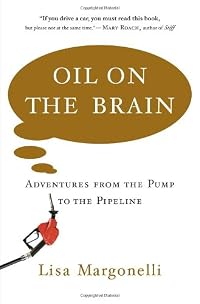
Oil on the Brain: Adventures from the Pump to the Pipeline
by Lisa Margonelli
On This Page
Description
Oil on the Brain is a smart, surprisingly funny account of the oil industry--the people, economies, and pipelines that bring us petroleum, brilliantly illuminating a world we encounter every day. Americans buy ten thousand gallons of gasoline a second, without giving it much of a thought. Where does all this gas come from? Lisa Margonelli's desire to learn took her on a one-hundred thousand mile journey from her local gas station to oil fields half a world away. In search of the truth behind show more the myths, she wriggled her way into some of the most off-limits places on earth: the Strategic Petroleum Reserve, the New York Mercantile Exchange's crude oil market, oil fields from Venezuela, to Texas, to Chad, and even an Iranian oil platform where the United States fought a forgotten one-day battle. In a story by turns surreal and alarming, Margonelli meets lonely workers on a Texas drilling rig, an oil analyst who almost gave birth on the NYMEX trading floor, Chadian villagers who are said to wander the oil fields in the guise of lions, a Nigerian warlord who changed the world price of oil with a single cell phone call, and Shanghai bureaucrats who dream of creating a new Detroit. Deftly piecing together the mammoth economy of oil, Margonelli finds a series of stark warning signs for American drivers. show lessTags
Recommendations
















Member Reviews
I have done much reading on the subject of oil and our society's seemingly insatiable desire for more of the stuff. This book does much to simplify the industry and at the same time make me shake my head in wonderment at the continuous collective hiding of our head in the sand in which our country indulges itself. We simply have to start doing something to curb our appetite. The recent economic crisis is only the latest manifestation of our oil dependency.
The author started out with her complaints about the price of gas at the pump and followed the product back to its source exploring the various explanations about why it costs so much. On the way she went to refineries and the NYMEX as well as to other countries. The NYMEX and the show more Strategic Petroleum Reserve turn out to be just as mysterious in their operations as does the governments of Nigeria and Iran. The author makes the connection between the modern petro-state and so many of the current instabilities in the world comprehensible and that is no mean feat.
This book is very readable and could provide valuable insights for the average reader. However, most American's don't want to see, hear, or read about anything that might make them feel bad about their love of SUV's and interfere with their current lifestyle. For that reason I suspect that this book has a limited audience. That is too bad as it is very illuminating. show less
The author started out with her complaints about the price of gas at the pump and followed the product back to its source exploring the various explanations about why it costs so much. On the way she went to refineries and the NYMEX as well as to other countries. The NYMEX and the show more Strategic Petroleum Reserve turn out to be just as mysterious in their operations as does the governments of Nigeria and Iran. The author makes the connection between the modern petro-state and so many of the current instabilities in the world comprehensible and that is no mean feat.
This book is very readable and could provide valuable insights for the average reader. However, most American's don't want to see, hear, or read about anything that might make them feel bad about their love of SUV's and interfere with their current lifestyle. For that reason I suspect that this book has a limited audience. That is too bad as it is very illuminating. show less
In the interest of full disclosure I need to say that I worked in the oil industry for 36 years and, in fact, my school years were spent in a community that was very largely dependent on oil refining for its livelihood. So, when it comes to the industry, I admit to being a little bit prejudiced in its favor and more than a little defensive when I sense that it is being unfairly criticized. The industry most certainly deserves some criticism when it comes to its past and to its present and I don't deny that. It's all of the nutty conspiracy theories that raise my blood pressure at times.
Lisa Margonelli's Oil on the Brain is the author's attempt to explain the price of a gallon of gasoline at the pump by tracing that refined product all show more the way back to its source. Margonelli came to her subject with the very limited understanding of the oil industry that the average American consumer has but, by spending time with industry people working in all of its many branches, she gathered enough information and insight to write an entertaining explanation of how gasoline is priced in today's market.
All of us, even oil company employees, shake our heads and cringe when we roll up to the gas pump for another painful purchase of enough gasoline to refill our tanks. That's why Margonelli begins her story at one of California's multi-pump convenience stores where she spent enough time to get a good feel for what it is like to be the retailer of a necessity for which the consumer feels gouged at every purchase. From there, she traces the flow of gasoline backward to the distribution system that includes truckers and pipeline systems, even riding with one trucker as he carried his dangerous cargo from its collection point to several California retailers.
Of course, she was still nowhere near the ultimate source of the gasoline, so she continued her backward journey and spent several days inside a California refinery where she watched the process of turning crude oil into its various finished products, including gasoline. She completed her journey by traveling to Freestone County, deep in East Texas, where she was welcomed onto one of the dozens of drilling rigs in the area.
Oil on the Brain does a fine job of simplifying and explaining the extremely complicated process of finding and producing oil and gas and I believe that most readers will gain a new appreciation for the complexity of such a risky undertaking. Margonelli also spent some time at the Strategic Petroleum Reserve located on the Texas Gulf Coast and in New York with the oil traders on the floor of the NYMEX. Those are particularly interesting chapters, especially the one concerning the NYMEX traders because it goes a long way in explaining why the price at the pump fluctuates as drastically and as often as it does.
The second half of Oil on the Brain recounts Margonelli's travels to Venezuela, Chad, Iran, Nigeria and China. All of these countries other than China are oil exporters and Margonelli details the effects, both good and bad, that impact the citizens of those countries when their governments become so dependent on the exportation of oil for their survival. Needless to say, the promises made to those citizens seldom morph into anything resembling the benefits listed by the oil companies because the local governments manage to squander and steal for themselves a large percentage of the new money that flows into the producing countries. Margonelli visited China to see for herself the rapid economic growth there that is causing the huge demand in oil imports that is so adversely impacting today's oil price.
I recommend this book to anyone who wants to understand how the search for a predictable oil supply impacts world politics and the lives of all of us. As Margonelli says in one chapter, the hidden cost in each gallon of gasoline might be as much as $5 per gallon if one includes all of the tax money being spent by the United States to make it possible to keep the oil flowing in this direction. That includes money spent on the military, foreign aid, and homeland security spending that has largely become necessary because of this country's presence in the Middle East in search of oil.
Rated at: 4.0 show less
Lisa Margonelli's Oil on the Brain is the author's attempt to explain the price of a gallon of gasoline at the pump by tracing that refined product all show more the way back to its source. Margonelli came to her subject with the very limited understanding of the oil industry that the average American consumer has but, by spending time with industry people working in all of its many branches, she gathered enough information and insight to write an entertaining explanation of how gasoline is priced in today's market.
All of us, even oil company employees, shake our heads and cringe when we roll up to the gas pump for another painful purchase of enough gasoline to refill our tanks. That's why Margonelli begins her story at one of California's multi-pump convenience stores where she spent enough time to get a good feel for what it is like to be the retailer of a necessity for which the consumer feels gouged at every purchase. From there, she traces the flow of gasoline backward to the distribution system that includes truckers and pipeline systems, even riding with one trucker as he carried his dangerous cargo from its collection point to several California retailers.
Of course, she was still nowhere near the ultimate source of the gasoline, so she continued her backward journey and spent several days inside a California refinery where she watched the process of turning crude oil into its various finished products, including gasoline. She completed her journey by traveling to Freestone County, deep in East Texas, where she was welcomed onto one of the dozens of drilling rigs in the area.
Oil on the Brain does a fine job of simplifying and explaining the extremely complicated process of finding and producing oil and gas and I believe that most readers will gain a new appreciation for the complexity of such a risky undertaking. Margonelli also spent some time at the Strategic Petroleum Reserve located on the Texas Gulf Coast and in New York with the oil traders on the floor of the NYMEX. Those are particularly interesting chapters, especially the one concerning the NYMEX traders because it goes a long way in explaining why the price at the pump fluctuates as drastically and as often as it does.
The second half of Oil on the Brain recounts Margonelli's travels to Venezuela, Chad, Iran, Nigeria and China. All of these countries other than China are oil exporters and Margonelli details the effects, both good and bad, that impact the citizens of those countries when their governments become so dependent on the exportation of oil for their survival. Needless to say, the promises made to those citizens seldom morph into anything resembling the benefits listed by the oil companies because the local governments manage to squander and steal for themselves a large percentage of the new money that flows into the producing countries. Margonelli visited China to see for herself the rapid economic growth there that is causing the huge demand in oil imports that is so adversely impacting today's oil price.
I recommend this book to anyone who wants to understand how the search for a predictable oil supply impacts world politics and the lives of all of us. As Margonelli says in one chapter, the hidden cost in each gallon of gasoline might be as much as $5 per gallon if one includes all of the tax money being spent by the United States to make it possible to keep the oil flowing in this direction. That includes money spent on the military, foreign aid, and homeland security spending that has largely become necessary because of this country's presence in the Middle East in search of oil.
Rated at: 4.0 show less
Lisa Margonelli has written a comprehensive account of the role petroleum plays in our lives, our economy, and our politics. Having worked in the petrochemical industry and being interested in world politics, I thought I was well-informed. Yet I learned something new in nearly every paragraph, often exclaiming and reading sections to anyone nearby.
Margonelli starts her journey at the local gas station, researching and directly observing how U.S. consumers interact with petroleum at the pump. She moves on to tankers that deliver the fuel and the refineries that supply it, then NYMEX, and finally to the sources of our petroleum around the world. Her travels take her from Venezuela to Africa and the Middle East and finally to China. It's a show more fascinating and troubling journey.
Says Mary Roach, the author of Stiff, on the cover, "If you drive a car, you must read this book, but please not at the same time." I would argue that, even if you don't drive a car, you must read this book. The politics of petroleum is touching every person on the planet, whether we know it or not. We should all be better informed. show less
Margonelli starts her journey at the local gas station, researching and directly observing how U.S. consumers interact with petroleum at the pump. She moves on to tankers that deliver the fuel and the refineries that supply it, then NYMEX, and finally to the sources of our petroleum around the world. Her travels take her from Venezuela to Africa and the Middle East and finally to China. It's a show more fascinating and troubling journey.
Says Mary Roach, the author of Stiff, on the cover, "If you drive a car, you must read this book, but please not at the same time." I would argue that, even if you don't drive a car, you must read this book. The politics of petroleum is touching every person on the planet, whether we know it or not. We should all be better informed. show less
Given the dramatic rise in oil prices, this is a timely book.
In brief, it takes a journey from Americans filling up their cars, with their irrational and (almost) unstoppable consumerism and lack of awareness about history and the world, through the chaos of oil-producing states (whose economies and governments have been hugely impacted by decades of US government, corporation, World Bank and IMF intervention), to the future of energy in China, which is trying (with very limited success) to hold back the tide of oil-burning car purchasers long enough to put in place a more sustainable system.
What I like about the book is that the author shows a lot of respect for everyone involved, from the convenience store clerk to oil ministers. She show more tries to understand the very human and often quite emotional factors that make up each complex individual. She does a very good job of conveying how challenging all of their jobs are, and how each individual's interests and motivations fit within the larger and even more complex global oil system.
While the television media tends to oversimplify everything to the point of nonsense, this book drills down through the many layers that make up our global oil system, so many complex interactions that are behind the apparent simplicity of gasoline coming out of a hose at a gas station. show less
In brief, it takes a journey from Americans filling up their cars, with their irrational and (almost) unstoppable consumerism and lack of awareness about history and the world, through the chaos of oil-producing states (whose economies and governments have been hugely impacted by decades of US government, corporation, World Bank and IMF intervention), to the future of energy in China, which is trying (with very limited success) to hold back the tide of oil-burning car purchasers long enough to put in place a more sustainable system.
What I like about the book is that the author shows a lot of respect for everyone involved, from the convenience store clerk to oil ministers. She show more tries to understand the very human and often quite emotional factors that make up each complex individual. She does a very good job of conveying how challenging all of their jobs are, and how each individual's interests and motivations fit within the larger and even more complex global oil system.
While the television media tends to oversimplify everything to the point of nonsense, this book drills down through the many layers that make up our global oil system, so many complex interactions that are behind the apparent simplicity of gasoline coming out of a hose at a gas station. show less
Margonelli spent three years traveling around the world documenting different stages in the oil flow. The book can be divided in two parts, the first part in the USA in six chapters: 1) gas station, 2) oil delivery trucks, 3) oil refinery, 4) oil drilling, 5) oil futures market, 6) strategic oil reserve. The second part examines overseas oil sources: 7) Venezuela, 8) Chad, 9) Iran, 10) Nigeria, 11) China. Within each chapter it is a human-interest story with Margonelli interacting with a main character (gas station owner, drill operator, oil warlord, Iranian minister of oil, etc..) with tangents to highlight encyclopedic facts about the history of the place or institution in a sometimes overly-wrought magazine-style prose.
I learned a show more lot. While other reviewers enjoyed the earlier chapters, I found the later overseas chapters the most interesting, to learn about the history of oil states and how interconnected everything is. The vast majority of the worlds oil is owned by governments, and not by the Exxon's of the world which only have about 20%, thus Margonelli's focus on the oil states was spot on. In regards to who is to blame for high gas prices in the US, the best theory was from a oil trader in NYC who says its simple supply and demand, China and other countries are demanding a lot more oil.
4 stars: stylistically the prose was inconsistent. At times it flowed well, other times it was choppy with halting sentences, or tried too hard to be clever and endearing (how many ways can you say "the bolt is as big as (fill in the blank)"). I also thought some of the exposes were unnecessarily unsympathetic. The excellent information about oil made it worth the trip, Margonelli's three years traveling around the world to remote and often dangerous places (and probably often boring) has been a great help in understanding first-hand what is happening. show less
I learned a show more lot. While other reviewers enjoyed the earlier chapters, I found the later overseas chapters the most interesting, to learn about the history of oil states and how interconnected everything is. The vast majority of the worlds oil is owned by governments, and not by the Exxon's of the world which only have about 20%, thus Margonelli's focus on the oil states was spot on. In regards to who is to blame for high gas prices in the US, the best theory was from a oil trader in NYC who says its simple supply and demand, China and other countries are demanding a lot more oil.
4 stars: stylistically the prose was inconsistent. At times it flowed well, other times it was choppy with halting sentences, or tried too hard to be clever and endearing (how many ways can you say "the bolt is as big as (fill in the blank)"). I also thought some of the exposes were unnecessarily unsympathetic. The excellent information about oil made it worth the trip, Margonelli's three years traveling around the world to remote and often dangerous places (and probably often boring) has been a great help in understanding first-hand what is happening. show less
The author sets out to trace the oil we use backwards from the gas tank to the point of production. She visits refineries, oil drilling sites, and gas stations along the way, then makes her way overseas to visit oil producing countries in the Third World. A good introduction to the subject, though the author tends to be a little naive at times, and might find her enthusiasm about BP a bit tempered by recent experiences.
in the beginning i really enjoyed the style, but eventually it got tedious and i found myself skipping forward and skimming for paragraphs with numbers and dates. rather informative. the bits about venezuela, chad, nigeria, and iran were all a bit long, but made it worth it to have continued reading.
Members
- Recently Added By
Lists

2008-2012 Notable Books for Adults
127 works; 10 members
Author Information

4 Works 396 Members
Awards and Honors
Common Knowledge
- Original publication date
- 2007
- People/Characters
- Jaun Pablo Perez Alfonzo; Hugo Chávez
- Important places
- California, USA; Texas, USA; Venezuela; Chad; Nigeria; Iran (show all 7); China
Classifications
- Genres
- Economics, Nonfiction, General Nonfiction, Business, Science & Nature, History
- DDC/MDS
- 338.27282 — Society, Government, and Culture Economics Production Mineral Extraction By Product Carbonaceous materials Oil, oil shales, tar sands, natural gas Oil
- LCC
- HD9560.5 .M3185 — Social sciences Industries. Land use. Labor Industries. Land use. Labor Special industries and trades Mineral industries. Metal trade
- BISAC
Statistics
- Members
- 261
- Popularity
- 123,619
- Reviews
- 9
- Rating
- (3.71)
- Languages
- Chinese, English
- Media
- Paper, Ebook
- ISBNs
- 4
- ASINs
- 3