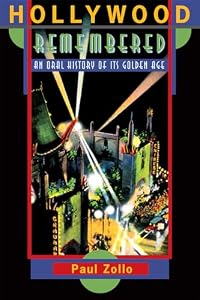
Hollywood Remembered: An Oral History of Its Golden Age
by Paul Zollo
On This Page
Description
In Hollywood Remembered, a wide array of Tinseltown veterans share their stories of life in the city of dreams from the days of silent pictures to the present. The 35 voices, many of whom have come to know Hollywood inside-out, range from film producers and movie stars to restaurateurs and preservationists. Actress Evelyn Keyes recalls how, fresh from Georgia, she met Cecil B. DeMille and was soon acting in Gone With the Wind; Blacklisted writer Walter Bernstein tells how he transformed his show more McCarthy era-experiences into drama with The Front; Steve Allen speaks out on how Hollywood has changed since he first came there in the 1920s; and Jonathan Winters relates how he left a mental institution to come work with Stanley Kramer in It's a Mad, Mad, Mad, Mad World. show lessTags
Recommendations












Member Reviews
Hollywood. The word conjures dreams of fame and fortune, and illusions of ideal beauty and heroic deeds emblazoned in the world’s collective conscience by the medium of sequential still images, recorded on film by a camera ‘box’, that at the rate of 24 images, or frames, per second fool our brain by way of our eyes into seeing a moving (motion) picture of an event or scene that seems actual and quite real. Although motion pictures were made elsewhere – in Astoria, Queens (a New York City borough), in New Jersey by Thomas Edison and in France by the brothers Lumière (ironic surname meaning ‘light’ most appropriate for these film makers), Hollywood has become the iconic emblem for the movies and its stars.
Paul Zollo in this show more 2011 reprint of _Hollywood Remembered, An Oral History of its Golden Age_, originally published in 2002, gives us three books in one: (1) a history of Hollywood from its beginnings in late-nineteenth-century southern California; (2) interviews of individuals who lived and worked in the city as screen writers, actors, musicians, bar tenders, and so on; and (3) a ‘tour’ of Hollywood’s famed hotels, restaurants, film studios, and the Hollywood Forever cemetery.
Figwood might have been the name of the world’s future movie capital, were it not for Daeida Wilcox, resident of Los Angeles in the 1880s, who first heard the name ‘Hollywood’ spoken by a stranger on a train, an affluent woman talking lovingly of her own home near Chicago, and then insisted that her husband Harvey Wilcox name their land in the Cahuenga valley northwest of Los Angeles, Hollywood and not Figwood. Ironically, Mr. Wilcox trying to create a vivid symbol of this new name, imported English holly shrubs and planted them on his new property only to discover that these plants would not take to the dry climate of the Cahuenga Valley. Zollo sees this as the first ever attempt to align the ideal, abstract image of Hollywood with something authentic and it failed.
That botanical failure would be a portent of the larger issue of drought and the need for a reliable source of water if fledgling Hollywood was to survive. It was William Mulholland, from Dublin, Ireland, a ditch digger who worked his way into what today is called public works and city planning, and who devised the Los Angeles gravity-flow aqueduct which brought water from 250 miles away. He also built a road atop the Santa Monica mountain range from Hollywood westward to the Pacific that bears his name – Mulholland Drive. Controversy followed success, however, with his proposed dam in the hills above Hollywood, begun in 1923 and abandoned after its ‘twin’ the St. Francis Dam collapsed releasing flood water that destroyed towns and farms on its path to the ocean, and ruined Mulholland.
Bad weather, Zollo informs, was the reason movie makers went westward to Hollywood. The Selig Polyscope Company left Chicago in 1907 for Los Angeles to shoot ‘The Count of Monte Cristo’. In 1909 the Bison Company arrived from New York; in 1910 Biograph, also from NYC, came to LA, with director D. W. Griffith and future star Mary Pickford. By 1913, ‘The Squaw Man’ made by the Lasky Feature Play Company (one of its owners was Cecil B. DeMille), from New York, was the first full-length film to be shot completely in Hollywood. From a multitude of independent movie companies, grew the major studios whose names are well known worldwide: United Artists (comprised of Charlie Chaplin, Douglas Fairbanks, Mary Pickford, D. W. Griffith), Columbia, Paramount, Warner Brothers, 20th Century Fox, RKO.
Zollo rounds out his history with nostalgic recollections of Hollywood’s famous restaurants (Ciro’s, Grauman’s Chinese Theater), Sunset Strip’s nightclubs (Trocadero, Mocambo, Palladium), the construction of the gargantuan, now iconic, ‘H O L L Y W O O D’ sign in hills above the city, and the origin of the now famous hand and foot prints of the Stars in concrete along the Walk of Fame. This practice grew out of the need to make a memorable and symbolic link to that historic set of early Hollywood streets and structures that had been demolished by bull dozers and wrecking cranes in the name of progress. That memory and imagination are at work (and play) in the construction and deconstruction of Hollywood is the theme of _Hollywood Remembered_.
Part Two, ‘The Memoirs’, comprises thirty seven interviews with actors (Karl Malden, Evelyn Keyes), bartenders (Hank Seivers), screen writers (Frederica Sagor Maas), song writers (Jules Fox), radio announcers (Robert Cornthwaite), comedians (Steve Allen, Jonathan Winters), and others. I particularly loved a comment by Else Blangstead, sound editor, born 22 May 1920, from Wuertsburg, Germany, about Cecil B. DeMille.
“Demille was a strange man. He was Hollywood. He was a concept. He was an ugly, bald man in riding britches with a whip. He wanted terror, he wanted confusion, and when he got what he wanted he would get an erection. Such that everyone could see; there was no missing it. I did not like him.” (p. 171)
Hollywood’s persona in a nutshell.
Zollo’s research method was simple. In 1984, he posted to community bulletin boards, lamp posts, telephone poles in and around Hollywood, bright ‘signal-orange’ paper flyers with two questions: (1) Do you remember Hollywood? (2) If so, are you willing to talk about it? Both questions were followed by his contact information. What happened next was an influx of vast and diverse responses from current residents of Hollywood, and by ‘word of mouth’ from current residents to former ones, and so on, that resulted in this “chain of shared remembrances” that is _Hollywood Remembered, An Oral History of its Golden Age_.
Part Three, ‘A Tour of Hollywood’, is an alphabetical listing of annotations about significant Hollywood locations and landmarks – from the American Society of Cinematographers to Yamashiro, now a Japanese restaurant, used as background in many movies including ‘Sayanara’ and ‘Teahouse of the August Moon.’ Included in this list is the Hollywood Forever Cemetery (6000 Santa Monica Boulevard), the Père Lachaise of Hollywood, with its permanent residents: Charlie Chaplin, Marion Davies, Cecil B. DeMille, Peter Finch, John Huston, Peter Lorre, Adolphe Menjou, Jayne Mansfield, Tyrone Power, Rudolph Valentino, and also Harvey Henderson Wilcox (1832-1891) and his wife Daeida Wilcox Beveridge (1861-1914), the founders of Hollywood.
_Hollywood Remembered_ is a superb book recommended to all who delight in dreams, in the discovery of ruins, and visiting a city with a forever golden age always in memory. show less
Paul Zollo in this show more 2011 reprint of _Hollywood Remembered, An Oral History of its Golden Age_, originally published in 2002, gives us three books in one: (1) a history of Hollywood from its beginnings in late-nineteenth-century southern California; (2) interviews of individuals who lived and worked in the city as screen writers, actors, musicians, bar tenders, and so on; and (3) a ‘tour’ of Hollywood’s famed hotels, restaurants, film studios, and the Hollywood Forever cemetery.
Figwood might have been the name of the world’s future movie capital, were it not for Daeida Wilcox, resident of Los Angeles in the 1880s, who first heard the name ‘Hollywood’ spoken by a stranger on a train, an affluent woman talking lovingly of her own home near Chicago, and then insisted that her husband Harvey Wilcox name their land in the Cahuenga valley northwest of Los Angeles, Hollywood and not Figwood. Ironically, Mr. Wilcox trying to create a vivid symbol of this new name, imported English holly shrubs and planted them on his new property only to discover that these plants would not take to the dry climate of the Cahuenga Valley. Zollo sees this as the first ever attempt to align the ideal, abstract image of Hollywood with something authentic and it failed.
That botanical failure would be a portent of the larger issue of drought and the need for a reliable source of water if fledgling Hollywood was to survive. It was William Mulholland, from Dublin, Ireland, a ditch digger who worked his way into what today is called public works and city planning, and who devised the Los Angeles gravity-flow aqueduct which brought water from 250 miles away. He also built a road atop the Santa Monica mountain range from Hollywood westward to the Pacific that bears his name – Mulholland Drive. Controversy followed success, however, with his proposed dam in the hills above Hollywood, begun in 1923 and abandoned after its ‘twin’ the St. Francis Dam collapsed releasing flood water that destroyed towns and farms on its path to the ocean, and ruined Mulholland.
Bad weather, Zollo informs, was the reason movie makers went westward to Hollywood. The Selig Polyscope Company left Chicago in 1907 for Los Angeles to shoot ‘The Count of Monte Cristo’. In 1909 the Bison Company arrived from New York; in 1910 Biograph, also from NYC, came to LA, with director D. W. Griffith and future star Mary Pickford. By 1913, ‘The Squaw Man’ made by the Lasky Feature Play Company (one of its owners was Cecil B. DeMille), from New York, was the first full-length film to be shot completely in Hollywood. From a multitude of independent movie companies, grew the major studios whose names are well known worldwide: United Artists (comprised of Charlie Chaplin, Douglas Fairbanks, Mary Pickford, D. W. Griffith), Columbia, Paramount, Warner Brothers, 20th Century Fox, RKO.
Zollo rounds out his history with nostalgic recollections of Hollywood’s famous restaurants (Ciro’s, Grauman’s Chinese Theater), Sunset Strip’s nightclubs (Trocadero, Mocambo, Palladium), the construction of the gargantuan, now iconic, ‘H O L L Y W O O D’ sign in hills above the city, and the origin of the now famous hand and foot prints of the Stars in concrete along the Walk of Fame. This practice grew out of the need to make a memorable and symbolic link to that historic set of early Hollywood streets and structures that had been demolished by bull dozers and wrecking cranes in the name of progress. That memory and imagination are at work (and play) in the construction and deconstruction of Hollywood is the theme of _Hollywood Remembered_.
Part Two, ‘The Memoirs’, comprises thirty seven interviews with actors (Karl Malden, Evelyn Keyes), bartenders (Hank Seivers), screen writers (Frederica Sagor Maas), song writers (Jules Fox), radio announcers (Robert Cornthwaite), comedians (Steve Allen, Jonathan Winters), and others. I particularly loved a comment by Else Blangstead, sound editor, born 22 May 1920, from Wuertsburg, Germany, about Cecil B. DeMille.
“Demille was a strange man. He was Hollywood. He was a concept. He was an ugly, bald man in riding britches with a whip. He wanted terror, he wanted confusion, and when he got what he wanted he would get an erection. Such that everyone could see; there was no missing it. I did not like him.” (p. 171)
Hollywood’s persona in a nutshell.
Zollo’s research method was simple. In 1984, he posted to community bulletin boards, lamp posts, telephone poles in and around Hollywood, bright ‘signal-orange’ paper flyers with two questions: (1) Do you remember Hollywood? (2) If so, are you willing to talk about it? Both questions were followed by his contact information. What happened next was an influx of vast and diverse responses from current residents of Hollywood, and by ‘word of mouth’ from current residents to former ones, and so on, that resulted in this “chain of shared remembrances” that is _Hollywood Remembered, An Oral History of its Golden Age_.
Part Three, ‘A Tour of Hollywood’, is an alphabetical listing of annotations about significant Hollywood locations and landmarks – from the American Society of Cinematographers to Yamashiro, now a Japanese restaurant, used as background in many movies including ‘Sayanara’ and ‘Teahouse of the August Moon.’ Included in this list is the Hollywood Forever Cemetery (6000 Santa Monica Boulevard), the Père Lachaise of Hollywood, with its permanent residents: Charlie Chaplin, Marion Davies, Cecil B. DeMille, Peter Finch, John Huston, Peter Lorre, Adolphe Menjou, Jayne Mansfield, Tyrone Power, Rudolph Valentino, and also Harvey Henderson Wilcox (1832-1891) and his wife Daeida Wilcox Beveridge (1861-1914), the founders of Hollywood.
_Hollywood Remembered_ is a superb book recommended to all who delight in dreams, in the discovery of ruins, and visiting a city with a forever golden age always in memory. show less
 This review was written for LibraryThing Early Reviewers.
Hollywood Remembered is an interesting book, but not without a few flaws. The first and third sections, “A History of Hollywood” and “A Tour of Hollywood,” are like reading a text book: they’re full of fascinating information, but are a dreadful slog.
The art was also kind of disappointing. There are several dozen photos, including some wonderful shots of Hollywood when it was still farmland, but they’re all in the middle of the book like somebody just stuck them in there and then forgot about them. It would have been nice if they had been scattered throughout the book or at least printed on glossy paper.
Also, the book is about ten years old and I can’t find any indication that it’s been updated since then. I don’t show more have any problem with the fact that it’s a bit dated, but the description of the book and the letter that came with it made it sound like a recently written book rather than a reprint. (I consider this an irritant rather than a flaw.)
What saves the book from being just another boring history of Hollywood is part two: “The Memoirs.” These stories from people who remember Hollywood as more than just the place where movies come from are a treasure. show less
The art was also kind of disappointing. There are several dozen photos, including some wonderful shots of Hollywood when it was still farmland, but they’re all in the middle of the book like somebody just stuck them in there and then forgot about them. It would have been nice if they had been scattered throughout the book or at least printed on glossy paper.
Also, the book is about ten years old and I can’t find any indication that it’s been updated since then. I don’t show more have any problem with the fact that it’s a bit dated, but the description of the book and the letter that came with it made it sound like a recently written book rather than a reprint. (I consider this an irritant rather than a flaw.)
What saves the book from being just another boring history of Hollywood is part two: “The Memoirs.” These stories from people who remember Hollywood as more than just the place where movies come from are a treasure. show less
This review was written for LibraryThing Early Reviewers.Zollo clearly loves Hollywood -- its landmarks, its geography, and the whole story of the studio system, which he feels was Hollywood's golden age. Unfortunately, what isn't clear is the organization of his book. As amanda4242 notes, the first and third sections are informative but rather dry, and Zollo's rundown of famous places often summarizes and repeats information cited earlier in the book. The interviews are by and large interesting, though I would've dropped the first one, as the interview subject criticizes actors as a profession and insults several by name. Also, it appears as if Zollo asked every one of them about his favorite landmarks, even if they all say the same things. I would recommend that this not be republished show more unless it gets some judicious reorganization, editing, and a map and/or a better variety of photos. show less
This review was written for LibraryThing Early Reviewers.Originally published in 2002, Paul Zello's Hollywood Remembered, gives us a century of oral history of Tinseltown during the Golden Age.
Much like C.M. Pierce, an entrepreneurial tourist guide mentioned in the first chapter, the author quickly shuttles the reader through the basic history of the city.
His academic overview begins with a brief history of the Hollywood founders, early residents and entrepreneurs, as well as the politics which shaped the area. With a quick synopsis of Thomas Edison and the invention of film, we learn how the industry moved west, establishing several movie studios.
Fifty pages later, the author neatly drops us off at the homes of various Hollywood personalities for an informal gossip session about the old show more days.
Most of the "oral history" comes from very chatty and opinionated silent era alumni, perhaps they're being heard for the first time. There are no cross references to the stories, no footnotes, no interview questions, nor any formal structure to what is being said, but the memorable tales will have you chuckling and adding obscure films to your movie queue.
Even though the various memories don't intertwine, a common theme does emerge: Hollywood has changed, and it will never be the same again. These Hollywood veterans are living out their golden years in a town they truly love. As the songwriter/publicist Jules Fox eloquently puts it (p. 101), "I guess the memories are still there." And I say, it's a good thing that Paul Zello listened. show less
Much like C.M. Pierce, an entrepreneurial tourist guide mentioned in the first chapter, the author quickly shuttles the reader through the basic history of the city.
His academic overview begins with a brief history of the Hollywood founders, early residents and entrepreneurs, as well as the politics which shaped the area. With a quick synopsis of Thomas Edison and the invention of film, we learn how the industry moved west, establishing several movie studios.
Fifty pages later, the author neatly drops us off at the homes of various Hollywood personalities for an informal gossip session about the old show more days.
Most of the "oral history" comes from very chatty and opinionated silent era alumni, perhaps they're being heard for the first time. There are no cross references to the stories, no footnotes, no interview questions, nor any formal structure to what is being said, but the memorable tales will have you chuckling and adding obscure films to your movie queue.
Even though the various memories don't intertwine, a common theme does emerge: Hollywood has changed, and it will never be the same again. These Hollywood veterans are living out their golden years in a town they truly love. As the songwriter/publicist Jules Fox eloquently puts it (p. 101), "I guess the memories are still there." And I say, it's a good thing that Paul Zello listened. show less
This review was written for LibraryThing Early Reviewers.A fascinating history of the early days of Hollywood. Zollo gives us a narrative history of the town (going all the way back to the days of the dinosaurs!) and a location by location run down of important landmarks, but the best part of this book is the longest, the oral histories. Zollo sat down with a wide variety of Hollywoodians: famous actors (Steve Allen, Jonathan Winters, Karl Malden), screenwriters, cinematographers, lingerie models (Fredrick's of Hollywood's first!), bartenders, secretaries, and munchkins. With such a wide scope the book is a little unfocused and there is a lot of repetition and some old-age exaggeration, nostalgia, and crankiness, but for the most part the voices of the interviewees really come through and the show more combination of kiss-and-tell gossip and evocative descriptions of the old Hollywood of Raymond Chandler couldn't be more engaging. Nicely indexed, but could have had better proofreading.
[full review here: http://spacebeer.blogspot.com/2011/10/hollywood-remembered-oral-history-of.html ] show less
[full review here: http://spacebeer.blogspot.com/2011/10/hollywood-remembered-oral-history-of.html ] show less
This review was written for LibraryThing Early Reviewers.In "Hollywood Remembered" Paul Zollo presents a collection of interviews from an array of individuals who spent a good amount of time in Hollywood during its "golden age." The focus of the book is Hollywood as a city, rather than as a metaphor for the film industry, which was a refreshing change from the norm. Of course most of the people interviewed did work in film or television in some capacity, but we also hear from bartenders, entrepreneurs, secretaries, cashiers, and others.
While there was nothing particularly wrong with the writing or even the source material of this book I found myself becoming bored with it fairly often. It's certainly not something I'd recommend reading cover to cover. Although, as someone who has never been show more to California and is completely unfamiliar with the landmarks discussed, I appreciated the book-ended sections on the history of Hollywood and some key landmarks, they didn't exactly make for a compelling read. Also, since there is so much emphasis on physical localities, geography and architecture, the book could have benefited from more illustrations. The meat of the book, the interviews, were interesting, but taken in bulk they began to feel a bit repetitive. I really don't know how many times I need to be told what a wonderful establishment Musso and Frank's is. I don't often say this, but I believe the subject matter here would have been better presented as a documentary film rather than a book.
I also felt that Zollo erred in his choice of opening interview. It was from a screenwriter who pretty much complained through the whole piece and repeatedly stressed that she "didn't give a damn about actors and actresses" yet didn't seem to have a problem with constant name-dropping. I was tempted to stop reading right there for fear that the remaining lot would be as exasperating. Luckily, they were not. show less
While there was nothing particularly wrong with the writing or even the source material of this book I found myself becoming bored with it fairly often. It's certainly not something I'd recommend reading cover to cover. Although, as someone who has never been show more to California and is completely unfamiliar with the landmarks discussed, I appreciated the book-ended sections on the history of Hollywood and some key landmarks, they didn't exactly make for a compelling read. Also, since there is so much emphasis on physical localities, geography and architecture, the book could have benefited from more illustrations. The meat of the book, the interviews, were interesting, but taken in bulk they began to feel a bit repetitive. I really don't know how many times I need to be told what a wonderful establishment Musso and Frank's is. I don't often say this, but I believe the subject matter here would have been better presented as a documentary film rather than a book.
I also felt that Zollo erred in his choice of opening interview. It was from a screenwriter who pretty much complained through the whole piece and repeatedly stressed that she "didn't give a damn about actors and actresses" yet didn't seem to have a problem with constant name-dropping. I was tempted to stop reading right there for fear that the remaining lot would be as exasperating. Luckily, they were not. show less
This review was written for LibraryThing Early Reviewers.For a lot of film books, "Hollywood" means the movie industry only. Hollywood Remembered is a history of both the city of Hollywood as a physical entity and an industry. Part 1 is capsule history, starting with the founding of Hollywood as an alcohol-free community by a Midwestern couple and continuing through the arrival of the movie industry and the changes brought to the town after WWII by the arrival of the freeway and the growth of LA. Part 2 contains oral histories by actors, screenwriters and film industry people as well as ordinary residents of Hollywood. Part 3 is a tour of Hollywood, covering what historical buildings remain as well as those that are gone.
Hollywood Remembered is full of enjoyable stories and gives a real show more flavor of the lore of the town -- the Mulholland Dam, the Krotona and Vendatana colonies, the movie mansions and exotic apartment buildings where starlets and writers holed up. show less
Hollywood Remembered is full of enjoyable stories and gives a real show more flavor of the lore of the town -- the Mulholland Dam, the Krotona and Vendatana colonies, the movie mansions and exotic apartment buildings where starlets and writers holed up. show less
This review was written for LibraryThing Early Reviewers.Members
- Recently Added By
Author Information
Paul Zollo is a singer-songwriter, photographer, and the author of seven books, including Conversations with Tom Petty and Hollywood Remembered. The editor of BlueRailroad.com and senior editor of American Songwriter, he's written for many magazines, including Musician, Variety, and Billboard. His most recent album is Universal Cure.
Common Knowledge
- Original publication date
- 2002
- People/Characters
- Karl Malden; Jonathan Winters
- Important places
- Hollywood, Los Angeles, California, USA
- First words
- What follows is a condensed history of physical Hollywood, an overview of the unprecedented evolution of this singular American town, intended to function as a foundation for the collective remembrances that comprise the body... (show all) of this book.
Classifications
- Genres
- Nonfiction, Biography & Memoir, General Nonfiction, History
- DDC/MDS
- 384.8 — Society, Government, and Culture Commerce, communications & transportation regulations Communications Motion pictures
- LCC
- PN1993.5 .U65 .Z65 — Language and Literature Literature (General) Literature (General) Drama Motion pictures
- BISAC
Statistics
- Members
- 36
- Popularity
- 796,328
- Reviews
- 10
- Rating
- (3.25)
- Languages
- English
- Media
- Paper, Ebook
- ISBNs
- 3
- ASINs
- 1