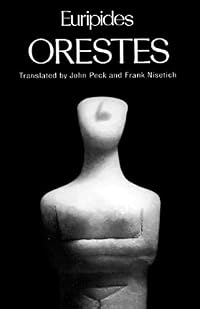
Orestes
by Euripides
On This Page
Description
This is a translation of Euripides's 'Orestes' by Peck, a poet, and Nisetich, a classicist, with introduction, glossary, and full stage directions.Tags
Recommendations






















Member Reviews
It is evident in everything that this is a piece by the mature Euripides. It was performed in 408 BCE, one or two years before his death (the exact date of which we do not know), when he was already well into his 70s. The composition is quite complex, with a long build-up in which verbal passages predominate, and a very dynamic and even a bit chaotic final section brimming with dramatic action.
As in the Orestes plays by Aeschyles and Sophocles (in his case, specifically in the play titled Electra), the question of the justice of revenge is central. After all, Orestes, together with his sister Electra and his friend Pylades, murdered his mother Clytemnestra because she had murdered her husband (and thus Orestes’ father). In Euripides, show more we see once again a wavering Orestes who is well aware of what he has done and anxiously awaits the consequences, to see whether he can escape divine justice (in the form of the goddesses of vengeance, the Erinyes) or human justice (the court at Argos). It comes to a (secular) trial in which all the arguments for and against are laid out once again, and ultimately a condemnation follows.
What is new in Euripides is that, for the first time, arguments of reason are explicitly addressed in that trial (the spiral of blood revenge must be brought to an end by applying alternative punishments such as banishment). And ultimately, it is not divine law, but secular law that prevails (a murderer must undergo the consequences of his deed, according to the letter of the law), although some leniency is applied.
The strange thing is that in the final part, Euripides then shows how blind hatred leads to complete derailment. At the instigation of his friend Pylades and his sister Electra, a violent plan of desperation is carried out, which unfolds in chaotic fashion and, strangely enough, is narrated through the eyes of a Phrygian slave, a complete outsider. It all ends rather suddenly, with Apollo, acting as a literal Deus ex Machina, settling the matter amicably.
In this play, Euripides introduces a tangle of narrative elements and themes that do not all come into their own equally well, but which nevertheless make this play one of the most interesting in his oeuvre.
There are also several historically interesting aspects, which are discussed in the review on my History account on Goodreads: https://www.goodreads.com/review/show/8592190196.
Disclaimer: I'm reading and reviewing all classic ancient Greek plays, more or less in chronological order. But I'm not giving a rating. How could I, given their age? I'll make an exception only when a play is exceptional and still strikes an emotional and/or intellectual chord. show less
As in the Orestes plays by Aeschyles and Sophocles (in his case, specifically in the play titled Electra), the question of the justice of revenge is central. After all, Orestes, together with his sister Electra and his friend Pylades, murdered his mother Clytemnestra because she had murdered her husband (and thus Orestes’ father). In Euripides, show more we see once again a wavering Orestes who is well aware of what he has done and anxiously awaits the consequences, to see whether he can escape divine justice (in the form of the goddesses of vengeance, the Erinyes) or human justice (the court at Argos). It comes to a (secular) trial in which all the arguments for and against are laid out once again, and ultimately a condemnation follows.
What is new in Euripides is that, for the first time, arguments of reason are explicitly addressed in that trial (the spiral of blood revenge must be brought to an end by applying alternative punishments such as banishment). And ultimately, it is not divine law, but secular law that prevails (a murderer must undergo the consequences of his deed, according to the letter of the law), although some leniency is applied.
The strange thing is that in the final part, Euripides then shows how blind hatred leads to complete derailment. At the instigation of his friend Pylades and his sister Electra, a violent plan of desperation is carried out, which unfolds in chaotic fashion and, strangely enough, is narrated through the eyes of a Phrygian slave, a complete outsider. It all ends rather suddenly, with Apollo, acting as a literal Deus ex Machina, settling the matter amicably.
In this play, Euripides introduces a tangle of narrative elements and themes that do not all come into their own equally well, but which nevertheless make this play one of the most interesting in his oeuvre.
There are also several historically interesting aspects, which are discussed in the review on my History account on Goodreads: https://www.goodreads.com/review/show/8592190196.
Disclaimer: I'm reading and reviewing all classic ancient Greek plays, more or less in chronological order. But I'm not giving a rating. How could I, given their age? I'll make an exception only when a play is exceptional and still strikes an emotional and/or intellectual chord. show less
My tepid rating of this play is due in part to the translation by Theodore Buckley (this is the most commonly available one in the public domain) & partly due to Euripides' writing. I read this as part of the Kindle omnibus, "The Tragedies Of Euripides Volume I" and also listened along to the Librivox recording.
While the plot of this play includes a considerable amount of bloody action, it almost all takes place off stage. This is basically a "talking" play -- the various characters tell each other about the action rather than portray it. Because of this, the late Victorian style of Buckley's translation has a large impact on the effect of the play on the reader. I found that in some passages, I was drifting off even as murder and show more revenge were being discussed.
I would recommend anyone considering this play to seek out a more modern translation. The plot itself is quite interesting, dealing with fate & punishment, revenge & murder. show less
While the plot of this play includes a considerable amount of bloody action, it almost all takes place off stage. This is basically a "talking" play -- the various characters tell each other about the action rather than portray it. Because of this, the late Victorian style of Buckley's translation has a large impact on the effect of the play on the reader. I found that in some passages, I was drifting off even as murder and show more revenge were being discussed.
I would recommend anyone considering this play to seek out a more modern translation. The plot itself is quite interesting, dealing with fate & punishment, revenge & murder. show less
My tepid rating of this play is due in part to the translation by Theodore Buckley (this is the most commonly available one in the public domain) & partly due to Euripides' writing. I read this as part of the Kindle omnibus, "The Tragedies Of Euripides Volume 1" and also listened along to the Librivox recording.
While the plot of this play includes a considerable amount of bloody action, it almost all takes place off stage. This is basically a "talking" play -- the various characters tell each other about the action rather than portray it. Because of this, the late Victorian style of Buckley's translation has a large impact on the effect of the play on the reader. I found that in some passages, I was drifting off even as murder and show more revenge were being discussed.
I would recommend anyone considering this play to seek out a more modern translation. The plot itself is quite interesting, dealing with fate & punishment, revenge & murder. show less
While the plot of this play includes a considerable amount of bloody action, it almost all takes place off stage. This is basically a "talking" play -- the various characters tell each other about the action rather than portray it. Because of this, the late Victorian style of Buckley's translation has a large impact on the effect of the play on the reader. I found that in some passages, I was drifting off even as murder and show more revenge were being discussed.
I would recommend anyone considering this play to seek out a more modern translation. The plot itself is quite interesting, dealing with fate & punishment, revenge & murder. show less
Goodness, this is blood drenched. And I'm not sure I follow the logic behind it.
Ratings
Members
- Recently Added By
Lists

Great Books Favorites
71 works; 6 members

Agamemnon's legacy
38 works; 4 members

Harold Bloom - The Western Canon: A. The Theocratic Age
97 works; 13 members

euripides ranked
23 works; 1 member
Author Information

1,342+ Works 34,048 Members
Euripides was born in Attica, Greece probably in 480 B.C. He was the youngest of the three principal fifth-century tragic poets. In his youth he cultivated gymnastic pursuits and studied philosophy and rhetoric. Soon after he received recognition for a play that he had written, Euripides left Athens for the court of Archelaus, king of Macedonia. show more Fragments of about fifty-five plays survive. Among his best-known plays are Alcestis, Medea and Philoctetes, Electra, Iphigenia in Tauris, The Trojan Women, and Iphigenia in Aulis Iphigenia. He died in Athens in 406 B.C. (Bowker Author Biography) show less
Some Editions
Series
Belongs to Publisher Series
Work Relationships
Is contained in
5 Plays: Bacchae / Heracles / Children of Heracles / Phoenician Women / Suppliant Women by Euripides
Great Books of The Western World: Aeschylus, Sophocles, Euripides, Aristophanes by Robert Maynard Hutchins (indirect)
9 Plays: Cyclops / Ion / Iphigenia in Aulis / Iphigenia in Tauris / Medea / Orestes / Phoenician Women / Suppliant Women / Trojan Women by Euripides
Euripides IV: Rhesus / The Suppliant Women / Orestes / Iphigenia in Aulis (The Complete Greek Tragedies) (Vol 6) by Euripides
Is retold in
Has as a student's study guide
Common Knowledge
- Original publication date
- 408 BCE
- People/Characters
- Electra; Helen of Troy; Orestes; Menelaus; Pylades; Hermione (show all 9); Phrygian Eunuch; Apollo; Tyndareus
- Important places
- Argos, Greece
Classifications
- Genres
- Fiction and Literature, Poetry
- DDC/MDS
- 882.01 — Literature & rhetoric Classical & modern Greek literatures Classical Greek dramatic poetry and drama standard subdivisions; collections; history, description, critical appraisal; Specific periods Ancient period to ca. 499
- LCC
- PA3975 .O7 — Language and Literature Greek language and literature. Latin language and literature Greek literature Individual authors Euripedes
- BISAC
Statistics
- Members
- 206
- Popularity
- 158,098
- Reviews
- 4
- Rating
- (3.56)
- Languages
- 9 — Danish, Dutch, English, French, Greek (Ancient), Italian, Norwegian (Bokmål), Portuguese, Spanish
- Media
- Paper, Ebook
- ISBNs
- 30
- ASINs
- 1