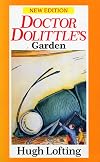
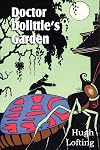
Doctor Dolittle's Garden
by Hugh Lofting
Doctor Dolittle (Publication Order) (1927), Doctor Dolittle (8)
On This Page
Description
Doctor Dolittle's garden is teeming with insects, including a giant moth from a world beyond earth.Tags
Recommendations




















Member Reviews
Doctor Dolittle's Garden occupies an odd spot in the Dolittle series; it's a transitional book, covering the end of the multi-book "entertainment" plot (as I call it) and the Moon plot that followed.
The entertainment plot begins all the way back in the first book of the series, when the Pushmi-Pullyu goes home with the Doctor to help him make money to pay off his debts. It continues with the Dolittle Zoo and Caravan, the Puddleby Pantomime, and the Canary Opera. While the Doctor is, of course, himself always quite uninterested in money and even actively hostile to the concept ("Money! It's a curse."), the essential thrust of the entertainment plot is always how to make more of it.
The Moon plot, on the other hand, couldn't be more show more different: not only is money not a factor, but the Doctor literally leaves the whole world in which money matters behind. That portion of the series focuses exclusively on discovery, exploration, and adventure. It almost seems that the Doctor's sudden fascination with the Moon might be a reaction to the previous multi-book focus on money, which was always an irritant to the character!
Doctor Dolittle's Garden spans the change-over between the two story arcs. But it's quite an abrupt change, so much so that in many ways it's really almost two different books rather than one.
I've been reading the entire Dolittle series to my son. We started when he was five years old; now he's seven. I should explain that we haven't restricted ourselves to Dolittle only, of course, and we mostly read at bedtime. On some nights he falls asleep so quickly that we make no progress at all, because he tends to forget the last page or so that I read before he fell asleep (or rather, I don't always notice exactly when he fell asleep).
Anyway, this was a tough one to get through - so much so that even though we renewed the book once (it's a library book), it's still a week or so overdue. My son started getting a little bored towards the end of the first quarter of the book; roughly half-way through the "garden" portion, which could be considered the end of the entertainment story arc. It took a bit of determination on my part to get him to stick with the book, plus the promise that the Moon portion was coming up soon. I'd told him a little about the Moon plot about a year ago, and the idea captured his imagination quite powerfully.
In fact, as the Moon plot picked up steam, his attention likewise sharpened. We even began reading the book in the car during my morning commute (in part, I must admit, because I felt guilty at having kept the book out from the library for so long - and on inter-library loan, too!).
As always, Prince Bumpo of the Jolliginki was a favorite. It's a pity that so much of him has been censored out of modern editions; fortunately the copy from the library was an old one, and therefore uncensored. There was only one "Bumpoism" that I recall, but it got a lot of laughs.
I should emphasize here that I don't feel that Lofting's portrayal of Prince Bumpo was racist. Lofting was a creature of his time: a Englishman of the early 20th century, with the provicial outlook typical of the time and some attitudes about race that can seem quite jarring to modern eyes (I'm reminded of Agatha Christie's casual racism, but Lofting is far less offensive). Losting's drawings, admittedly, can be odd; they make Bumpo look more than half a giant chimpanzee. For example, there's a drawing of Bumpo in Doctor Dolittle's Garden that was so ape-like that my son remarked on it; he thought it was strange.
But Bumpo himself, for all that he's a comic character, is always clearly represented from the first book onward as good-hearted and brave, a friend to the Doctor and his animals - as witnessed by the fact that he is still a member of the Dolittle "family" many books later. And unlike the often-misbehaving Matthew Mugg (the Cat's-Meat-Man), Bumpo is always a trustworthy and staunch member of the family. Not that Matthew is bad, of course...he just has difficulty restraining his criminal tendencies (one of my son's favorite Dolittle memories is of the time that the Doctor goes to jail and finds Matthew's initials on his cell wall).
Bumpo does have a tendency to violence towards intruding outsiders, and in previous books there were some humorous references to cannibalism which were doubtless deleted from modern editions. But Bumpo, like Jim from Huckleberry Finn, has been the victim of perhaps well-intentioned but certainly misplaced censorship by over-nervous editors (including, alas, Lofting's son).
Once the Moon story is properly launched the pace of the plot picks up. My son regained his interest at that point. But fair warning: the book ends quite abruptly, and on what can only be called a cliffhanger. The Doctor and his companions are still hanging just above the surface of the Moon!
If you're just starting the Dolittle series, this book is not the place to start. Unless for some reason you want to restrict yourself to the Moon plot only - in which case, you'd probably want to start half-way through. But I wouldn't recommend it. Much better to start with the first book and progress in order throughout the series, even though it does tend to jump back and forth in time between books. That said, despite the slow patch in the first half or so, Doctor Dolittle's Garden is still an exciting, enjoyable book that my son and I both liked very much. show less
The entertainment plot begins all the way back in the first book of the series, when the Pushmi-Pullyu goes home with the Doctor to help him make money to pay off his debts. It continues with the Dolittle Zoo and Caravan, the Puddleby Pantomime, and the Canary Opera. While the Doctor is, of course, himself always quite uninterested in money and even actively hostile to the concept ("Money! It's a curse."), the essential thrust of the entertainment plot is always how to make more of it.
The Moon plot, on the other hand, couldn't be more show more different: not only is money not a factor, but the Doctor literally leaves the whole world in which money matters behind. That portion of the series focuses exclusively on discovery, exploration, and adventure. It almost seems that the Doctor's sudden fascination with the Moon might be a reaction to the previous multi-book focus on money, which was always an irritant to the character!
Doctor Dolittle's Garden spans the change-over between the two story arcs. But it's quite an abrupt change, so much so that in many ways it's really almost two different books rather than one.
I've been reading the entire Dolittle series to my son. We started when he was five years old; now he's seven. I should explain that we haven't restricted ourselves to Dolittle only, of course, and we mostly read at bedtime. On some nights he falls asleep so quickly that we make no progress at all, because he tends to forget the last page or so that I read before he fell asleep (or rather, I don't always notice exactly when he fell asleep).
Anyway, this was a tough one to get through - so much so that even though we renewed the book once (it's a library book), it's still a week or so overdue. My son started getting a little bored towards the end of the first quarter of the book; roughly half-way through the "garden" portion, which could be considered the end of the entertainment story arc. It took a bit of determination on my part to get him to stick with the book, plus the promise that the Moon portion was coming up soon. I'd told him a little about the Moon plot about a year ago, and the idea captured his imagination quite powerfully.
In fact, as the Moon plot picked up steam, his attention likewise sharpened. We even began reading the book in the car during my morning commute (in part, I must admit, because I felt guilty at having kept the book out from the library for so long - and on inter-library loan, too!).
As always, Prince Bumpo of the Jolliginki was a favorite. It's a pity that so much of him has been censored out of modern editions; fortunately the copy from the library was an old one, and therefore uncensored. There was only one "Bumpoism" that I recall, but it got a lot of laughs.
I should emphasize here that I don't feel that Lofting's portrayal of Prince Bumpo was racist. Lofting was a creature of his time: a Englishman of the early 20th century, with the provicial outlook typical of the time and some attitudes about race that can seem quite jarring to modern eyes (I'm reminded of Agatha Christie's casual racism, but Lofting is far less offensive). Losting's drawings, admittedly, can be odd; they make Bumpo look more than half a giant chimpanzee. For example, there's a drawing of Bumpo in Doctor Dolittle's Garden that was so ape-like that my son remarked on it; he thought it was strange.
But Bumpo himself, for all that he's a comic character, is always clearly represented from the first book onward as good-hearted and brave, a friend to the Doctor and his animals - as witnessed by the fact that he is still a member of the Dolittle "family" many books later. And unlike the often-misbehaving Matthew Mugg (the Cat's-Meat-Man), Bumpo is always a trustworthy and staunch member of the family. Not that Matthew is bad, of course...he just has difficulty restraining his criminal tendencies (one of my son's favorite Dolittle memories is of the time that the Doctor goes to jail and finds Matthew's initials on his cell wall).
Bumpo does have a tendency to violence towards intruding outsiders, and in previous books there were some humorous references to cannibalism which were doubtless deleted from modern editions. But Bumpo, like Jim from Huckleberry Finn, has been the victim of perhaps well-intentioned but certainly misplaced censorship by over-nervous editors (including, alas, Lofting's son).
Once the Moon story is properly launched the pace of the plot picks up. My son regained his interest at that point. But fair warning: the book ends quite abruptly, and on what can only be called a cliffhanger. The Doctor and his companions are still hanging just above the surface of the Moon!
If you're just starting the Dolittle series, this book is not the place to start. Unless for some reason you want to restrict yourself to the Moon plot only - in which case, you'd probably want to start half-way through. But I wouldn't recommend it. Much better to start with the first book and progress in order throughout the series, even though it does tend to jump back and forth in time between books. That said, despite the slow patch in the first half or so, Doctor Dolittle's Garden is still an exciting, enjoyable book that my son and I both liked very much. show less
This is a slightly strange Dr. Doolittle book, a bit disjointed and a non-ending, but containing lots of entertainingly told stories within. The book comprises roughly three different themes, although it's allegedly divided into four parts.
The first part of the book tells about a club for crossbred dogs and has several of them telling stories after dinner about their lives. It's quite entertaining.
Then, leaving the dogs behind, Dr. Doolittle becomes obsessed with learning the language of insects, so he contrives an apparatus for doing that, and eventually manages to learn some insect stories, particularly one about a water beetle who was transported in a clod of mud on a duck's foot over to Brazil, and eventually a few years later, show more back again.
Somewhere in the story telling, Dr. Doolittle hears rumors of giant moths, so quizzes his animal and insect friends for more information about them. Then, quite suddenly, a giant moth shows up in his garden. So they spend the last third of the book (roughly) learning to communicate with the moth, trying to keep the public away, wondering about where to go on a new voyage and whom to take, and so forth.
This story is told through the eyes of Thomas Stubbins who has become Dr. Doolittle's assistant somewhere after Dr. Doolittle's Circus and before the present book (two volumes that I seem to have missed in my current re-reading of the series). I've always thought the primary fun in the Dr. Doolittle books were the little stories that the animals tell each other within the confines of the major plot themes. show less
The first part of the book tells about a club for crossbred dogs and has several of them telling stories after dinner about their lives. It's quite entertaining.
Then, leaving the dogs behind, Dr. Doolittle becomes obsessed with learning the language of insects, so he contrives an apparatus for doing that, and eventually manages to learn some insect stories, particularly one about a water beetle who was transported in a clod of mud on a duck's foot over to Brazil, and eventually a few years later, show more back again.
Somewhere in the story telling, Dr. Doolittle hears rumors of giant moths, so quizzes his animal and insect friends for more information about them. Then, quite suddenly, a giant moth shows up in his garden. So they spend the last third of the book (roughly) learning to communicate with the moth, trying to keep the public away, wondering about where to go on a new voyage and whom to take, and so forth.
This story is told through the eyes of Thomas Stubbins who has become Dr. Doolittle's assistant somewhere after Dr. Doolittle's Circus and before the present book (two volumes that I seem to have missed in my current re-reading of the series). I've always thought the primary fun in the Dr. Doolittle books were the little stories that the animals tell each other within the confines of the major plot themes. show less
Doctor Dolittle's garden is teeming with insects. So the Doctor decides to learn the insect languages and soon hears lots of fascinating stories. None is more fascinating than the tale of the giant moths, and the doctor starts to plan a trip to seek them out. But before he can set off, he is amazed by the arrival of one of these moths. What is the reason for the moth's visit?
The Hugh Lofting Doctor Dolittle stories are classics that stand the test of time. I really enjoy them and find them clever and enjoyable. I think the writing can be seen as a bit dated but I think it's still extremely readable.
The good Doctor continues his researches into zoology and animal languages. His fame has spread far and wide and an emissary is sent to fetch him: as a mode of travel, going to the Moon in the fur on the back of a giant moth, breathing oxygen along the way from giant moon flowers, just can't be beaten. And all with Lofting's simple, slightly odd, line drawings.
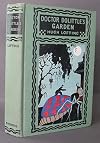
Book Description: New York: F. A. Stokes, 1927. Pictorial Cloth Over Boards. Very Good/No Jacket. First Edition. 8vo - over 7¾" - 9¾" tall. 327 pp. mildly browned, nice pictorial cover,
Picture cover scratched, front cover slightly bowed, tight copy and good binding
Picture cover scratched, front cover slightly bowed, tight copy and good binding
Members
- Recently Added By
Author Information

165+ Works 13,737 Members
Hugh Lofting was born in 1866 in Maidenhead, England. He trained as a civil engineer, getting his education from the Massachusetts Institute of Technology and the Polytechnic Institute of London. He worked in Africa, the West Indies and Canada and then settled in New York to become a writer. The stories about Doctor Dolittle began as letters to show more his children while overseas in England during World War I, where Lofting served with the British Army. The first Doctor Dolittle book published was "The Story of Doctor Dolittle" in 1920. He wrote thirteen more, winning the Newberry Medal in 1923 for "The Voyages of Doctor Dolittle." Lofting illustrated all of the Dolittle books himself. In 1967, the Doctor Dolittle books were made into a musical film starring Rex Harrison. Hugh Lofting died in 1947 at the age of 81. show less
Series


Belongs to Publisher Series
Puffin Story Books (368)
Work Relationships
Common Knowledge
- Canonical title
- Doctor Dolittle's Garden
- Original publication date
- 1928
- People/Characters
- Doctor Dolittle; Thomas Stubbins; Bumpo
- Important places
- The Moon; England, UK
- First words
- I suppose there is no part of my life with the Doctor that I, Thomas Stubbins, look back on with more pleasure than that period when I was assistant manager of the zoo.
- Last words
- (Click to show. Warning: May contain spoilers.)Water and Life!
- Blurbers
- Goodall, Jane
Classifications
Statistics
- Members
- 357
- Popularity
- 88,063
- Reviews
- 9
- Rating
- (3.69)
- Languages
- 6 — Dutch, English, Estonian, German, Polish, Spanish
- Media
- Paper, Ebook
- ISBNs
- 14
- ASINs
- 33