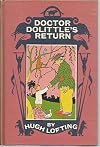
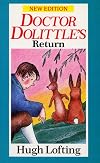
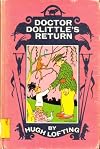
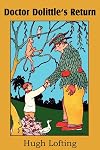
Doctor Dolittle's Return
by Hugh Lofting
Doctor Dolittle (10), Doctor Dolittle (Publication Order) (1933)
On This Page
Description
At long last, the anxious watchers at Puddleby-on-the-Marsh see the signal which means that Doctor Dolittle is on his way back from the moon! To everyone's surprise, the Doctor arrives on the back of an enormous locust - and he, too, has reached an enormous size through years of living on the moon. Explainations and thrilling tales of adventure follow the Doctor's return . . .Tags
Recommendations















Member Reviews
Doctor Dolittle's Return is the ninth book in Hugh Lofting's classic Doctor Dolittle series. Remarkably, it features some of the most memorable and funniest moments of the whole series. That's a rare thing in a long series!
The book directly continues the plot line begun in the preceeding book, Doctor Dolittle in the Moon. It should be noted that Lofting originally intended to end the series with that book, but for some reason changed his mind; five years after the publication of Doctor Dolittle in the Moon, Doctor Dolittle's Return was published.
Almost all the old favorites are here: Polynesia, Dab-Dab, Jip, Gub-Gub, Chee-Chee, Too-Too, Cheapside the Cockney sparrow, Whitey the mouse, and the old lame horse. Not to mention our narrator, show more Tommy Stubbins, and Matthew Mugg, the Cat's Meat Man.
The Pushmi-pullyu is entirely absent; his presence in the entire series is actually rather slight. He's a relatively undeveloped character, and vanished from view as the series progressed (my son often asked where he went). Also missing, unfortunately, is Prince Bumpo. However heis at least mentioned in the text; he's gone back to school, as I recall. On the other hand, even if he'd been included in the book modern publishers would doubtless have censored him out of current editions.
As you might guess, the book tells how the Doctor returns from the Moon. The first half of the book covers the lives of Tommy Stubbins, the Doctor's assistant, and the Dolittle family of animals in England as they wait for his return; then the exciting moment when he does return; and the Doctor's convalescence, as well as the story of how he managed to escape from the Moon. There are many extremely charming and hilarious moments.
The second half of the book deals with the quest of the Doctor for peace and quiet. He wants to write a book about the Moon, and perform Moon-related experiments, but the constant demands of his patients make his other projects nearly impossible to complete. This leads to what are undoubtedly the funniest moments in the entire series...but I'll avoid spoiling them for you.
The solution that works is both logical and very aesthetically pleasing. And the ending itself is extremely moving, for all that it is quiet and almost anticlimactic. Lofting's writing style developed considerably over the course of the series, and in Doctor Dolittle's Return he brought a greater depth of feeling and thought to his work than ever before.
Although it's roughly the same length as the other books in the series, Doctor Dolittle's Return reads very quickly indeed. In large part that's because it's one of the most lively books in the series; there are no dead spots that bog the flow of the story down. It felt as if the book flew by, far more rapidly than many of the other Dolittle books.
I read the book to my seven-year-old son, Sebastian, and he absolutely loved it - I think it is his new favorite. He enjoyed all the Dolittle books very much, but his interest in this was was on an entirely new level. He had me bring the book with us in the car, so I could read it to him every morning and every night as we drove to and from the train station (I wasn't driving, of course). He had me read it to him in the evenings, instead of watching television. He giggled and laughed...it really is the funniest book in the series, so far.
And, in many ways, it feels like the perfect closing point of the series. There are three more Dolittle books, plus a stand-alone book by Gub-Gub the pig, but by all accounts these are more grim and sad, with a darker view of both human and animal nature (well, Gub-Gub's book is probably an exception, since it's an outright work of humor).
I believe I read the entire series when I was young, with the exception of the Gub-Gub book (which is quite rare). But I don't remember anything past the end of Doctor Dolittle's Return. Is that because the later books were depressing? Or is it that I never read them? I'm not sure. I'll admit that I'm a little concerned, because Sebastian very much wants to continue reading the Dolittle series; as described, though, the final books may not be appropriate for him. We'll simply have to try and see. And if for some reason they're not appropriate for a seven-year-old, at least we'll have the pleasure of reading the first nine books all over again - at least one or two more times, before he's too grown-up to listen to stories read by his old Dad. show less
The book directly continues the plot line begun in the preceeding book, Doctor Dolittle in the Moon. It should be noted that Lofting originally intended to end the series with that book, but for some reason changed his mind; five years after the publication of Doctor Dolittle in the Moon, Doctor Dolittle's Return was published.
Almost all the old favorites are here: Polynesia, Dab-Dab, Jip, Gub-Gub, Chee-Chee, Too-Too, Cheapside the Cockney sparrow, Whitey the mouse, and the old lame horse. Not to mention our narrator, show more Tommy Stubbins, and Matthew Mugg, the Cat's Meat Man.
The Pushmi-pullyu is entirely absent; his presence in the entire series is actually rather slight. He's a relatively undeveloped character, and vanished from view as the series progressed (my son often asked where he went). Also missing, unfortunately, is Prince Bumpo. However heis at least mentioned in the text; he's gone back to school, as I recall. On the other hand, even if he'd been included in the book modern publishers would doubtless have censored him out of current editions.
As you might guess, the book tells how the Doctor returns from the Moon. The first half of the book covers the lives of Tommy Stubbins, the Doctor's assistant, and the Dolittle family of animals in England as they wait for his return; then the exciting moment when he does return; and the Doctor's convalescence, as well as the story of how he managed to escape from the Moon. There are many extremely charming and hilarious moments.
The second half of the book deals with the quest of the Doctor for peace and quiet. He wants to write a book about the Moon, and perform Moon-related experiments, but the constant demands of his patients make his other projects nearly impossible to complete. This leads to what are undoubtedly the funniest moments in the entire series...but I'll avoid spoiling them for you.
The solution that works is both logical and very aesthetically pleasing. And the ending itself is extremely moving, for all that it is quiet and almost anticlimactic. Lofting's writing style developed considerably over the course of the series, and in Doctor Dolittle's Return he brought a greater depth of feeling and thought to his work than ever before.
Although it's roughly the same length as the other books in the series, Doctor Dolittle's Return reads very quickly indeed. In large part that's because it's one of the most lively books in the series; there are no dead spots that bog the flow of the story down. It felt as if the book flew by, far more rapidly than many of the other Dolittle books.
I read the book to my seven-year-old son, Sebastian, and he absolutely loved it - I think it is his new favorite. He enjoyed all the Dolittle books very much, but his interest in this was was on an entirely new level. He had me bring the book with us in the car, so I could read it to him every morning and every night as we drove to and from the train station (I wasn't driving, of course). He had me read it to him in the evenings, instead of watching television. He giggled and laughed...it really is the funniest book in the series, so far.
And, in many ways, it feels like the perfect closing point of the series. There are three more Dolittle books, plus a stand-alone book by Gub-Gub the pig, but by all accounts these are more grim and sad, with a darker view of both human and animal nature (well, Gub-Gub's book is probably an exception, since it's an outright work of humor).
I believe I read the entire series when I was young, with the exception of the Gub-Gub book (which is quite rare). But I don't remember anything past the end of Doctor Dolittle's Return. Is that because the later books were depressing? Or is it that I never read them? I'm not sure. I'll admit that I'm a little concerned, because Sebastian very much wants to continue reading the Dolittle series; as described, though, the final books may not be appropriate for him. We'll simply have to try and see. And if for some reason they're not appropriate for a seven-year-old, at least we'll have the pleasure of reading the first nine books all over again - at least one or two more times, before he's too grown-up to listen to stories read by his old Dad. show less
The Hugh Lofting Doctor Dolittle stories are classics that stand the test of time. I really enjoy them and find them clever and enjoyable. I think the writing can be seen as a bit dated but I think it's still extremely readable.
A late, ;ess=known Dolittle story, in which he returns from his voyage to the moon.
Ratings
Members
- Recently Added By
Author Information

166+ Works 13,822 Members
Hugh Lofting was born in 1866 in Maidenhead, England. He trained as a civil engineer, getting his education from the Massachusetts Institute of Technology and the Polytechnic Institute of London. He worked in Africa, the West Indies and Canada and then settled in New York to become a writer. The stories about Doctor Dolittle began as letters to show more his children while overseas in England during World War I, where Lofting served with the British Army. The first Doctor Dolittle book published was "The Story of Doctor Dolittle" in 1920. He wrote thirteen more, winning the Newberry Medal in 1923 for "The Voyages of Doctor Dolittle." Lofting illustrated all of the Dolittle books himself. In 1967, the Doctor Dolittle books were made into a musical film starring Rex Harrison. Hugh Lofting died in 1947 at the age of 81. show less
Series


Belongs to Publisher Series
Puffin Story Books (371)
Work Relationships
Common Knowledge
- Canonical title
- Doctor Dolittle's Return
- Original publication date
- 1933
- People/Characters
- Doctor Dolittle
Classifications
Statistics
- Members
- 288
- Popularity
- 112,311
- Reviews
- 4
- Rating
- (3.60)
- Languages
- English, German, Norwegian, Polish
- Media
- Paper, Ebook
- ISBNs
- 12
- ASINs
- 20