On This Page
Description
Between Parker's 1961 debut and his return in the late 1990s, the whole world of crime changed. Now fake IDs and credit cards had to be purchased from specialists; increasingly sophisticated policing made escape and evasion tougher; and, worst of all, money had gone digital-the days of cash-stuffed payroll trucks were long gone. But cash isn't everything: Flashfire and Firebreak find Parker going after, respectively, a fortune in jewels and a collection of priceless paintings. In Flashfire, show more Parker's in West Palm Beach, competing with a crew that has an unhealthy love of explosions. When things go sour, Parker finds himself shot and trapped-and forced to rely on a civilian to survive. Firebreak takes Parker to a palatial Montana "hunting lodge" where a dot-com millionaire hides a gallery of stolen old masters-which will fetch Parker a pretty penny if his team can just get it past the mansion's tight security. The forests of Montana are an inhospitable place for a heister when well-laid plans fall apart, but no matter how untamed the wilderness, Parker's guaranteed to be the most dangerous predator around. show lessTags
Recommendations








Member Reviews
With the very first line of Firebreak I had to laugh, though there is nothing funny about Richard Stark’s Parker books. If you want that, read the misadventures of John Dortmunder written under the author’s real name of Donald E. Westlake. But that opening sentence: “When the phone rang, Parker was in the garage, killing a man.” It tells you everything you need to know about Parker. The rest are details. Like that he’s a professional thief; professional meaning that it is how he makes his living and the attitude with which he goes about his work. An attitude that carries with it some hard and near-unbreakable rules. A major one is, because it brings more heat from the police, you avoid killing whenever possible. That Parker show more usually leaves a long line of bodies in his wake, it tells you everything you need to know about the series.
It’s about the complications. It may be possible to write a story where the planning and execution of a robbery plays out perfectly--it probably has been done--but that does not a series make. When the setup and/or completion of a job encounters what seems to be unending interference and obstacles, that’s when Parker is at his most ruthlessly efficient. Everything that does not pertain to success is expendable. And everyone. And that’s what we paid to see.
The man being killed in the garage was a hit man sent to kill Parker. The phone call concerns liberating some priceless but illegal paintings from their current owner. Initially Parker has to trace and eliminate the source of the first so he is free to concentrate on the second. More complications ensue.
As they had to.
As Parker backtracks the trail of the assassin; as we meet and learn the lives of his current colleagues and what complications their personal situations bring to the equation; and, of course, how far Parker will have to go to clear each obstruction. Otherwise what’s the point? Westlake had always meant these books to be quick, clean reads and, despite all the bodies, light entertainment. Since there are no deeper meanings or serious introspection to be found, individual success depends on each set of complications. Are they interesting? And is Parker’s response as they begin to pile up equally engaging? It’s not always the case. Firebreak is an example of when it is. Quick, clean entertainment. show less
It’s about the complications. It may be possible to write a story where the planning and execution of a robbery plays out perfectly--it probably has been done--but that does not a series make. When the setup and/or completion of a job encounters what seems to be unending interference and obstacles, that’s when Parker is at his most ruthlessly efficient. Everything that does not pertain to success is expendable. And everyone. And that’s what we paid to see.
The man being killed in the garage was a hit man sent to kill Parker. The phone call concerns liberating some priceless but illegal paintings from their current owner. Initially Parker has to trace and eliminate the source of the first so he is free to concentrate on the second. More complications ensue.
As they had to.
As Parker backtracks the trail of the assassin; as we meet and learn the lives of his current colleagues and what complications their personal situations bring to the equation; and, of course, how far Parker will have to go to clear each obstruction. Otherwise what’s the point? Westlake had always meant these books to be quick, clean reads and, despite all the bodies, light entertainment. Since there are no deeper meanings or serious introspection to be found, individual success depends on each set of complications. Are they interesting? And is Parker’s response as they begin to pile up equally engaging? It’s not always the case. Firebreak is an example of when it is. Quick, clean entertainment. show less
Great first line:
“When the phone rang, Parker was in the garage, killing a man.”
“… a firebreak, the small fire you set in front of the big fire to steal its fuel and keep it from coming on.”
“Every once in a while, something that was old that was supposed to be done with, comes back and has to be dealt with again. This is one of those.”
'Those' meaning someone from the past is attempting to kill Parker. Never a good idea. Just like double crossing him, or trying to cheat him. Bad, bad ideas.
There are two plotlines in this book - dealing with the above situation, and trying to steal gold and priceless artwork from a hunting lodge in Montana. They are both fun to read, but I did get confused with all of the character names. show more Maybe I'm just getting old. But not old enough to thoroughly enjoy when Parker threatens an entire organization, like he did with the Outfit 20 books ago! This time it's a group called Cosmopolitan. And this time, the group gives in much quicker than the Outfit did. I guess some folks are learning on how to deal with Parker! show less
“When the phone rang, Parker was in the garage, killing a man.”
“… a firebreak, the small fire you set in front of the big fire to steal its fuel and keep it from coming on.”
“Every once in a while, something that was old that was supposed to be done with, comes back and has to be dealt with again. This is one of those.”
'Those' meaning someone from the past is attempting to kill Parker. Never a good idea. Just like double crossing him, or trying to cheat him. Bad, bad ideas.
There are two plotlines in this book - dealing with the above situation, and trying to steal gold and priceless artwork from a hunting lodge in Montana. They are both fun to read, but I did get confused with all of the character names. show more Maybe I'm just getting old. But not old enough to thoroughly enjoy when Parker threatens an entire organization, like he did with the Outfit 20 books ago! This time it's a group called Cosmopolitan. And this time, the group gives in much quicker than the Outfit did. I guess some folks are learning on how to deal with Parker! show less
Another excellent neo-noir Parker story, this one has the additional complication of two competing plot threads.
Parker has been approached to help rip off a dotcom billionaire with some Dutch masters stashed in the basement. But before he can get to that, he needs to do something about the hit that's just been taken out on him. Old friends and new pop up in Firebreak, and Parker's brutal efficiency will be called upon more than once.
I liked this Parker novel a lot - like all of them. Written after Stark's decades-long break from Parker, it's refreshing to see some characters from early book re-surface. It's easy to think of Parker as a Fugitive-like figure, every day a new chapter, and I enjoyed seeing his past catch up with him in show more positive and negative senses.
The heist, as usual, is meticulously paced and plotted and - to this non-criminal - utterly plausible. Stark's age and relative ignorance regarding computers and the internet does show here - as is often the case, the "hackers" in the story may as well put on wizard caps for all the magic they're capable of. But that is a churlish, niggling criticism.
The brevity of the Parker novels make reading them a breeze, and they also give the books a heady, irresistible propulsion. Something happens on every page of a Parker book, and that something is usually rough, well-written, and sometimes even funny. Great stuff. show less
Parker has been approached to help rip off a dotcom billionaire with some Dutch masters stashed in the basement. But before he can get to that, he needs to do something about the hit that's just been taken out on him. Old friends and new pop up in Firebreak, and Parker's brutal efficiency will be called upon more than once.
I liked this Parker novel a lot - like all of them. Written after Stark's decades-long break from Parker, it's refreshing to see some characters from early book re-surface. It's easy to think of Parker as a Fugitive-like figure, every day a new chapter, and I enjoyed seeing his past catch up with him in show more positive and negative senses.
The heist, as usual, is meticulously paced and plotted and - to this non-criminal - utterly plausible. Stark's age and relative ignorance regarding computers and the internet does show here - as is often the case, the "hackers" in the story may as well put on wizard caps for all the magic they're capable of. But that is a churlish, niggling criticism.
The brevity of the Parker novels make reading them a breeze, and they also give the books a heady, irresistible propulsion. Something happens on every page of a Parker book, and that something is usually rough, well-written, and sometimes even funny. Great stuff. show less
Parker and the Dot Com Paintings
Review of the Blackstone Audio Inc. audiobook edition (May 2013) of the Mysterious Press hardcover (2001)
Richard Stark was one of the many pseudonyms of the prolific crime author Donald E. Westlake (1933-2008), who wrote over 100 books. The Stark pseudonym was used primarily for the Parker novels, an antihero criminal who is usually betrayed or ensnared in some manner and who spends each book getting revenge or escaping the circumstances.
In Firebreak, Parker is part of a heist of a dot com billionaire's secret stash of rare paintings hidden at his rural retreat. This also requires the involvement of a computer hacker to circumvent the security systems, and the hacker brings with him his own amateur show more complications. Meanwhile, Parker is being hunted by hitmen as a result of a revenge plan by villains still around after The Sour Lemon Score (Parker #12 - 1969) just to add to the problems.
These final Parker novels from #17 to #24 seem stronger and more complex than the original run which was probably due to Westlake/Stark's development as a writer over the years and during the 23 year hiatus. Several of these are strong 4's to 5's (I've actually read or listened to all of them now and am just parceling out the reviews over time).
Firebreak is the 4th book of 5 in a book titles arc by Richard Stark where the second syllable in each one-word title provides the first syllable of the next one as in 1) Comeback, 2) Backflash, 3) Flashfire, 4) Firebreak and 5) Breakout.
Narrator Stephen Thorne does an excellent job in all voices in this audiobook edition. The narration does not include the Foreword by Terry Teachout as included in the paperback.
I had never previously read the Stark/Parker novels but became curious when they came up in my recent reading of The Writer's Library: The Authors You Love on the Books That Changed Their Lives (Sept. 2020) by Nancy Pearl & Jeff Schwager. Here is a (perhaps surprising) excerpt from their discussion with author Amor Towles:
The 24 Parker books are almost all available for free on Audible Plus, except for #21 & #22 which aren't available at all.
Other Reviews
There is an extremely detailed review and plot summary of Firebreak (with spoilers obviously) at The Westlake Review, February 7, 2017.
Trivia and Links
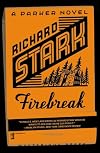
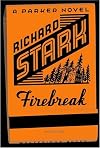
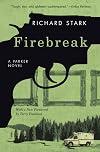
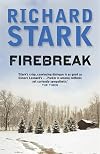
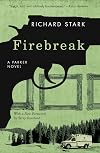
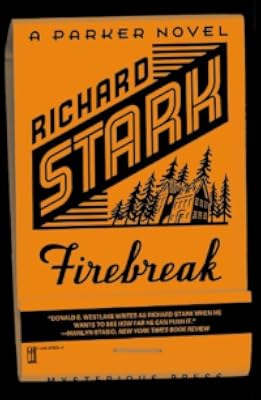
The Firebreak page at The Violent World of Parker website is not as complete as those for the earlier books, but does provide cover images of the different editions.
Like many of the 2010-2013 Blackstone Audio Inc. audiobook editions which share the same cover art as the University of Chicago Press 2009-2011 reprints, this audiobook DOES NOT include the Foreword by author Terry Teachout. show less
Review of the Blackstone Audio Inc. audiobook edition (May 2013) of the Mysterious Press hardcover (2001)
Richard Stark was one of the many pseudonyms of the prolific crime author Donald E. Westlake (1933-2008), who wrote over 100 books. The Stark pseudonym was used primarily for the Parker novels, an antihero criminal who is usually betrayed or ensnared in some manner and who spends each book getting revenge or escaping the circumstances.
In Firebreak, Parker is part of a heist of a dot com billionaire's secret stash of rare paintings hidden at his rural retreat. This also requires the involvement of a computer hacker to circumvent the security systems, and the hacker brings with him his own amateur show more complications. Meanwhile, Parker is being hunted by hitmen as a result of a revenge plan by villains still around after The Sour Lemon Score (Parker #12 - 1969) just to add to the problems.
These final Parker novels from #17 to #24 seem stronger and more complex than the original run which was probably due to Westlake/Stark's development as a writer over the years and during the 23 year hiatus. Several of these are strong 4's to 5's (I've actually read or listened to all of them now and am just parceling out the reviews over time).
Firebreak is the 4th book of 5 in a book titles arc by Richard Stark where the second syllable in each one-word title provides the first syllable of the next one as in 1) Comeback, 2) Backflash, 3) Flashfire, 4) Firebreak and 5) Breakout.
Narrator Stephen Thorne does an excellent job in all voices in this audiobook edition. The narration does not include the Foreword by Terry Teachout as included in the paperback.
I had never previously read the Stark/Parker novels but became curious when they came up in my recent reading of The Writer's Library: The Authors You Love on the Books That Changed Their Lives (Sept. 2020) by Nancy Pearl & Jeff Schwager. Here is a (perhaps surprising) excerpt from their discussion with author Amor Towles:
Nancy: Do you read Lee Child?
Amor: I know Lee. I had never read his books until I met him, but now I read them whenever they come out. I think some of the decisions he makes are ingenious.
Jeff: Have you read the Parker books by Donald Westlake [writing as Richard Stark]?
Amor: I think the Parker books are an extraordinary series.
Jeff: They feel like a big influence on Reacher, right down to the name. Both Reacher and Parker have a singular focus on the task in front of them.
Amor: But Parker is amoral. Reacher is just dangerous.
Jeff: Right. Reacher doesn't have a conventional morality, but he has his own morality. Parker will do anything he has to do to achieve his goal.
Amor: But to your point, Westlake's staccato style with its great twists at the end of the paragraphs, and his mesmerizing central character - these attributes are clearly shared by the Reacher books.
The 24 Parker books are almost all available for free on Audible Plus, except for #21 & #22 which aren't available at all.
Other Reviews
There is an extremely detailed review and plot summary of Firebreak (with spoilers obviously) at The Westlake Review, February 7, 2017.
Trivia and Links
The Firebreak page at The Violent World of Parker website is not as complete as those for the earlier books, but does provide cover images of the different editions.
Like many of the 2010-2013 Blackstone Audio Inc. audiobook editions which share the same cover art as the University of Chicago Press 2009-2011 reprints, this audiobook DOES NOT include the Foreword by author Terry Teachout. show less
A little different than Stark's usual plot, where Parker assembles a team for a heist and then something goes wrong, often betrayal by a greedy partner. The book opens with Parker killing someone sent to kill him, which sidetracks the heist as Parker toodles off to track down who hired the assassin. I admired his restraint in not killing the elderly couple sent to monitor his home as he figures out they too were duped. The heist is stealing stolen art masterpieces back from a dot-com billionaire. When the team is finally ready to strike, the ATF, FBI and local police all converge on the billionaire's Montana mansion, making the score look impossible until a highly motivated, but unstable member of the team provides some real ingenuity.
Parker continues his brutal low-key approach to the commission of crime. This picks up strands from several previous novels as Parker and Lloyd seek to rob the secret art gallery of a dot-com magnate. It is a highly satisfying addition to the series but no place to start reading Parker stories.
Not one of my favorite Parker novels, like when they focus mostly on just him, too much on the secondary characters
Members
- Recently Added By
Lists

Art heist books at PPL
122 works; 1 member
Author Information

Author Donald E. Westlake was born in Brooklyn, New York on July 12, 1933. He attended colleges in New York, but did not graduate. He wrote more than 100 novels and 5 screenplays throughout his lifetime. He also wrote under numerous pseudonyms including Richard Stark, Tucker Coe, and Samuel Holt. Almost 20 of his novels were adapted into films and show more he created the television series, The Father Dowling Mysteries. He is a three-time winner of the Edgar Award from the Mystery Writers of America and was nominated for an Academy Award for his screenplay for The Grifters. He was also named a Mystery Writers of America Grand Master in 1993. He died of a heart attack on December 31, 2008 at the age of 75. (Bowker Author Biography) Donald E. Westlake has won three Edgar Awards & was nominated for an Academy Award for Best Adapted Screenplay for "The Grifters". He lives in upstate New York. (Publisher Provided) show less
Series

Common Knowledge
- Original title
- Firebreak
- Original publication date
- 2001
- People/Characters
- Parker
- Important places
- Montana, USA
- Dedication
- For Bill Malloy, who read it first
- First words
- When the phone rang, Parker was in the garage, killing a man.
- Last words
- (Click to show. Warning: May contain spoilers.)“That's a great smell.”
- Original language
- English
Classifications
Statistics
- Members
- 359
- Popularity
- 87,982
- Reviews
- 8
- Rating
- (3.84)
- Languages
- English, French, German
- Media
- Paper, Audiobook, Ebook
- ISBNs
- 19
- ASINs
- 6