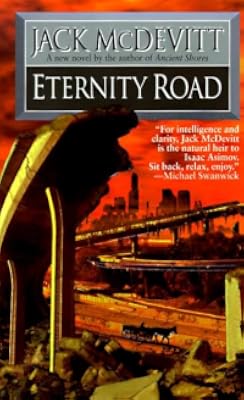
Eternity Road
by Jack McDevitt
On This Page
Description
The Roadmakers left only ruins behind, but what magnificent ruins! Their concrete highways still cross the continent. Their cups, combs, and jewelry are found in every Illyrian home. They left behind a legend, too, a hidden sanctuary called Haven, where even now the secrets of their civilization might still be found. Chaka's brother was one of those who sought to find Haven and never returned. But now Chaka has inherited a rare Roadmaker artifact, a book called A Connecticut Yankee in King show more Arthur's Court, which has inspired her to follow in his footsteps. Gathering an unlikely band of companions around her, Chaka embarks upon a journey where she will encounter bloodthirsty river pirates, electronic ghosts who mourn their lost civilization, and machines that skim over the ground and air. Ultimately, the group will learn the truth about their own mysterious past. show lessTags
Recommendations






Member Reviews
This one is a seamless combination of post-apocalyptic fiction with Tokeinesque quest fantasy. A community several generations past whatever broke the earth have an enduring myth about a quest to find some great knowledge that will help rebuild things. The myth is tied inextricably with books from the old world, as books have taken on a totem status in their cultural and spiritual life. One of the elders of the community dies, one with a fair bit of mystery surrounding him from a previous attempt to find the lost books, and he leaves one of those old, precious books – I only wish it had been something other than Twain – to someone unexpected. The heiress uses the book and the whispered rumors of the previous quest to put together show more her own party. The quest is wonderful, as it requires them to noodle through things left behind in order to survive – like, how do you break a malfunctioning and deadly sentry robot with logic rather than firepower. There’s even a hot-air balloon ride at the end of their quest.
The only criticism is that the ending feels rushed and a little anti-climactic. I would have liked this one to stretch out and have more meaning in the end. Sadly, McDevitt rushed through the final pieces of the quest and has never written about this world again apparently. Indeed, this book seems altogether unique, as the other books I’ve found by him seem much more of the space opera ilk.
4 ½ bones!!!!!
Highly recommended show less
The only criticism is that the ending feels rushed and a little anti-climactic. I would have liked this one to stretch out and have more meaning in the end. Sadly, McDevitt rushed through the final pieces of the quest and has never written about this world again apparently. Indeed, this book seems altogether unique, as the other books I’ve found by him seem much more of the space opera ilk.
4 ½ bones!!!!!
Highly recommended show less
"Eternity Road" is a good example of altered expectations. While the book's premise - and, indeed, its back-jacket synopsis - suggest a book with science-fiction tones lain atop a generic adventure story, the contents of the novel are surprisingly fresh, and very inventive.
Set more than a thousand years in the future, humanity recuperates after having been nearly exterminated by a plague of unknown description or origin. Whatever the reason, the human race has been reduced to a few scattered settlements living in a simulacrum of Middle Ages-era nobility. Academia toils on, but understanding their ancestors is difficult; little is known of the former civilization of man that spread across the globe. In fact, our most enduring creations - show more and that which gives our bygone culture its name to the descendants - are our highways. Thus, the former civilization is known as the Roadmakers, and is studied closely.
Only fragmentary records exist of the Roadmaker era, and books are highly prized. Legend tells of a vast repository of books and other knowledge at a place called "Haven," but no clue still exists as to the location of the cache. An expedition sent to find Haven ends in disaster - all but the organizer of the expedition die before returning. However, with the sole survivor comes an amazing, tantalizing artifact: a complete Roadmaker book. The narrative that follows details the follow-up expedition, their encounters with Roadmaker ruins and technology, and much about the descended civilization.
"Eternity Road" is a clever blend of archeology, mystery, and dystopian future blended together into a book that is difficult to surrender. As with many of McDevitt's works, "Eternity Road" does suffer from a lengthy and slow introductory segment, but once the narrative's expedition gets underway, it is surprisingly difficult to put the book down; you will want to know both what happens to the expedition, naturally, but also to learn of what happened to us - and what remains.
Full of stunning narrative descriptions, thoughtful extrapolations, well-placed humor and deep, philosophical moments, "Eternity Road" is an excellent read. show less
Set more than a thousand years in the future, humanity recuperates after having been nearly exterminated by a plague of unknown description or origin. Whatever the reason, the human race has been reduced to a few scattered settlements living in a simulacrum of Middle Ages-era nobility. Academia toils on, but understanding their ancestors is difficult; little is known of the former civilization of man that spread across the globe. In fact, our most enduring creations - show more and that which gives our bygone culture its name to the descendants - are our highways. Thus, the former civilization is known as the Roadmakers, and is studied closely.
Only fragmentary records exist of the Roadmaker era, and books are highly prized. Legend tells of a vast repository of books and other knowledge at a place called "Haven," but no clue still exists as to the location of the cache. An expedition sent to find Haven ends in disaster - all but the organizer of the expedition die before returning. However, with the sole survivor comes an amazing, tantalizing artifact: a complete Roadmaker book. The narrative that follows details the follow-up expedition, their encounters with Roadmaker ruins and technology, and much about the descended civilization.
"Eternity Road" is a clever blend of archeology, mystery, and dystopian future blended together into a book that is difficult to surrender. As with many of McDevitt's works, "Eternity Road" does suffer from a lengthy and slow introductory segment, but once the narrative's expedition gets underway, it is surprisingly difficult to put the book down; you will want to know both what happens to the expedition, naturally, but also to learn of what happened to us - and what remains.
Full of stunning narrative descriptions, thoughtful extrapolations, well-placed humor and deep, philosophical moments, "Eternity Road" is an excellent read. show less
Eternity Road
Jack McDevitt
Eos
1998
Mass Market Paperback
ISBN: 0061054275
416 pages
Lean in closer, my reading friends…. Closer still…. That’s better!
I have a secret to tell. I am totally hooked on well-written post-apocalyptic fantasies that reflect broken and collapsed civilizations. Throw in a bit of half-working technology, a few cannibals or bandits, and a mythical “Haven” that holds all the answers and its all the better. Make it a road trip through the decimated countryside of an under-populated, over-demolished America and you have “Eternity Road.”
Now, I know that there are quite a few naysayers out there who have taken potshots at this particular work and I have to wonder why. Yes, post-apocalyptic stories are legion show more and only a few seem to rise to the top (i.e. “A Canticle for Liebowitz,” “Deus Irae,” etc.) but I believe there’s always room for more. In other words “been there – done that” does not necessarily equate to a merit-less contribution. Especially when penned by a gifted writer. And, make no mistake; Jack McDevitt is a very talented writer. Here’s why “Eternity Road” should be on your reading list and why you should not listen to the negative reviews.
Small pockets of civilization remain after the world has been devastated by an unnamed calamity. In Mississippi the community of Illyria is just beginning to reemerge from the destruction. Within the community is the Imperium, a throw-back university whose sole purpose is to unravel the mysteries of the artifacts and the history left behind by the “Roadmakers.” (That would be us, my silent readers.) Over the years, the hint of a rumor remains. “Haven” exists! Haven, the one place the apocalypse has left untouched. Where the world remains as it did in the days of the “Roadmakers.” A place where technology rules, knowledge is readily available, and everyone leads a life of ease.
Enter Karik Endine, the only survivor of a failed mission to locate Haven. After his return to Illyria he becomes despondent, closed off to his friends and acquaintances, and silent about the details of the disastrous quest. Ten years elapse and Endine moves further away from his family and friends. Finally, the mysterious and untold deaths of his companions become too unbearable to deal with and he commits suicide. After his death the discovery of a Roadmaker book in his possession, A Connecticut Yankee in King Arthur’s Court, and a journal of unusual sketches causes some Illyrians to believe that Endine may have located the lost Haven. But if he did why would he keep silent all those years? Based on this new information and using the sketches as a roadmap a small band of six companions set off in search of the mysterious city of Haven.
The narrative of “Eternity Road” is, in my estimation, riveting and is in some scenes reminiscent of medieval fantasy (see the works of J. R.R. Tolkien and Raymond E. Feist for example). Especially when McDevitt describes the many ruins of the ancient Roadmakers civilization, or when the band leaves the Crooked Man, a tavern at the edge of civilization, or when they try to cross the Wabash River.
In the semi-literate society of Illyria, books hold a certain fascination. Even those who are illiterate tend to understand their importance for rebuilding society. Other reviewers have called the process of literacy decline unlikely in McDevitt’s scenario but I strongly disagree. When people are forced to live off the land, to farm and scrounge and work long days simply to survive then literacy, schools, and books will take a back seat. That people will revere the written word under these circumstances is most probable. We only have to look back at our own not-to-distant past to see the truth. At the turn of the last century the majority of illiteracy occurred in rural, thinly populated farming communities where people worked long, hard days and had little time for reading. The literate minority were regarded with something equivalent to awe and there was a social stigma attached to those who could not read and write. The Illyrians would not look upon books as curiosities, as some might think, but rather as a means to become a better more advanced and knowledgeable society.
4 ½ out of 5 stars
One other thing I believe, and this is important to me personally, is that with the deaths of many of the golden age writers, Heinlein, Clarke, Vonnegut, to name a few, we as avid SF readers are going to need other talented writers to replace them. I think Jack McDevitt fits that mold. His stories are intelligent, quirky, and contain enough science to make them believable yet he still manages to make them enjoyable to read. With the newfound popularity of Urban Fantasy, Steampunk, and Historical Science Fiction, which I enjoy immensely by the way, we still need throwback writers who can successfully expand our imaginations. Jack McDevitt does just that.
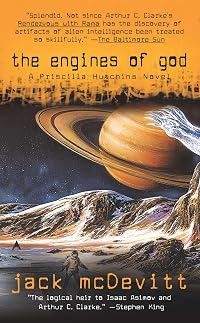
If you’re not sure what I mean pick up any one of McDevitt’s “Priscilla “Hutch” Hutchins” books; The Engines of God (1994), Deepsix (2001), Chindi (2002), Omega (2003), Odyssey (2006), and Cauldron (2007); or his “Alex Benedict” books; A Talent for War (1989), Polaris (2004), Seeker (2005) and The Devil's Eye (2008).
Awards:
By the by, McDevitt has won, or been nominated for, a number of prestigious Science Fiction awards:
* Nebula Best Short Story nominee (1983) : Cryptic
* Philip K. Dick Award (special citation) (1986) : The Hercules Text
* Nebula Best Short Story nominee (1988) : “The Fort Moxie Branch”
* Hugo Best Short Story nominee (1989) : “The Fort Moxie Branch”
* International UPC Science Fiction Award winner (1993) : “Ships in the Night” (first English language winner)
* Nebula Best Novella nominee (1996) : “Time Travelers Never Die”
* Arthur C. Clarke Best Novel nominee (1997) : Engines of God
* Hugo Best Novella nominee (1997) : “Time Travelers Never Die”
* Nebula Best Novel nominee (1997) : Ancient Shores
* Nebula Best Novel nominee (1998) : Moonfall
* Nebula Best Novelette nominee (1999) : “Good Intentions” (co-writer Stanley Schmidt)
* Nebula Best Novel nominee (2000) : Infinity Beach
* John W. Campbell Memorial Award for Best Novel nominee (2001) : Infinity Beach
* John W. Campbell Memorial Award for Best Novel nominee (2002) : Deepsix
* Nebula Best Short Story nominee (2002) : “Nothing Ever Happens in Rock City”
* Nebula Best Novel nominee (2003) : Chindi
* Campbell Award winner (2004) : Omega
* Nebula Best Novel nominee (2004) : Omega
* Nebula Best Novel nominee (2005) : Polaris
* Nebula Best Novel winner (2006) : Seeker
* John W. Campbell Memorial Award for Best Novel nominee (2006) : Seeker
* John W. Campbell Memorial Award for Best Novel nominee (2007) : Odyssey
* Nebula Best Novel nominee (2007) : Odyssey
* Nebula Best Novel nominee (2008) : Cauldron
Related Website:
Jack McDevitt’s author site
Jack McDevitt Wikipedia site
ISFDB Website
Google Books
Michael Swanwick’s profile of Jack McDevitt
Jack McDevitt’s Facebook fan club
Jack’s own explanation of how “Eternity Road” came to be
The Alternative
Southeast Wisconsin show less
Jack McDevitt
Eos
1998
Mass Market Paperback
ISBN: 0061054275
416 pages
Lean in closer, my reading friends…. Closer still…. That’s better!
I have a secret to tell. I am totally hooked on well-written post-apocalyptic fantasies that reflect broken and collapsed civilizations. Throw in a bit of half-working technology, a few cannibals or bandits, and a mythical “Haven” that holds all the answers and its all the better. Make it a road trip through the decimated countryside of an under-populated, over-demolished America and you have “Eternity Road.”
Now, I know that there are quite a few naysayers out there who have taken potshots at this particular work and I have to wonder why. Yes, post-apocalyptic stories are legion show more and only a few seem to rise to the top (i.e. “A Canticle for Liebowitz,” “Deus Irae,” etc.) but I believe there’s always room for more. In other words “been there – done that” does not necessarily equate to a merit-less contribution. Especially when penned by a gifted writer. And, make no mistake; Jack McDevitt is a very talented writer. Here’s why “Eternity Road” should be on your reading list and why you should not listen to the negative reviews.
Small pockets of civilization remain after the world has been devastated by an unnamed calamity. In Mississippi the community of Illyria is just beginning to reemerge from the destruction. Within the community is the Imperium, a throw-back university whose sole purpose is to unravel the mysteries of the artifacts and the history left behind by the “Roadmakers.” (That would be us, my silent readers.) Over the years, the hint of a rumor remains. “Haven” exists! Haven, the one place the apocalypse has left untouched. Where the world remains as it did in the days of the “Roadmakers.” A place where technology rules, knowledge is readily available, and everyone leads a life of ease.
Enter Karik Endine, the only survivor of a failed mission to locate Haven. After his return to Illyria he becomes despondent, closed off to his friends and acquaintances, and silent about the details of the disastrous quest. Ten years elapse and Endine moves further away from his family and friends. Finally, the mysterious and untold deaths of his companions become too unbearable to deal with and he commits suicide. After his death the discovery of a Roadmaker book in his possession, A Connecticut Yankee in King Arthur’s Court, and a journal of unusual sketches causes some Illyrians to believe that Endine may have located the lost Haven. But if he did why would he keep silent all those years? Based on this new information and using the sketches as a roadmap a small band of six companions set off in search of the mysterious city of Haven.
The narrative of “Eternity Road” is, in my estimation, riveting and is in some scenes reminiscent of medieval fantasy (see the works of J. R.R. Tolkien and Raymond E. Feist for example). Especially when McDevitt describes the many ruins of the ancient Roadmakers civilization, or when the band leaves the Crooked Man, a tavern at the edge of civilization, or when they try to cross the Wabash River.
In the semi-literate society of Illyria, books hold a certain fascination. Even those who are illiterate tend to understand their importance for rebuilding society. Other reviewers have called the process of literacy decline unlikely in McDevitt’s scenario but I strongly disagree. When people are forced to live off the land, to farm and scrounge and work long days simply to survive then literacy, schools, and books will take a back seat. That people will revere the written word under these circumstances is most probable. We only have to look back at our own not-to-distant past to see the truth. At the turn of the last century the majority of illiteracy occurred in rural, thinly populated farming communities where people worked long, hard days and had little time for reading. The literate minority were regarded with something equivalent to awe and there was a social stigma attached to those who could not read and write. The Illyrians would not look upon books as curiosities, as some might think, but rather as a means to become a better more advanced and knowledgeable society.
4 ½ out of 5 stars
One other thing I believe, and this is important to me personally, is that with the deaths of many of the golden age writers, Heinlein, Clarke, Vonnegut, to name a few, we as avid SF readers are going to need other talented writers to replace them. I think Jack McDevitt fits that mold. His stories are intelligent, quirky, and contain enough science to make them believable yet he still manages to make them enjoyable to read. With the newfound popularity of Urban Fantasy, Steampunk, and Historical Science Fiction, which I enjoy immensely by the way, we still need throwback writers who can successfully expand our imaginations. Jack McDevitt does just that.
If you’re not sure what I mean pick up any one of McDevitt’s “Priscilla “Hutch” Hutchins” books; The Engines of God (1994), Deepsix (2001), Chindi (2002), Omega (2003), Odyssey (2006), and Cauldron (2007); or his “Alex Benedict” books; A Talent for War (1989), Polaris (2004), Seeker (2005) and The Devil's Eye (2008).
Awards:
By the by, McDevitt has won, or been nominated for, a number of prestigious Science Fiction awards:
* Nebula Best Short Story nominee (1983) : Cryptic
* Philip K. Dick Award (special citation) (1986) : The Hercules Text
* Nebula Best Short Story nominee (1988) : “The Fort Moxie Branch”
* Hugo Best Short Story nominee (1989) : “The Fort Moxie Branch”
* International UPC Science Fiction Award winner (1993) : “Ships in the Night” (first English language winner)
* Nebula Best Novella nominee (1996) : “Time Travelers Never Die”
* Arthur C. Clarke Best Novel nominee (1997) : Engines of God
* Hugo Best Novella nominee (1997) : “Time Travelers Never Die”
* Nebula Best Novel nominee (1997) : Ancient Shores
* Nebula Best Novel nominee (1998) : Moonfall
* Nebula Best Novelette nominee (1999) : “Good Intentions” (co-writer Stanley Schmidt)
* Nebula Best Novel nominee (2000) : Infinity Beach
* John W. Campbell Memorial Award for Best Novel nominee (2001) : Infinity Beach
* John W. Campbell Memorial Award for Best Novel nominee (2002) : Deepsix
* Nebula Best Short Story nominee (2002) : “Nothing Ever Happens in Rock City”
* Nebula Best Novel nominee (2003) : Chindi
* Campbell Award winner (2004) : Omega
* Nebula Best Novel nominee (2004) : Omega
* Nebula Best Novel nominee (2005) : Polaris
* Nebula Best Novel winner (2006) : Seeker
* John W. Campbell Memorial Award for Best Novel nominee (2006) : Seeker
* John W. Campbell Memorial Award for Best Novel nominee (2007) : Odyssey
* Nebula Best Novel nominee (2007) : Odyssey
* Nebula Best Novel nominee (2008) : Cauldron
Related Website:
Jack McDevitt’s author site
Jack McDevitt Wikipedia site
ISFDB Website
Google Books
Michael Swanwick’s profile of Jack McDevitt
Jack McDevitt’s Facebook fan club
Jack’s own explanation of how “Eternity Road” came to be
The Alternative
Southeast Wisconsin show less
I enjoyed this story, although it seemed to take forever to get going and then to get anywhere.
Centuries after a plague wipes out most humans and the civilizations of our own time fall (one mention indicates at least 700 years), a small group sets out on horseback from a Mississippi settlement to try to find a (possibly mythical) location known as Haven. Legend has it that remnants of the lost cultures have been hidden away there, to await a future where they can be of use. A first mission 9 years earlier ended in all but one person dead, and the survivor refused to discuss what happened, so these travelers rely on some drawings they find after his death and on marks they recognize as directional indicators left by the previous show more expedition's guide. The towns growing up along the Mississippi have always known that a great civilization preceded them because they're surrounded by the rotting ruins of buildings, highways, and technology. But how such wonders were possible is beyond current imagining, and there are more discoveries to be made on the trip itself.
Although published less than 20 years ago, this book is reminiscent of earlier SF writers and is mostly oriented towards the human experience. show less
Centuries after a plague wipes out most humans and the civilizations of our own time fall (one mention indicates at least 700 years), a small group sets out on horseback from a Mississippi settlement to try to find a (possibly mythical) location known as Haven. Legend has it that remnants of the lost cultures have been hidden away there, to await a future where they can be of use. A first mission 9 years earlier ended in all but one person dead, and the survivor refused to discuss what happened, so these travelers rely on some drawings they find after his death and on marks they recognize as directional indicators left by the previous show more expedition's guide. The towns growing up along the Mississippi have always known that a great civilization preceded them because they're surrounded by the rotting ruins of buildings, highways, and technology. But how such wonders were possible is beyond current imagining, and there are more discoveries to be made on the trip itself.
Although published less than 20 years ago, this book is reminiscent of earlier SF writers and is mostly oriented towards the human experience. show less
There's a lot to like in this quest story set in North America several centuries after a plague brought the "Roadmaker" civilization to an end in 2079. There are the scholarly speculations, sometimes comical, sometimes poignant, on the meaning of Roadmaker ruins and literature. It is the discovery of a lost Mark Twain work that sets a group of scholars in search of the legendary Haven, reputed treasure trove of Roadmaker learning.
The journey to Haven definitely holds the reader's interest with the scholars encountering artifical intelligences that still haunt the landscape, river pirates, and other hazards of the road. However, the story quickly falters when Haven is reached. McDevitt hurries the conclusion to his tale and, though he show more provides a definite conclusion , it is so rushed it makes the book seem unfinished. show less
The journey to Haven definitely holds the reader's interest with the scholars encountering artifical intelligences that still haunt the landscape, river pirates, and other hazards of the road. However, the story quickly falters when Haven is reached. McDevitt hurries the conclusion to his tale and, though he show more provides a definite conclusion , it is so rushed it makes the book seem unfinished. show less
McDevitt, Jack. Eternity Road. Eos, 2004.
Jack McDevitt has written more than two dozen novels that routinely put him on the shortlist for the major awards in science fiction. His novels featuring Pricilla Hutchins and Alex Benedict provide entertaining explorations of Xenoarchaeology. Eternity Road, by contrast, is an earthbound postapocalyptic quest novel that does not seem as well thought out as most of McDevitt’s work. The story begins centuries after war and plagues have depopulated most of the planet. In the southern Mississippi Valley, villagers admire the ancient Roadbuilders who built the broken and partially buried concrete highways. Most of the continent has returned to a primeval forest, and travel is hampered by dangerous show more animals and brigands. A small team sets out to find a cache of books rumored to be somewhere near the Great Lakes. Unfortunately, McDevitt’s ideas about what kinds of technology and buildings might have survived don’t always seem credible. His world is not as fantastic as the Road Warrior movies, but disbelief is not always easy to suspend. 3 stars. show less
Jack McDevitt has written more than two dozen novels that routinely put him on the shortlist for the major awards in science fiction. His novels featuring Pricilla Hutchins and Alex Benedict provide entertaining explorations of Xenoarchaeology. Eternity Road, by contrast, is an earthbound postapocalyptic quest novel that does not seem as well thought out as most of McDevitt’s work. The story begins centuries after war and plagues have depopulated most of the planet. In the southern Mississippi Valley, villagers admire the ancient Roadbuilders who built the broken and partially buried concrete highways. Most of the continent has returned to a primeval forest, and travel is hampered by dangerous show more animals and brigands. A small team sets out to find a cache of books rumored to be somewhere near the Great Lakes. Unfortunately, McDevitt’s ideas about what kinds of technology and buildings might have survived don’t always seem credible. His world is not as fantastic as the Road Warrior movies, but disbelief is not always easy to suspend. 3 stars. show less
All that's left of civilization is ruins - roads, bridges, buildings, and a very few surviving books to help us make sense of the roadmakers' culture. There was an expedition to Haven that returned not only empty-handed, but with all the expedition members save one dead.
That's the scenario of Eternity Road. Against this background, a party of explorers seeks out "Haven", the mythical site of a cache of Roadmaker artifacts. The characters are memorable, likeable (mostly), and the story stayed with me. My favorite book my Mr. McDevitt so far.
(You can also see this review on my blog.)
That's the scenario of Eternity Road. Against this background, a party of explorers seeks out "Haven", the mythical site of a cache of Roadmaker artifacts. The characters are memorable, likeable (mostly), and the story stayed with me. My favorite book my Mr. McDevitt so far.
(You can also see this review on my blog.)
Members
- Recently Added By
Lists

Dystopian and Apocalyptic Literature
350 works; 74 members

hypatian_kat to-read
429 works; 3 members

Books Read in 2024
4,623 works; 126 members
Author Information

124+ Works 20,893 Members
Jack McDevitt (born 1935) is an American science fiction author whose novels frequently deal with attempts to make contact with alien races, and with archaeology or xenoarchaeology. He attended La Salle University, where a short story of his won the annual Freshman Short Story Contest and was published in the school's literary magazine, Four show more Quarters. He received a Master's degree in literature from Wesleyan University in 1971. Before becoming a full-time author, he was an English teacher, naval officer, Philadelphia taxi driver, customs officer and motivational trainer. His first published story was The Emerson Effect in The Twilight Zone Magazine in 1981. Two years later, he published his first novel, The Hercules Text, which won the Philip K. Dick Special Award. He won the 2006 Nebula Award for Best Novel for Seeker, the UPC International Prize for his novella Ships in the Night in 1991, and the John W. Campbell Memorial Award for best SF novel for Omega in 2003. (Bowker Author Biography) show less
Some Editions
Awards and Honors
Awards
Series
Belongs to Publisher Series
Bastei Science Fiction-Special (24245)
Common Knowledge
- Canonical title
- Eternity Road
- Original title
- Eternity Road
- Original publication date
- 1997
- People/Characters
- Chaka Milana; Silas Glote; Quait Esterhok; Avila; Flojian Endine; Karik Endine (show all 7); Jon Shannon
- Important places
- Mississippi Valley, USA; Illyria; Argon; Imperium; Farroad
- Epigraph
- I asked him how far we were from Hartford. He said he had never heard of the place.
-Mark Twain - First words
- It is a fond and universally held notion that only things of the spirit truly endure: love, sunsets, music, drama.
- Last words
- (Click to show. Warning: May contain spoilers.)She's intelligent, far too bright to make an issue of the fact that her husband occasionally tosses in his sleep, and cries out another woman's name.
- Blurbers
- Swanwick, Michael; Gregory Benford; Robert J. Sawyer; Jeffrey A. Carver; James Patrick Kelly
Classifications
Statistics
- Members
- 1,203
- Popularity
- 20,634
- Reviews
- 23
- Rating
- (3.63)
- Languages
- English, German, Polish
- Media
- Paper, Audiobook, Ebook
- ISBNs
- 11
- ASINs
- 7