
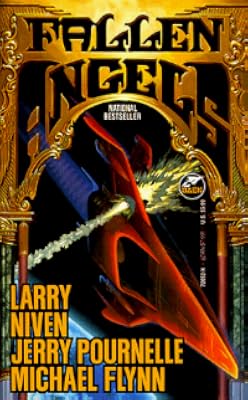
Fallen Angels
by Larry Niven, Michael F. Flynn, Jerry Pournelle
On This Page
Description
Reeling under a new ice age, the lunatic fringe of the environmental movement controls the US government. Abandoned by Earth, the space colonies replenish their air by scoop-ships diving into the atmosphere - but Alex and Gordon's ship was hit by a missile, and they are now wanted dead or alive.Tags
Recommendations













Member Reviews
This book is both fun and depressing. Fun because of quirky characters and snappy dialogue. Depressing because of the setup- humanity, in particular the United States, having turned their back on technology, is fighting a losing battle against an Ice Age. The government writes off whole regions and populations, spending resources instead on persecuting fans of science fiction as subversives. In different hands, this premise could create a dystopia in some ways bleaker than 1984. Instead, the cautionary tale is simply the backdrop for what is best described as a caper novel: a group of ragtag misfits staying one step ahead of the law. It's not a page turner, but I found it enjoyable. I find it hard to imagine the government coalition show more described here (Greens, feminists and... Christians? O-kay), but Greens are the main baddies, at least that we get to see. There are a couple of scenes towards the end that, literally, had my jaw dropping. If I were a feminist, I would get hopping mad; since I'm not, it was just hilarious and satisfying. I will definitely be checking out all three authors separately (I've only read one book by Michael Flynn), to see what kind of stuff they write on their own. show less
My reactions to reading this book in 1991. Some spoilers may follow.
This novel was a big disappointment. All these authors are capable of good work, and Niven and Pournelle together have done some great stuff. It's not that I think these authors can't work together; it's that I don't like what they set out to do -- and probably succeeded in doing.
This book is dedicated to Science Fiction Fandom and that is the main focus of the book. This book panders to fandom's lofty notions of itself. To be sure, fans are shown as bickering, silly, obnoxious but ultimately effectual. I did like some fannish bits: the thinly disguised Forest J. Ackerman character (here Tremont J. Fielding) and his Minneapolis mansion (as far as I can tell, the show more authors got all the Twin Cities details right but you'd expect these guys to) and the allusions to Pournelle's and Niven's alter egos (Pournelle is a drunk, Niven has been exiled to Australia).
However, the book contained many allusions to people, places, and works in the real and fictional sf world which were not really necessary but just a fannish exercise in spot the allusion. Some, like Army Engineer George Scithers, were fun. Most were pointless like Wisconsin farmer Enoch Wallace named after the main character in Clifford D. Simak's Way Station. I did like some of the characters: Gordon Tanner, spacer and enthusiastic amateur poet was my favorite. Though I liked policeman Lee Arteria; however, the authors blow her portrayal with their final, one-paragraph explanation on why she switched from sf fan and aeronautical engineer to Green police investigator, albeit for the Air Force. Very unconvincing. I also liked the Alderman (no doubt a Pournelle invention and reminiscent of the Boss in H.G. Wells' film version of Things to Come) of dying Milwaukee.
It was that bit in Milwaukee that I hoped the rest of the book would be like: a wide portrait of industrial society meeting an ice age and a satire on radical environmentalism. The book had just a bit of that. To be sure, the stupidity of the Greens was not exaggerated over what they're like now. But if the authors were trying to make a propaganda point similar to Pournelle and Niven's Lucifer's Hammer (which I think they were) -- that industrial civilization is worth saving -- they failed. Their message was not frequent enough and buried under fans on a quest for a spaceship. The need for space was even less effectively argued for here though NASA was bashed frequently -- and, probably, deservedly so. The intents of the book -- satirical and propaganda -- are clear from the acknowledgements. They are less well handled in the text. In short, fandom killed a story that could have been better satire and propaganda. show less
This novel was a big disappointment. All these authors are capable of good work, and Niven and Pournelle together have done some great stuff. It's not that I think these authors can't work together; it's that I don't like what they set out to do -- and probably succeeded in doing.
This book is dedicated to Science Fiction Fandom and that is the main focus of the book. This book panders to fandom's lofty notions of itself. To be sure, fans are shown as bickering, silly, obnoxious but ultimately effectual. I did like some fannish bits: the thinly disguised Forest J. Ackerman character (here Tremont J. Fielding) and his Minneapolis mansion (as far as I can tell, the show more authors got all the Twin Cities details right but you'd expect these guys to) and the allusions to Pournelle's and Niven's alter egos (Pournelle is a drunk, Niven has been exiled to Australia).
However, the book contained many allusions to people, places, and works in the real and fictional sf world which were not really necessary but just a fannish exercise in spot the allusion. Some, like Army Engineer George Scithers, were fun. Most were pointless like Wisconsin farmer Enoch Wallace named after the main character in Clifford D. Simak's Way Station. I did like some of the characters: Gordon Tanner, spacer and enthusiastic amateur poet was my favorite. Though I liked policeman Lee Arteria; however, the authors blow her portrayal with their final, one-paragraph explanation on why she switched from sf fan and aeronautical engineer to Green police investigator, albeit for the Air Force. Very unconvincing. I also liked the Alderman (no doubt a Pournelle invention and reminiscent of the Boss in H.G. Wells' film version of Things to Come) of dying Milwaukee.
It was that bit in Milwaukee that I hoped the rest of the book would be like: a wide portrait of industrial society meeting an ice age and a satire on radical environmentalism. The book had just a bit of that. To be sure, the stupidity of the Greens was not exaggerated over what they're like now. But if the authors were trying to make a propaganda point similar to Pournelle and Niven's Lucifer's Hammer (which I think they were) -- that industrial civilization is worth saving -- they failed. Their message was not frequent enough and buried under fans on a quest for a spaceship. The need for space was even less effectively argued for here though NASA was bashed frequently -- and, probably, deservedly so. The intents of the book -- satirical and propaganda -- are clear from the acknowledgements. They are less well handled in the text. In short, fandom killed a story that could have been better satire and propaganda. show less
Larry says: Save the planet- kill an environmentalist.: Ever said that you're a science fiction fan, and been called a geek? Ever wanted to be able to save the world? Read Fallen Angels. But don't take it too seriously. Fallen Angels is a rather scizophrenic book- it seems unsure as to what it wants to be. On the one hand, it's a fast-moving romp through an interesting future world- a world where an extreme radical Green party has gained power in America, and, in effect, banned science. In this future world, scientists, and science fiction fans have much the same status as Communists did in 1950's America. However, the authors (noted opponents of Green politics) go absolutely overboard on the politicaL side of the book, meaning that show more every good character spouts Nivenist Politik, and every bad character is a stupid, blinkered Green Nazi. This total polarisation of character makes the book hard to take seriously- a political discussion is boring when one party is shown to be so obviously right (in the authors view, anyway). In fact, considering the authors fine scientific background, the science in the book is perilously dodgy- Biomass fuel is not produced through burning farm produce, and I think you'd be hard pressed to find anyone who'd think it's a good idea to pump CO2, and CFCs into the atmosphere "in case there's an ice-age". In case you're wondering why I gave this book three stars after the hammering I've just given it, I did actually quite enjoy it. Despite the heavy didactism, the book is funny, fast-moving, and had engaging central characters. It at least makes you think about what you're reading, which is more than I can say about most books I've read. Overall- recommended. But don't let it change your life. show less
The premise of a glacier slowly expanding down into the continental US is a lot more interesting than the book ended up being. There's a lot of dated anti-environmentalist ranting, which I might not have minded when it was written in 1991 but bugged me given current politics, and a lot of inside jokes about fan culture, which I didn't find especially interesting. And I don't know about the print editions, but the copyediting of the ebook was not very good.
This book was ok, but it didn’t really grab me and keep me interested throughout the entire book. The premise is that, instead of the global warming that most people predicted, Earth entered into an ice age. Everybody’s attempts to "go green" and limit pollution actually helped hasten that ice age. The book is very U.S.-centric and we don’t really learn what’s going on in the rest of the world but, in the U.S., there’s a glacier moving its way across the U.S. People are cold, resources are limited, and, oddly enough, science is taboo so people aren’t able to find ways to improve things. Even science fiction fans are persecuted, and possessing science fiction paraphernalia can get you arrested.
There are a group of people show more still living in space stations orbiting earth from before NASA was shut down. These people periodically send scoopships into Earth’s atmosphere to collect gasses that they need, and people from Earth try to shoot them down. The book starts off with two men flying a scoopship and getting shot down. Closet science fiction fans try to find them and get them somewhere safe before the government finds them.
This book I guess was written largely for people who are more involved with, or at least familiar with, the “fandom” scene. The science fiction fans were the heroes of the story and some of them were as over-the-top as one would expect based on stereotypes of fandom culture. I learned all sorts of new terms and acronyms such as fafiated, gafiated, FIAWOL, and FIJAGH. Since I’ve never been to a convention and don’t really participate in any of that, this stuff often dragged me out of the story. There was a constant barrage of it. However, most of the terms were easy enough to understand within their context and others were explained. The two men from the space station, one of whom was born in space and the other of whom had left Earth with his parents as a very young child, were unfamiliar with fandom so they served as an excuse for the authors to explain things to the uninitiated reader.
Some parts of the story held my interest well, and other parts bored me. There were some very funny parts in the book that made me laugh out loud. Sometimes I was drawn into the story, but I was never really drawn into caring about the characters. I never felt that concerned about what happened to them, and sometimes I was annoyed by them. I also wish we’d been told more about the space stations -- how they were established, what their original intent was, whether they had ever attempted to reach any agreement with people on Earth, etc. They were never really explained in detail, aside from occasional snippets about what life was like on them as told by the characters who were from the space stations.
My e-book edition of this book also had a LOT of errors. Spelling errors, grammatical errors, punctuation errors, you name it – more errors than I’ve ever seen in a book published by a traditional publisher (Baen). And there, were commas, in really, weird, places. Everywhere, commas. In, places where they, made no sense. The book was originally published in 1991 (and it showed its age more than some older books I’ve read), so perhaps the e-book was created using OCR and various spots on the page were read in as commas? Or maybe it was supposed to be some sort of a homage to William Shatner’s delivery method as Kirk in the original Star Trek series. I have no idea, but it was annoying.
In any case I found some enjoyment in the book and I’ve certainly read worse books, but I was happy to reach the end of it so I could move onto something else. show less
There are a group of people show more still living in space stations orbiting earth from before NASA was shut down. These people periodically send scoopships into Earth’s atmosphere to collect gasses that they need, and people from Earth try to shoot them down. The book starts off with two men flying a scoopship and getting shot down. Closet science fiction fans try to find them and get them somewhere safe before the government finds them.
This book I guess was written largely for people who are more involved with, or at least familiar with, the “fandom” scene. The science fiction fans were the heroes of the story and some of them were as over-the-top as one would expect based on stereotypes of fandom culture. I learned all sorts of new terms and acronyms such as fafiated, gafiated, FIAWOL, and FIJAGH. Since I’ve never been to a convention and don’t really participate in any of that, this stuff often dragged me out of the story. There was a constant barrage of it. However, most of the terms were easy enough to understand within their context and others were explained. The two men from the space station, one of whom was born in space and the other of whom had left Earth with his parents as a very young child, were unfamiliar with fandom so they served as an excuse for the authors to explain things to the uninitiated reader.
Some parts of the story held my interest well, and other parts bored me. There were some very funny parts in the book that made me laugh out loud. Sometimes I was drawn into the story, but I was never really drawn into caring about the characters. I never felt that concerned about what happened to them, and sometimes I was annoyed by them. I also wish we’d been told more about the space stations -- how they were established, what their original intent was, whether they had ever attempted to reach any agreement with people on Earth, etc. They were never really explained in detail, aside from occasional snippets about what life was like on them as told by the characters who were from the space stations.
My e-book edition of this book also had a LOT of errors. Spelling errors, grammatical errors, punctuation errors, you name it – more errors than I’ve ever seen in a book published by a traditional publisher (Baen). And there, were commas, in really, weird, places. Everywhere, commas. In, places where they, made no sense. The book was originally published in 1991 (and it showed its age more than some older books I’ve read), so perhaps the e-book was created using OCR and various spots on the page were read in as commas? Or maybe it was supposed to be some sort of a homage to William Shatner’s delivery method as Kirk in the original Star Trek series. I have no idea, but it was annoying.
In any case I found some enjoyment in the book and I’ve certainly read worse books, but I was happy to reach the end of it so I could move onto something else. show less
I have a soft spot for this book, in part due to one of the minor characters in it; but it's not terribly good, I'm afraid.
This was a fun book to read, with a serious undertone. Although I was never big on the whole fan side of SF, I did attend a couple of conventions in my younger days, enough so that I could really enjoy some, maybe many, of the references to fandom.
Members
- Recently Added By
Author Information

331+ Works 98,220 Members
Larry Niven received his B.A. in mathematics in 1962. His first novel, World of Ptavvs (1966), was a success and launched his career. Niven has won five Hugos and one Nebula award, testimony that his colleagues in the science fiction world respect his work. Perhaps Niven's most well-known creation is Ringworld, a distant planet that may be taken show more as a metaphor for Earth, as it was once great but has since fallen into decay. (Bowker Author Biography) show less

60+ Works 5,679 Members

148+ Works 40,488 Members
Jerry Eugene Pournelle was born in Shreveport, Louisiana on August 7, 1933. During the Korean War, he served in the U. S. Army. He received a B.S. in psychology in 1955, an M.S. in psychology in 1958, and a Ph.D. in political science in 1964 from the University of Washington. He worked for Boeing and NASA where he worked on the Mercury, Gemini, show more and Apollo missions. He also advised the federal government on military matters and space exploration. He wrote science fiction and helped popularize the military science fiction genre. His first novel, Red Heroin, was published in 1969 under the pen name Wade Curtis. His other novels published under his own name included Janissaries, Starswarm, and The Mercenary. He also wrote novels with Larry Niven including Oath of Fealty, The Mote in God's Eye, Lucifer's Hammer, Inferno, Escape from Hell, and Footfall. Pournelle was widely credited as the first major author to write a published novel entirely on a computer. He wrote a witty advice columns for computer users in Byte magazine. He received the John W. Campbell Award for Best New Writer of 1973. He died of heart failure on September 8, 2017 at the age of 84. (Bowker Author Biography) show less
Some Editions
Awards and Honors
Awards
Series
Belongs to Publisher Series
Common Knowledge
- Original title
- Fallen Angels
- Original publication date
- 1991-07
- Dedication
- For Science Fiction Fandom
- First words
- High over the northern hemisphere the scoopship's hull began to sing.
- Quotations
- Yngvi is a louse.
- Last words
- (Click to show. Warning: May contain spoilers.)“…And when the stars are conquered, it'll be by wanted fans!”
- Original language
- English
Classifications
Statistics
- Members
- 1,258
- Popularity
- 19,440
- Reviews
- 16
- Rating
- (3.30)
- Languages
- English, German
- Media
- Paper, Ebook
- ISBNs
- 9
- ASINs
- 11