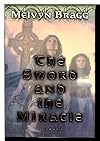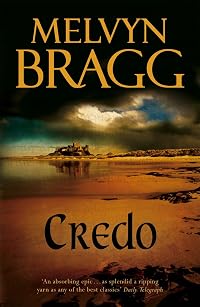
Credo
by Melvyn Bragg
On This Page
Description
Britain during the Dark Ages is the setting for the fascinating story of Bega, a young Irish princess who became a saint, and her lifelong bond with Padric, prince of the north-western kingdom of Rheged. This dramatic, far-reaching tale brings to life a land of warring kings, Christians and pagans, and tribes divided by language and culture, illuminating a little-known yet critical period in British history.Tags
Recommendations









Member Reviews
Credo is a tale set in 7th Century England. It's essentially the story of a couple, Bega and Padric. As the story opens, Padric is a guest in the hall of Cathal, a king in Ireland. Padric himself is a prince of the kingdom of Rheged in Britain. Bega is Cathal's daughter and, at the start of the tale, Padric's pupil. Both Padric and Bega are strong, intelligent and idealistic; capable warriors and pious Christians. There's a budding romance between the two, but neither one of them has the maturity to realize it. The dawning realization of their mutual attraction permeates the background of the first section of the book, like the beginning overture of a symphony. The following book is a work of art. There's a gripping plot, compelling show more characters and a milieu that feels genuine. For me, the biggest appeal of the book is that Mr. Bragg captures what it's like to be a Christian. Every soul in the book, whether pious or impious, struggles with their faith. The good characters have their sinful side and the evil ones worry about facing the throne of God. Of course, as a Lutheran, sometimes I wished I could give these good Catholics a lecture on grace, but overall I identified with these characters. Credo is a great book.
--J. show less
--J. show less
Boy, this book is heavy, in several senses of the word. A historical novel based on the religious and ethnic tensions of Dark Age Britain, it follows the life of the semi-fictional nun Bega, who travels from Ireland to Cumbria and becomes embroiled with all the great names of the day: Wilfrid, Cuthbert, King Oswy of Northumbria, Colman of Lindisfarne. A romance thwarted by her vow of celibacy threads through the book, but threatens to be swamped by the history: at one point I wondered if the whole thing was just a preamble to a reconstruction of the minutes of the Synod of Whitby. Some of the characters and incidents are nicely drawn, and Bragg does (mostly) manage to engage our sympathy with Celtic Christians whose religious outlook show more borders on the psychotic, but who valiantly resist both the arrogant uniformity of the Church of Rome and the monstrous oppression of the Saxon kings, while fighting a rearguard action against Celtic paganism. The author's historical learning is wide, but often too near the surface, and he does not have the deft novelist's touch of a writer such as Edith Pargeter or Rosemary Sutcliff. The book could probably have been about two thirds of the size without serious loss of content, but I got through it unscathed - and better informed about the period. MB 13-v-2010 show less
Weaving the known historical facts of the latter half of the 7th century with his own imagination Bragg has created an epic read. Telling the story of the conflict of the Celts; Picts and native British against the Saxon invaders in 7th century BC Britain; also the differences between the Celtic church and the Roman Catholic church. This is a time that shaped Britain. Love and belief, both Pagan and Christian; the ambition of men to rule and to use religion towards that end; the missions to convert people to one belief and the idea that the one true belief comes from Rome and the Pope combine to form a compelling story. The central character is Bega, an Irish princess, who is forced to flee to Britain where she becomes a nun. Her tutor show more Padric, a Celtic prince, returns to his homeland in the north of Britain determined to expel the invading Saxons.
A wonderful story. The hardship of life; the landscape; the beliefs of his characters are all well described. The story is believable and reflects the times. If you are at all interested in this period of history this book is well worth reading. show less
A wonderful story. The hardship of life; the landscape; the beliefs of his characters are all well described. The story is believable and reflects the times. If you are at all interested in this period of history this book is well worth reading. show less
I don't know anything about the history of "Dark Age". I read this book just as a fiction and wasn't let down by Mr. Bragg. Yes, the book is very long. But, it has given him ample space to build his characters and describe the places and events in detail. There are a few places where the narrative gets repetitive, though. In a nutshell, I quite liked it.
A book about the religious side of life in the post-Roman British Isles. It is well researched and written, and reminds me that i'm not sad not to be a Catholic. If this is a life goal, I'm not up for these people.
Set in the latter half of the 7th Century, this book tells of the lives of two people, both based on historical figures, Padric and Bega. In an era where great sacrifice in the name of faith was an aspiration, these two were given the grace to sacrifice their life together to the greater good of their people. Bragg has done a creditable job of documenting the details of this era with precision and without allowing his own values and sensibilities to distort the truth of that era. Like most historical writers who are in love with a timeline, Bragg sometimes packs in a bit more information than the reader cares to deal with but this is a sweeping drama of a fascinating time and is well worth the time.
Historical fiction from Anglo-Saxon dark ages. Educated, historic - but still airport fiction.
Read Sept 2004
Read Sept 2004
Members
- Recently Added By
Author Information

70+ Works 5,635 Members
Melvyn Bragg is a British writer and broadcaster. His novels include The Hired Man, for which he won the Time/Life Silver Pen Award, Without a City Wall, winner of the John Llewellyn Rhys Prize, The Soldier's Return, winner of the WHSmith Literary Award, A Son of War and Crossing the Lines, both of which were longlisted for the Man Booker Prize, show more and most recently Grace and Mary. He has also written several works of non-fiction, the latest being The Book of Books about the King James Bible. In 2015, his book The Adventure of English became a New York Times bestseller. He lives in London and Cumbria. (Publisher Provided) show less
Series
Belongs to Publisher Series
Ullstein Buch (24541)
Common Knowledge
- Original title
- Credo
- Alternate titles
- The Sword and the Miracle
- Original publication date
- 1996
- Disambiguation notice
- Credo (UK) = The Sword and the Miracle (US)
Classifications
Statistics
- Members
- 482
- Popularity
- 63,277
- Reviews
- 8
- Rating
- (3.25)
- Languages
- English, German, Swedish
- Media
- Paper, Audiobook, Ebook
- ISBNs
- 14
- ASINs
- 4