
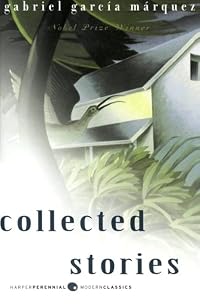
Collected Stories
by Gabriel García Márquez
On This Page
Description
Contains twenty-six short stories by the 1982 Nobel Laureate appearing in the order in which they were originally published in Spanish.Tags
Recommendations
































Member Reviews
“Only his own death came between him and his grave. Resigned, he listened to the drop, thick, heavy, exact, as it dripped in the other world, in the mistaken and absurd world of rational creatures.’’
In twenty-six stories from Eyes of a Blue Dog, Big Mama's Funeral, and The Incredible and Sad Tale of lnnocent Eréndira and Her Heartless Grandmother, the greatness of Gabriel García Márquez is confirmed once again. Stories of communities torn apart by dispute, poverty and superstition. Stories of communities brought together by hope and love and the daily struggle to survive. Towns where angels with gigantic wings roam free, demons spread their stink which the perfume of roses cannot disguise, women are either revered figures or show more seductresses that search for an escape from a bleak reality. Either way, it is women that hold the strings to the puppet show of a paranoid world.
‘’Every day I try to remember the phrase with which I am to find you,’’ I said. ‘’Now I don’t think I’ll forget it tomorrow. Still, I’ve always said the same thing and when I wake up I’ve always forgotten what the words I can find you with are.’’
Eyes of A Blue Dog
It would be impossible to choose my favourite stories in the array of crumbling towns, and dirty harbours. In the company of fairs, civil servants and officials, shady encounters and enterprises and otherworldly women. In the nights of August, with its melancholy and strange magnetism, all things are possible. ‘’I remembered the August nights in whose wondrous silence nothing could be heard except the millenary sound that the earth makes as it spins on its rusty, unoiled axis. Suddenly I felt overcome by an overwhelming sadness.’’
‘’Since it’s Sunday and it’s stopped raining, I think I’ll take a bouquet of roses to my grave.’’
Birds are breaking windows, invading houses only to die inside. In the August heat, the deserted streets, unwashed because of the droughts, are suffocating the pedestrians with the stench of death. What does the troubled priest actually see around him? The Wandering Jew or the Devil himself? Blind women try to warn others with their vision but who believes them? Wives ask to be buried alive, and a town is visited by the travelling show of the woman who was turned into a spider for having disobeyed her parents. The isolated, ruined towns have lost their multicoloured glory, eaten away by the vicious sun and the cruel sea. And there is no mercy in store for the residents.
If we find each other sometime, put your ear to my ribs when I sleep on the left side and you’ll hear me echoing.’’
Eyes of a Blue Dog: A sensual, haunting, mesmerizing elegy of a relationship in a dream.
Someone Has Been Disarranging These Roses: Who is the ghost? Who is dead? Who is alive? A tale of loneliness, isolation, sanctity and sacred roses.
Monologue of Isabel Watching It Rain in Macondo: The desire for rain becomes an unimaginable terror for the community of Macondo. A story that represents the unique, lyrical voice of Márquez.
The Incredible and Sad Tale of Innocent Erendira and Her heartless Grandmother: One of the most powerful, cruel, raw stories by Márquez. How much does innocence cost in a community that cannot find its way through the darkness?
Every passage written by Márquez is a revelation of the power of Literature. Its magic, its lyrical voice, its mesmerizing quality to carry you in dark worlds into your soul. In a site that supposedly promotes reading, it is astonishing to see many ‘’readers’’ dismissing Márquez on the grounds of ‘’magical realism’’ and being ‘’incomprehensible’’. How about you try a little more?
‘’The angel was the only one who took no part in his own act. He spent his time trying to get comfortable in his borrowed nest, befuddled by the hellish heat of the oil lamps and sacramental candles that had been placed along the wire.’’
‘’She’s done a lot of travelling’’, Mr Herbert said. ‘’She’s carrying behind the flowers from all the seas of the world.’’ show less
In twenty-six stories from Eyes of a Blue Dog, Big Mama's Funeral, and The Incredible and Sad Tale of lnnocent Eréndira and Her Heartless Grandmother, the greatness of Gabriel García Márquez is confirmed once again. Stories of communities torn apart by dispute, poverty and superstition. Stories of communities brought together by hope and love and the daily struggle to survive. Towns where angels with gigantic wings roam free, demons spread their stink which the perfume of roses cannot disguise, women are either revered figures or show more seductresses that search for an escape from a bleak reality. Either way, it is women that hold the strings to the puppet show of a paranoid world.
‘’Every day I try to remember the phrase with which I am to find you,’’ I said. ‘’Now I don’t think I’ll forget it tomorrow. Still, I’ve always said the same thing and when I wake up I’ve always forgotten what the words I can find you with are.’’
Eyes of A Blue Dog
It would be impossible to choose my favourite stories in the array of crumbling towns, and dirty harbours. In the company of fairs, civil servants and officials, shady encounters and enterprises and otherworldly women. In the nights of August, with its melancholy and strange magnetism, all things are possible. ‘’I remembered the August nights in whose wondrous silence nothing could be heard except the millenary sound that the earth makes as it spins on its rusty, unoiled axis. Suddenly I felt overcome by an overwhelming sadness.’’
‘’Since it’s Sunday and it’s stopped raining, I think I’ll take a bouquet of roses to my grave.’’
Birds are breaking windows, invading houses only to die inside. In the August heat, the deserted streets, unwashed because of the droughts, are suffocating the pedestrians with the stench of death. What does the troubled priest actually see around him? The Wandering Jew or the Devil himself? Blind women try to warn others with their vision but who believes them? Wives ask to be buried alive, and a town is visited by the travelling show of the woman who was turned into a spider for having disobeyed her parents. The isolated, ruined towns have lost their multicoloured glory, eaten away by the vicious sun and the cruel sea. And there is no mercy in store for the residents.
If we find each other sometime, put your ear to my ribs when I sleep on the left side and you’ll hear me echoing.’’
Eyes of a Blue Dog: A sensual, haunting, mesmerizing elegy of a relationship in a dream.
Someone Has Been Disarranging These Roses: Who is the ghost? Who is dead? Who is alive? A tale of loneliness, isolation, sanctity and sacred roses.
Monologue of Isabel Watching It Rain in Macondo: The desire for rain becomes an unimaginable terror for the community of Macondo. A story that represents the unique, lyrical voice of Márquez.
The Incredible and Sad Tale of Innocent Erendira and Her heartless Grandmother: One of the most powerful, cruel, raw stories by Márquez. How much does innocence cost in a community that cannot find its way through the darkness?
Every passage written by Márquez is a revelation of the power of Literature. Its magic, its lyrical voice, its mesmerizing quality to carry you in dark worlds into your soul. In a site that supposedly promotes reading, it is astonishing to see many ‘’readers’’ dismissing Márquez on the grounds of ‘’magical realism’’ and being ‘’incomprehensible’’. How about you try a little more?
‘’The angel was the only one who took no part in his own act. He spent his time trying to get comfortable in his borrowed nest, befuddled by the hellish heat of the oil lamps and sacramental candles that had been placed along the wire.’’
‘’She’s done a lot of travelling’’, Mr Herbert said. ‘’She’s carrying behind the flowers from all the seas of the world.’’ show less
This is a collection of García Márquez’ short stories sorted in more or less chronological order. His early work resembles that of Silvina Ocampo: alienating and untethered to traditional fictional representations of reality. The stories get less weird and more narrative over time, but even then their magical realism remains central to their character. Other definitional features are a confidence of voice and delivery paired with a calculated balance between sparseness and lyricism. The man could write, no doubt about it.
Many of these stories I enjoyed reading; others I enjoy having read more than ploughing through them. But on the whole this was a very worthwhile book.
Many of these stories I enjoyed reading; others I enjoy having read more than ploughing through them. But on the whole this was a very worthwhile book.
6. Collected Stories by Gabriel García Márquez
translators: Gregory Rabassa & J. S. Bernstein
published: 1984
format: 343 page paperback
acquired: December
read: Jan 18-25
rating: 4½
Original collections:
Eyes of the Blue Dog: stories 1947-1955, English translation 1968. Translated by Gregory Rabassa
Big Mama’s Funeral: stories 1962, English translation 1972. Translated by J. S. Bernstein
The Incredible and Sad Tale of Innocent Eréndira and Her Heartless Grandmother: stories 1968-1972, English translation 1978. Translated by Gregory Rabassa
Márquez spent his youngest years away from his parents, living in the Columbia coastal town of Aracataca with his grandparents, who he explains were both great story tellers. His grandmother would mix in show more fanciful aspects to her stories without breaking her tone, as if she was telling all fact. He has explained these were huge influences on his writing. And it seems he was always writing.
This is my first step into Márquez. I will follow him in mostly a chronological manner, and this collection includes some of his earliest published work. The first story, The Third Resignation, was published in 1947 when Márquez was 20 years old. What this collection offers in an evolution in the writing of talented and creative story teller.
[Eyes of the Blue Dog], the first collection, is weakest and yet the one I find I have the most to say about, because of how his writing changes from story to story. Several things are notable about the earliest stories, The Third Resignation, The Other Side of Death, and Eva is inside her cat. They have striking opening lines, with words like "sharp", and phrases like "cold, cutting, vertical noise", they are psychoanalytical, idea heavy, and rather dull to read, leaving this reader interested, but counting pages till the end. The Other Side of Death ends "in the other world, the mistaken and absurd world of rational creatures,” A phrase that is maybe revealing as to where Márquez was headed. These stories all have very different approaches, and strengths. In the title story a man has an intimate conversations with a woman in his dreams, one he can see, but can't touch, and who he completely forgets as soon as he wakes, even as she keeps telling him how to find her. It's an exploration of desire and relationships. It's a good story, but most notable because of different way to approaching what he is exploring. Whereas the most compelling story for me, the first one where I forgot to count the pages, was straight forward. Titled The Woman Who Came at Six O’Clock, it's only a conversation, a flirtatious and manipulative one between between a woman and a bar tender in an empty bar. There are five more stories after that, and I would say each one is just a much better story, much more readable, then the earlier ones, but still very imaginative. And, in each story, it seems he's getting closer to home.
Every story in [Big Mama’s Funeral] is well developed. One might say a maturing author developing into mastering his abilities. The stories are starting to feel like pieces of a larger worlds, like Márquez is just giving us a window and that he could keep going on and I wouldn't have minded. Most of these stories are very much his world in small town coastal Columbia, in Aracataca, which gets mentioned in the last story, the title story. Characters reoccur, the tone changes, and there is a heavy, if dark or darkly tinted, humor. In the title story the tone is hyper-formal. "...and for the third time in twenty centuries there was an hour of confusion, chagrin, and bustle in the limitless empire of Christendom...
The author of [1926190::The Incredible and Sad Tale of Innocent Eréndira and Her Heartless Grandmother] is not experimenting so much as making his points through story telling. In the opening story, A Very Old Man With Enormous Wings, an angel falls into a town and becomes something like a zoo attraction. He doesn't speak and doesn't interact with anyone, just stoically bides his time until his wings heal and he wordlessly flies off. What is Márquez saying? The main sense in all these stories is of a fairy tale, but with all the dark elements, with wonderful characters, usually leaving us with a sense of how small they are in a strange wider world they will never understand. When the outside world comes, it seems everyone always ends up losing something to them, and when they branch out, the characters just disappear. Several of these are really quote terrific, and they all leave something to think about, even if it seems mostly through the authors restraint. He just has a way of writing up strange or fantastic events in the same flat fairy tale tone and it leaves the reader wondering.
So, a fun a collection and a good start for my tour through his work.
2018
https://www.librarything.com/topic/279863#6361035 show less
translators: Gregory Rabassa & J. S. Bernstein
published: 1984
format: 343 page paperback
acquired: December
read: Jan 18-25
rating: 4½
Original collections:
Eyes of the Blue Dog: stories 1947-1955, English translation 1968. Translated by Gregory Rabassa
Big Mama’s Funeral: stories 1962, English translation 1972. Translated by J. S. Bernstein
The Incredible and Sad Tale of Innocent Eréndira and Her Heartless Grandmother: stories 1968-1972, English translation 1978. Translated by Gregory Rabassa
Márquez spent his youngest years away from his parents, living in the Columbia coastal town of Aracataca with his grandparents, who he explains were both great story tellers. His grandmother would mix in show more fanciful aspects to her stories without breaking her tone, as if she was telling all fact. He has explained these were huge influences on his writing. And it seems he was always writing.
This is my first step into Márquez. I will follow him in mostly a chronological manner, and this collection includes some of his earliest published work. The first story, The Third Resignation, was published in 1947 when Márquez was 20 years old. What this collection offers in an evolution in the writing of talented and creative story teller.
[Eyes of the Blue Dog], the first collection, is weakest and yet the one I find I have the most to say about, because of how his writing changes from story to story. Several things are notable about the earliest stories, The Third Resignation, The Other Side of Death, and Eva is inside her cat. They have striking opening lines, with words like "sharp", and phrases like "cold, cutting, vertical noise", they are psychoanalytical, idea heavy, and rather dull to read, leaving this reader interested, but counting pages till the end. The Other Side of Death ends "in the other world, the mistaken and absurd world of rational creatures,” A phrase that is maybe revealing as to where Márquez was headed. These stories all have very different approaches, and strengths. In the title story a man has an intimate conversations with a woman in his dreams, one he can see, but can't touch, and who he completely forgets as soon as he wakes, even as she keeps telling him how to find her. It's an exploration of desire and relationships. It's a good story, but most notable because of different way to approaching what he is exploring. Whereas the most compelling story for me, the first one where I forgot to count the pages, was straight forward. Titled The Woman Who Came at Six O’Clock, it's only a conversation, a flirtatious and manipulative one between between a woman and a bar tender in an empty bar. There are five more stories after that, and I would say each one is just a much better story, much more readable, then the earlier ones, but still very imaginative. And, in each story, it seems he's getting closer to home.
Every story in [Big Mama’s Funeral] is well developed. One might say a maturing author developing into mastering his abilities. The stories are starting to feel like pieces of a larger worlds, like Márquez is just giving us a window and that he could keep going on and I wouldn't have minded. Most of these stories are very much his world in small town coastal Columbia, in Aracataca, which gets mentioned in the last story, the title story. Characters reoccur, the tone changes, and there is a heavy, if dark or darkly tinted, humor. In the title story the tone is hyper-formal. "...and for the third time in twenty centuries there was an hour of confusion, chagrin, and bustle in the limitless empire of Christendom...
The author of [1926190::The Incredible and Sad Tale of Innocent Eréndira and Her Heartless Grandmother] is not experimenting so much as making his points through story telling. In the opening story, A Very Old Man With Enormous Wings, an angel falls into a town and becomes something like a zoo attraction. He doesn't speak and doesn't interact with anyone, just stoically bides his time until his wings heal and he wordlessly flies off. What is Márquez saying? The main sense in all these stories is of a fairy tale, but with all the dark elements, with wonderful characters, usually leaving us with a sense of how small they are in a strange wider world they will never understand. When the outside world comes, it seems everyone always ends up losing something to them, and when they branch out, the characters just disappear. Several of these are really quote terrific, and they all leave something to think about, even if it seems mostly through the authors restraint. He just has a way of writing up strange or fantastic events in the same flat fairy tale tone and it leaves the reader wondering.
So, a fun a collection and a good start for my tour through his work.
2018
https://www.librarything.com/topic/279863#6361035 show less
This started out barely a 1 star book, and has caused me to rethink my penchant for reading authors' output from first published text to last. The first story in this collection was written when the author was just nineteen and his inexperience shows. While there is obvious talent, and beauty, in the writing, the stories are tortuously dull and self-indulgent. Only with the most poorly-written text books have I previously had the experience of my head hurting, my chest constricting with a type of bad writing-induced anxiety and my eyes seeming to continually slide off the page, unable to focus. I tried to persevere, but after three and a bit soul-destroying stories I gave up on the first collection and skipped ahead to the second. The show more improvement was marked and the standard got better and better as the stories unfolded, with the third and final collection being an absolute delight: brilliant and enthralling. I will certainly be reading Gabriel García Márquez again, but will give his very early works a wide berth. show less
This is the first I've read by Marquez and OK, I guess.
One of Marquez's themes that becomes clear over the course of these twenty-six stories is the way that the odd quickly becomes familiar, and how some things that are familiar are actually rather odd in practice. The first batch of stories, published as "Eyes of a Blue Dog" in Spanish, are insistently concerned with the limits of physical existence. The characters experience blindness, death, and other hardships tied to their bodies. Marquez finds a way to pick out the salient details, creating drama out of even a man shaving himself using his own reflection.
That reflection story in particular manages to hint at his later moves towards the fantastic. The third and final batch of show more stories starts with the excellent story "A Very Old Man with Enormous Wings," which chronicles the arrival in town of a very old man with enormous wings. Initially a spectacle, he quickly ceases to hold any value for the town's residents, forced to subsist on mush in a chicken coop. Marquez shows how the ordinary can subtly be fantastic by presenting a fantastic situation that quickly turns ordinary. I suppose this is an aim of the larger magical realism movement too.
The voice is hard to pin down, too. It's got that slippery feel of translated prose to it, but not the simple, plain-spoken quality of Murakami's take on magical realism. It can be sensuous one moment, and clinical the next. It dives into characters and spins out of them just as quickly. It refuses to be pinned down, but still feels as if it was all written by the same author. I could never really get my thumb on it, partially because the stories span such a length of time in the developing talent of Marquez.
Overall, it was a pleasure to read but I can't say that I was blown away like I was by some of the other stuff I've read recently. The stories did have their wonderful moments, but they were diffuse and not quite as discrete-blow-to-the-cranium as the best ones are. The book felt weird, but too comfortable for my taste. Maybe it's because today's authors have already digested and iterated on Marquez's style, but the whole experience felt like I was reading something I'd seen somewhere else. I can understand why my friend Maggie so eagerly pushed it on me, but the effect was more of recognizing why it's good, not feeling why it's good. show less
One of Marquez's themes that becomes clear over the course of these twenty-six stories is the way that the odd quickly becomes familiar, and how some things that are familiar are actually rather odd in practice. The first batch of stories, published as "Eyes of a Blue Dog" in Spanish, are insistently concerned with the limits of physical existence. The characters experience blindness, death, and other hardships tied to their bodies. Marquez finds a way to pick out the salient details, creating drama out of even a man shaving himself using his own reflection.
That reflection story in particular manages to hint at his later moves towards the fantastic. The third and final batch of show more stories starts with the excellent story "A Very Old Man with Enormous Wings," which chronicles the arrival in town of a very old man with enormous wings. Initially a spectacle, he quickly ceases to hold any value for the town's residents, forced to subsist on mush in a chicken coop. Marquez shows how the ordinary can subtly be fantastic by presenting a fantastic situation that quickly turns ordinary. I suppose this is an aim of the larger magical realism movement too.
The voice is hard to pin down, too. It's got that slippery feel of translated prose to it, but not the simple, plain-spoken quality of Murakami's take on magical realism. It can be sensuous one moment, and clinical the next. It dives into characters and spins out of them just as quickly. It refuses to be pinned down, but still feels as if it was all written by the same author. I could never really get my thumb on it, partially because the stories span such a length of time in the developing talent of Marquez.
Overall, it was a pleasure to read but I can't say that I was blown away like I was by some of the other stuff I've read recently. The stories did have their wonderful moments, but they were diffuse and not quite as discrete-blow-to-the-cranium as the best ones are. The book felt weird, but too comfortable for my taste. Maybe it's because today's authors have already digested and iterated on Marquez's style, but the whole experience felt like I was reading something I'd seen somewhere else. I can understand why my friend Maggie so eagerly pushed it on me, but the effect was more of recognizing why it's good, not feeling why it's good. show less
The ultimate challenge with literature being read in a language other than that in which it was originally written is the translation. That is one of the many reasons I am constantly amazed by Haruki Murakami’s writing. Not only how elegant and excellent the writing is, but also how well it translates (and that means a generous nod to the translators.) All this to say, “I wonder if something was lost in the translation?” As an example – the opening sentence of “Tuesday Siesta” - “The train emerged from the quivering tunnel of sandy rocks…” Now, unless this is incredibly Freudian (and I missed it), or unless this is an extremely exquisite way to say that the ground was shaking (and I missed it), this is almost show more senseless. Such is the issue I found throughout this collection – phrases that just flat didn’t make sense.
Yet, there is evidence of the poetry and wonder that the blurbs on the book would lead you to expect. The ending lines of the first two stories (“But most likely he is so resigned to dying now that he might well die of resignation” from “The Third Resignation” and “Only his own death came between him and his grave” from “The Other Side of Death”) put exclamation marks on pieces that are otherwise flat and lifeless.
This particular book is a collection of three of Marquez’s collections of short stories which are provided in chronological order. This is never the best way to discover a writer, because you are forced to watch the maturation process rather than experiencing the art and then learning the development. I think this is the other problem with this book (along with the translations). Because the real value here is in the last collection. There are one or two stories in the first two that show what Marquez can accomplish, but it takes until this last part to see the fruit of that experience. The last stories, in general, are quite good. However, taken as a whole, this collection is more of a “slogged through” than “truly enjoyed”. show less
Yet, there is evidence of the poetry and wonder that the blurbs on the book would lead you to expect. The ending lines of the first two stories (“But most likely he is so resigned to dying now that he might well die of resignation” from “The Third Resignation” and “Only his own death came between him and his grave” from “The Other Side of Death”) put exclamation marks on pieces that are otherwise flat and lifeless.
This particular book is a collection of three of Marquez’s collections of short stories which are provided in chronological order. This is never the best way to discover a writer, because you are forced to watch the maturation process rather than experiencing the art and then learning the development. I think this is the other problem with this book (along with the translations). Because the real value here is in the last collection. There are one or two stories in the first two that show what Marquez can accomplish, but it takes until this last part to see the fruit of that experience. The last stories, in general, are quite good. However, taken as a whole, this collection is more of a “slogged through” than “truly enjoyed”. show less
Good book, but only a diehard Marquez fan will read and enjoy all stories.
While reading first set of stories, I was totally lost and thought that either stories are beyond me or I lost appetite for Marquez style stories. It was hard to read 10 pages in one sitting. But things fell in place when noticed that book is actually collection of 3 sets of stories published in different years:
- Eyes of a Blue Dog (1947)
- Big Mama's Funeral (1962)
- The Incredible and Sad Tale of Innocent Erendira and Her Heartless Grandmother (1978)
Marquez earlier stories were quite rough and did not have the magical touch that can be found in his novels like One Hundred Years of Solitude and Love in the Time of Cholera. Once stories that were published in later show more year started, I could feel the difference as magic came back! By the time I started last story "Erendira", it was hard to put down the book.
For someone starting to read Marquez for first time, I would recommend to skip over first set of stories and jump to second set, especially if reader feel like putting away the book while reading first set of stories.
I would have given 4 or more, but gave 3.5 stars as first set of stories were not really great. show less
While reading first set of stories, I was totally lost and thought that either stories are beyond me or I lost appetite for Marquez style stories. It was hard to read 10 pages in one sitting. But things fell in place when noticed that book is actually collection of 3 sets of stories published in different years:
- Eyes of a Blue Dog (1947)
- Big Mama's Funeral (1962)
- The Incredible and Sad Tale of Innocent Erendira and Her Heartless Grandmother (1978)
Marquez earlier stories were quite rough and did not have the magical touch that can be found in his novels like One Hundred Years of Solitude and Love in the Time of Cholera. Once stories that were published in later show more year started, I could feel the difference as magic came back! By the time I started last story "Erendira", it was hard to put down the book.
For someone starting to read Marquez for first time, I would recommend to skip over first set of stories and jump to second set, especially if reader feel like putting away the book while reading first set of stories.
I would have given 4 or more, but gave 3.5 stars as first set of stories were not really great. show less
Members
- Recently Added By
Lists

Books Read in 2023
5,547 works; 145 members

Books Read in 2016
4,666 works; 197 members

Magic Realism
371 works; 52 members
Author Information

386+ Works 147,059 Members
Gabriel García Márquez was born in Aracataca, Colombia on March 6, 1927. After studying law and journalism at the National University of Colombia in Bogota, he became a journalist. In 1965, he left journalism, to devote himself to writing. His works included Leaf Storm, No One Writes to the Colonel, The Evil Hour, One Hundred Years of Solitude, show more Love in the Time of Cholera, The Autumn of the Patriarch, Chronicle of a Death Foretold, The General in His Labyrinth, Clandestine in Chile, and the memoir Living to Tell the Tale. He won the Nobel Prize for Literature in 1982. He died on April 17, 2014 at the age of 87. (Bowker Author Biography) show less
Some Editions
Series
Belongs to Publisher Series
KiWi Paperback (504)
Work Relationships
Is contained in
Contains
Has as a student's study guide
Common Knowledge
- Canonical title*
- Na gearrscéalta go léir
- Original title
- Todos los cuentos
- Original publication date
- 1984
- Blurbers
- Updike, John; Leonard, John; ALA Booklist; Baltimore Sun
- Original language
- Spanish
- Disambiguation notice
- This work is for editions collecting the 26 stories from Eyes of a Blue Dog, Big Mama's Funeral, and The Incredible and Sad Tale of lnnocent Eréndira and Her Heartless Grandmother.
*Some information comes from Common Knowledge in other languages. Click "Edit" for more information.
Classifications
Statistics
- Members
- 2,677
- Popularity
- 6,917
- Reviews
- 20
- Rating
- (4.01)
- Languages
- 9 — Dutch, English, German, Irish, Italian, Polish, Portuguese, Russian, Spanish
- Media
- Paper, Audiobook, Ebook
- ISBNs
- 60
- ASINs
- 24